
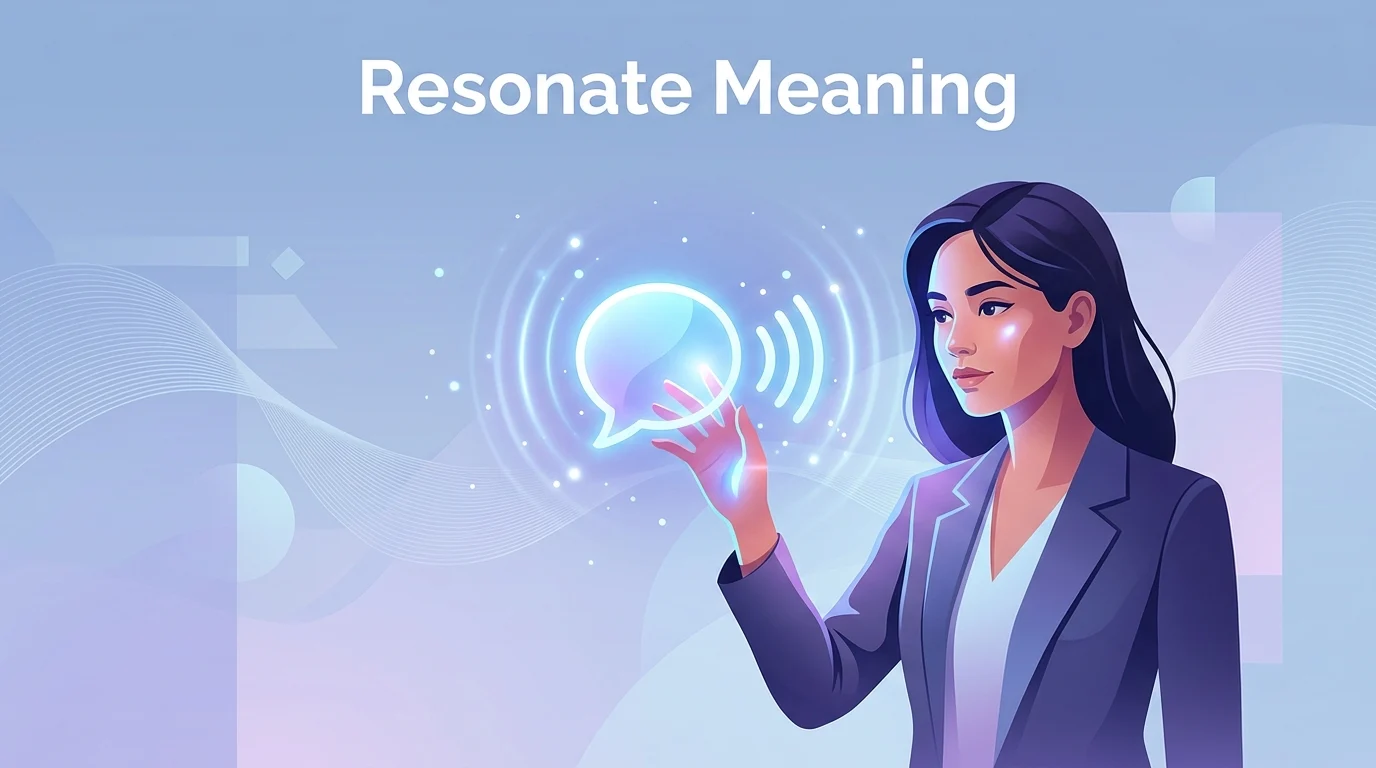

You might hear someone say, “That message really resonated with me,” and wonder what they mean. The word resonate generally means to create a strong feeling, connection, or sense of recognition in someone. It can describe an idea, story, song, experience, or message that feels personally meaningful. In other contexts, especially technical ones, it can describe something producing or responding to a strong vibration. Understanding the resonate meaning therefore depends on how the word is being used. Below, you’ll learn its everyday definition, meaning in text, examples, emotional tone, common uses, and how it differs from similar words.
What Does Resonate Mean?
Resonate usually means that something creates a strong emotional or personal connection with someone. If an idea “resonates with you,” you understand it, relate to it, or feel that it reflects your own thoughts or experiences.
| Detail | Explanation |
|---|---|
| Most Common Meaning | To create a strong emotional or personal connection |
| Full Form | Not an abbreviation; no full form |
| Tone | Usually positive, thoughtful, or neutral |
| Common Use | Ideas, stories, music, experiences, messages, and opinions |
| Formal or Informal | Used in both everyday and formal English |
For example, if someone says, “Her story really resonated with me,” they mean the story affected them because they could relate to it or found it personally meaningful.
The Main Resonate Meaning in Everyday English
The most common resonate meaning is to connect with someone on an emotional, personal, or intellectual level. The word often appears with with, as in “resonate with me,” “resonate with people,” or “resonate with the audience.”
You can use it when something reminds you of your own experiences or expresses something you already believe or feel.
Example:
“I loved that movie because its message resonated with me.”
Here, “resonated with me” means the movie’s message felt personally meaningful or relatable.
Resonate does not necessarily mean that you completely agree with something. You might simply recognize your own feelings in an idea or understand why it matters to you.
What Does Resonate Mean in Text or Chat?
In text messages, resonate usually has the same meaning as it does in everyday conversation. Someone may use it to say that a post, quote, song, story, opinion, or personal experience strongly connected with them.
For example:
“That quote really resonates with me.”
This means the person feels that the quote reflects something they have experienced, believe, or feel.
Because “resonate” sounds slightly more thoughtful than casual words such as “like” or “relate,” it can make a response sound sincere and reflective. It is not normally slang, although people may use it casually in social media conversations.
How Context Changes the Meaning
The surrounding conversation usually tells you what kind of connection resonate describes.
- Emotional: “Her story resonated with me.” — You felt personally connected to her experience.
- Intellectual: “That explanation resonated with me.” — The idea made sense or matched your way of thinking.
- Cultural or social: “The campaign resonated with younger audiences.” — Many people connected with its message or themes.
- Technical: “The structure began to resonate.” — The word refers to physical vibration rather than emotional connection.
The relationship between speakers can also affect the tone. A friend saying “That really resonates with me” may simply be sharing that they relate, while a workplace speaker may use the same phrase to describe how an idea connects with an audience.
Resonate in Different Contexts
Unlike internet abbreviations, resonate does not normally change meaning from one social platform to another. The important difference is the subject being discussed.
Text Messages and Group Chats
It commonly describes a personal reaction.
Example: “That part of the video resonated with me.”
The tone is usually sincere and conversational.
TikTok, Instagram, and Social Media
People may use it when discussing posts, videos, stories, captions, or opinions that feel relatable or meaningful.
Example: “This message resonated with so many people.”
Here, the focus is on emotional or personal connection.
Workplace Communication
Resonate is also common in professional conversations.
Example: “The new campaign seems to resonate with customers.”
In this setting, it usually means that people respond positively to or connect with a particular message, product, or idea.
Technical or Scientific Contexts
The word can have a literal physical meaning involving vibration or resonance.
Example: “The object began to resonate at a particular frequency.”
That meaning is different from the emotional sense used in conversations and social media.
Real Conversation Examples
1: Friends
Person A: “I watched that documentary last night.”
Person B: “Same. The part about starting over really resonated with me.”
Meaning: Person B personally connected with that part of the documentary.
2: Social Media
Person A: “Why did you share that post?”
Person B: “Because the message resonated with me.”
Meaning: The post expressed something Person B strongly related to or found meaningful.
3: Workplace
Person A: “How did people react to the presentation?”
Person B: “The section about flexible schedules seemed to resonate with the team.”
Meaning: The team responded positively to or connected with that particular idea.
Is Resonate Positive, Negative, or Neutral?
Resonate is usually neutral to positive. When someone says something “resonated with them,” they generally mean it had a meaningful effect or felt relevant to them.
However, the surrounding words can change the emotional direction.
- “That beautiful story resonated with me.” — Positive and appreciative.
- “That painful experience resonated with me.” — Emotional but not necessarily positive.
- “His criticism resonated with some employees.” — Neutral; it means the criticism connected with their concerns.
The word itself does not automatically mean “good.” It simply describes a strong connection or response.
Is Resonate Rude?
No, resonate is not inherently rude. It is generally a respectful way to explain that something feels meaningful or relatable.
For example, saying “What you said really resonated with me” is normally supportive and sincere. A sarcastic tone could change how any phrase is received, but the word itself is not offensive or insulting.
Is Resonate Flirty?
Resonate is not inherently flirty. In a romantic conversation, however, saying “That really resonates with me” can show emotional connection or understanding.
For example, if someone shares a personal experience and you respond that it resonates with you, the message may feel emotionally intimate. Whether it is actually flirtatious depends on the broader conversation, relationship, and wording.
How to Reply When Someone Says Something Resonates With Them
Your response should acknowledge the connection they expressed.
Friendly Replies
- “I’m glad you connected with it.”
- “I felt the same way.”
- “Exactly! That part stood out to me too.”
- “I completely understand what you mean.”
- “That’s what I liked about it too.”
When You Want to Continue the Conversation
- “What part resonated with you most?”
- “I’d love to hear why it connected with you.”
- “Was there something specific that reminded you of your experience?”
These replies work because they recognize the other person’s reaction instead of simply changing the subject.
When to Use the Word Resonate
You can comfortably use resonate in casual conversations, social media discussions, personal messages, presentations, and professional communication.
It works especially well when you want to describe a deeper connection rather than simply saying that you liked something. For example, “The message resonated with me” communicates more emotional depth than “I liked the message.”
It is also appropriate in formal or academic writing when the context calls for describing how an idea affects an audience.
When to Avoid Resonate
There is no general rule that says you must avoid the word in casual or formal communication. However, clearer wording may be better when your audience is unfamiliar with the expression or when precision matters.
Instead of saying “The idea resonated,” you could say “The idea received strong support” if you specifically mean people supported it. Similarly, “The story resonated with me” may be less precise than “The story reminded me of my own experience” when personal similarity is the exact point.
Common Mistakes About Resonate
| Common Mistake | Correct Understanding |
|---|---|
| Assuming resonate only means “agree” | It can mean feeling connected to an idea without completely agreeing with it. |
| Treating it as slang | Resonate is a standard English word used in casual and formal settings. |
| Assuming it always describes emotions | It can also describe intellectual connections or physical vibration. |
Another common mistake is assuming that “resonate with someone” means they had exactly the same experience. Usually, it only means they found something meaningful, familiar, relevant, or understandable.
Similar Words to Resonate
| Term | Meaning | Main Difference |
|---|---|---|
| Relate | Understand or identify with something | More directly emphasizes personal similarity |
| Connect | Form a relationship or association | Broader and less specifically emotional |
| Affect | Produce an emotional or other effect | Focuses on impact rather than personal recognition |
| Inspire | Encourage a particular feeling or action | Usually suggests motivation or positive influence |
| Identify with | See yourself reflected in something | More explicitly emphasizes personal similarity |
“Resonate” overlaps with these words, but it often suggests that something strikes a meaningful chord with a person or audience.
Resonate vs. Relate
These two words are especially easy to confuse. Relate often means that you understand or identify with another person’s experience, while resonate suggests that something has a deeper personal, emotional, or intellectual impact.
Compare:
- “I can relate to your experience.” — Your experience is similar to mine.
- “Your story resonates with me.” — Your story strongly connects with something I feel, believe, or have experienced.
They can sometimes be used interchangeably, but the emphasis is slightly different.
Quick Recap
- Resonate usually means to create a strong personal, emotional, or intellectual connection.
- “Resonate with me” commonly means “I find this meaningful or relatable.”
- The word is standard English, not an abbreviation or slang term.
- Context determines whether the meaning is emotional, intellectual, social, or technical.
- In professional communication, it can describe how an idea or message connects with an audience.
Frequently Asked Questions
What does resonate mean in text?
In text, resonate usually means that something feels personally meaningful, relatable, or strongly connected to the person.
Is resonate a slang word?
Resonate is a standard English word, although people commonly use it casually in texts, conversations, and social media.
What does resonate mean on TikTok?
On TikTok, resonate usually describes a video, message, or experience that viewers find personally relatable or meaningful.
How should you reply when someone says something resonates?
A natural response is to acknowledge their connection and ask what part of the message felt especially meaningful.
Can resonate have different meanings?
Yes, resonate can describe emotional or intellectual connection in conversation and physical vibration in technical or scientific contexts.
Final Thoughts
The resonate meaning is usually about connection: something resonates when it feels meaningful, familiar, or relevant to a person or audience. In text and social media, “that resonates with me” commonly means “I strongly relate to that” or “that speaks to my experience.” The word can also describe intellectual responses, audience reactions, and physical vibration, so context matters. It is not inherently slang, rude, or flirty. When you use or interpret it, pay attention to the subject, surrounding wording, and situation to understand the intended meaning accurately.
Discover More Post:
25+ Funny Ghosting Responses to a Guy (Funny, and Clever …
25+ Funny Responses to Dinner Invitations (Clever and …
Funny Responses to What Are You Thinking About






Pingback: OG Meaning | What Does OG Mean in Text and Slang?
Pingback: Monday Meme | Meaning, Examples, Context, and How to Use It
Pingback: Luffy Meaning | What Does Luffy Mean?
Pingback: Shrek Meme | Meaning, Examples, and Internet Culture Explained
Pingback: Spiderman Meme Meaning | What the Pointing Meme Means
Pingback: Dog Meme Meaning | What Does a Dog Meme Mean?
Pingback: SMH Meaning in Text | What Does SMH Mean?
Pingback: GTS Meaning in Text | What Does GTS Mean?
Pingback: Unhinged Meaning | What Does Unhinged Mean in Slang?
Pingback: Agnostic Meaning | What Does Agnostic Mean?
Pingback: Elegy Meaning | Definition, Examples, Types & Uses
Pingback: Ditto Meaning | What Does Ditto Mean in Text and Chat?
Pingback: Nonchalant Meaning | Definition, Examples, Tone & Usage
Pingback: Platonic Meaning | What Does Platonic Mean?
Pingback: Fascist Meaning | Definition, Context, and Examples
Pingback: Jit Meaning | What Does Jit Mean in Slang?
Pingback: EARP Meaning | What It Means in Text, Slang, and Online
Pingback: Nubile Meaning | Definition, Usage, Context, and Examples
Pingback: Deerstalker Meaning | What It Is and Why It Matters
Pingback: Seles Meaning | What It Means in Text, Slang, and Online
Pingback: Tonearm Meaning | What It Is and How the Term Is Used