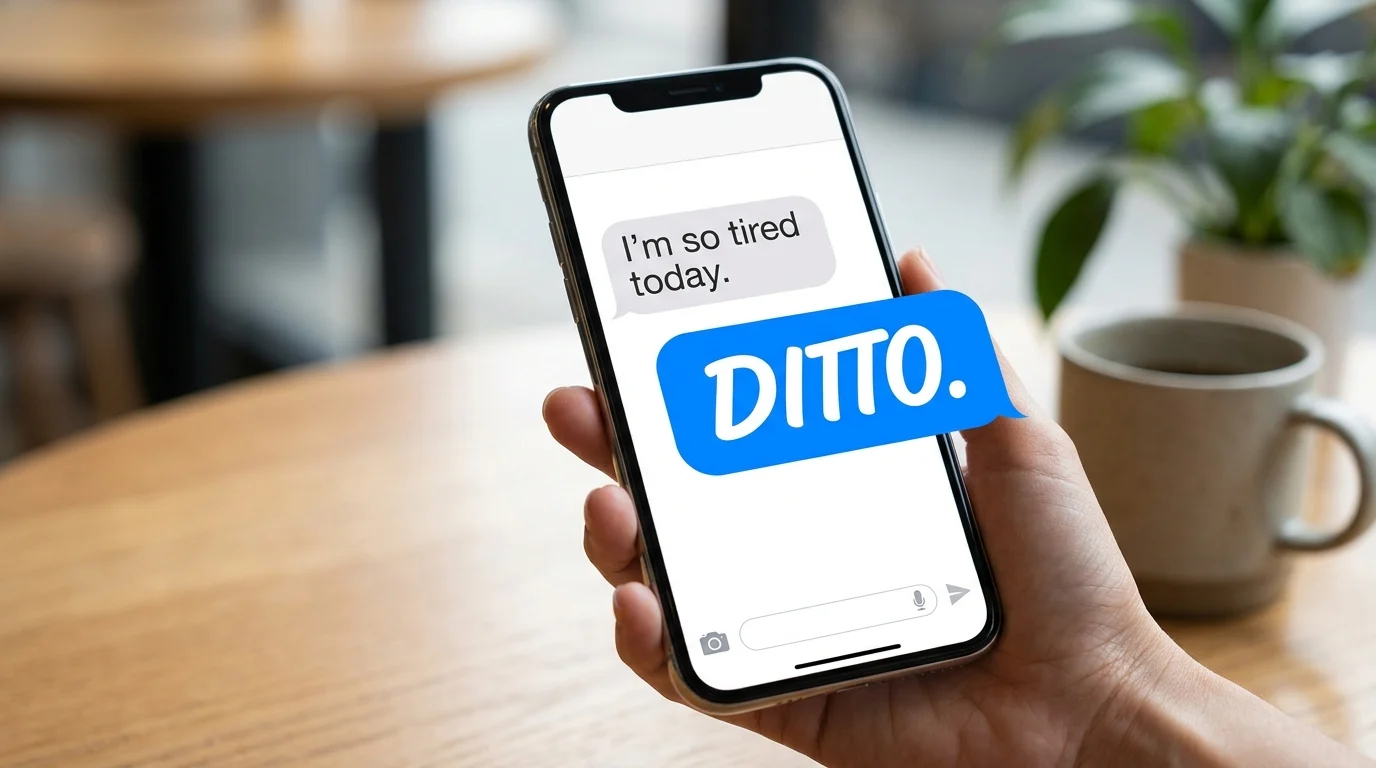

You send a friend a message saying, “I’m exhausted after that meeting,” and they reply, “Ditto.” If you are unsure whether that means agreement, repetition, or something else, the answer is simple: ditto means “same,” “me too,” or “I agree with what you just said.” The word is not an acronym or a shortened phrase, so there is no “ditto full form.” In text and everyday conversation, its exact tone comes from the surrounding message and the relationship between the speakers. Understanding the context makes it easy to tell whether “ditto” sounds friendly, casual, humorous, or slightly dismissive.
What Does Ditto Mean?
The ditto meaning is essentially “the same as what was just mentioned.” In texting, someone can use “ditto” as a quick way to say “me too,” “I feel the same,” or “I agree.”
| Detail | Explanation |
|---|---|
| Most common meaning | Same; me too; I agree |
| Full form | None; “ditto” is a word, not an acronym |
| Tone | Usually casual, neutral, or friendly |
| Common use | Texts, chats, conversations, and informal writing |
| Formal or informal | Mostly informal, though the word itself is standard English |
For example:
Person A: “I really need a vacation.”
Person B: “Ditto.”
Here, Person B means, “I really need a vacation too.” They are agreeing with the first person’s statement without repeating the entire sentence.
The Main Ditto Meaning in Text and Chat
When you see ditto meaning in text, think of it as a compact way of repeating or agreeing with something that came immediately before.
It can replace phrases such as:
- “Same here.”
- “Me too.”
- “I agree.”
- “I feel the same way.”
- “Exactly.”
The word can also refer more literally to a duplicate or copy of something. For example, someone might say, “Send me a ditto of that document,” although this usage is less common in casual texting than the agreement meaning.
Because “ditto” points back to something already said, the previous message matters. It normally does not introduce a completely new idea.
Is Ditto Slang?
“Ditto” is not technically slang. It is an established English word that is commonly used in informal conversation and messaging.
People sometimes search for the ditto slang meaning because the word appears frequently as a short response in texts and social conversations. In that setting, however, it is better understood as a casual expression of agreement rather than internet slang or an acronym.
Unlike abbreviations such as “IDK” or “TBH,” “ditto” does not stand for a longer phrase.
How Context Changes the Meaning
The basic meaning stays fairly consistent, but the tone can change depending on what was said before it.
1. Agreement
Person A: “That movie was surprisingly good.”
Person B: “Ditto.”
The response means, “I agree.”
2. Shared feeling
Person A: “I’m so ready for the weekend.”
Person B: “Ditto!”
The exclamation mark makes the response feel more enthusiastic and friendly.
3. Shared situation
Person A: “I forgot my umbrella.”
Person B: “Ditto.”
Here, “ditto” means something closer to “I did the same thing.”
4. Repetition or duplication
Person A: “Please use the same format for the second file.”
Person B: “Ditto.”
In this context, it can mean “use the same thing again” rather than “me too.”
Look at the surrounding words, punctuation, and timing when interpreting a short response. A plain “Ditto.” can feel more restrained than “Ditto 😂” or “Ditto!!”
Ditto on Different Platforms
The ditto meaning generally does not change from one platform to another. Unlike many internet abbreviations, it does not have a special TikTok, Snapchat, or Instagram definition.
Text Messages
In ordinary texting, “ditto” usually means “same” or “me too.”
Example:
“I’m craving pizza.”
“Ditto.”
TikTok and Instagram
In comments or direct messages, it can show agreement with someone’s opinion or feeling.
Example:
“Everyone needs to watch this.”
“Ditto.”
The tone is usually casual and supportive.
Snapchat and WhatsApp
The word commonly works as a quick response to something the other person has just said.
Example:
“I’m completely exhausted.”
“Ditto.”
There is no widely established platform-specific definition that changes the basic meaning.
Real Conversation Examples
1: Friends
Person A: “I could sleep for another ten hours.”
Person B: “Ditto.”
Meaning: Person B feels exactly the same way.
2: Group Chat
Person A: “Who else thinks this assignment is way too long?”
Person B: “Ditto 🙋”
Meaning: Person B agrees and is also complaining about the assignment.
3: Dating Conversation
Person A: “I had a really good time tonight.”
Person B: “Ditto 😊”
Meaning: Person B is saying they also enjoyed the time together. The emoji can make the response warmer and potentially more affectionate, but “ditto” by itself is not inherently flirty.
What Tone Does Ditto Have?
Most of the time, “ditto” sounds casual, neutral, or friendly. It is especially useful when you want to agree without repeating the other person’s entire sentence.
The tone can shift slightly depending on presentation:
- “Ditto.” — simple and matter-of-fact
- “Ditto!” — enthusiastic agreement
- “Ditto 😂” — playful or humorous
- “Ditto ❤️” — warmer or affectionate
- “Ditto…” — potentially tired, reluctant, or understated
Is Ditto Rude?
Ditto is not inherently rude. However, replying with only one word can occasionally seem brief or dismissive if the other person has shared something serious or emotionally important.
For example, if someone says, “I’m having a really difficult day,” responding with “Ditto” may sound like you are redirecting the conversation toward yourself rather than acknowledging their feelings.
In casual situations, though, the response is perfectly normal.
Is Ditto Flirty?
Ditto is not inherently flirty. In a romantic conversation, it can carry a warmer meaning when the surrounding message is affectionate.
For example:
Person A: “I’d love to see you again.”
Person B: “Ditto 😊”
The romantic feeling comes mainly from the context, not from the word “ditto” itself.
Is Ditto Offensive?
No. “Ditto” is generally harmless and does not contain an offensive meaning. The only concern is whether a very short response seems insensitive in a serious conversation.
How to Reply to Ditto
Your best response depends on what the person is agreeing with.
Friendly Replies
If someone uses “ditto” casually, you can keep the conversation moving:
- “Glad I’m not the only one!”
- “We’re definitely on the same page.”
- “Exactly!”
- “Same here!”
- “Haha, I knew you’d agree.”
Funny Replies
If the conversation is playful, you can joke about the repetition:
- “Ditto to your ditto.”
- “Copy that.”
- “We have reached maximum agreement.”
- “Twins 😂”
Replies When You Are Confused
If you are not sure what they are agreeing with, ask directly:
- “Ditto to which part?”
- “You mean you feel the same?”
- “Same about what? 😂”
These responses work particularly well when several topics appeared in the previous messages.
When to Use Ditto
Use “ditto” when you want to agree with something that was just said without repeating the entire thought.
It works naturally in:
- Casual text messages
- Conversations with friends
- Group chats
- Social media comments
- Informal online conversations
- Playful conversations
- Familiar communities
It is especially useful when the previous statement is short and your agreement is obvious.
For example, if someone says, “I need coffee,” replying “Ditto” is clear because both people understand exactly what is being repeated.
When to Avoid Ditto
Although “ditto” is a normal English word, clearer wording may be better in situations where precision matters.
Consider avoiding it in:
- Job applications
- Formal business emails
- Academic writing
- Client communication
- Official announcements
- Sensitive conversations
- Messages to people unfamiliar with the expression
That does not mean the word is grammatically wrong or always inappropriate. It simply means that “I agree,” “I feel the same,” or “Please repeat the same format” may communicate your intention more clearly.
Common Mistakes About Ditto
| Common Mistake | Correct Understanding |
|---|---|
| Thinking ditto is an acronym | It is a standalone word, not a shortened phrase with a full form. |
| Assuming it always means “me too” | It can also mean “the same as previously mentioned” or indicate duplication. |
| Treating it as internet-only slang | “Ditto” is an established English word used beyond social media. |
Another common misunderstanding is assuming that “ditto” always sounds enthusiastic. A bare “Ditto.” can be completely neutral, while punctuation or emojis can make it warmer, funnier, or more expressive.
Similar Terms to Ditto
| Term | Meaning | Main Difference |
|---|---|---|
| Same | I feel or think the same | More modern and conversational |
| Me too | I also feel or have the same experience | More explicit than “ditto” |
| Exactly | Strong agreement | Usually emphasizes agreement with the statement |
| Agreed | I agree with your point | More direct and sometimes more formal |
| Likewise | The same applies to me | Often sounds slightly more polished |
“Same” and “me too” are probably the closest everyday alternatives when you’re using ditto as a response.
Origin and Popularity of the Word Ditto
“Ditto” is not a newly created texting term. It comes from Italian detto, meaning “said,” and entered English centuries ago. The word has traditionally been used to indicate that something should be repeated or is the same as something previously stated.
That history explains why “ditto” can work in two related ways: it can mean the same thing and, by extension, the same as what was just said.
Its modern conversational use follows naturally from that basic idea of repetition.
Quick Recap
- Ditto means “same,” “me too,” or “I agree” when used as a conversational response.
- It is an established English word, not an acronym or abbreviation.
- In text and chat, the meaning usually comes directly from the previous message.
- It can also refer to something duplicated or repeated.
- The tone can range from neutral to playful or affectionate depending on punctuation, emojis, and context.
- “Ditto” is generally best suited to casual communication rather than situations requiring formal or highly precise wording.
Frequently Asked Questions
What does ditto mean in text?
In text messages, “ditto” usually means “same,” “me too,” or “I agree with what you just said.”
Is ditto rude?
Ditto is generally not rude, although a one-word response may seem dismissive during serious or emotionally sensitive conversations.
What does ditto mean on TikTok?
On TikTok, ditto generally means the commenter agrees with or shares the opinion, feeling, or experience just mentioned.
How should you reply to ditto?
Reply naturally with “same,” “exactly,” or a follow-up that continues the conversation based on what the person agreed with.
Can ditto have different meanings?
Yes, ditto can mean agreement in conversation or refer more literally to something being repeated, copied, or duplicated.
Final Thoughts
The ditto meaning is straightforward: it usually means “same,” “me too,” or “I agree with what you just said.” In text and chat, it provides a quick way to show agreement without repeating the entire message. It is not an acronym, and there is no hidden full form behind the word. Context still matters, especially when the response is only “Ditto.” Pay attention to the previous message, punctuation, emojis, and relationship between the speakers. For casual conversations, it is a convenient and natural way to express that you feel or think the same.
Discover More Post:
Nonse Meaning | What Does It Mean and How Is It Used?
SYBAU Meaning | What Does This Acronym Stand For?
DIABOLO Meaning | Complete Guide to Definition, Usage …