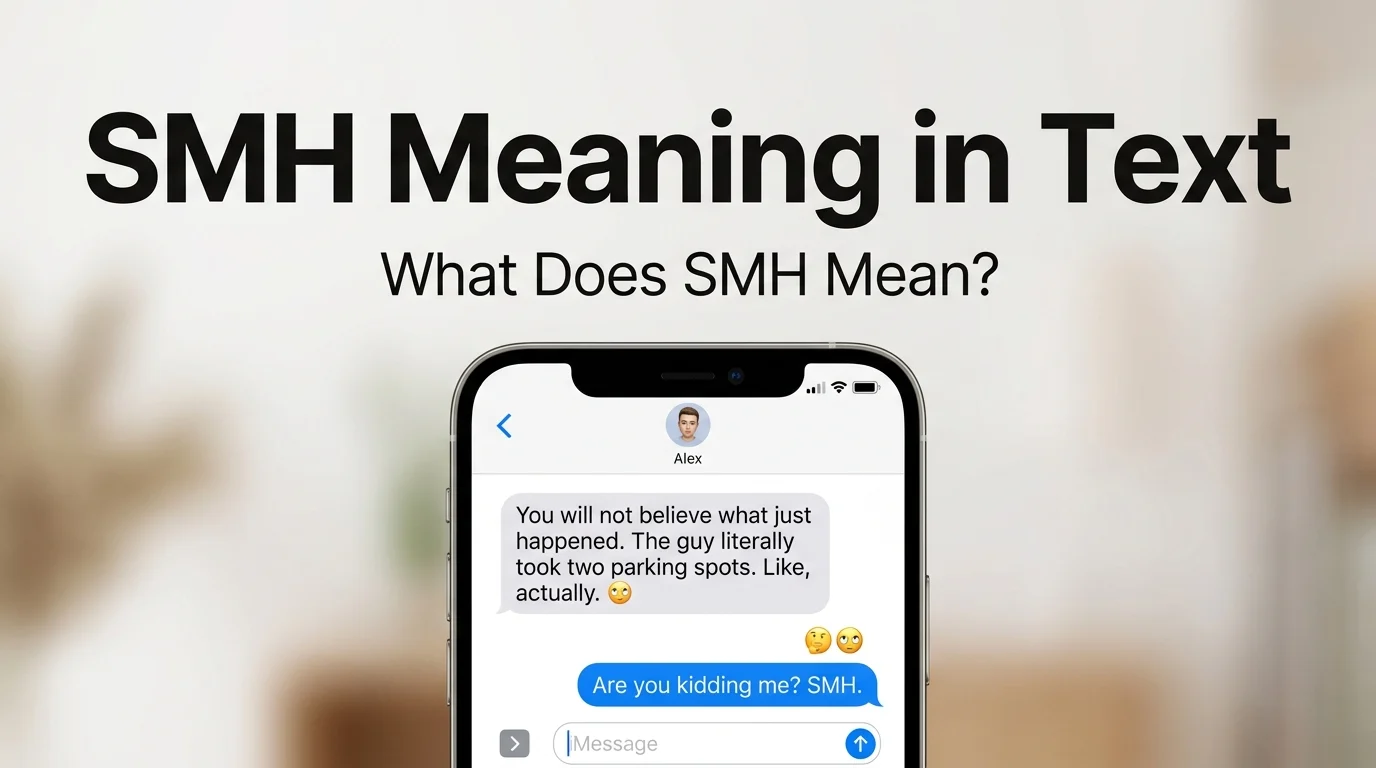

You get a text saying “SMH, you really forgot again,” and the meaning is usually clear from the tone even if you have never used the abbreviation yourself. SMH meaning in text is “shaking my head,” an expression people use to show disappointment, disbelief, annoyance, frustration, or amused disbelief. The exact feeling depends on the conversation and relationship between the people texting. You may see SMH in casual messages, social media comments, group chats, and online communities. Understanding the wording around it helps you tell whether someone is genuinely irritated, joking around, or simply reacting to something surprising.
What Does SMH Mean in Text?
SMH stands for “shaking my head.” In text conversations, it expresses a reaction similar to physically shaking your head at something someone said or did. It can communicate disappointment, disbelief, annoyance, frustration, or sometimes playful amusement.
| Detail | Explanation |
|---|---|
| Most Common Meaning | Shaking my head |
| Full Form | Shaking my head |
| Tone | Disappointed, annoyed, disbelieving, or amused |
| Common Platforms | Texts, social media, chats, comments |
| Formal or Informal | Informal |
For example:
“SMH, you left your phone at home again.”
Here, the sender is probably mildly frustrated or teasing the other person for repeating an avoidable mistake.
The Main SMH Slang Meaning
The most common SMH slang meaning is a reaction to something that seems foolish, disappointing, surprising, or difficult to believe.
Unlike an abbreviation that simply replaces a longer phrase, SMH adds emotion to a message. Someone may use it when they think another person’s behavior makes little sense, when they are disappointed by an outcome, or when something is so ridiculous that they do not know what else to say.
For example:
“You said you were going to study, then watched six episodes instead. SMH.”
The sender is not necessarily angry. They may be joking with a friend while expressing disbelief at the friend’s decision.
SMH can appear at the beginning, middle, or end of a message:
- “SMH, that was such a bad decision.”
- “I can’t believe you did that, smh.”
- “You forgot the tickets again. SMH.”
Lowercase smh and uppercase SMH generally carry the same basic meaning. Capitalization can sometimes make the reaction look slightly stronger, but there is no fixed rule.
How Context Changes the SMH Meaning in Text
The surrounding message usually tells you what emotion SMH carries. The abbreviation itself does not automatically mean someone is seriously angry.
Consider these examples:
1. Mild frustration
“SMH, you forgot your keys again.”
The sender is probably annoyed because the same mistake happened repeatedly.
2. Playful teasing
“SMH, you really ordered pizza after saying you weren’t hungry 😂”
The laughing emoji makes the message feel more playful than hostile.
3. Genuine disappointment
“SMH. I trusted him to finish the project, and he didn’t even start.”
Here, SMH supports a more serious expression of frustration.
4. Disbelief
“SMH, they charged $20 for that tiny sandwich?”
In this case, the sender is reacting to something surprising or ridiculous rather than criticizing a person directly.
Pay attention to the words around SMH, punctuation, emojis, and your relationship with the sender. A friend saying “smh 😂” is usually different from a coworker sending “SMH.” in a tense conversation.
SMH Meaning on Different Platforms
SMH generally keeps the same meaning across major messaging and social platforms. The difference is usually the context in which people use it, not the definition itself.
Text Messages and Group Chats
In private texts, SMH is commonly used as a quick reaction to something a friend or family member has said or done.
“SMH, you really forgot my birthday?”
The tone can range from genuine disappointment to playful teasing depending on the relationship.
TikTok and Instagram
On TikTok and Instagram, people may use SMH in comments or captions when reacting to a video, opinion, story, or situation they find ridiculous or disappointing.
“SMH, people actually believe this?”
It often functions as a short written reaction rather than a literal description of someone’s physical action.
Snapchat
On Snapchat, SMH can appear in direct messages, captions, or replies. Its meaning remains “shaking my head,” often signaling disbelief, annoyance, or amusement.
“smh you knew we had plans 😂”
The lowercase spelling and emoji can make it feel casual.
Discord and Online Communities
In gaming or community chats, SMH may be used when someone makes an obvious mistake or does something unexpected.
“You walked straight past the objective smh.”
The tone is often informal and can be teasing, especially among people who know each other.
SMH Examples in Real Conversations
1: Friends
Person A: “I just realized I left my wallet at the restaurant.”
Person B: “SMH 😂 You checked everywhere except your own pocket.”
Meaning: Person B is teasing their friend while expressing amused disbelief.
2: Family
Person A: “Dad tried to fix the Wi-Fi and somehow unplugged the router.”
Person B: “SMH, what did he expect would happen?”
Meaning: The sender is jokingly criticizing the situation rather than expressing serious anger.
3: Classmates
Person A: “Our group member didn’t submit anything again.”
Person B: “SMH. We reminded him three times.”
Meaning: Here, SMH communicates genuine frustration and disappointment.
What Tone Does SMH Have?
SMH is usually informal and emotional, but its exact tone changes with context.
It can sound:
- Amused: when something is ridiculous in a funny way.
- Annoyed: when someone repeatedly makes a mistake.
- Disappointed: when someone’s behavior falls short of expectations.
- Disbelieving: when something seems hard to believe.
- Sarcastic: when the sender is mocking an obvious or silly situation.
Is SMH Rude?
SMH is not automatically rude, but it can sound dismissive or judgmental if directed at someone’s serious mistake, opinion, or personal situation.
For example, “SMH 😂” between close friends may be harmless teasing. However, replying “SMH” to someone who is discussing a sensitive problem could make you appear unsympathetic.
Is SMH Offensive?
SMH is not inherently offensive. Its impact comes mainly from what you are reacting to and how the other person interprets your response.
If someone is already upset, SMH can make your message sound like criticism rather than support.
How to Reply to SMH
Your best response depends on why the person used SMH.
Friendly Replies
If they are teasing you, you can keep the exchange light:
- “I know, I know 😂”
- “Don’t judge me!”
- “Okay, fair enough.”
- “I messed up this time.”
- “You had to bring that up, huh?”
Funny Replies
If the conversation is clearly playful:
- “I accept your disappointment.”
- “My brain took the day off.”
- “In my defense, I had a plan.”
- “SMH at yourself for expecting better.”
- “We all make questionable choices.”
Polite Replies
If the sender sounds genuinely frustrated:
- “Yeah, that was my mistake.”
- “You’re right, I should’ve checked.”
- “Sorry about that. I’ll fix it.”
- “I understand why you’re frustrated.”
If you are unsure whether SMH is serious or playful, ask directly:
“Are you actually annoyed or just messing with me?”
That is often better than guessing the sender’s intention.
When to Use SMH
SMH works best in casual communication where abbreviations and informal reactions are expected. You can use it with friends, familiar group chats, social media communities, gaming contacts, or people who regularly communicate in slang.
It is especially useful when you want to express a reaction quickly without writing a full sentence.
Still, consider the relationship first. A short “SMH” can sound much harsher when the recipient does not know your sense of humor.
When to Avoid SMH
There is usually no need to avoid SMH completely, but clearer wording is safer in situations where tone matters.
Consider using standard language instead in:
- Professional emails
- Job applications
- Academic assignments
- Client communication
- Formal announcements
- Sensitive personal conversations
- Messages to unfamiliar people
For example, instead of writing “SMH” to a client who made an error, saying “I think there may have been a misunderstanding” is clearer and more professional.
Common Mistakes About SMH
| Common Mistake | Correct Understanding |
|---|---|
| Assuming SMH always means anger | It can express annoyance, disbelief, disappointment, or playful amusement. |
| Treating every SMH as an insult | The relationship, wording, and surrounding conversation determine whether it feels harsh. |
| Assuming lowercase smh has a different definition | “smh” and “SMH” normally mean the same thing. |
| Using it in every situation | It is primarily informal and may sound inappropriate in formal communication. |
One common misunderstanding is assuming that every abbreviation has a completely different meaning on each platform. With SMH, the core definition generally stays the same.
Similar Slang Terms
Several expressions can communicate reactions similar to SMH, but they are not interchangeable in every situation.
| Term | Meaning | Main Difference |
|---|---|---|
| SMH | Shaking my head | Focuses on disbelief, disappointment, or annoyance |
| OMG | Oh my God | Usually expresses surprise, shock, excitement, or disbelief |
| WTF | What the f*** | Stronger and often more vulgar disbelief or frustration |
| Facepalm | A reaction to something foolish | More directly conveys embarrassment or exasperation |
| LOL | Laughing out loud | Signals amusement rather than disappointment |
For example, “OMG” may communicate surprise, while “SMH” usually suggests that the situation is ridiculous, disappointing, or frustrating.
Where Did SMH Come From?
SMH is an established internet and texting abbreviation for “shaking my head.” Its meaning comes directly from the physical gesture of shaking your head to communicate disagreement, disbelief, frustration, or disappointment.
The exact point at which the abbreviation first appeared is not necessary to understand its modern use, and claims about a specific creator or single invention should be treated cautiously.
Quick Recap
- SMH means “shaking my head.”
- In text, it commonly expresses disbelief, frustration, disappointment, or amused annoyance.
- The meaning usually stays consistent across texting, TikTok, Snapchat, Instagram, and online chats.
- Emojis, punctuation, wording, and your relationship with the sender can change the tone.
- SMH is best suited to casual conversations rather than formal or sensitive communication.
Frequently Asked Questions
What does SMH mean in text?
SMH means “shaking my head,” expressing disbelief, disappointment, frustration, annoyance, or amused reaction in casual messages.
Is SMH rude?
SMH can sound rude or dismissive when used toward someone seriously discussing a mistake, problem, or sensitive situation.
What does SMH mean on TikTok?
On TikTok, SMH usually means “shaking my head” and signals disbelief, annoyance, disappointment, or amusement about posted content.
How should you reply to SMH?
Reply casually when it is teasing, or acknowledge your mistake and apologize when the sender sounds genuinely frustrated.
Can SMH have different meanings?
SMH overwhelmingly means “shaking my head” in casual online communication, while its emotional tone changes with context.
Final Thoughts
The SMH meaning in text is straightforward: it stands for “shaking my head.” People use it to react to something disappointing, frustrating, ridiculous, surprising, or amusingly foolish. Although the definition stays consistent across most messaging and social platforms, the emotional tone can change considerably. A laughing emoji may turn SMH into playful teasing, while a period or serious conversation can make it sound more critical. Use SMH naturally with people who understand casual internet slang, and choose clearer wording when the conversation is professional, sensitive, or open to misunderstanding.
Discover More Post:
Fritz Meaning | What It Means in Text, Slang, and Everyday Use
What Does Caveat Mean? – TextingRoast.com –
What Does SDIYBT Mean in Slang? – TextingRoast.com –