
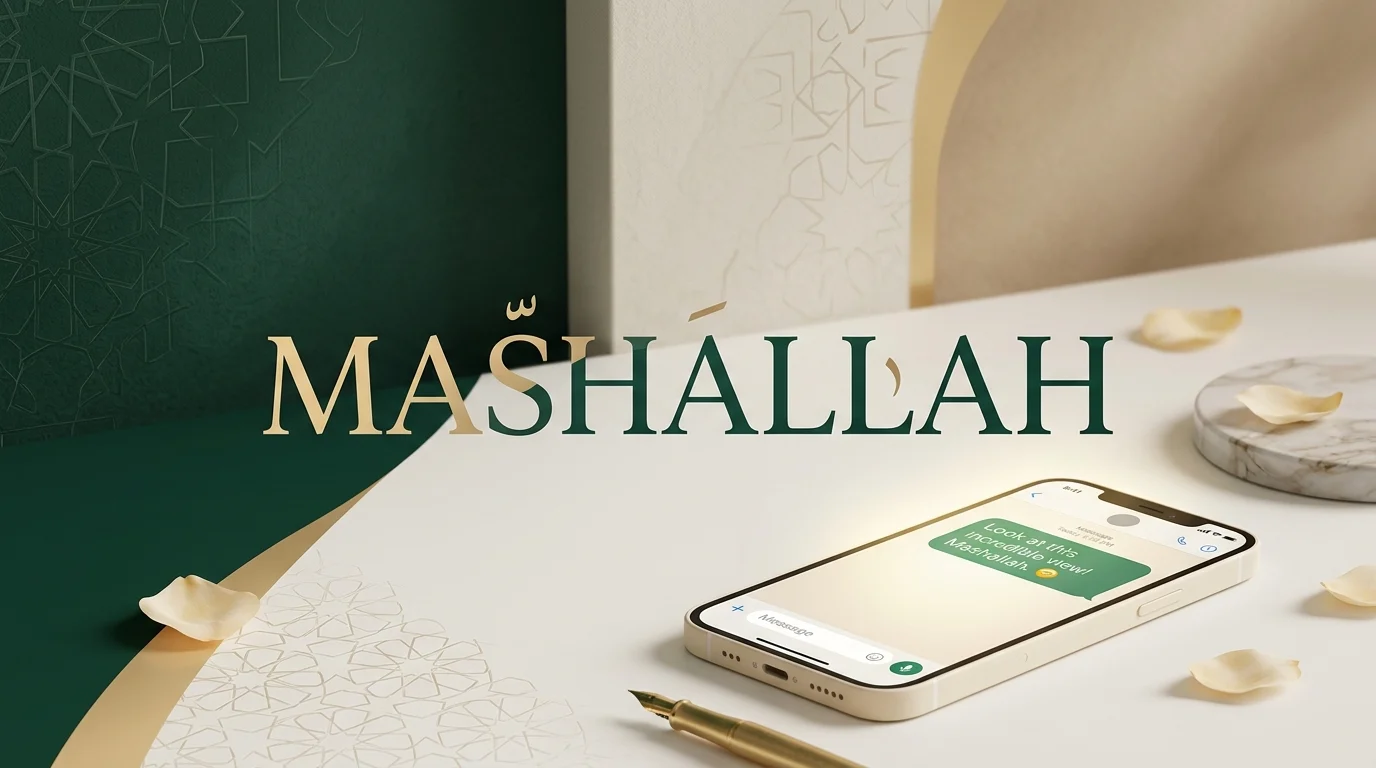

Someone may comment “Mashallah!” under a photo, send it in a text, or say it after hearing good news, leaving you wondering exactly what they mean. The mashallah meaning is generally an expression of admiration, appreciation, or praise for something good, with the phrase recognizing that it has happened by God’s will. It is an Arabic expression widely used by Muslims and also familiar in many communities influenced by Arabic and Islamic culture. The meaning can feel slightly different depending on the situation, so context matters. Below, you’ll see what mashallah means in text, how people use it, its tone, examples, and appropriate ways to respond.
What Does Mashallah Mean?
Mashallah is commonly understood as “what God has willed” or “as God has willed.” People often say it when admiring something positive, such as a person’s appearance, a child, an achievement, or good news.
The expression can communicate genuine appreciation while acknowledging God’s will and blessing. It is not simply a casual synonym for “wow,” although it can function similarly in some conversations.
| Detail | Explanation |
|---|---|
| Most Common Meaning | “What God has willed” or “as God has willed” |
| Tone | Admiring, appreciative, positive |
| Common Use | Praise, congratulations, admiration, or appreciation |
| Formal or Informal | Used in both everyday speech and more meaningful religious or cultural contexts |
For example, someone might see a friend’s new home and say, “Mashallah, your house is beautiful.” Here, the speaker is expressing admiration while using a culturally and religiously meaningful phrase.
Mashallah Meaning in Text and Chat
In texting, mashallah usually carries the same basic meaning as it does in spoken conversation. Someone might type “mashallah” after seeing a photo, hearing about an accomplishment, or receiving positive news.
For example:
“I finally graduated!”
“Mashallah, congratulations!”
The message expresses happiness and admiration for the achievement. Depending on the relationship between the people, it can sound warm, affectionate, respectful, or simply appreciative.
You may also see variations such as “MashaAllah,” “Masha Allah,” or “Mash Allah.” These differences are mainly ways of writing the phrase in English letters rather than separate meanings.
What Does Mashallah Stand For?
Mashallah is not an acronym, so it does not have a “full form” in the same sense as internet abbreviations such as LOL or BTW.
The English meaning is commonly given as “what God has willed” or “as God has willed.” The phrase comes from Arabic and is associated with recognition of God’s will when expressing admiration or appreciation.
This distinction matters because treating mashallah as ordinary internet slang can miss part of its religious and cultural significance.
When Do People Say Mashallah?
People commonly use mashallah when they notice or hear about something good. The exact situation can vary, but the expression often accompanies admiration.
Common examples include:
- Complimenting someone’s appearance
- Praising a child
- Reacting to an achievement
- Admiring a new home or possession
- Responding to positive family news
- Complimenting someone’s work or success
- Reacting positively to a photograph
For example, a relative might say, “Mashallah, your daughter is growing so quickly.” The phrase adds an expression of admiration rather than functioning as a literal description of growth.
How Context Changes the Mashallah Meaning
The basic meaning remains consistent, but the emotional effect can change according to the situation.
1. Admiration
If someone posts a beautiful photograph, a comment such as “Mashallah, you look great!” communicates appreciation and admiration.
2. Congratulations
After someone shares good news, “Mashallah, you got the job!” can express happiness and praise for the achievement.
3. Appreciation for a Child
A family member might say “Mashallah, what a beautiful baby” when meeting a newborn. The phrase conveys admiration in a culturally meaningful way.
4. Appreciation for an Achievement
If a friend says, “I finished my degree,” replying “Mashallah, that’s amazing” recognizes the accomplishment positively.
Surrounding words, punctuation, emojis, and the relationship between speakers can affect the tone. A sincere “Mashallah ❤️” may feel especially warm, while a bare “mashallah” in a short online comment may simply indicate admiration.
Mashallah on Social Media and Different Platforms
The mashallah meaning generally does not change from one platform to another. Whether it appears on Instagram, TikTok, Snapchat, WhatsApp, or in an ordinary text message, it normally retains its basic meaning.
On social media, it is particularly common to see the phrase used as a reaction to positive posts.
Instagram:
“Your wedding photos are gorgeous, mashallah.”
TikTok:
“Mashallah, look how talented she is.”
Snapchat or WhatsApp:
“Mashallah! Congrats on the new car.”
The platform mainly changes how the phrase is presented, not what it means. Emojis, capitalization, and surrounding words may make the message feel more enthusiastic, affectionate, or casual.
Real Conversation Examples
1: Friends
Person A: “I just found out I got accepted into the program!”
Person B: “Mashallah! That’s incredible. Congratulations!”
Meaning: Person B is expressing admiration and happiness about the good news.
2: Family
Person A: “Look at the picture from my son’s birthday.”
Person B: “Mashallah, he’s gotten so big!”
Meaning: The speaker is warmly admiring the child and commenting positively on his growth.
3: Social Media
Person A: “Posted a photo of my new studio.”
Person B: “Mashallah, this place looks amazing!”
Meaning: The commenter is praising the new space and expressing genuine admiration.
Is Mashallah Rude?
Mashallah is generally positive rather than rude. It is commonly used to express admiration, appreciation, or recognition of something good.
However, context still matters. If someone uses the word sarcastically, the surrounding message may change how the comment feels. For example, punctuation or an obviously mocking statement could make an otherwise positive phrase sound insincere.
When someone uses mashallah sincerely, treating it as a respectful expression of admiration is usually the appropriate interpretation.
Is Mashallah a Compliment?
Yes, mashallah can accompany a compliment, especially when someone is praising something they admire.
For instance:
- “Mashallah, you look beautiful.”
- “Mashallah, what a lovely family.”
- “Mashallah, you did an excellent job.”
- “Mashallah, your new home is beautiful.”
The phrase itself does not always function as a complete compliment. Instead, it often accompanies praise or admiration.
How to Reply to Mashallah
Your response should match the situation and your relationship with the person. You do not need a complicated reply.
Friendly Replies
- “Thank you!”
- “Thank you, I really appreciate that.”
- “That’s so kind of you.”
- “Thanks so much!”
Warm or Respectful Replies
- “JazakAllah khair.”
- “Thank you, that means a lot.”
- “Ameen, thank you.”
If you are unfamiliar with the religious context, a simple “Thank you!” is perfectly natural. You do not need to use Arabic terminology just to match the other person.
When to Use Mashallah
Use mashallah when you understand and are comfortable with its religious or cultural context. It can be appropriate in conversations with friends, relatives, community members, or others who use the expression naturally.
It can also appear in social media comments and casual messages when someone is expressing admiration for a positive situation.
The key is sincerity. Since mashallah has religious significance, it is better to use it because you understand its meaning rather than treating it as a random substitute for “nice” or “cool.”
When to Avoid Mashallah
There is no universal rule that the phrase must be avoided in particular settings, but clearer wording may be preferable when your audience may not understand it.
For example, in a formal business email, academic paper, job application, or professional announcement, a straightforward expression such as “Congratulations” or “That is excellent” may communicate your meaning more clearly.
You should also avoid using religious expressions mockingly or in situations where you are deliberately imitating someone’s beliefs or speech.
Common Mistakes About Mashallah
| Common Mistake | Correct Understanding |
|---|---|
| Treating it as an acronym | Mashallah is an Arabic expression, not an acronym with an English full form. |
| Assuming it simply means “wow” | It can express admiration, but its meaning includes recognition of God’s will. |
| Thinking it is always slang | It is better understood as a religious and cultural expression that is also used casually. |
| Assuming it is automatically a compliment | It often accompanies praise, but the surrounding words determine the complete message. |
Another common misunderstanding is assuming that every use has exactly the same emotional tone. A heartfelt spoken “Mashallah” and a brief social-media “mashallah” can both express admiration while feeling different in intensity.
Similar Expressions and Their Differences
| Term | Meaning | Main Difference |
|---|---|---|
| Alhamdulillah | “Praise be to God” | Often expresses gratitude or praise to God. |
| Inshallah | “If God wills” | Commonly refers to a hoped-for or future event. |
| Mashallah | “What God has willed” | Commonly accompanies admiration or appreciation of something present or accomplished. |
| Subhanallah | “Glory be to God” | Often expresses wonder, amazement, or recognition of God’s greatness. |
These expressions can appear together in conversation, but they are not interchangeable. Their meanings relate to different situations and intentions.
Origin and Meaning in Islamic Usage
Mashallah comes from Arabic and is commonly associated with the phrase mā shāʾ Allāh, meaning roughly “what God has willed.” Its use is rooted in Islamic religious and cultural practice, although the expression is also familiar in broader Arabic-speaking and Muslim communities.
The phrase is sometimes used when admiring something to acknowledge that the good thing exists by God’s will. Because of this background, its meaning goes beyond ordinary internet slang or a simple reaction word.
Quick Recap
- Mashallah meaning: “What God has willed” or “as God has willed.”
- It commonly expresses admiration, appreciation, or praise.
- In text and chat, it usually has the same meaning as in spoken conversation.
- It can accompany compliments, congratulations, and positive reactions.
- It has religious and cultural significance, so it should not be treated as meaningless slang.
- A simple “Thank you!” is an appropriate response when someone says it to you.
Frequently Asked Questions
What does mashallah mean in text?
Mashallah in text expresses admiration or appreciation while recognizing that something good has occurred by God’s will.
Is mashallah rude?
Mashallah is generally respectful and positive, although sarcasm or mocking context can make any expression sound insincere.
What does mashallah mean on TikTok?
On TikTok, mashallah usually expresses admiration for someone’s appearance, achievement, family, talent, or another positive subject.
How should you reply to mashallah?
A simple “Thank you” works well, while “JazakAllah khair” can be appropriate in a Muslim religious or cultural context.
Can mashallah have different meanings?
Its core meaning remains consistent, but the surrounding conversation can make the expression feel admiring, congratulatory, affectionate, or respectful.
Final Thoughts
The mashallah meaning is commonly understood as “what God has willed” or “as God has willed.” People use it to express admiration, appreciation, congratulations, or positive recognition, often while acknowledging God’s will. In text messages, social media comments, and everyday conversation, the basic meaning stays the same even though the tone can vary with context. Understanding its religious and cultural background helps you use the phrase respectfully rather than treating it as ordinary slang. If someone says mashallah to you, a sincere “Thank you” is usually all you need.
Discover More Post:
25 Funny Ghosting Responses to a Girl That Will Make …
25+ Funny Responses to What’s for Dinner (Hilarious Answers …
Funny Responses to How’s It Going | 150+ Witty, Clever …





Pingback: OG Meaning | What Does OG Mean in Text and Slang?
Pingback: Zesty Meaning Slang | What Does Zesty Mean?
Pingback: SMH Meaning in Text | What Does SMH Mean?
Pingback: IMO Meaning in Text | What Does IMO Mean?
Pingback: In Lieu Of Meaning | Definition, Usage & Examples
Pingback: WTM Meaning in Text | What Does WTM Mean?
Pingback: GTS Meaning in Text | What Does GTS Mean?
Pingback: Ethereal Meaning | Definition, Examples, and Usage
Pingback: BTA Meaning | What It Means in Text, Chat, and Social Media