
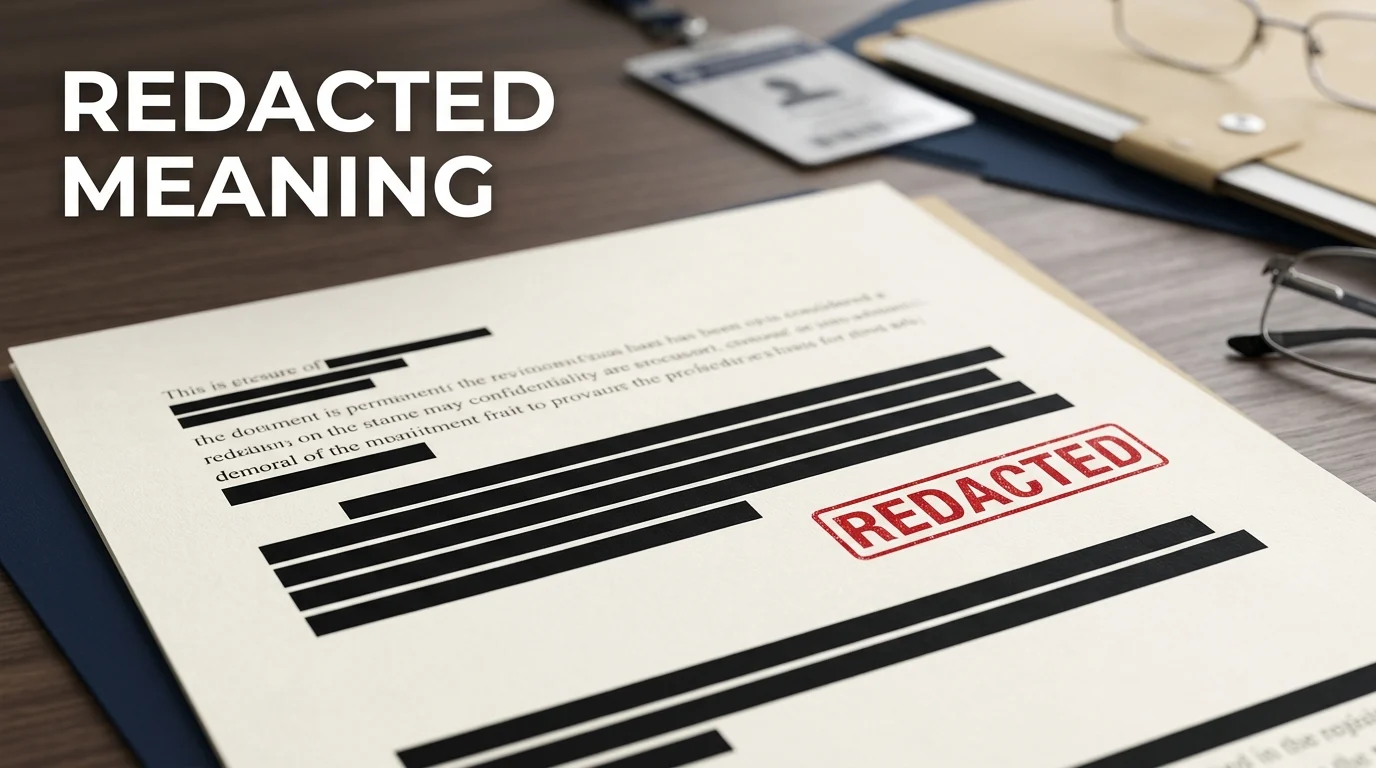

You may see the word “redacted” on a document, screenshot, social media post, or message where some information has been blacked out or hidden. The basic redacted meaning is that information has been deliberately removed, covered, or obscured from view, usually because it is private, sensitive, confidential, or legally protected. The word is more formal than typical internet slang, although people sometimes use it jokingly in chats and online posts. Understanding the surrounding context helps you tell whether “redacted” refers to an official document, personal information, a secret, or a humorous way of saying something cannot be revealed.
What Does Redacted Mean?
| Detail | Explanation |
|---|---|
| Most Common Meaning | Information has been removed or hidden |
| Full Form | Not an abbreviation; “redacted” is a regular word |
| Tone | Usually neutral or formal; sometimes humorous online |
| Common Platforms | Documents, websites, social media, chats, screenshots |
| Formal or Informal | Formal in official use, informal when used jokingly |
For example, an official report might show a person’s name as “[REDACTED].” The reader can see that information was intentionally withheld, even though they cannot see the original name.
The word does not necessarily mean that the information was deleted permanently. It often means that the information was removed from the version being presented to a particular audience.
Redacted Meaning in Text and Chat
In text messages and online conversations, “redacted” can have a more playful meaning. Someone may use it to suggest that they are deliberately withholding a name, detail, screenshot, confession, or other piece of information.
For example:
Person A: “Who were you talking about?”
Person B: “Name redacted.”
Here, “redacted” is not necessarily describing an actual legal document. It humorously means, “I’m not telling you the name.”
The tone is often joking, mysterious, or teasing when the word appears in casual conversation.
What Does Redacted Mean on a Document?
On an official document, redaction has a specific practical purpose.
- Personal identification details
- Private contact information
- Financial information
- Confidential business information
- Certain legal information
- Security-sensitive details
- Information concerning other private individuals
A document might therefore contain a sentence such as:
The investigation was conducted by [REDACTED].
The brackets or black bars indicate that part of the original material is unavailable in the published version.
Redaction is different from simply forgetting to include information. A redacted section is intentionally concealed.
Why Do People Redact Information?
The reason for redaction depends on the situation. Privacy is one common reason, but it is not the only one.
An organization may redact information because releasing it could expose someone’s personal details. A company may conceal confidential material before distributing a report more widely.
In casual online communication, the reason can be much simpler. Someone might redact a person’s name because they do not want to identify them publicly, even though there is no formal legal requirement.
How Context Changes the Meaning
1. Official document“Several names were redacted from the report.”
Here, the word has its standard formal meaning. Specific information was deliberately removed or concealed.
2. Social media post
“My entire dating history is redacted.”
This is likely humorous. The person is jokingly presenting their private history as classified information.
3. Group chat
“Who sent you that screenshot?”
“Source: redacted.”
The speaker is probably refusing to identify the source in a playful or secretive way.
4. Personal conversation
“I could tell you what happened, but most of it is redacted.”
The wording suggests that the speaker is intentionally withholding details, possibly for privacy or comedic effect.
Pay attention to capitalization, punctuation, emojis, and the relationship between the people involved. “[REDACTED]” in a government-style document looks very different from “lol, name redacted 😂” in a group chat.
Redacted on Different Platforms
The basic meaning usually stays the same across platforms, but the tone can change.
Text Messages
In ordinary texts, “redacted” often means someone is intentionally leaving out a name or detail.
Example: “I know who you’re talking about, but I’ll keep that part redacted.”
The tone may be playful or deliberately mysterious.
Social Media
On Instagram, TikTok, or similar platforms, people may use “redacted” when discussing private information without revealing it.
Example: “The person who said this shall remain redacted.”
The purpose is often humorous rather than technical.
Snapchat
A Snapchat user might use “redacted” to avoid naming someone in a story or conversation.
Example: “Redacted because I don’t need another argument.”
The word can signal privacy while keeping the message casual.
Discord and Gaming Chats
Example: “Where did you get that item?”
“Location: redacted.”
The wording makes the withheld information sound secret or classified.
Real Conversation Examples
1: Friends
Person A: “Who gave you the surprise?”
Person B: “That information is redacted.”
Meaning: Person B is jokingly refusing to reveal the person’s identity.
2: Social Media
Person A: “You said your weekend was complicated. What happened?”
Person B: “The details are redacted for everyone’s safety.”
Meaning: Person B is humorously suggesting that the story is too private or embarrassing to share.
3: Group Chat
Person A: “What’s the password?”
Person B: “Nice try. Password: redacted.”
Meaning: Person B is deliberately withholding the password, using “redacted” as a playful substitute for “secret.”
Is Redacted Rude?
“Redacted” is not inherently rude. In conversation, the tone depends on how it is used. Saying “name redacted” jokingly among friends can sound playful, while repeatedly using it to avoid answering a serious question could seem dismissive.
If you are unsure about the other person’s reaction, clearer wording such as “I’d rather not say” is usually more direct.
Is Redacted Flirty?
The word itself is not inherently flirty. However, someone can use it playfully in a flirtatious conversation to create mystery or tease the other person.
For example:
Person A: “Who were you thinking about?”
The emoji and surrounding conversation create the flirtatious tone, not the word “redacted” by itself.
How to Reply to Redacted
Your response should match the situation and whether the person is being serious or playful.
Friendly Replies
- “Fair enough, keep your secrets.”
- “Okay, classified information.”
- “I’ll respect the redaction.”
- “Got it, I won’t ask.”
Funny Replies
- “Request for declassification denied?”
- “I knew it was classified.”
- “Fine, Agent Redacted.”
- “Guess I’ll never know.”
Replies When You Are Confused
- “Do you mean you’re keeping that part private?”
- “Wait, what exactly was redacted?”
- “Are you joking, or was the information actually removed?”
These responses work because they acknowledge the meaning without automatically assuming why the person withheld the information.
When to Use the Term
“Redacted” works naturally when you are discussing documents, privacy, confidential information, or intentionally hidden details. It can also work in casual conversations when everyone understands the joke.
You might use it with friends, in group chats, social media captions, gaming communities, or other informal online spaces. The humorous version works best when the audience understands that you are deliberately imitating formal or classified language.
If the person you are talking to may not know the term, simply saying “private” or “I can’t share that” may communicate your meaning more clearly.
When to Avoid the Term
There is no universal rule that says you cannot use “redacted” casually, but formal clarity matters in professional settings.
For a job application, client email, academic assignment, or formal announcement, use precise language that explains why information is unavailable when appropriate.
Common Mistakes
| Common Mistake | Correct Understanding |
|---|---|
| Treating redacted as an abbreviation | It is a normal English word, not a standard acronym |
| Assuming redacted always means deleted | Redaction generally means information was deliberately concealed or removed from the presented version |
| Assuming it is always serious | Casual users may use it humorously to hide names or details |
Another common misunderstanding is assuming that every blacked-out section contains the same type of information. The reason for redaction depends on the document and circumstances.
Similar Terms
| Term | Meaning | Main Difference |
|---|---|---|
| Censored | Information is suppressed or restricted | Often emphasizes preventing access to particular content |
| Hidden | Something is not visible | Broader and less specific than redacted |
| Removed | Something has been taken out | Does not necessarily imply privacy or confidentiality |
| Confidential | Information is intended to remain private | Describes the information’s status rather than the act of removing it |
| Classified | Information is formally restricted | Usually associated with controlled or sensitive official information |
These words can overlap, but they are not perfect substitutes. “Redacted” specifically focuses on information being concealed or removed from material that is otherwise being presented.
Origin and Usage
“Redacted” comes from the verb “redact,” which means to edit or prepare written material for publication.
The term has also become familiar in casual internet language because the idea is easy to turn into a joke: instead of saying “I won’t tell you,” someone can pretend that the information has been officially classified or blacked out.
The exact tone therefore depends heavily on context. A black bar over a legal document and a laughing emoji beside “name redacted” communicate very different situations.
Quick Recap
- It is not an abbreviation and does not have a standard “full form.”
- In official documents, redaction commonly protects private, confidential, or restricted information.
- In texts and social media, “redacted” can be a playful way to say that someone is keeping a detail secret.
- The surrounding words, punctuation, emojis, and relationship between speakers help determine the intended tone.
Frequently Asked Questions
What does redacted mean in text?
Redacted in text usually means someone is intentionally withholding a name, detail, or piece of information.
Is redacted rude?
Redacted is usually neutral, but casual use can sound dismissive when someone uses it to avoid a serious question.
What does redacted mean on TikTok?
On TikTok, redacted usually means information has been hidden, omitted, or jokingly withheld from viewers.
How should you reply to redacted?
You can respond playfully with “classified information?” or respectfully ask whether the person prefers keeping the detail private.
Can redacted have different meanings?
Yes, redacted can describe formally concealed information or humorously indicate that someone is keeping a detail secret.
Final Thoughts
The redacted meaning is straightforward: information has been intentionally hidden, removed, or concealed from the version being shown. In official documents, the term usually has a serious purpose related to privacy, confidentiality, or restricted information. In texts and social media, however, people often use “redacted” more playfully to avoid revealing a name or detail. Context matters most, especially when the word appears in casual conversation. If someone says “redacted” to you, look at the surrounding message and tone before deciding whether they are being formal, private, mysterious, or simply joking.