
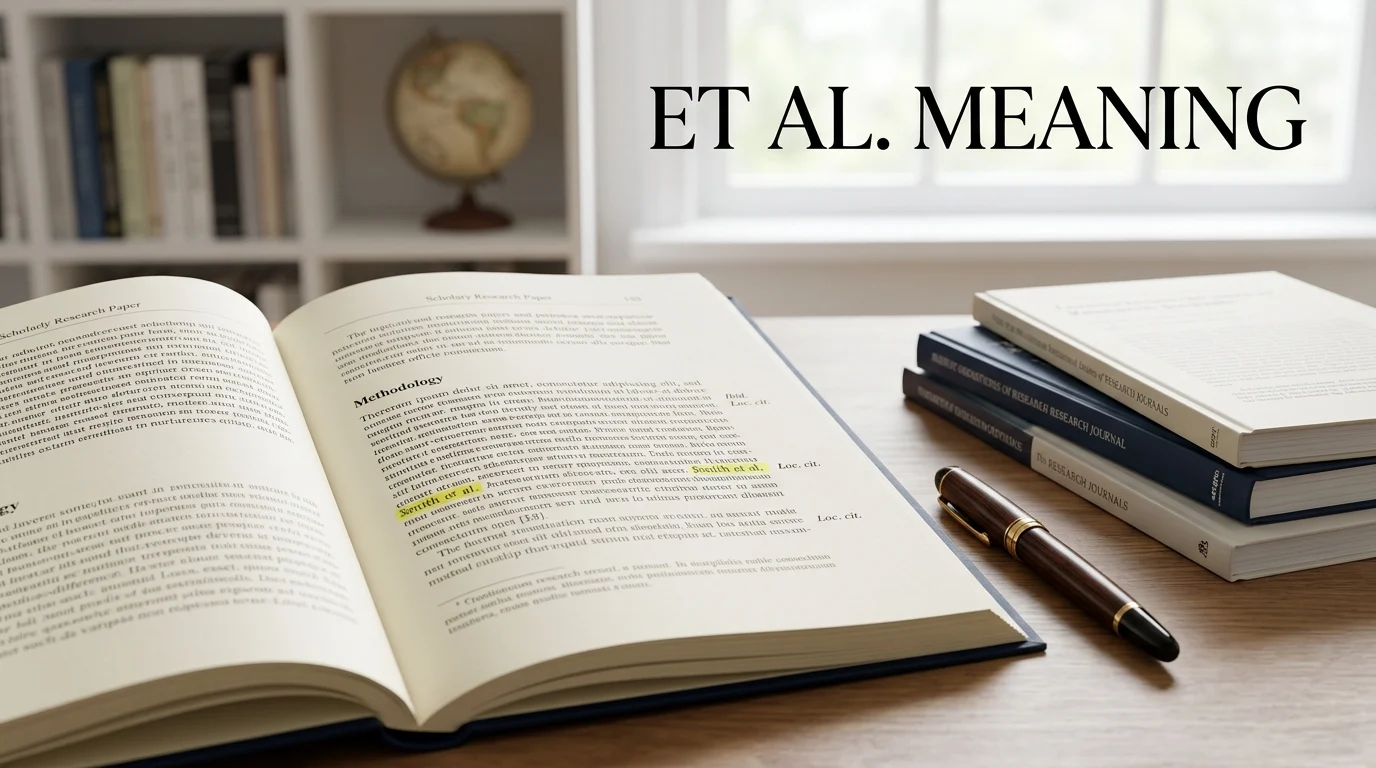

You may have seen “et al.” after an author’s name in a research paper, textbook, or citation and wondered what the short phrase actually means. The et al meaning is simply “and others” or “and other people.” It is a Latin abbreviation commonly used in academic and scholarly writing when a work has multiple authors. Unlike internet slang or a texting abbreviation, “et al.” has a formal, established purpose. Understanding its full form, punctuation, pronunciation, and citation rules can help you recognize it immediately and use it correctly when writing about research.
What Does Et Al. Mean?
Et al. is a Latin abbreviation meaning “and others.” It is short for et alii, et aliae, or et alia, depending on the grammatical gender of the people or things being referenced. In modern academic writing, however, et al. is generally treated as a convenient abbreviation used to shorten references containing multiple authors.
| Detail | Explanation |
|---|---|
| Most Common Meaning | “And others” |
| Full Latin Forms | et alii, et aliae, or et alia |
| Typical Use | Academic citations and scholarly references |
| Tone | Formal and neutral |
| Common Contexts | Research papers, books, journals, citations |
| Informal Slang? | No |
For example, a citation might say Smith et al. (2024) instead of listing every author’s name. The phrase tells the reader that Smith is one author and that additional authors contributed to the cited work.
Et Al. Full Form and Meaning
The et al. full form is not one single Latin phrase in every historical grammatical context. Et means “and,” while al. is an abbreviation of a Latin word meaning “others.”
The most familiar forms include:
- et alii — “and other men” or “and other people”
- et aliae — “and other women”
- et alia — “and other things”
In contemporary scholarly citations, writers generally do not choose among these forms based on the authors’ genders. Et al. has become the standard abbreviated expression for referring to multiple contributors without naming them all.
The period after al. is important because al. is an abbreviation. The word et is normally written without a period because it is a complete Latin word rather than an abbreviation.
How Do You Pronounce Et Al.?
Et al. is commonly pronounced “et al” or “et-all.” The pronunciation is straightforward, and the period after al. does not mean you should pronounce an extra word or pause.
For example:
Smith et al. published the study in 2024.
You would normally read this aloud as:
“Smith et al published the study in 2024.”
How Et Al. Is Used in Academic Writing
The main purpose of et al. is to make citations shorter and easier to read when a source has several authors.
Imagine a research article written by six people. Repeating all six names every time you mention the study would make the text unnecessarily cumbersome. Depending on the required citation style and number of authors, you may instead use the first author’s surname followed by et al.
For example:
Johnson, Patel, Garcia, Lee, Brown, and Davis found a significant relationship between the variables.
A shortened citation might appear as:
Johnson et al. found a significant relationship between the variables.
The abbreviation does not mean that Johnson conducted the research alone. It indicates that Johnson is being named while the other contributors are being represented collectively.
The exact point at which et al. should be used depends on the citation style and edition of the style guide you are following. APA, MLA, Chicago, and other systems have different rules for author lists, so you should follow the requirements of your institution or publication.
How Context Changes the Et Al. Meaning
The basic meaning stays consistent, but the context tells you exactly what et al. is referring to.
1. Academic research
Garcia et al. reported higher participation among students.
Here, et al. refers to Garcia’s coauthors.
2. A journal citation
The theory was examined by Miller et al. (2023).
The phrase identifies Miller and the other authors of the cited publication.
3. A book reference
The textbook by Wilson et al. covers several approaches to learning.
Again, et al. represents additional authors.
4. A sentence with multiple sources
Several researchers have reached similar conclusions (Adams et al., 2022; Chen et al., 2024).
The abbreviation applies separately to the authors associated with each cited source.
Unlike slang expressions, emojis, capitalization, or punctuation usually do not change the fundamental meaning of et al. Its interpretation is primarily determined by the surrounding citation and the publication being discussed.
Does Et Al. Mean “And Others”?
Yes. “And others” is the simplest English translation of et al.
However, the phrase should not be treated as a casual replacement for “and other people” in ordinary conversation. Its modern use is strongly associated with scholarly references and formal citation systems.
For example:
Correct academic use: Taylor et al. examined the results.
But this would sound unusual:
Unnecessary casual use: I went shopping with Taylor et al.
In the second sentence, simply saying “Taylor and the others” or naming the people would usually be clearer.
Real Conversation and Writing Examples
1: Class discussion
Person A: “Who wrote the study we’re presenting?”
Person B: “Garcia et al. are listed as the authors.”
Meaning: Garcia is the named author, while et al. indicates that other authors also contributed.
2: Research paper
Person A: “Do I have to write every author’s name every time?”
Person B: “Not necessarily. Check the required citation style to see when you should use et al.”
Meaning: The abbreviation may shorten repeated references to a multi-author source when the applicable style permits it.
3: Workplace research
Person A: “Where did this statistic come from?”
Person B: “It’s from a study by Nguyen et al.”
Meaning: Nguyen is one of several authors responsible for the study.
Is Et Al. Formal or Informal?
Et al. is formal and academic rather than slang. You are most likely to encounter it in scholarly articles, research papers, citations, bibliographies, legal or technical materials, and other writing that refers to published works.
It can appear in ordinary speech when someone is discussing research, but the expression itself remains formal. It does not carry a friendly, sarcastic, flirty, rude, or offensive tone.
That distinction matters if you searched for the et al slang meaning because of something you saw online. In most cases, there is no special texting or social-media slang interpretation to look for. If you see “et al.” in a citation, it almost certainly has its standard scholarly meaning.
Is Et Al. Rude or Offensive?
No. Et al. is neither rude nor offensive. It is a neutral abbreviation used to identify additional authors or contributors without listing every name.
The only potential issue is incorrect usage. For example, using et al. where a citation style requires specific author names could make your academic work technically incorrect, but that is a formatting problem rather than a matter of tone.
Et Al. on TikTok, Snapchat, and Social Media
Unlike many modern abbreviations, et al. does not have a standard platform-specific meaning on TikTok, Snapchat, Instagram, or WhatsApp.
If you encounter it on social media, the meaning normally comes from the surrounding content. A post discussing a scientific paper might use et al. exactly as an academic citation would. Someone discussing several people informally might also use the phrase humorously, but that is an adaptation of the formal expression rather than a separate established slang definition.
For example:
“According to Rivera et al., sleep affects memory.”
Here, the meaning remains “Rivera and the other authors.”
How to Use Et Al. Correctly
The safest approach is to use et al. only when the relevant citation style allows it.
Keep these points in mind:
- Write et al., not et. al.
- The abbreviation al. normally includes a period.
- Do not automatically use it for every source with more than one author.
- Check whether your required style specifies a particular number of authors before shortening the citation.
- Keep the formatting consistent throughout your document.
- Remember that et al. represents additional authors; it does not mean the named author worked alone.
The rules can differ substantially between academic styles, so following your instructor, journal, publisher, or institution’s specified style is more reliable than applying one universal rule.
When to Use Et Al.
Use et al. when you are working within a citation or reference system that permits or requires the abbreviation.
Common situations include:
- Academic research papers
- Literature reviews
- Journal articles
- Scholarly essays
- Scientific writing
- Research presentations
- Technical publications
- Discussions of published studies
It is especially useful when repeatedly referring to a source with several authors and the applicable style provides a shortened citation format.
When to Avoid Et Al.
Avoid using et al. simply because you want to shorten a sentence. It is not a general-purpose replacement for “and others.”
In particular, clearer wording may be preferable in:
- Casual text messages
- Personal emails
- Job applications
- Everyday conversation
- Messages to unfamiliar readers
- Situations where the audience may not understand academic abbreviations
In formal academic work, do not avoid it when your required style specifically calls for it. The important point is to use the abbreviation according to the rules governing your document.
Common Mistakes About Et Al.
| Common Mistake | Correct Understanding |
|---|---|
| Treating it as internet slang | It is primarily a formal scholarly abbreviation. |
| Writing “et. al.” | The standard form is et al. |
| Assuming it names every author | It abbreviates a group of additional authors or contributors. |
| Using it whenever several people are involved | Its use depends on context and citation-style rules. |
Another common misunderstanding is believing that et al. is a person’s name. In a citation such as “Brown et al.,” Brown is the surname of a named author, while et al. indicates additional authors.
Et Al. vs. Similar Terms
| Term | Meaning | Main Difference |
|---|---|---|
| et al. | And others | Used mainly for multiple authors or contributors |
| etc. | And so on | Used for additional items or examples |
| e.g. | For example | Introduces an example |
| i.e. | That is | Clarifies or restates something |
| and colleagues | And other researchers | Plain-English alternative in suitable contexts |
The most important distinction is between et al. and etc. They are not interchangeable. Et al. generally refers to additional people, particularly authors, while etc. refers to additional things, examples, or items.
For instance:
Smith et al. studied the issue.
means Smith and other authors studied it.
Meanwhile:
The study examined age, income, education, etc.
means there were additional items or factors beyond those listed.
Where Did Et Al. Come From?
Et al. comes from Latin, where et means “and” and al. abbreviates a form meaning “others.” Its use in scholarly citation developed from the long-standing use of Latin expressions in academic and bibliographic writing.
There is no need to assign the phrase to a particular modern creator. Its history is tied to Latin and the conventions of formal scholarly writing rather than to internet culture or a specific social-media trend.
Quick Recap
- Et al. means “and others.”
- It is a Latin-derived abbreviation used mainly in academic and scholarly writing.
- In citations, it generally represents additional authors after a named author.
- The standard written form is et al., not “et. al.”
- Its exact use depends on the citation style you are following.
- It is formal and neutral, not standard internet slang.
- Et al. and etc. have different meanings and should not be confused.
Frequently Asked Questions
What does et al. mean in text?
Et al. means “and others,” usually referring to additional authors or contributors in an academic citation.
What does et al. stand for?
Et al. abbreviates Latin expressions meaning “and others,” including et alii, et aliae, and et alia.
What does et al. mean on TikTok?
On TikTok, et al. normally retains its standard meaning and does not have a widely established slang definition.
Is et al. rude?
Et al. is not rude; it is a neutral, formal abbreviation commonly used to shorten references to multiple authors.
Can et al. have different meanings?
Et al. has related Latin grammatical forms, but its modern scholarly use consistently means “and others.”
Final Thoughts
The et al meaning is straightforward: “and others.” You will mainly see it in academic citations when a source has multiple authors and the citation style permits shortening the author list. It is not normally texting slang, and it does not carry a rude, flirty, or offensive tone. If you encounter et al. in a research paper, journal article, or scholarly reference, read it as a concise way of acknowledging additional authors. For correct usage, pay attention to the citation style and the context in which the abbreviation appears.
Discover More Post:
Snow Bunny Meaning Slang | Definition, Origin & Usage
WTW Meaning in Text | What Does WTW Mean?
25+ Funny Responses to A Hilarious (Clever, Witty, and …