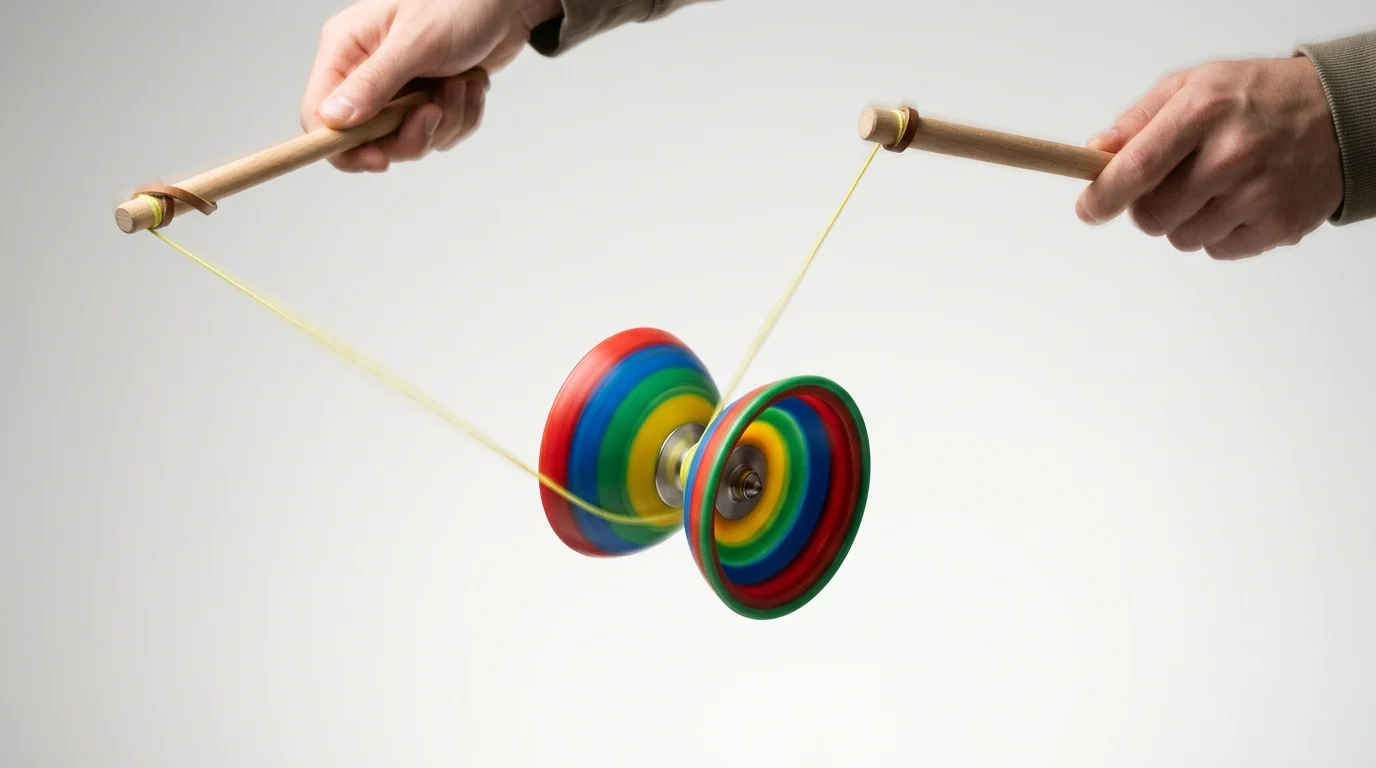

DIABOLO has three primary meanings: (1) a juggling prop consisting of a spool-like object spun and tossed on a string attached to two hand sticks, also known as a Chinese yo-yo; (2) a non-alcoholic French mixed drink made with lemon soda and flavored syrup; (3) a slang term derived from the Latin “diabolus” meaning devil, used to express surprise or admiration. The word traces back to the Ancient Greek “diabállō,” meaning “to throw across”.
Have you ever come across the word “diabolo” and wondered what it actually means? You are not alone. This intriguing term appears in multiple contexts, from circus performances to French cafes and even internet slang. Depending on where you encounter it, “diabolo” could refer to a juggling toy, a refreshing drink, or an expression of surprise.
In this complete guide, we will break down every meaning of “diabolo,” explore its origins, show you real-life usage examples, and explain how the term is used across different platforms and situations. By the end, you will have a full understanding of this versatile word and how to use it correctly.
Quick Answer
| Category | Details |
|---|---|
| Primary Meaning | Juggling prop (Chinese yo-yo) / French soft drink / Slang for devil |
| Word Origin | From Latin “diabolus” (devil) and Greek “diabállō” (to throw across) |
| Pronunciation | dee-AB-uh-loh |
| Common Misspelling | Often misspelled as “diablo” |
| Primary Contexts | Circus/juggling, French cafes, casual conversation |
| Tone | Neutral to informal |
What Does DIABOLO Mean?
The meaning of “diabolo” depends entirely on the context in which you encounter it. Let us break down the three main definitions.
The Juggling Prop
The most common and original meaning of “diabolo” refers to a juggling prop. A diabolo is an object consisting of an axle with two cups (hourglass or egg timer shaped) that is spun and tossed on a string attached to two hand sticks. It is sometimes called a Chinese yo-yo, though the diabolo has a shorter axle and larger cups compared to its Chinese counterpart.
The diabolo maintains its spinning motion through the conservation of angular momentum, similar to a Western yo-yo. A wide variety of tricks are possible, including tosses, grinds (balancing the diabolo on a stick), and suicides (temporarily letting go of the sticks and catching them again). Multiple diabolos can even be spun on a single string.
The diabolo has a rich history dating back to the late Ming Dynasty in China (1572-1620), where it was known as “kong zhong” or “air bell”. Europeans encountered it during the colonial era, and it became fashionable among Parisian upper classes around 1810. The modern name “diabolo” was formalized in the early 20th century, with the first recorded use in English around 1905-1910.
The French Drink
In France, “diabolo” refers to a popular non-alcoholic mixed drink. It consists of lemon soda or sparkling lemonade mixed with flavored syrup. Common flavors include:
- Diabolo Menthe (mint syrup)
- Diabolo Grenadine (pomegranate syrup)
- Diabolo Fraise (strawberry syrup)
- Diabolo Citron (lemon syrup)
The drink originated before 1920 and gained widespread popularity across France during the 1920s, reflecting the era’s growing cafe culture. It remains a staple in French cafes, bars, and restaurants today, often enjoyed during social gatherings like l’apero in the late afternoon or early evening.
The Slang Term
The third meaning of “diabolo” is as a slang term. In informal contexts, “diabolo” (often misspelled as “diablo”) can be used to express surprise, disbelief, or admiration. This usage derives from the Latin word “diabolus,” meaning devil.
The slang usage is less common than the juggling prop or drink meanings, but it appears in casual conversation, particularly in French-influenced contexts or among younger speakers.
Word Origin and Etymology
Understanding the origin of “diabolo” helps clarify its various meanings. The word has a fascinating linguistic journey.
The term comes from the Italian word “diavolo,” meaning devil, which itself derives from the Latin “diabolus”. The Latin word comes from the Ancient Greek “διάβολος” (diábolos), meaning “devil” or “slanderer,” which is derived from the verb “διαβάλλω” (diabállō), meaning “to throw across” or “to slander”.
Some commentators have suggested a direct semantic connection between the “throw across” meaning and the juggling prop, since the diabolo is thrown across the string. However, there is no evidence that this connection is anything other than coincidence.
The older name for the diabolo was “the devil on two sticks,” which reflects the Italian “diavolo” (devil) origin. This name likely came from the difficulty of mastering the prop, as it can be quite devilish to control!
Context and Usage
Let us explore how “diabolo” is used in different contexts.
In Juggling and Circus Arts
When used in the context of juggling or circus arts, “diabolo” refers specifically to the prop itself or the activity of manipulating it. You might hear phrases like:
- “She performed an incredible diabolo routine at the circus.”
- “He has been practicing diabolo for years and can do some amazing tricks.”
- “The diabolo is one of the most popular juggling props worldwide.”
In French Cafes and Restaurants
In France, ordering a “diabolo” means you want a refreshing soda drink. The specific flavor is usually specified:
- “Je vais prendre un diabolo menthe” (I will have a mint diabolo)
- “Un diabolo grenadine, s’il vous plait” (A grenadine diabolo, please)
In Casual Conversation
As slang, “diabolo” might be used in casual conversation, though this usage is relatively rare in English. You are more likely to encounter “diablo” (without the “o”) used this way, particularly in Spanish-influenced contexts.
Real-Life Examples
Here are five conversation examples showing how “diabolo” might be used in different situations.
1: At the Circus
Person A: “Did you see the juggler’s act? That diabolo work was incredible!”
Person B: “I know! I have no idea how he kept three of them spinning at once.”
2: At a French Cafe
Person A: “What are you going to order?”
Person B: “I think I will get a diabolo menthe. It is so refreshing on a hot day.”
Person A: “Good choice. I might try the grenadine one.”
3: Learning to Juggle
Person A: “I just bought my first diabolo. Any tips for beginners?”
Person B: “Start with just getting it spinning on the string before you try any throws. Patience is key.”
4: Casual Slang Usage
Person A: “Did you hear what happened at the party last night?”
Person B: “Diabolo! I cannot believe it.”
5: Teaching a Child
Parent: “Look at that performer with the diabolo. Do you want to try?”
Child: “Yes! How does it stay on the string like that?”
Parent: “It is all about the spinning motion. The faster it spins, the more stable it becomes.”
Platform-Specific Meaning
The meaning of “diabolo” can vary depending on the platform or medium where you encounter it.
Social Media
On social media platforms like Instagram, TikTok, and YouTube, “diabolo” most commonly appears in the context of juggling videos and circus performance content. You will find hashtags like #diabolo, #diabolotricks, and #juggling. The term is rarely used as slang on these platforms, as the juggling meaning dominates.
Messaging Apps (WhatsApp, Snapchat, iMessage)
In personal messaging, “diabolo” might appear in several ways:
- Sharing videos of diabolo performances
- Making plans to visit a French cafe that serves diabolos
- Occasionally used as playful slang (though this is uncommon)
Gaming Platforms
In gaming communities, “diabolo” occasionally appears as a username or reference to devil-themed content, though the more common spelling is “diablo.” The juggling prop meaning is rarely used in gaming contexts.
French-Language Platforms
On French-language platforms and websites, “diabolo” almost always refers to the drink. French speakers ordering online or discussing food and drink will use “diabolo” in this context.
E-commerce and Shopping
On shopping platforms, “diabolo” can refer to:
- Juggling props for sale
- Diabolo drink syrups and mixes
- Diabolo-branded products
Alternative Meanings
While the three main meanings we have covered are the most common, “diabolo” has a few other niche applications.
Air Gun Pellets
In some contexts, “diabolo” refers to the most common design of air gun pellet. These pellets have a distinctive hourglass shape that resembles the juggling prop, which is where the name comes from.
Manga and Pop Culture
“Diabolo” is also the title of a manga set in Japan. This is a niche reference that only appears in specific fan communities.
Diabolo Day
On Urban Dictionary, “Diabolo Day” is defined as May 22nd, described as “the worst day of the year where all the bad and evil stuff is likely plan out”. Another definition describes it as “any period of time where you and your friends go out without initial purpose or expectations”. This is internet slang with very limited usage.
Related Terms and NLP Variations
To fully understand “diabolo,” it helps to know related terms and variations.
How to Respond When Someone Says “DIABOLO”
Your response to someone using “diabolo” depends entirely on the context.
If They Are Talking About Juggling
Response: “Oh, you mean the juggling prop! Do you practice diabolo yourself, or were you watching a performance?”
Alternative: “That is so cool! I have always wanted to learn how to use one of those.”
If They Are Talking About the Drink
Response: “Are you talking about the French soda? Which flavor do you like best?”
Alternative: “I have never tried a diabolo. What does it taste like?”
If They Are Using It as Slang
Response: (If you understand the slang usage) “I know, right? That is wild.”
Alternative: (If you are unsure) “Wait, what do you mean by that?
If You Are Unsure of the Context
Response: “Do you mean the juggling thing, the French drink, or something else?
This is a safe and natural way to clarify without appearing confused.
Misinterpretations to Avoid
Because “diabolo” has multiple meanings, misinterpretations are common. Here are the most frequent mistakes.
Confusing Diabolo with Diablo
The most common error is confusing “diabolo” with “diablo.” While “diablo” means devil in Spanish and is sometimes used as slang, “diabolo” specifically refers to the juggling prop or the French drink. They are related etymologically but have distinct meanings.
Assuming It Only Means One Thing
Many people encounter “diabolo” in one context and assume that is the only meaning. A circus performer might think it only refers to the prop, while a French traveler might think it only refers to the drink. Remember that the meaning depends on context.
Thinking It Is Always Slang
While “diabolo” has some slang usage, it is not primarily a slang term. The juggling prop and drink meanings are far more common and established.
Mispronouncing the Word
The correct pronunciation is “dee-AB-uh-loh”. Common mispronunciations include “dee-ah-boh-loh” or “dye-AB-oh-loh.”
When NOT to Use “DIABOLO”
There are situations where using “diabolo” might not be appropriate.
In Formal Writing
Unless you are specifically writing about juggling props or French beverages, “diabolo” is too niche for formal academic or professional writing. Use more specific terms like “juggling prop” or “French soda” instead.
When Clarity Is Essential
If your audience is unlikely to know what “diabolo” means, avoid using it without explanation. The word is not widely known in American English, so using it without context can cause confusion.
When You Mean “Diablo”
If you mean “devil” or are using Spanish slang, use “diablo” instead of “diabolo.” They are not interchangeable despite their similar spelling.
Usage Tips
Here are some practical tips for using “diabolo” correctly.
Specify the Context
When using “diabolo,” provide enough context for your listener or reader to understand which meaning you intend. For example:
- “I bought a diabolo for juggling practice.”
- “Let us get a diabolo menthe at that French cafe.”
- (Avoid using it as standalone slang unless your audience understands)
Learn the Pronunciation
Practice saying “dee-AB-uh-loh” so you sound confident when using the word. The stress is on the second syllable.
Use the Correct Spelling
Always spell it “diabolo” (with an “o” at the end) unless you specifically mean “diablo” (the Spanish word for devil).
Embrace the Versatility
Part of the charm of “diabolo” is its versatility. It is a word that connects circus arts, French culture, and linguistic history. Using it correctly shows cultural awareness and linguistic sophistication.
Frequently Asked Questions
What does DIABOLO mean in slang?
In slang, “diabolo” (often misspelled as “diablo”) can be used to express surprise, disbelief, or admiration. It derives from the Latin word “diabolus,” meaning devil. However, this slang usage is relatively uncommon compared to the juggling prop and drink meanings.
Is DIABOLO the same as DIABLO?
No, they are not the same. “Diablo” is the Spanish word for devil and is sometimes used as slang or in pop culture references. “Diabolo” specifically refers to a juggling prop or a French soft drink. They are related etymologically but have distinct meanings.
How do you pronounce DIABOLO?
The correct pronunciation is “dee-AB-uh-loh”. The stress falls on the second syllable (AB). It is commonly misspelled and mispronounced as “diablo.”
What is a DIABOLO in juggling?
In juggling, a diabolo is a prop consisting of an axle with two cups (hourglass or egg timer shaped) that is spun and tossed on a string attached to two hand sticks. It is sometimes called a Chinese yo-yo and is used to perform various tricks and routines.
What is a DIABOLO drink?
A diabolo is a non-alcoholic mixed drink popular in France, consisting of lemon soda or sparkling lemonade mixed with flavored syrup. Popular flavors include mint (diabolo menthe), grenadine, strawberry, and lemon.
Where does the word DIABOLO come from?
The word comes from the Italian “diavolo” (devil), which derives from the Latin “diabolus” and the Ancient Greek “διάβολος” (diábolos). The Greek word comes from the verb “διαβάλλω” (diabállō), meaning “to throw across” or “to slander”.
Is DIABOLO a common word in English?
No, “diabolo” is not a common word in everyday American English. It is a niche term primarily used in juggling communities, French cultural contexts, and among people interested in circus arts or French cuisine.
What are some DIABOLO tricks?
Common diabolo tricks include tosses (throwing the diabolo into the air and catching it on the string), grinds (balancing the diabolo on a stick), suicides (temporarily letting go of the sticks), and various string manipulations. Advanced performers can spin multiple diabolos on a single string.
Can you use DIABOLO in a sentence?
Yes. Examples include: “The circus performer amazed the audience with her diabolo routine.” “I ordered a diabolo menthe at the Parisian cafe.” “He has been practicing diabolo for years and can now do advanced tricks.”
What is the difference between a DIABOLO and a yo-yo?
A yo-yo consists of a single spool attached to a string that is wound and unwound around the axle. A diabolo is larger, has two cups, and is manipulated on a string attached to two hand sticks. The diabolo is spun and tossed, while a yo-yo is typically moved up and down on a single string.
Conclusion
“Diabolo” is a fascinating word with multiple meanings that span different cultures and contexts. Whether you are watching a circus performance, ordering a drink at a French cafe, or exploring linguistic history, understanding the various meanings of “diabolo” enriches your cultural and linguistic knowledge.
The three primary meanings are:
- A juggling prop (the Chinese yo-yo)
- A French non-alcoholic soda drink
- A slang term derived from the word for devil
The word’s journey from Ancient Greek “diabállō” (to throw across) to Latin “diabolus” (devil) to Italian “diavolo” and finally to the English “diabolo” reflects centuries of linguistic evolution and cultural exchange.
Remember to consider the context when encountering or using “diabolo.” Is someone talking about juggling? Are they ordering a drink? Or are they using it as playful slang? The answer will guide your understanding and response.
Now that you have a complete understanding of “diabolo” meaning, you can confidently use and interpret this versatile term in any situation.