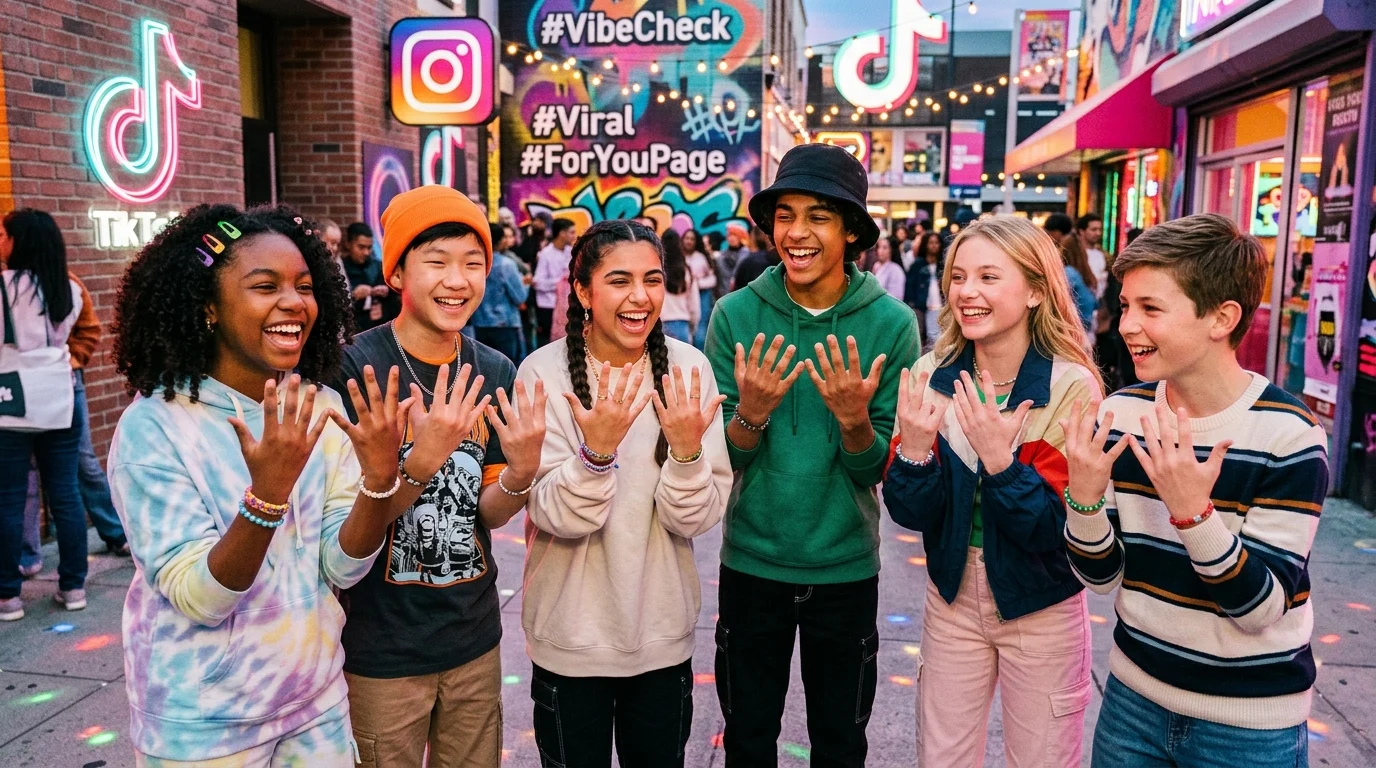

67 (pronounced “six seven,” not “sixty-seven”) is a viral, ambiguous slang term popularized by Gen Alpha on TikTok and Instagram. It has no fixed meaning but is often used to mean “so-so,” “maybe this, maybe that,” or as a nonsensical response to any question. The term originated from the drill rap song “Doot Doot (6 7)” by Skrilla and was popularized through basketball edits featuring LaMelo Ball, who stands 6’7″. It is typically accompanied by a hand gesture where both palms face up and move alternately up and down.
If you have heard kids shouting “67” in hallways, seen it flood your social media feed, or watched a classroom erupt after a teacher accidentally said the number, you are not alone. The term “67” has taken over the internet, baffling parents, teachers, and anyone who does not spend their days on TikTok.
In 2025, Dictionary.com named “67” its Word of the Year, describing it as “meaningless, ubiquitous, and nonsensical”. But how can a word with no meaning become so popular? The answer lies in the way Gen Alpha uses language not to communicate information, but to signal belonging, create inside jokes, and participate in internet culture.
This guide breaks down everything you need to know about the “67” slang term: where it came from, how to use it, what it means (or doesn’t mean), and why it has become one of the most defining cultural phenomena of 2025.
Quick Answer Box
| Aspect | Details |
|---|---|
| Meaning | No fixed meaning; often used to mean “so-so,” “maybe this, maybe that,” or as a nonsensical response |
| Pronunciation | “six seven” (never “sixty-seven”) |
| Context | Social media, classrooms, sports events, everyday conversation |
| Primary Users | Gen Alpha and younger Gen Z |
| Platforms | TikTok, Instagram Reels, Snapchat, WhatsApp, text messaging |
| Example | “How was school today?” “67.” |
| Tone | Playful, absurd, inside joke, brainrot culture |
What Does 67 Mean in Slang?
The Official Definition
Dictionary.com defines 67 as “a viral, ambiguous slang term that has waffled its way through Gen Alpha social media and school hallways”. The dictionary further notes that the term is “largely nonsensical,” with some interpreting it as “so-so” or “maybe this, maybe that”. It is one of the few “words” that a dictionary has admitted is impossible to define.
The “Brainrot” Connection
The term is closely associated with “brainrot” culture, a phenomenon where internet content is purposefully nonsensical, absurd, and designed to be enjoyed precisely because it lacks meaning. Urban Dictionary describes 67 as “a nonsense term in brainrot culture used to reference that we ourselves are brainrotted, a running joke with no punchline or meaning that comments on how the entire Internet is made of brainrotted running jokes”.
A Term Defined by Its Lack of Definition
Perhaps the most defining feature of 67 is that it has no fixed meaning. It can be used as a response to any question, as an exclamation, or simply as a way to acknowledge that you are “in on” the joke. As one observer put it, “67 is a vibe, not a meaning”. The term’s ambiguity is its superpower, allowing users to deploy it in virtually any situation.
Context and Usage
How and When to Use 67
The beauty of 67 is its versatility. Here are the most common ways people use it:
As a Response to Any Question
The most common usage is as a reply to practically any question. A parent might ask, “How was school today?” and receive “67” in response. A teacher might ask, “What’s 120 minus 53?” and the class shouts “67”. The response is often delivered with the signature hand gesture for maximum effect.
As an Exclamation
People shout “67” in group settings like sporting events, classrooms, or anywhere a crowd gathers. The term functions almost like a tribal call, signaling that everyone present is part of the same inside joke.
As a Reaction to Seeing the Number
Simply seeing the numbers “67” in order, whether on a math problem, a phone number, or a receipt, can trigger someone to say “67”. This has led to some interesting real-world consequences, including In-N-Out Burger reportedly removing “67” from its ticket order system because crowds of teenagers would gather waiting for the number to be called.
As a Weighing of Options
When paired with the hand gesture (palms up, moving alternately), 67 can indicate that someone is weighing two options, essentially saying “maybe this, maybe that”.
The Hand Gesture
No discussion of 67 is complete without mentioning the hand gesture. The gesture involves holding both palms face-up and moving one hand up while the other moves down, in an alternating motion. It resembles the motion of weighing two objects or a shrug. The gesture is as important as the spoken word itself; saying “67” without the gesture is like telling a joke without the punchline.
Real-Life Examples
Conversation Example 1: Parent and Child
Parent: “How was your day at school?”
Child: “67.” (accompanied by the hand gesture)
Parent: “What does that mean?”
Child: “Exactly.” (walks away)
Conversation Example 2: Among Friends
1: “Did you see that shot in the game last night?”
2: “67, bro.”
1: “Fr, no cap.”
Conversation Example 3: Classroom Setting
Teacher: “Who can tell me the answer to problem number 5?”
Student: “67.”
Entire class: erupts in laughter and does the hand gesture
Teacher: “I’m banning that word.”
Conversation Example 4: Text Messaging
A: “You coming to the party tonight?”
B: “67”
A: “Is that a yes or a no?”
B: “Yes.”
Conversation Example 5: TikTok Comment Section
1: “This edit is fire 🔥”
2: “67”
3: “six seven”
4: “i understood that reference”
Platform-Specific Meaning
TikTok
TikTok is the primary platform where 67 exploded. The app currently shows over 1.1 million related videos. Users create edits set to Skrilla’s “Doot Doot (6 7),” often featuring basketball players, particularly LaMelo Ball. The term is used in comments, captions, and as a sound itself. TikTokers have created entire personas around the term, including the “67 Kid” who went viral for shouting it at a basketball game.
Instagram Reels
Instagram Reels has also embraced the trend, with users creating similar basketball edits and meme content. The visual nature of the platform makes it ideal for showcasing the hand gesture and the absurdity of the term.
Snapchat
On Snapchat, 67 is used in snaps, stories, and as a quick reply to friends. Its brevity (just two numbers) makes it perfect for the platform’s fast-paced communication style. Users often pair it with the hand gesture in video snaps.
WhatsApp and Text Messaging
In text-based platforms like WhatsApp and SMS, 67 serves as a shorthand response that conveys a specific “vibe” without needing to explain it. It’s the ultimate low-effort reply that signals you are part of the in-group.
Life360
The family location-sharing app Life360 added “67” as an option to send to other users, with the app explaining it means “I am just messing around. This shows how deeply the term has penetrated even non-social-media platforms.
Alternative Meanings of 67
While the slang meaning is the most relevant in 2025, “67” has several other meanings depending on context:
The UK Drill Gang
“67” is also the name of a notorious gang based in Brixton Hill, South London, known for its involvement in UK drill music and violent crime. The gang’s name is derived from the telephone code for their south London neighborhood. This is entirely separate from the Gen Alpha slang term, though both share the same numbers.
Police Code 10-67
In some contexts, “10-67” is a police code used to report a death. However, Skrilla, the rapper who popularized “6-7,” has denied that his song references this code.
A Cardinal Number
Of course, 67 is simply the number between 66 and 68. In math class, it’s the answer to various arithmetic problems. This is precisely why it’s so effective as a slang term: it’s a number that appears everywhere, making it the perfect vessel for a nonsensical joke.
Reference to 67th Street
Some have suggested that the term refers to 67th Street in Chicago or Philadelphia, where Skrilla is from. The rapper himself has never confirmed this, preferring to keep the meaning ambiguous.
Related Terms and NLP Variations
Six-Sendy
A mashup of “67” and “getting sendy” (meaning to go all out or commit enthusiastically). The “get sendy” phrase itself builds on older action-sports slang “send it”. When kids shout “six-sendy,” they’re combining two viral slang terms at once.
41
Dictionary.com notes that “41” is a spinoff of or perhaps the new “67”. It’s pronounced “forty-one” or “four-one” and has its own hand gesture where palms face downward and move alternately back and forth across the chest. The meme phrase is possibly tied to “41 Song” by Blizzi Boi and, like 67, doesn’t have a solid meaning.
Brainrot
“Brainrot” is the broader cultural phenomenon that 67 exemplifies. It refers to digital media deemed to be of poor quality or purposefully nonsensical. Oxford University Press named “brain rot” its word of the year in 2024.
Getting Sendy
Meaning “go all out” or “commit enthusiastically,” this phrase builds on older action-sports slang “send it”. It has been combined with 67 to create “six-sendy.”
How to Respond to 67
If You’re In on the Joke
If someone says “67” to you and you understand the reference, the best response is simply to say “67” back, ideally with the hand gesture. This confirms that you are both part of the same inside joke.
Example:
Friend: “67”
You: “67” (with hand gesture)
Friend: “Fr, no cap.”
If You’re Confused
If you don’t understand the reference, you can simply ask what it means. Be prepared for a non-answer, as the whole point is that it doesn’t mean anything.
Example:
Kid: “67”
You: “What does that mean?”
Kid: “Exactly.” (does the hand gesture and walks away)
If You’re a Teacher or Parent
Many teachers and parents have chosen to lean into the trend rather than fight it. Some have turned it into a learning opportunity, like the choir teacher who asked her students to write a song about the slang. Others have banned it outright, with one teacher requiring students to write a 67-word essay about the term’s meaning if they break the rule.
Misinterpretations
It’s Not About the Gang
The Gen Alpha slang term “67” has nothing to do with the UK drill gang of the same name. While both use the same numbers, they are entirely unrelated phenomena. The gang is a serious criminal organization based in London, while the slang is a playful internet meme.
It’s Not a Secret Code
Despite some speculation, 67 is not a secret code for anything illicit or inappropriate. Dictionary.com has confirmed that it’s simply a nonsensical term used for humor and social signaling.
It’s Not “Sixty-Seven”
One of the most common mistakes is pronouncing 67 as “sixty-seven.” The correct pronunciation is “six seven” (two separate numbers). Saying “sixty-seven” completely misses the point and identifies you as someone who is not in on the joke.
It’s Not Always “So-So”
While some interpret 67 as meaning “so-so” or “maybe this, maybe that,” this is not a fixed definition. The term can be used in virtually any context, and its meaning is entirely dependent on the situation and the vibe.
When NOT to Use 67
In Formal Settings
Avoid using 67 in professional environments, job interviews, academic papers, or any formal communication. It is firmly rooted in internet slang and will likely be misunderstood or seen as unprofessional.
With People Who Won’t Understand
Using 67 with older adults, people who are not active on social media, or anyone who doesn’t follow Gen Alpha culture will likely result in confusion. While this confusion can sometimes be the point, it’s not always appropriate.
When You Actually Need to Communicate
If you genuinely need to convey information, 67 is not the right choice. Its ambiguity means it cannot be relied upon for clear communication.
In Math Class (Maybe)
While some teachers have embraced the trend, others have banned it entirely. Saying “67” in math class might get a laugh from your classmates, but it could also get you in trouble.
Usage Tips
Master the Hand Gesture
The hand gesture is essential to the full 67 experience. Practice the alternating palm-up motion until it feels natural. Without the gesture, you’re only telling half the joke.
Know Your Audience
Use 67 with people who will understand it. This means Gen Alpha, younger Gen Z, and anyone who spends time on TikTok or Instagram Reels. Using it with the wrong audience will just make you look confused.
Embrace the Absurdity
The whole point of 67 is that it’s nonsensical. Don’t try to force a meaning onto it. The joke is that it has no joke. Embrace the absurdity and have fun with it.
Don’t Overuse It
Like any slang term, overusing 67 can make it lose its impact. Use it sparingly for maximum effect. Part of its charm is that it’s a shared inside joke, not a replacement for actual language.
Pair It with Other Slang
67 works well when paired with other Gen Alpha and Gen Z slang terms like “fr” (for real), “no cap” (no lie), “lowkey,” and “ngl” (not gonna lie). This creates a cohesive slang vocabulary that signals you are fully immersed in the culture.
FAQs
1. What does 67 mean in slang?
67 is a viral slang term popularized by Gen Alpha. It has no fixed meaning but is often used to mean “so-so,” “maybe this, maybe that,” or as a nonsensical response to any question. It was named Dictionary.com’s 2025 Word of the Year.
2. How do you pronounce 67?
It is pronounced “six seven” (two separate numbers), not “sixty-seven”.
3. Where did 67 come from?
The term originated from the drill rap song “Doot Doot (6 7)” by Skrilla, released in December 2024. It was popularized through video edits featuring NBA player LaMelo Ball, who is 6’7″ tall, and a viral video of a boy known as the “67 Kid”.
4. What is the 67 hand gesture?
The hand gesture involves holding both palms face-up and moving one hand up while the other moves down, in an alternating motion. It resembles weighing two options.
5. Is 67 a bad word?
No, 67 is not a bad word or a secret code for anything inappropriate. It’s a playful, nonsensical slang term used for humor and social signaling.
6. Why did Dictionary.com choose 67 as Word of the Year?
Dictionary.com chose 67 because it “capture[s] pivotal moments in language and culture”. The term is emblematic of brainrot culture and represents how Gen Alpha uses language to create inside jokes and signal belonging.
7. Who uses 67?
The term is primarily used by Gen Alpha and younger Gen Z on platforms like TikTok and Instagram Reels, as well as in classrooms and school hallways.
8. What does 67 mean on Life360?
On Life360, 67 is an option to send to other users that means “I am just messing around.
9. What is the difference between 67 and 41?
“41” is a spinoff of 67 with its own hand gesture (palms down, moving alternately across the chest). Like 67, it doesn’t have a solid meaning.
10. Is 67 related to the 67 gang?
No, the Gen Alpha slang term has no connection to the UK drill gang called 67. They are entirely unrelated phenomena that happen to share the same numbers.
11. Can 67 be used in text messages?
Yes, 67 is frequently used in text messages, WhatsApp, and other messaging apps as a quick, low-effort response.
12. What does “six-sendy” mean?
“Six-sendy” is a mashup of 67 and “getting sendy” (meaning to go all out or commit enthusiastically).
13. Why do kids shout 67 in class?
Kids shout 67 in class as a joke, often when a teacher says the number or as a nonsensical response to a question. It’s a way to share an inside joke and signal that they are part of the trend.
14. Is 67 just a meme?
Yes, 67 is primarily an internet meme that has transcended social media to become a cultural phenomenon.
15. Will 67 still be popular in the future?
Like most slang terms, 67’s popularity will likely fade over time as new terms emerge. However, its selection as Dictionary.com’s Word of the Year suggests it will be remembered as a defining term of 2025.
Conclusion
The “67” slang term is a perfect example of how language evolves in the digital age. It’s a word that means nothing and everything at the same time, a shared inside joke that signals belonging and cultural awareness. For Gen Alpha, it’s more than just a number; it’s a vibe, a gesture, and a way of connecting with peers.
While adults may find it confusing or frustrating, the term represents something deeper: a generation’s desire to create its own language, separate from the world of their parents and teachers. It’s playful, absurd, and deliberately nonsensical, and that’s exactly the point.
Whether you love it or hate it, “67” has earned its place in the cultural lexicon. It’s a reminder that language is not just about conveying information; it’s also about connection, identity, and having fun. So the next time someone asks you what 67 means, you can confidently say: “It means whatever you want it to mean. And that’s the whole point.”