
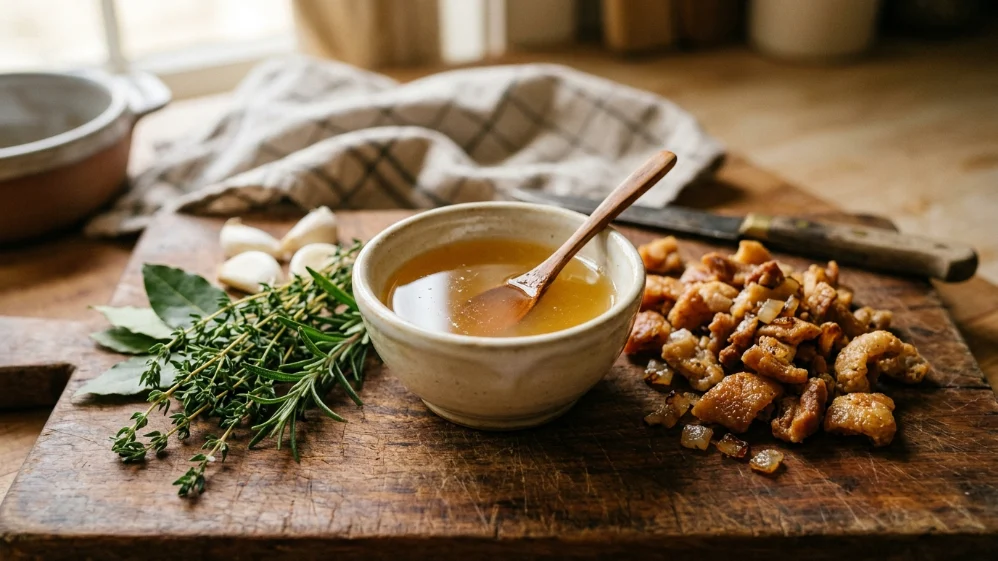

Schmaltz meaning refers to two distinct concepts: the culinary tradition of rendered chicken or goose fat in Jewish cooking, and the figurative use describing excessive sentimentality or melodrama in art, music, and entertainment. This guide covers everything you need to know about schmaltz meaning, from its Yiddish origins to modern usage.
Schmaltz (also spelled schmalz or shmalz) has two primary meanings: (1) rendered chicken or goose fat used in traditional Ashkenazi Jewish cooking for dishes like matzo ball soup, latkes, and chopped liver; and (2) excessive or exaggerated sentimentalism, especially in art, music, or writing, often described as cheesy, sappy, or over-the-top.
The term comes from the Yiddish word “shmalts,” meaning animal fat.
If you have ever watched a movie that felt way too sappy or heard a song that laid the emotion on way too thick, you have encountered schmaltz. But the word carries a dual life that many people do not realize. On one hand, schmaltz is a beloved cooking fat central to Ashkenazi Jewish cuisine for centuries. On the other, it is a slang term for anything overly sentimental, melodramatic, or cheesy.
This article breaks down everything about schmaltz meaning: its culinary roots, its figurative use, how to use it in conversation, platform-specific meanings, and answers to the most frequently asked questions. Whether you are a food lover, a language nerd, or just curious about where this quirky word comes from, you will find everything you need here.
Quick Answer Box
| Aspect | Details |
|---|---|
| Meaning | Rendered chicken/goose fat (culinary) OR excessive sentimentality (figurative) |
| Context | Jewish cooking / entertainment, art, music critique |
| Usage | Noun: “That movie has too much schmaltz.” / “I cooked the latkes in schmaltz.” |
| Platforms | Cooking blogs, film reviews, music criticism, social media |
| Example | “The finale was pure schmaltz, but I cried anyway.” |
| Tone | Informal, often disapproving when figurative; affectionate when culinary |
What Does Schmaltz Mean?
Schmaltz is a word with two distinct but connected meanings. Understanding both is key to grasping the full schmaltz meaning.
The Culinary Meaning
In the kitchen, schmaltz is rendered chicken or goose fat. It is made by slowly cooking poultry fat and skin until the fat melts into a clear liquid, leaving behind crispy bits called gribenes. This fat has been a staple in Ashkenazi Jewish cooking for centuries, used in dishes like matzo ball soup, latkes, chopped liver, and matzah brei.
Schmaltz was particularly important in Eastern European Jewish communities where olive oil was not widely available and kosher dietary laws prevented the use of butter with meat meals. Today, schmaltz is experiencing a revival among chefs and home cooks who appreciate its rich, savory flavor.
The Figurative Meaning
Figuratively, schmaltz refers to excessive or exaggerated sentimentality. It describes art, music, writing, or even conversations that are overly emotional, sappy, or cheesy in a way that feels forced or insincere.
The connection between the two meanings is metaphorical: just as chicken fat is rich and heavy, sentimental schmaltz is emotionally rich and heavy, sometimes to the point of being cloying. The term was first applied figuratively to popular music in the mid-1930s, particularly to sentimental or florid music.
Full Definition
To fully understand schmaltz meaning, here is a comprehensive definition covering all its dimensions:
Primary Definitions
- Culinary: Rendered (clarified) chicken or goose fat, used as a cooking fat, spread, or flavor enhancer in traditional Ashkenazi Jewish cuisine.
- Figurative: Excessive or exaggerated sentimentalism, especially in art, music, or writing. Often used disapprovingly to describe works that are overly sappy, melodramatic, or cheesy.
Secondary Definitions
- Maudlin sentimentality: A particularly weepy, self-indulgent form of emotional expression.
- Corny sweetness: Overly sentimental content that feels dated or lacking in subtlety.
- Crowd pleaser: In some contexts, schmaltz refers to content designed to appeal to popular tastes in an obvious or manipulative way.
Pronunciation
Schmaltz is pronounced shmalts (rhymes with “malts”). The “sch” is pronounced as “sh,” and the “tz” is pronounced as “ts.”
Part of Speech
Schmaltz is primarily used as a noun. The adjective form is schmaltzy, meaning characterized by schmaltz.
Context and Usage
Schmaltz appears in various contexts, and knowing when and how to use it correctly is important.
When to Use the Culinary Meaning
Use schmaltz in its culinary sense when discussing:
- Traditional Jewish cooking and recipes
- Kosher cooking practices
- Food history and Ashkenazi cuisine
- Cooking techniques involving rendered fats
Examples:
- “I use schmaltz instead of oil for frying latkes.”
- “The secret to great matzo ball soup is good schmaltz.”
- “Schmaltz adds a depth of flavor that vegetable oil just cannot match.”
When to Use the Figurative Meaning
Use schmaltz figuratively when critiquing or describing:
- Movies, TV shows, or plays that are overly sentimental
- Music that is sappy or melodramatic
- Writing that lays emotion on too thick
- Speeches or conversations that feel insincere or manipulative
Examples:
- “The movie’s ending was pure schmaltz.”
- “I cannot stand that song; it is nothing but schmaltz.”
- “His speech was full of political schmaltz.”
Tone and Register
Schmaltz is informal and often carries a disapproving tone when used figuratively. It is the kind of word you might use in conversation, a film review, or a casual critique. In its culinary sense, it is neutral or even affectionate.
Real-Life Examples
Seeing schmaltz in action helps solidify its meaning. Here are five realistic conversation examples.
1: Movie Night
- Person A: “What did you think of that romantic comedy?”
- Person B: “It was okay, but the ending had way too much schmaltz for me. They did not need that cheesy montage.”
- Person A: “I know, right? It felt like they were trying too hard to make us cry.”
2: Music Critique
- Person A: “Have you heard the new ballad from that pop star?”
- Person B: “Yeah, it is pure schmaltz. The strings, the key change, the dramatic pause… it is like a parody of itself.”
- Person A: “Fr, no cap. I could not take it seriously.”
3: Cooking
- Person A: “What are you making for Hanukkah?”
- Person B: “Latkes, of course. I am using schmaltz this year instead of oil.”
- Person A: “Oh, that is going to be amazing. My grandmother always used schmaltz.”
- Person B: “Exactly. It just hits different.”
4: Book Review
- Person A: “I just finished that bestseller everyone is talking about.”
- Person B: “How was it?”
- Person A: “Honestly? Too much schmaltz. The author laid the sentimentality on so thick I could barely finish it.”
Person B: “That is disappointing. I was going to read it next.”
5: Social Media
Person A: “Did you see that viral video of the soldier coming home?”
Person B: “Yeah, it was sweet but lowkey schmaltzy. They definitely edited it for maximum tears.”
Person A: “Ngl, I still cried though.”
Person B: “Same. Schmaltz works every time.”
Platform-Specific Meaning
Schmaltz appears across different platforms and contexts, each with its own nuance.
Film and Television
In film criticism, schmaltz describes movies that rely on manipulative emotional tactics. Think of the overly dramatic score, the slow-motion reunion, the tearful monologue. Critics use schmaltz to call out films that prioritize sentiment over substance.
Example: “The director’s latest film is heavy on schmaltz and light on genuine emotion.”
Music
In music, schmaltz refers to overly sentimental or florid compositions. This can include power ballads, over-orchestrated pop songs, or any music that feels emotionally manipulative.
Example: “That power ballad is pure schmaltz, but I love it anyway.”
Literature
In writing, schmaltz describes prose that is overly sentimental, often in romance novels, memoirs, or inspirational content. It suggests a lack of subtlety or restraint.
Example: “The author’s latest novel descends into schmaltz in the final chapters.”
Social Media
On platforms like TikTok, Instagram, and Twitter, schmaltz is used to call out content that is overly emotional or designed to manipulate viewers’ feelings. It is often used ironically or humorously.
Example: “This TikTok is pure schmaltz and I am here for it.”
Cooking and Food Content
On cooking blogs, YouTube channels, and food social media, schmaltz is discussed in its literal sense. Food creators often highlight its flavor benefits and cultural significance.
Example: “This recipe uses schmaltz for the most flavorful roasted potatoes.”
Alternative Meanings and Variations
While the primary meanings of schmaltz are clear, there are some variations and related terms worth knowing.
Schmaltzy (Adjective)
The adjective form describes something that is characterized by schmaltz. A schmaltzy movie, song, or speech is one that is overly sentimental or cheesy.
Example: “I enjoy a good schmaltzy holiday movie now and then.”
Shmaltz (Alternate Spelling)
Schmaltz is sometimes spelled “shmaltz.” Both spellings are correct and interchangeable.
Schmalz (Alternate Spelling)
Another common spelling is “schmalz,” which is closer to the original German. This spelling is also acceptable.
Schmaltz Herring
Despite the name, schmaltz herring is not made with schmaltz. It is herring pickled in an oily brine rather than vinegar. It is a traditional treat at Shabbat morning kiddush receptions.
Schmaltzed (Verb Form)
The verb form “schmaltzed” means to add schmaltz to something, either literally (adding fat to food) or figuratively (adding excessive sentimentality to a creative work).
Example: “The director really schmaltzed up the ending.”
Related Terms and NLP Variations
Understanding schmaltz also means knowing the words and phrases connected to it.
Synonyms (Figurative)
- Sentimentality: Excessive emotional expression
- Melodrama: Overly dramatic emotional content
- Mawkishness: Sentimentality that is sickly or insipid
- Mushiness: Soft, overly emotional content
- Corniness: Cheesy, dated sentimentality
- Drippiness: Excessive, weak sentimentality
Synonyms (Culinary)
- Rendered fat: Fat that has been melted and clarified
- Chicken fat: The specific fat used in schmaltz
- Goose fat: Another common source for schmaltz
- Poultry fat: The broader category
Antonyms (Figurative)
- Restraint: Emotional control and subtlety
- Subtlety: Understated expression
- Dryness: Lack of sentimentality
- Irony: Detached, self-aware expression
Related Phrases
- “Schmaltz it up”: To add excessive sentimentality to something
- “Full of schmaltz”: Describing something heavily sentimental
- “Too much schmaltz”: A common criticism of overly emotional content
How to Respond or Reply
When someone uses schmaltz in conversation, here is how you can respond effectively.
If Someone Critiques Something as Schmaltz
Response: “I know, right? It was way too much.” or “I actually liked the schmaltz. Sometimes you need a good cry.”
This acknowledges their point while offering your own perspective.
If Someone Uses Schmaltz in a Food Context
Response: “Oh, I have always wanted to try cooking with schmaltz.” or “My grandmother used schmaltz all the time.
This shows engagement and cultural awareness.
If You Are Unsure What They Mean
Response: “Wait, do you mean the cooking fat or the sentimental thing?”
It is perfectly fine to ask for clarification since schmaltz has two distinct meanings.
How to Use It Yourself
If you want to start using schmaltz in conversation, try these approaches:
- Critiquing content: “That movie was good, but the ending was pure schmaltz.”
- Describing food: “I made these latkes with schmaltz, and they were incredible.”
- Being playful: “I know this song is schmaltz, but I do not care. I love it.”
Misinterpretations
Schmaltz is sometimes misunderstood. Here are common misinterpretations and the truth behind them.
Misinterpretation 1: “Schmaltz Is Just Grease”
Truth: While schmaltz is fat, it is specifically rendered poultry fat, not just any grease. It has a distinct flavor and cultural significance that sets it apart from generic cooking oils or lard.
Misinterpretation 2: “Schmaltz Is Always Negative”
Truth: In its figurative sense, schmaltz is often used disapprovingly, but it is not always negative. Some people enjoy a good dose of schmaltz in their entertainment. It can be affectionate or even nostalgic.
Misinterpretation 3: “Schmaltz Is Only a Jewish Term”
Truth: While schmaltz originates from Yiddish and is central to Jewish cuisine, it has entered mainstream English. It is used by people of all backgrounds to describe overly sentimental content.
Misinterpretation 4: “Schmaltz and Schmaltzy Mean the Same Thing”
Truth: Schmaltz is a noun (the thing itself), while schmaltzy is an adjective (describing something that has schmaltz). They are related but not interchangeable.
Misinterpretation 5: “Schmaltz Is Outdated”
Truth: Schmaltz is making a comeback. Searches for the term have increased significantly, and it is being used by younger generations on social media.
When NOT to Use It
Knowing when not to use schmaltz is just as important as knowing when to use it.
Avoid in Formal Writing
Schmaltz is informal. In academic papers, business reports, or formal correspondence, opt for more neutral terms like “sentimentality” or “rendered poultry fat.”
Avoid When Precision Matters
If you need to be precise about the type of fat, say “chicken fat” or “goose fat” instead of schmaltz. If you need to be precise about emotional content, say “excessive sentimentality” or “melodrama.”
Avoid with People Unfamiliar with the Term
If you are speaking with someone who might not know the word, either explain it or use a more common synonym. Not everyone is familiar with Yiddish-derived slang.
Avoid in Sensitive Contexts
Be mindful when using schmaltz figuratively. Calling someone’s heartfelt expression “schmaltz” could come across as dismissive or rude. Use it for content, not for people’s genuine emotions.
Usage Tips
Here are practical tips for using schmaltz correctly and effectively.
Tip 1: Know Your Audience
If you are in a food or Jewish cultural context, schmaltz in its culinary sense will be understood and appreciated. In a film or music discussion, the figurative meaning is more appropriate.
Tip 2: Use It Sparingly
Schmaltz is a flavorful word, literally and figuratively. Overusing it can make your speech or writing feel repetitive. Save it for moments when it really fits.
Tip 3: Embrace the Double Meaning
The dual nature of schmaltz makes it a great word for wordplay. You can make jokes about “too much schmaltz” in a movie while literally cooking with schmaltz.
Tip 4: Pronounce It Correctly
Pronounce it “shmalts” to sound natural and confident. Mispronouncing it as “sch-malts” can undermine your credibility.
Tip 5: Learn the Adjective Form
Knowing “schmaltzy” expands your vocabulary and allows you to describe things more precisely. A movie can be schmaltzy; a song can be schmaltzy; a speech can be schmaltzy.
Frequently Asked Questions
What does schmaltz mean in simple terms?
Schmaltz has two meanings: (1) rendered chicken or goose fat used in cooking, and (2) excessive or exaggerated sentimentality in art, music, or writing. It comes from the Yiddish word for animal fat.
Is schmaltz a negative word?
In its figurative sense, schmaltz is often used disapprovingly to describe content that is overly sentimental or cheesy. However, it is not always negative; some people enjoy a good dose of schmaltz, and in its culinary sense, it is neutral or positive.
What is the difference between schmaltz and schmaltzy?
Schmaltz is a noun referring to the sentimentality or the fat itself. Schmaltzy is an adjective describing something that is characterized by schmaltz, such as a schmaltzy movie or song.
Is schmaltz a Yiddish word?
Yes, schmaltz comes from Yiddish, where it means rendered animal fat. It entered English in the mid-1930s, first being used to describe sentimental music.
What foods are made with schmaltz?
Schmaltz is used in traditional Ashkenazi Jewish dishes like matzo ball soup, latkes, chopped liver, matzah brei, fried chicken, and as a spread on bread.
Is schmaltz healthy?
Schmaltz is high in fat and calories, like any cooking fat. It is primarily composed of monounsaturated and saturated fats. It should be consumed in moderation as part of a balanced diet.
Can I substitute schmaltz with something else?
For cooking, you can substitute schmaltz with other fats like vegetable oil, butter, or lard, but the flavor will be different. Schmaltz has a distinct savory, rich taste that is hard to replicate.
Why is schmaltz used in Jewish cooking?
Schmaltz was widely used in Eastern European Jewish communities because olive oil was not readily available, butter could not be used with meat meals due to kosher dietary laws, and lard (pork fat) is not kosher.
What does “schmaltz it up” mean?
“Schmaltz it up” means to add excessive sentimentality or emotional content to something, often in a way that feels forced or over-the-top.
Is schmaltz still used today?
Yes, schmaltz is experiencing a revival. Chefs and home cooks are rediscovering its flavor benefits, and the term is being used more frequently in popular culture and social media.
Conclusion
Schmaltz is a word with a rich history and two distinct but interconnected meanings. On one hand, it is a beloved cooking fat that has sustained Jewish communities for centuries, adding depth and flavor to traditional dishes. On the other, it is a slang term for the kind of sentimental, melodramatic content that can make us roll our eyes or reach for the tissues.
Understanding schmaltz meaning means appreciating both its culinary roots and its cultural evolution. Whether you are using it to describe a cheesy movie, a heartfelt ballad, or the secret ingredient in your grandmother’s latkes, schmaltz is a word that carries flavor, history, and a touch of humor.
Next time you encounter a movie that lays the emotion on too thick, or you fry up some latkes in rich poultry fat, you will know exactly what to call it. That is the schmaltz meaning, in all its richness.