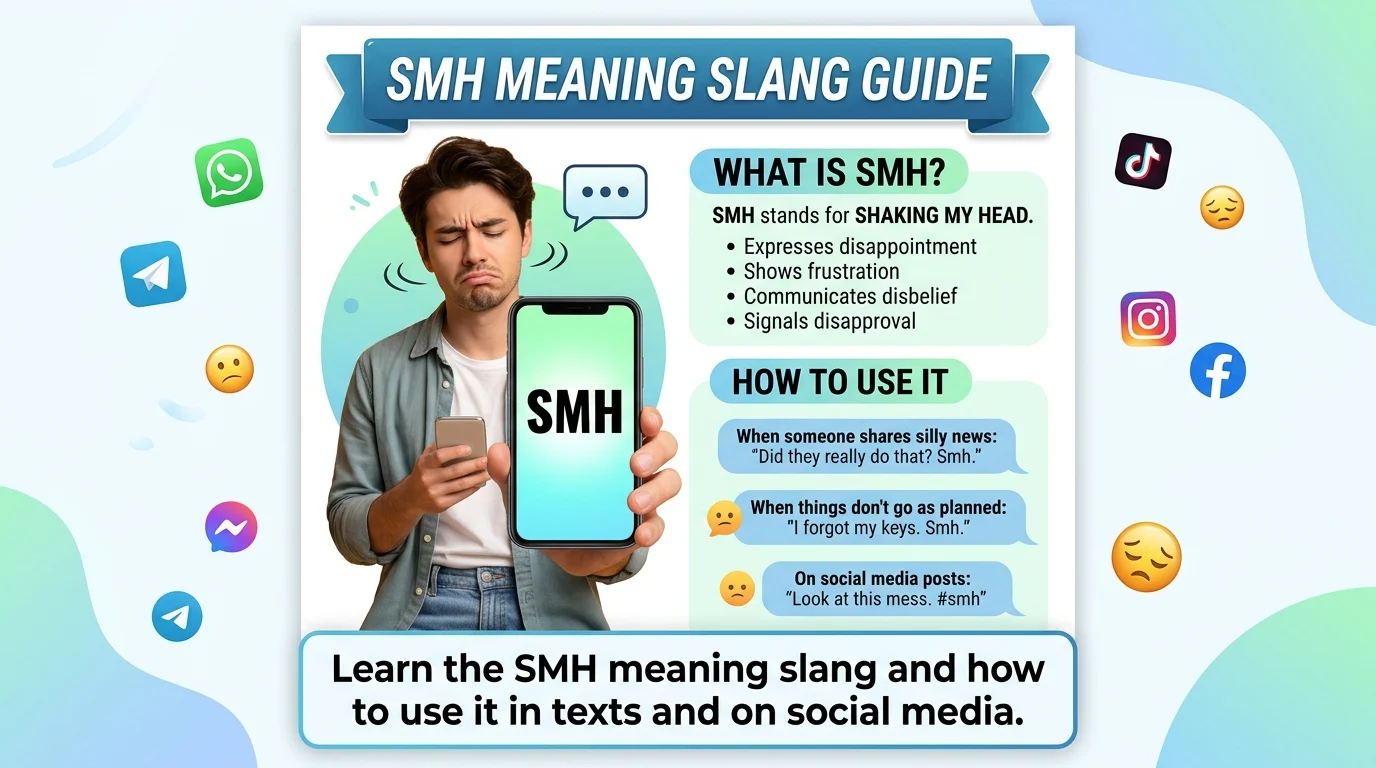

SMH is an internet acronym that stands for “shaking my head.” It is used in digital communication to express disappointment, disbelief, frustration, or exasperation toward something someone said or did. It functions similarly to a facepalm or a disappointed sigh, conveying that the user finds a situation foolish, annoying, or hard to believe. The term is widely used across texting, social media platforms like TikTok, Snapchat, Instagram, and Twitter, and in casual online conversations.
Introduction
If you have spent any time on social media, texting, or scrolling through comment sections, you have probably come across the acronym “SMH.” It appears everywhere from Twitter threads to TikTok comment sections, often in response to something ridiculous, frustrating, or just plain. But what exactly does it mean, and how do you use it correctly?
In this complete guide, we will break down the SMH meaning slang, explore its origins, show you how to use it in real conversations, and explain how it differs across platforms like Snapchat, WhatsApp, and Instagram. Whether you are a parent trying to decode your teen’s texts or someone looking to level up their internet slang game, this article has you covered. By the end, you will know exactly when to drop an SMH and when to keep it to yourself.
Quick Answer
| Element | Details |
|---|---|
| Meaning | Shaking My Head |
| Context | Digital communication, texting, social media |
| Usage | Expressing disappointment, disbelief, frustration, or exasperation |
| Platforms | TikTok, Snapchat, Instagram, Twitter, WhatsApp, iMessage, Discord |
| Example | “He really said that? SMH.” |
| Tone | Informal, casual, often humorous or sarcastic |
What Does SMH Mean?
SMH is an acronym that stands for “shaking my head.” It is used to convey a range of negative reactions, including disappointment, disbelief, frustration, annoyance, or exasperation. When someone types SMH, they are essentially saying, “I am so disappointed or frustrated by what you just said or did that I am literally shaking my head.”
The term is often used in response to something foolish, ignorant, or outrageous. It can also be used humorously among friends to tease someone about a silly mistake. Unlike some internet slang that has evolved to mean something entirely different from its original form, SMH has remained relatively consistent in its meaning since it first gained popularity.
The Origin of SMH
SMH originated in the early days of internet chat rooms and instant messaging. It gained significant traction in the 2000s with the rise of SMS texting and early social media platforms like MySpace and Twitter. The acronym provided a quick and efficient way to express a physical reaction without needing to type out a full sentence.
The gesture of shaking one’s head has long been a universal nonverbal cue for disapproval or disbelief. SMH simply digitized this gesture, allowing people to convey the same emotion in written form. Over time, it became one of the most recognized and widely used internet acronyms, cementing its place in digital communication.
Why People Use SMH
People use SMH for several reasons. First, it is efficient. Typing “shaking my head” takes time, whereas SMH is just three letters. Second, it conveys a specific emotional tone that other words might not capture as succinctly. Third, it has become a cultural shorthand that signals the user is plugged into internet culture.
SMH is often used as a form of gentle or not-so-gentle ridicule. It can be directed at a public figure, a friend, a family member, or even oneself. The flexibility of the term is part of what makes it so enduring.
Context and Usage
Understanding the context in which SMH is used is crucial to using it correctly. The term is almost always informal and should be reserved for casual conversations. You would not use SMH in a professional email or a formal report, but it is perfectly at home in a text message to a friend or a comment on a social media post.
Emotional Spectrum of SMH
SMH can convey a wide range of emotions depending on the context. Here is a breakdown of the emotional spectrum:
| Emotion | Description | Example |
|---|---|---|
| Disappointment | Feeling let down by someone’s actions or words. | “I studied all night and still failed the test. SMH.” |
| Disbelief | Finding something so absurd that it is hard to accept. | “She said the earth is flat. SMH.” |
| Frustration | Feeling annoyed or irritated by a situation. | “My phone died right as I was about to send the text. SMH.” |
| Exasperation | Feeling exhausted or fed up with a repeated behavior. | “He keeps making the same mistake over and over. SMH.” |
| Humorous Teasing | Playfully mocking a friend for a minor blunder. | “You forgot your own birthday? SMH.” |
Formal vs. Informal Usage
SMH is strictly informal. It belongs in the realm of text messages, social media posts, and casual online forums. Using SMH in a formal context, such as a job application or a business report, would be inappropriate and could undermine your professionalism.
However, the line between formal and informal is blurring in some workplaces, especially in tech and creative industries. In these environments, you might occasionally see SMH used in internal Slack channels or team chat apps. Even then, it is best to gauge the culture of your specific workplace before using slang.
Tone and Intention
The tone of SMH can vary from lighthearted to genuinely critical. The difference often comes down to the relationship between the people communicating and the subject matter. Among close friends, SMH is often used playfully. In response to a news story or a public figure’s actions, it can carry a more serious tone of disapproval.
It is also worth noting that SMH can be used self-deprecatingly. For example, if you make a silly mistake, you might text a friend, “I just locked my keys in the car again. SMH.” In this case, you are shaking your head at yourself.
Real-Life Examples of SMH in Conversations
To truly understand how SMH is used, it helps to see it in action. Here are five realistic conversation examples that demonstrate the versatility of this acronym.
1: Disbelief
Person A: “Did you hear that Mark quit his job to become a professional video game streamer?”
Person B: “Wait, really? He has never even played a video game competitively.”
Person A: “I know. He said he watched a few YouTube videos and figured he could make it big.”
Person B: “SMH. That is not how any of this works.”
2: Frustration
Person A: “I cannot believe the Wi-Fi is down again. This is the third time this week.”
Person B: “Did you call the provider?”
Person A: “I have been on hold for 45 minutes.”
Person B: “SMH. That is so annoying.”
3: Playful Teasing
Person A: “I just realized I have been wearing my shirt inside out all day.”
Person B: “No way. How did you not notice?”
Person A: “I have no idea. I am a disaster.”
Person B: “SMH. You are something else.”
4: Self-Deprecation
Person A: “I spent an hour looking for my glasses and they were on my head the whole time.”
Person B: “That is hilarious.”
Person A: “SMH. I cannot believe myself sometimes.”
5: Exasperation
Person A: “My brother ate the last slice of pizza even though he knew I was saving it.”
Person B: “That is so rude.”
Person A: “Right? He does this all the time. SMH.”
Platform-Specific Meaning of SMH
While the core meaning of SMH remains consistent across platforms, the way it is used and the context in which it appears can vary. Here is a breakdown of how SMH is used on different platforms.
1. SMH on TikTok
On TikTok, SMH is frequently used in comment sections and video captions. It often appears in response to viral videos that feature questionable decisions, cringe-worthy moments, or outright stupidity. TikTok users might also use SMH in duet videos or stitches to react to another user’s content.
TikTok’s culture is heavily driven by reaction and commentary, making SMH a natural fit. The acronym is often paired with other slang terms like “no cap” or “fr” to emphasize the sincerity of the reaction.
2. SMH on Snapchat
Snapchat is a more private and ephemeral platform, so SMH on Snapchat is typically used in direct messages or on Snap Stories. Because Snapchat is popular among younger demographics, SMH is widely understood and frequently used.
On Snapchat, SMH might be accompanied by a photo or video of the user actually shaking their head for added emphasis. The visual nature of the platform allows for a more expressive use of the term.
3. SMH on Instagram
Instagram sees SMH used in comments, captions, and direct messages. It is particularly common in the comment sections of posts that feature controversial opinions, bad takes, or embarrassing moments.
On Instagram, SMH is often used as a quick way to signal disapproval without writing a lengthy comment. It can also be used in Stories as a text overlay on a photo or video.
4. SMH on Twitter (X)
Twitter, now known as X, is where SMH truly thrives. The platform’s character limit and fast-paced nature make acronyms essential. SMH is frequently used in tweets, quote tweets, and replies.
Twitter users often deploy SMH in response to news events, political statements, or celebrity behavior. It is a staple of the platform’s culture of hot takes and rapid-fire reactions.
5. SMH on WhatsApp
WhatsApp is a messaging app, so SMH is used in one-on-one chats and group conversations. It functions much like it does in standard texting.
In WhatsApp group chats, SMH is often used to react to something another group member said. It can serve as a bonding mechanism, with group members collectively shaking their heads at a shared frustration.
6. SMH in Texting (SMS and iMessage)
In traditional texting, SMH is used exactly as it is defined: to express disappointment, disbelief, or frustration. It is a quick and efficient way to convey a reaction without typing out a full sentence.
Texting is where SMH first gained widespread popularity, and it remains a staple of the medium. Whether you are using iMessage, Android Messages, or any other texting app, SMH is universally recognized.
Alternative Meanings of SMH
While “shaking my head” is by far the most common meaning, SMH can have other interpretations depending on the context. It is important to be aware of these alternative meanings to avoid confusion.
So Much Hate
In some contexts, SMH can stand for “so much hate.” This usage is less common but can be found in online discussions about controversial topics. For example, someone might comment “SMH” on a post about a celebrity to mean “there is so much hate in these comments.
However, this interpretation is relatively rare, and the vast majority of the time, SMH means “shaking my head.” If you are unsure which meaning is intended, look at the context of the conversation.
Somebody Help Me
Another less common meaning is “somebody help me.” This usage is typically found in more urgent or desperate contexts, such as a plea for assistance. However, it is not as widely recognized as “shaking my head.”
In most cases, if someone types SMH, they mean “shaking my head.” The other meanings are niche and context-dependent.
Other Rare Interpretations
There are a few other rare interpretations of SMH, including “scratching my head” (expressing confusion) and “smack my head” (expressing frustration). However, these are not standard and are unlikely to be encountered in everyday digital communication.
For all intents and purposes, SMH means “shaking my head.” Stick with that definition, and you will be understood 99% of the time.
Related Slang Terms and Variations
SMH is part of a broader ecosystem of internet slang and acronyms. Understanding these related terms can help you navigate digital communication more effectively.
1. SMH vs. Facepalm
Facepalm is another popular internet expression that conveys similar emotions to SMH. Both are used to express frustration, disbelief, or exasperation. However, there is a subtle difference.
Facepalm typically conveys a stronger sense of “I cannot believe how this is.” It is often used in response to something genuinely absurd or idiotic. SMH, on the other hand, can be used for a wider range of emotions, from mild disappointment to strong disapproval.
In practice, the two terms are often used interchangeably, but facepalm tends to be more dramatic.
2. SMH vs. SMFH
SMFH stands for “shaking my f***ing head.” It is an intensified version of SMH that conveys stronger frustration or disbelief. The addition of the expletive adds emphasis and emotional weight.
SMFH is used in the same contexts as SMH but is reserved for situations that warrant a stronger reaction. It is more informal and should be used with caution, as the expletive might be offensive to some.
3. SMH vs. SMDH
SMDH stands for “shaking my damn head.” Like SMFH, it is an intensified version of SMH. It conveys frustration or disbelief but is slightly less intense than SMFH.
SMDH is used in similar contexts to SMH and SMFH. The choice between them often comes down to personal preference and the desired level of emphasis.
Other Related Slang
| Term | Meaning | Usage |
|---|---|---|
| FR | For real | Used to emphasize sincerity or agreement. |
| No Cap | No lie | Used to indicate that something is true. |
| NGL | Not gonna lie | Used to preface an honest opinion. |
| Lowkey | Secretly or moderately | Used to express a subdued feeling. |
| Bruh | Brother or friend | Used as an exclamation of disbelief or frustration. |
| Yikes | Expression of shock or dismay | Used in response to something cringe-worthy. |
How to Respond When Someone Uses SMH
If someone uses SMH in a conversation with you, how should you respond? The appropriate response depends on the context and your relationship with the person.
Acknowledge and Validate
If someone uses SMH in response to something you said or did, the best response is often to acknowledge their reaction. You might say something like, “Yeah, I know. That was a bad move,” or “You are right, that is frustrating.”
Acknowledging the other person’s reaction shows that you respect their feelings and are willing to engage with their perspective. It can also de-escalate tension if the SMH was used in a critical context.
Ask for Clarification
If you are unsure why someone used SMH, it is perfectly acceptable to ask for clarification. You might say, “What are you shaking your head at?” or “Is that a good SMH or a bad one?”
Asking for clarification shows that you are engaged in the conversation and want to understand the other person’s perspective. It can also prevent misunderstandings.
Use Humor
If the SMH was used playfully, you can respond with humor. For example, you might say, “Hey, do not shake your head at me!” or “I know, I am a mess.”
Using humor can keep the conversation light and prevent the interaction from becoming too serious. It is a good strategy for maintaining a positive rapport.
Ignore It
In some cases, the best response is no response at all. If the SMH was directed at a third party or used in a general comment, you might not need to acknowledge it directly.
Ignoring an SMH can be appropriate if you do not have anything meaningful to add or if the conversation has moved on. However, be careful not to ignore an SMH that was directed at you, as this could come across as dismissive.
Misinterpretations and Common Mistakes
Even though SMH is widely used, there are still some common misinterpretations and mistakes. Being aware of these can help you use the term correctly.
Confusing SMH with Other Acronyms
One common mistake is confusing SMH with other similar acronyms. For example, some people mistakenly think SMH means “so much hate” or “somehow.” While these are alternative meanings, they are not the primary definition.
To avoid confusion, always assume that SMH means “shaking my head” unless the context clearly indicates otherwise.
Using SMH in the Wrong Context
Another common mistake is using SMH in a formal or professional context. As mentioned earlier, SMH is informal slang and should not be used in professional emails, reports, or presentations.
Using SMH in the wrong context can make you appear unprofessional or out of touch. When in doubt, err on the side of formality and avoid using slang.
Overusing SMH
Like any slang term, SMH can lose its impact if it is overused. If you use SMH in every other message, it will start to feel meaningless and might even annoy the people you are talking to.
To keep SMH effective, use it sparingly and only when it genuinely applies. Reserve it for situations that truly warrant a reaction of disappointment or disbelief.
Misreading the Tone
SMH can be difficult to read in text because it lacks the nonverbal cues that accompany face-to-face communication. A playful SMH among friends might be interpreted as a serious criticism by someone who does not know you well.
To avoid misreading the tone, pay attention to the broader context of the conversation. Consider your relationship with the person and the subject matter. If you are unsure, do not hesitate to ask for clarification.
When NOT to Use SMH
There are certain situations where using SMH is not appropriate. Knowing when to avoid the term is just as important as knowing when to use it.
In Professional Settings
As a general rule, avoid using SMH in professional settings. This includes emails to clients, presentations, reports, and formal meetings. Using slang in these contexts can undermine your credibility and make you appear unprofessional.
There are some exceptions in casual workplace environments, but it is always better to err on the side of caution. If you are unsure, stick with standard English.
In Serious or Sensitive Conversations
Avoid using SMH in serious or sensitive conversations. If someone is sharing something personal or emotional, responding with SMH can come across as dismissive or uncaring.
In these situations, it is better to respond with empathy and understanding. Save SMH for lighter, more casual interactions.
When You Are Not Sure of the Meaning
If you are not entirely sure what SMH means or how to use it, it is better to avoid it altogether. Using a term incorrectly can lead to misunderstandings and make you look foolish.
Take the time to learn the meaning and proper usage of SMH before incorporating it into your vocabulary. This guide is a great place to start.
In Written Communication with Older Generations
While SMH is widely understood among younger generations, it might not be familiar to older individuals. If you are communicating with someone who is not familiar with internet slang, it is best to avoid using SMH.
Instead, spell out what you mean. For example, you could say, “I am shaking my head in disbelief” or “That is so frustrating.” This ensures that your message is understood by everyone.
Usage Tips for SMH
To wrap up this section, here are some practical tips for using SMH effectively.
Know Your Audience
The most important tip is to know your audience. SMH is perfectly acceptable in conversations with friends, family, and peers who are familiar with internet slang. However, it might not be appropriate in conversations with colleagues, clients, or older individuals.
Before using SMH, consider who you are talking to and whether they will understand and appreciate the term.
Use It Sparingly
As mentioned earlier, overusing SMH can diminish its impact. Use it sparingly to ensure that it retains its meaning and emotional weight.
Reserve SMH for situations that genuinely warrant a reaction of disappointment, disbelief, or frustration. When you do use it, it will carry more weight.
Pair It with Other Slang for Emphasis
If you want to emphasize your reaction, you can pair SMH with other slang terms. For example, you might say, “SMH, no cap” to indicate that you are genuinely shaking your head in disbelief.
Pairing SMH with other terms can add nuance and emphasis to your message. However, be careful not to overdo it, as too much slang can make your message difficult to understand.
Use Emojis for Clarity
Because SMH can be difficult to read in text, consider pairing it with an emoji for added clarity. The facepalm emoji (🤦) or the disappointed face emoji (😞) can help convey the intended tone.
Using emojis can make your message more expressive and reduce the risk of misinterpretation. They are a useful tool for enhancing digital communication.
FAQs
1. What does SMH mean in texting?
SMH stands for “shaking my head.” It is used in texting to express disappointment, disbelief, frustration, or exasperation.
2. Is SMH rude?
SMH is not inherently rude, but it can be perceived as rude depending on the context and tone. It is generally used among friends and peers in casual conversations.
3. What does SMH mean on Snapchat?
On Snapchat, SMH means the same thing as it does in texting: “shaking my head.” It is used to express disappointment or disbelief.
4. What does SMH mean from a girl?
SMH means the same thing regardless of who uses it. If a girl uses SMH, she is expressing disappointment, disbelief, or frustration.
5. What does SMH mean in a bad way?
SMH can be used in a negative way to express strong disapproval or criticism. However, it can also be used playfully among friends.
6. What is the difference between SMH and facepalm?
SMH and facepalm both express frustration or disbelief, but facepalm is often more dramatic and conveys a stronger sense of “I cannot believe how this is.”
7. Can SMH mean “so much hate”?
Yes, in some contexts, SMH can stand for “so much hate.” However, this is a less common interpretation, and “shaking my head” is the primary meaning.
8. Is SMH still used in 2026?
Yes, SMH is still widely used in 2026. It remains one of the most recognized and frequently used internet acronyms.
9. How do you respond to SMH?
You can respond to SMH by acknowledging the other person’s reaction, asking for clarification, using humor, or ignoring it, depending on the context.
10. What does SMH mean in Roblox?
In Roblox and other gaming communities, SMH means “shaking my head.” It is used to express disappointment or disbelief in response to something that happened in the game.
Conclusion
SMH is a versatile and enduring piece of internet slang that has stood the test of time. From its origins in early chat rooms to its current status as a staple of digital communication, SMH has become an essential tool for expressing disappointment, disbelief, and frustration in a quick and efficient way.
Whether you are texting a friend, commenting on a TikTok video, or reacting to a tweet, SMH allows you to convey a complex emotional reaction with just three letters. However, like any slang term, it is important to use it appropriately. Know your audience, use it sparingly, and be mindful of the context.
By following the tips and guidelines in this article, you can master the art of using SMH and navigate the world of internet slang with confidence. So the next time you encounter something truly facepalm-worthy, do not hesitate to drop an SMH. Just remember to use it wisely.