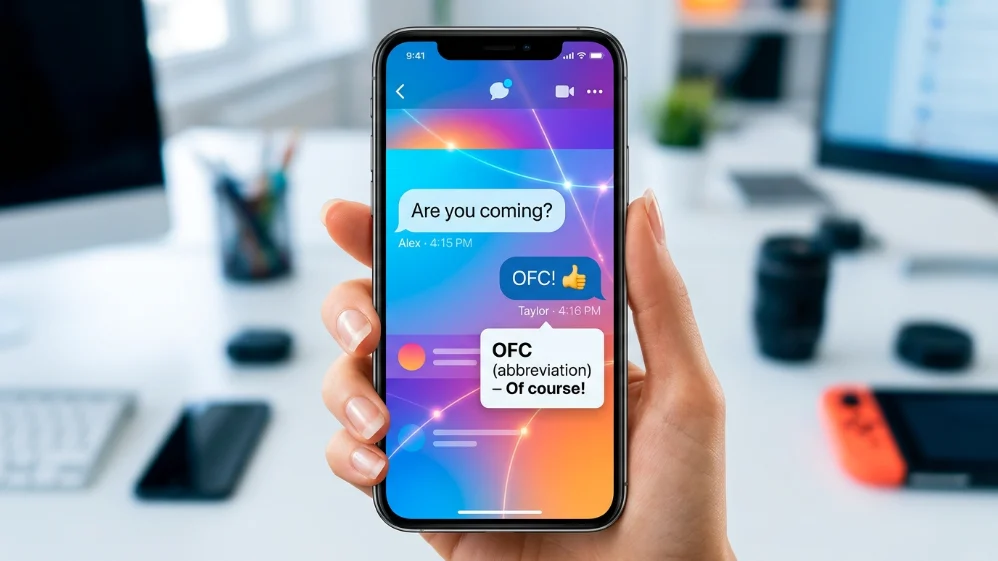

What does OFC mean? OFC stands for “of course.” It is a popular internet abbreviation used in texting and social media to express agreement, confirmation, or affirmation. People use OFC as a quick way to say “yes,” “definitely,” or “obviously” without typing the full phrase.
The acronym can be written in uppercase (OFC) or lowercase (ofc), and both versions mean the same thing. In some contexts, OFC can also mean “of f***ing course” for emphasis or sarcasm.
You’re texting a friend, and suddenly they drop three letters into the chat: “OFC.” You stare at your screen, wondering if it’s a typo, a secret code, or something you’re supposed to understand. Sound familiar?
Internet slang evolves faster than most people can keep up. New abbreviations pop up daily, and it can feel impossible to stay on top of them all. But OFC is different. It’s been around for over two decades, and it’s one of the most commonly used text abbreviations in the English-speaking world.
This guide breaks down everything you need to know about OFC meaning. You’ll learn what it stands for, how to use it across different platforms, when to avoid it, and how to respond when someone sends it to you. Whether you’re a parent trying to decode your teenager’s messages, a professional navigating workplace chat, or just someone who wants to understand internet culture better, this article has you covered.
Quick Answer Box
| Element | Details |
|---|---|
| Meaning | Of course |
| Context | Texting, social media, online chat |
| Usage | Agreement, confirmation, affirmation, sarcasm |
| Platforms | WhatsApp, Snapchat, TikTok, Instagram, Twitter/X, Facebook, Discord |
| Example | “Are you coming tonight?” → “OFC!” |
| Tone | Casual, friendly, sometimes sarcastic |
What Does OFC Mean?
At its core, OFC is an abbreviation for “of course.” It’s a shorthand way to agree with someone, confirm a statement, or affirm that something is obviously true.
Think of OFC as the digital equivalent of nodding your head. When someone asks you a question and you reply with OFC, you’re saying “yes, absolutely” without typing out all the words.
The abbreviation is part of a larger family of internet slang that emerged to make texting faster and more efficient. Just as people use LOL for “laugh out loud” and BRB for “be right back,” OFC serves as a quick way to say “of course.”
Primary Definition
OFC = Of Course
This is the meaning you’ll encounter 95% of the time. It expresses:
- Agreement: “Yes, I agree with you.”
- Confirmation: “Yes, that’s correct.”
- Affirmation: “Yes, definitely.”
- Willingness: “Yes, I’m happy to do that.”
- Enthusiasm: “Yes, and I’m excited about it.”
Secondary Definition (Emphatic)
OFC = Of F*ing Course**
In some contexts, the “F” in OFC stands for a swear word. This version adds emphasis, intensity, or sarcasm to the message.
For example:
- “Are you going to the party?” → “OFC I am!” (enthusiastic)
- “You forgot your keys again?” → “OFC I did.” (sarcastic, self-deprecating)
The swear-word version is common among friends who are comfortable with casual language. In more formal settings, the abbreviation usually just means “of course” without any profanity implied.
Context and Usage
Where OFC Is Used
OFC appears across virtually every digital communication platform:
- Text messages between friends and family
- WhatsApp chats and group conversations
- Snapchat DMs and story replies
- TikTok comments and video captions
- Instagram DMs, comments, and posts
- Twitter/X replies and quote tweets
- Facebook comments and Messenger
- Discord servers and DMs
- Slack and other workplace chat platforms (informal contexts)
When to Use OFC
OFC works best in casual, informal conversations. Use it when:
- Someone asks you a yes/no question and you want to say “definitely”
- You want to confirm plans or agreements quickly
- You’re responding to something obvious
- You want to show enthusiasm or support
- You’re matching the casual tone of the conversation
When NOT to Use OFC
Avoid OFC in these situations:
- Formal writing: Emails to bosses, clients, or professors
- Professional documents: Reports, proposals, or official communications
- First-time interactions: With someone you don’t know well
- Serious conversations: When discussing sensitive or emotional topics
- When clarity is critical: If there’s any chance of misunderstanding
Tone and Placement
The meaning of OFC can shift depending on where it appears in a sentence:
At the start of a sentence: Usually positive and definite.
“Ofc I’ll be there. Wouldn’t miss it.”
At the end of a sentence: Can sound slightly more sarcastic or condescending.
“I’ll be there, ofc.” (implies “obviously, why wouldn’t I be?”)
As a standalone reply: Friendly and affirming.
“Can you help me with this?” → “Ofc!”
Real-Life Examples
1: Making Plans
- Person A: “Hey, are you free this Saturday?”
- Person B: “Ofc! What did you have in mind?”
- Person A: “Thinking about going to that new sushi place.”
- Person B: “OFC I’m down. I’ve been wanting to try it.”
2: Asking for Help
- Person A: “Could you give me a ride to the airport tomorrow?”
- Person B: “Ofc! What time do you need to be there?”
- Person A: “Flight’s at 10 AM, so probably 8.”
- Person B: “Got it. Ofc I’ll pick you up.”
3: Sarcastic Reply
- Person A: “I can’t believe I left my phone at home again.”
- Person B: “Ofc you did. You always forget it.”
- Person A: “Thanks for the support.”
- Person B: “Ofc. That’s what friends are for.”
4: Enthusiastic Agreement
- Person A: “Did you see the new season dropped?”
- Person B: “OFC I did. I stayed up all night watching it.”
- Person A: “No spoilers! I haven’t started yet.”
- Person B: “Ofc, wouldn’t do that to you.”
5: Quick Confirmation
- Person A: “You’re still coming to the game tonight, right?”
- Person B: “Ofc!”
- Person A: “Cool, I’ll save you a seat.”
- Person B: “Thanks. Ofc I’ll be there.”
Platform-Specific Meaning
OFC on WhatsApp
On WhatsApp, OFC carries a cool, confident tone. It’s often paired with emojis to amplify the meaning.
Example: “Are you joining the group call?” → “OFC! Send me the link.”
OFC on Snapchat
Snapchat users frequently use OFC in DMs and story replies. It’s a quick way to say “no problem,” “you’re welcome,” or “definitely.”
Example: “Can I vent to you for a sec?” → “Ofc you can!”
OFC on TikTok
TikTok comments often feature OFC to quickly affirm opinions or participate in trends. The tone can be humorous, sarcastic, or supportive depending on the context.
Example: “This is the best video I’ve seen all day.” → “OFC it is. This creator never misses.”
OFC on Instagram
Instagram users deploy OFC in comments, DMs, and captions. It often adds casual excitement to responses.
Example: “OFC! Can’t wait for the meetup.”
OFC on Discord and Messenger
In gaming and community platforms like Discord, OFC serves as quick affirmation during fast-paced conversations.
Example: “Anyone want to queue up?” → “Ofc. Give me two minutes.”
Alternative Meanings
While “of course” is the most common meaning, OFC can stand for other things in different contexts.
Original Female Character (Fanfiction)
In fanfiction and creative writing communities, OFC stands for “original female character.” This refers to a female character created by a fanfiction author that doesn’t exist in the source material.
Example: “I’m writing a Harry Potter fanfic with an OFC who’s Hermione’s cousin.”
Oceania Football Confederation
In sports, OFC refers to the Oceania Football Confederation, one of six continental confederations of international association football. It includes New Zealand, Papua New Guinea, and several Pacific Island nations.
Officer (Military and Law Enforcement)
In military and law enforcement contexts, OFC can be an abbreviation for “officer.”
Other Technical Meanings
OFC appears in various technical fields:
- Oxygen Free Copper (electronics and audio)
- Optical Fiber Communications (telecommunications)
- Order Fulfillment Center (logistics)
- Operations and Facilities Council (business)
Urban Dictionary Meanings (Rare and Joking)
Urban Dictionary lists some humorous and unofficial meanings for OFC, including:
- “Orgy Fuck Club”
- “Olympic Fuck Champion”
These are not serious definitions and are rarely used in actual conversation.
Related Terms and NLP Variations
OFC belongs to a family of internet abbreviations and slang terms. Understanding these related terms helps build a complete picture of digital communication.
Similar Abbreviations
| Term | Meaning | Usage |
|---|---|---|
| OFC | Of course | Agreement, confirmation |
| OBVS | Obviously | Stating something obvious |
| SRSLY | Seriously | Expressing disbelief or emphasis |
| W/E | Whatever | Indifference or dismissal |
| IDK | I don’t know | Uncertainty |
| IMO | In my opinion | Sharing a perspective |
| IIRC | If I recall correctly | Expressing uncertainty about memory |
| LOL | Laugh out loud | Amusement |
| BRB | Be right back | Temporary absence |
| OMG | Oh my god | Surprise or emphasis |
Synonyms for OFC
If you want to vary your language, here are alternatives to OFC:
- Definitely – “Definitely coming tonight.”
- Absolutely – “Absolutely, count me in.”
- For sure – “For sure, I’ll be there.”
- Obviously – “Obviously, that’s the plan.”
- Naturally – “Naturally, I agreed.”
- Sure thing – “Sure thing, happy to help.”
- You bet – “You bet, I’m in.”
Antonyms
- No way – Strong disagreement
- Absolutely not – Emphatic refusal
- Not at all – Polite disagreement
- Hard pass – Firm rejection
How to Respond to OFC
When someone sends you OFC, your response depends on the context and your relationship with the sender.
Responding to a Friendly OFC
If someone sends OFC as a friendly confirmation, match their tone:
Them: “Can you cover my shift tomorrow?” → You: “Ofc!”
Your response: “Thanks! You’re a lifesaver.”
Or:
Them: “Are you coming to the party?” → You: “OFC!”
Your response: “Awesome! See you there.”
Responding to a Sarcastic OFC
If OFC seems sarcastic, you can acknowledge the tone:
Them: “You forgot to lock the door again.” → You: “Ofc I did.”
Your response: “Okay, fair. I’ll remember next time.”
Responding in a Group Chat
In group settings, keep it brief:
Them: “Who’s down for pizza?” → You: “Ofc!”
Your response: “Great, I’ll order.”
When You Don’t Understand OFC
If you’re unsure what OFC means in a specific context, just ask:
You: “Wait, does OFC mean ‘of course’ or something else?”
Most people will appreciate the clarification and explain their intent.
Misinterpretations and Common Mistakes
Mistake 1: Assuming OFC Always Includes a Swear Word
Many people assume the “F” in OFC always stands for a swear word. This isn’t true. In most everyday usage, OFC simply means “of course” without any profanity.
Mistake 2: Using OFC in Formal Settings
OFC is casual slang. Using it in professional emails, official documents, or formal conversations can come across as unprofessional or disrespectful.
Mistake 3: Confusing OFC with Other Abbreviations
OFC is sometimes confused with:
- OFC (Original Female Character) – Fanfiction context
- OFC (Oceania Football Confederation) – Sports context
- OFC (Officer) – Military/law enforcement context
Always consider the context to determine the correct meaning.
Mistake 4: Overusing OFC
Like any slang term, overusing OFC can make your communication feel repetitive or lazy. Mix it up with other responses like “definitely,” “absolutely,” or “for sure.”
Mistake 5: Misreading Tone
Without context, OFC can be hard to interpret. A simple “ofc” could mean:
- Enthusiastic agreement
- Casual confirmation
- Sarcastic dismissal
- Polite acknowledgment
Pay attention to punctuation, emojis, and the overall conversation to gauge tone.
When NOT to Use OFC
Professional Communication
Avoid OFC in:
- Emails to clients, executives, or external partners
- Job applications and cover letters
- Performance reviews or feedback
- Official company announcements
- Legal or financial documents
Sensitive Conversations
Don’t use OFC when discussing:
- Serious personal issues
- Grief, loss, or trauma
- Conflicts or disagreements
- Apologies or reconciliations
First Impressions
When meeting someone new or communicating with someone you don’t know well, stick to full phrases. “Of course” sounds more polite and respectful than “OFC.”
Academic and Formal Writing
Never use OFC in:
- Academic papers or essays
- Research publications
- Formal reports or proposals
- News articles or journalism
Usage Tips
Tip 1: Match the Other Person’s Tone
If someone uses OFC with you, it’s generally safe to use it back. If they’re using full sentences and formal language, stick to full phrases.
Tip 2: Use Emojis for Clarity
Pair OFC with emojis to clarify your tone:
- “OFC! ” = Enthusiastic agreement
- “Ofc ” = Friendly confirmation
- “OFC ” = Playful or joking
- “Ofc…” = Sarcastic or reluctant
Tip 3: Vary Your Language
Don’t rely on OFC for every response. Mix in alternatives:
- “Definitely!”
- “Absolutely!”
- “For sure!”
- “You bet!”
- “100%”
Tip 4: Consider Capitalization
All versions mean the same thing:
- OFC – Uppercase, common in social media
- ofc – Lowercase, more common in texting
- Ofc – Mixed case, personal preference
Choose whichever feels natural to you.
Tip 5: Know Your Audience
Think about who you’re talking to before using OFC:
- Friends – Safe to use
- Family – Usually safe, but know your family’s comfort with slang
- Coworkers – Only in informal channels like Slack or Teams
- Boss or client – Avoid unless they use it first
- Strangers – Stick to full phrases
Frequently Asked Questions
1. What does OFC mean in text?
OFC in text stands for “of course.” It’s used to express agreement, confirmation, or affirmation in casual digital conversations.
2. Does OFC mean “of f***ing course”?
Sometimes. In emphatic or sarcastic contexts, OFC can mean “of f***ing course.” However, in everyday usage, it usually just means “of course” without any profanity.
3. What does OFC mean on Snapchat?
On Snapchat, OFC means “of course.” It’s used in DMs and story replies to quickly agree, confirm, or say “no problem.”
4. What does OFC mean on TikTok?
On TikTok, OFC means “of course.” It appears in comments, captions, and video replies to affirm opinions, participate in trends, or show agreement.
5. What does OFC mean in fanfiction?
In fanfiction and creative writing, OFC stands for “original female character” – a female character created by the author that doesn’t exist in the original source material.
6. Is OFC considered rude?
No, OFC is not inherently rude. However, like any slang, it can come across as rude if used in the wrong context or with a sarcastic tone. Always consider your audience.
7. Can I use OFC in professional emails?
Generally, no. OFC is casual slang and should be avoided in professional emails, formal documents, and official communications. Use “of course” instead.
8. What’s the difference between OFC and ofc?
There’s no difference in meaning. OFC (uppercase) and ofc (lowercase) both stand for “of course.” The choice comes down to personal preference or platform norms.
9. How do I respond to OFC?
Respond based on the context. If someone sends OFC as a friendly confirmation, thank them or acknowledge their response. If it seems sarcastic, address the tone appropriately.
10. Is OFC still popular in 2026?
Yes, OFC remains widely used across all major social media platforms and messaging apps. It has been a staple of internet communication since the early 2000s and continues to be relevant.
11. What does OFC stand for in gaming?
In gaming contexts, OFC usually means “of course.” On rare occasions, it might refer to gaming clans or groups like “Old Fart Clan” or “Omega Force Clan.”
12. Can OFC be used in voice conversations?
No, OFC is a text abbreviation. In voice conversations, people say “of course” instead. The abbreviation only works in written communication.
Conclusion
OFC is one of the most enduring and widely used abbreviations in internet culture. Since its first appearance on Urban Dictionary in 2004, it has become a staple of digital communication across text messages, social media platforms, and online chats.
Understanding OFC meaning is essential for navigating modern digital conversations. Whether you’re responding to a friend’s question, confirming plans in a group chat, or participating in a TikTok trend, OFC offers a quick, casual way to say “of course.
Remember these key points:
- OFC stands for “of course”
- It expresses agreement, confirmation, and affirmation
- Use it in casual, informal settings
- Avoid it in professional and formal communication
- Context determines whether it includes a swear word
- All capitalization variations mean the same thing
The next time someone drops OFC into a message, you’ll know exactly what they mean. And when you use it yourself, you’ll communicate with confidence, clarity, and a touch of internet savvy.
So, are you ready to start using OFC in your conversations? Ofc you are.