
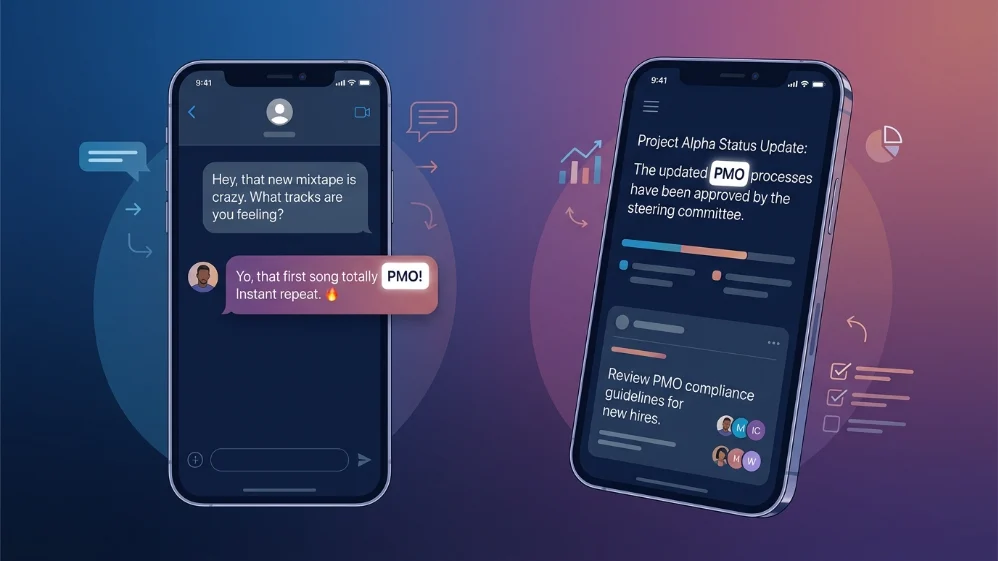

PMO stands for “Put Me On” in texting and social media. People use it when they want someone to recommend, introduce, or share something new with them. For example, if a friend says, “PMO to that new artist you’ve been listening to,” they’re asking you to introduce them to that artist.
However, in the business world, PMO stands for “Project Management Office.” The correct PMO meaning depends entirely on the context of the conversation.
Have you ever received a message saying “you PMO” or “this PMO” and wondered what it really means? You’re not alone. Every day, people search for PMO meaning, what is PMO, define PMO, PMO define, what does PMO mean, what does PMO mean in text, what does PMO stand for, and PMO means after spotting the abbreviation on TikTok, Snapchat, Instagram, X, or in text messages.
The confusing part is that PMO has multiple meanings, and each one depends on the situation. In this guide, we’ll explain what PMO means, define every common usage, break down what does PMO stand for in both social media and professional settings, and show real-life examples so you can easily understand phrases like “you PMO” and “this PMO.”
Our content is carefully researched, fact-checked, and written in simple language to provide clear, accurate, and up-to-date information. By the end of this guide, you’ll know exactly which PMO meaning fits the conversation and how to use the abbreviation with confidence.
Quick Answer Box
| Element | Details |
|---|---|
| Meaning | Put Me On (most common) or Project Management Office |
| Context | Social media, texting, or professional settings |
| Usage | Asking for an intro, recommendation, or opportunity |
| Platforms | Instagram, Snapchat, WhatsApp, TikTok, professional emails |
| Example | “PMO to your friend who does photography” |
| Tone | Casual, friendly, sometimes enthusiastic |
What Does PMO Mean?
PMO stands for two very different things depending on where you are and who you’re talking to.
In Texting & Social Media
PMO = Put Me On
This is the dominant meaning in everyday conversation. When someone says “PMO,” they want you to introduce them to something — a person, a song, a brand, a show, a restaurant, or even a new opportunity.
Think of it as a digital way of saying “hook me up” or “connect me.
Examples:
- “PMO to that new coffee shop downtown”
- “PMO to your cousin who does graphic design”
- “PMO to that playlist you’ve been gatekeeping”
In Business & Project Management
PMO = Project Management Office
This is a department within an organization that sets project management standards. They maintain best practices, track project progress, and help teams deliver work on time and within budget.
The PMO is the backbone of project delivery in many companies. They create templates, define processes, and ensure consistency across all projects.
As a Typo
Sometimes, people type “PMO” when they mean “PM” (private message). If someone says “PMO” in a context where “Put Me On” doesn’t fit, they might simply be asking you to message them privately.
Example:
- “Can you PMO the details?” → They meant “PM me”
Full Definition & Core Meaning
Primary Meaning: Put Me On
In its most common usage, PMO is a slang term used to request a connection or introduction. The phrase “put me on” comes from the idea of being placed onto something — like being put onto a guest list, a new trend, or a valuable contact.
The term has roots in hip-hop and Black culture. Putting someone on” means giving them access to something they didn’t have before. It could be music, fashion, business connections, or simply information.
In internet culture, PMO has become the shorthand version of this request. It’s quick, casual, and gets straight to the point.
Key characteristics:
- It’s always a request
- It implies you trust the person you’re asking
- It suggests the thing you’re asking about has value
- It’s informal and conversational
Secondary Meaning: Project Management Office
This meaning is entirely professional. The Project Management Office is a department that oversees project management across an organization.
Key functions of a PMO:
- Standardizing project management processes
- Providing training and guidance
- Tracking project metrics
- Ensuring projects align with business strategy
- Managing resources across multiple projects
In this context, PMO is never used in casual conversation. If you’re in a meeting and someone says “the PMO,” they mean the department, not a request for an introduction.
Context & Usage
When to Use PMO (Slang)
You can use PMO whenever you want someone to introduce you to something or someone. It works best in casual settings where you have an established rapport with the person you’re talking to.
Good situations for PMO:
- A friend mentions a new artist → “PMO to their music”
- Someone knows a person you want to meet → “PMO to them”
- You see someone wearing something cool → “PMO to where you got that”
Who it’s for:
- Friends
- Close acquaintances
- Social media followers
- People in your community
When NOT to Use PMO
PMO is not appropriate in formal or professional settings. If you use it with your boss, a client, or someone you’ve just met, they probably won’t understand what you mean. And even if they do, it might come across as too casual or even unprofessional.
Avoid PMO when:
- Emailing a supervisor
- Writing a cover letter
- Communicating with a client
- Speaking to someone much older or in a position of authority
- In a formal business meeting
Tone & Emotion
The tone of PMO depends on how you use it. Without additional context, it’s neutral — just a request. But with emojis, extra words, or specific punctuation, it can convey different emotions.
Casual/Neutral:
- “PMO to that barber”
Enthusiastic:
- “PMO to that artist rn they’re so good 🔥”
Sarcastic/Funny:
- “PMO to whatever you’re on because I need some of that energy”
Serious/Intense:
- “For real, PMO to that opportunity”
Real-Life Examples
Conversation Example 1: Music Recommendation
Person A: “I’ve been listening to this new artist all week”
Person B: “Oh word? PMO then”
Person A: “Here’s the link to their latest album. You’re gonna love track 3”
Conversation Example 2: Professional Connection
Person A: “My cousin owns a marketing agency”
Person B: “Wait for real? PMO to them I’ve been looking for a new role”
Person A: “Send me your portfolio and I’ll forward it”
Conversation Example 3: Restaurant Recommendation
Person A: “Just had the best tacos of my life”
Person B: “Where at? PMO”
Person A: “That spot on 5th Street. Go on Tuesdays, they have a deal”
Conversation Example 4: Gaming
Person A: “I’m in a crew that does tournaments every weekend”
Person B: “Bro PMO I’ve been trying to get into competitive gaming”
Person A: “Drop your gamer tag and I’ll add you to the group”
Conversation Example 5: Fashion
Person A: “Got these sneakers for half off”
Person B: “PMO to that plug lowkey”
Person A: “It’s this app called [name]. Use my code for extra discount”
Platform-Specific Meaning
PMO Meaning on WhatsApp
On WhatsApp, PMO almost always means “Put Me On.” It’s used in group chats and one-on-one conversations among friends and family. Since WhatsApp is primarily a personal messaging app, the business meaning rarely appears here.
Common uses on WhatsApp:
- Sharing music and entertainment
- Asking for introductions
- Getting restaurant and travel recommendations
- Discovering new products and services
PMO Meaning on Snapchat
Snapchat’s fast-paced, visual nature makes PMO a natural fit. It’s often used in response to stories or snaps. Someone posts a picture of a cool place, and the response is “PMO” to ask where it is or how to get there.
Snapchat context:
- Reply to a story → “PMO to that view”
- Replying to a snap → “PMO to your friend in that photo
- Quick, brief exchanges
PMO Meaning on TikTok
TikTok is where PMO thrives. The platform is built on discovery — you’re constantly finding new creators, trends, and content. PMO is a natural request to be introduced to something you’ve discovered through someone else’s video.
TikTok usage:
- “PMO to this creator’s other content”
- “PMO to how they did this effect”
- “PMO to the original sound they used”
PMO Meaning on Instagram
Instagram’s visual focus means PMO is often used in DMs rather than comments. If you see someone post about an event, a product, or a person, you might DM them “PMO” to get more information or an introduction.
Instagram context:
- DMing about a post
- Asking about tagged products
- Getting introduced to someone featured in a post
PMO Meaning in Business
In professional settings, PMO exclusively means Project Management Office. When your boss says “check with the PMO,” they’re telling you to talk to the department that manages projects and processes.
Business context includes:
- Corporate meetings
- Professional emails
- Project documentation
- Internal company communication
Alternative Meanings of PMO
While “Put Me On” and “Project Management Office” are the most common, PMO can mean other things in specific contexts. It’s worth knowing these in case you encounter them.
Please Move On
In some online communities, PMO is used as “Please Move On” to politely end a conversation or ask someone to stop discussing a particular topic.
Example:
- “We’ve been going back and forth for an hour. PMO.”
Performance Management Office
A variation of the business meaning, though less common than Project Management Office.
Personally My Opinion
Less common, but occasionally seen. In this usage, “PMO” is similar to “IMO” (In My Opinion) with an extra “P” for “Personal.”
Example:
- “PMO, this is the best release this year”
Post-Medium Operations
Used in certain technical fields, usually related to communications or technology.
Related Terms & NLP Variations
Variations of PMO
Put Me On variations:
- “Put me onto” — The full phrase that PMO shortens
- “Pmo” — Lowercase is common in casual texts
- “P.M.O.” — With periods, usually when someone is being extra clear
Synonyms for “Put Me On”
- “Hook me up” — Probably the closest in meaning
- “Connect me” — More formal but similar
- “Introduce me” — More direct
- “Put me onto” — The original full phrase
- “Show me” — When talking about something visual
- “Recommend” — More formal alternative
- “Fill me in” — More about information than introduction
Related Slang Terms
Gatekeeping — When someone deliberately doesn’t share or recommend something. It’s the opposite of PMO.
- “Why you gatekeeping? PMO”
Lowkey — Used with PMO to request something casually or discreetly.
- “Lowkey PMO to that spot”
Fr (For Real) — Adds emphasis to the request.
- “PMO fr I’ve been looking everywhere”
No cap — Emphasizes that the request is genuine.
- “PMO no cap that’s the best show I’ve seen”
Bet — A response that shows agreement, often used after someone says PMO.
- “PMO to that new album” → “Bet”
How to Respond to PMO
When someone sends you “PMO,” they’re asking you for something — an introduction, a recommendation, or access to something you have. How you respond depends on what they’re asking for.
Responding with a Recommendation
If you’re being asked to recommend something, the response is straightforward.
Examples:
- “Here’s the link to that playlist I was talking about”
- “It’s called [name], you can find it on [platform]”
- “The place is at [address], tell them I sent you”
Responding with an Introduction
When someone asks to be introduced to a person, you need to handle it with a bit of care.
Examples:
- “Let me ask them first and get back to you”
- “Send me your info and I’ll pass it along”
- “They’re actually looking for help right now, let me connect you”
Responding When You’re Not Comfortable
Sometimes, the request isn’t appropriate or you don’t know the person well enough.
Examples:
- “I don’t really know them like that, sorry”
- “That’s not really my space to share”
- “I can’t right now, but I’ll let you know if something changes”
Responding When You Don’t Have the Answer
If you don’t actually have what they’re asking for, be honest.
Examples:
- “I wish I knew, I got it from [somewhere else]”
- “I can’t remember, let me check and get back to you”
- “Actually that wasn’t mine, I’m not sure”
Misinterpretations & Common Confusions
“PMO” vs “PM” vs “DM”
People sometimes confuse these because they look similar and all relate to communication.
PM (Private Message):
- A direct message, often used on platforms like Facebook and Twitter
- PM me the details” means send them privately
DM (Direct Message):
- A private message, most commonly associated with Instagram and Twitter
- “DM me for more info”
PMO (Put Me On):
- A request for an introduction or recommendation
- Not a messaging action, but a content request
“PMO” vs “HMO” vs “IMO”
HMO: Health Maintenance Organization (in business context)
IMO: In My Opinion (in texting context)
These are not interchangeable with PMO.
What PMO Isn’t
- It’s not a greeting
- It’s not a response to “how are you”
- It’s not an expression of emotion
- It’s not an invitation by itself
When NOT to Use PMO
Formal Settings
Don’t use PMO at work or in any professional context unless you’re very certain the other person will understand and appreciate it.
Instead use:
- “Could you recommend…”
- “Would you mind introducing me to…”
- “Can you connect me with…”
With Strangers
If you don’t know someone well, asking them to “PMO” can come across as presumptuous or entitled. Build some rapport first.
When Something is Clearly Private
If someone mentions something and you get the sense it’s not meant for sharing, don’t ask them to “PMO.” Respect boundaries.
Usage Tips
Natural Usage
- Keep it casual and conversational
- Use it when you genuinely want something, not just to be trendy
- Don’t overuse it — a little goes a long way
- Match the energy of the conversation
Social Media Strategy
- Use PMO to discover new content
- Respond quickly when someone asks you to PMO
- Share good finds generously — it builds community
FAQs
What does PMO stand for in text?
In texting, PMO usually stands for “Put Me On.” It’s a request for an introduction or recommendation to something or someone new.
What does PMO mean on Instagram?
On Instagram, PMO means “Put Me On.” It’s used in DMs to ask for introductions, recommendations, or access to opportunities.
What does PMO mean in business?
In business, PMO stands for “Project Management Office” — the department responsible for managing and standardizing project processes across an organization.
What does PMO mean on Snapchat?
On Snapchat, PMO is “Put Me On.” It’s used casually to ask for recommendations or introductions, often in response to stories or snaps.
What does PMO mean on WhatsApp?
On WhatsApp, PMO means “Put Me On.” It’s used in personal messaging to request connections, recommendations, or introductions.
What does PMO mean in gaming?
In gaming, PMO typically means “Put Me On” — asking to be invited to a group, introduced to a team, or given access to something.
What is the full form of PMO?
In slang, PMO stands for “Put Me On.” In professional settings, it stands for “Project Management Office.”
Is PMO formal or informal?
PMO is informal when it means “Put Me On.” It is formal only in the business context where it means “Project Management Office.
Can I use PMO at work?
Avoid using “Put Me On” at work unless it’s casual conversation with close colleagues. In professional communication, PMO refers only to the Project Management Office.
What’s the difference between PMO and PM?
PM is “Private Message” or “Project Manager.” PMO is “Put Me On” (slang) or “Project Management Office” (business). They’re not the same.
Conclusion
PMO is a versatile term with two main meanings. Most of the time in texts and social media, it’s a friendly request someone wants you to share something new with them. It’s a way of connecting people and sharing discoveries, the lifeblood of internet culture.
The business meaning is completely different. In the professional world, the PMO is the engine of successful project management, making sure everything runs smoothly and consistently.
The key to using PMO is knowing your audience. Use it with friends when you want recommendations. Use it at work only when you mean Project Management Office. Understand the context, choose your words carefully, and you’ll never get it wrong.




Pingback: Mortgage Calculator | Calculate Monthly Payments, Interest, Loan Costs, and Affordability
Pingback: CFS Meaning | Don't Reply Until You Know These Popular Texting Meanings 2026
Pingback: Namaste Meaning | True Spiritual Meaning, Proper Response & Hidden Cultural Wisdom Explained (2026)