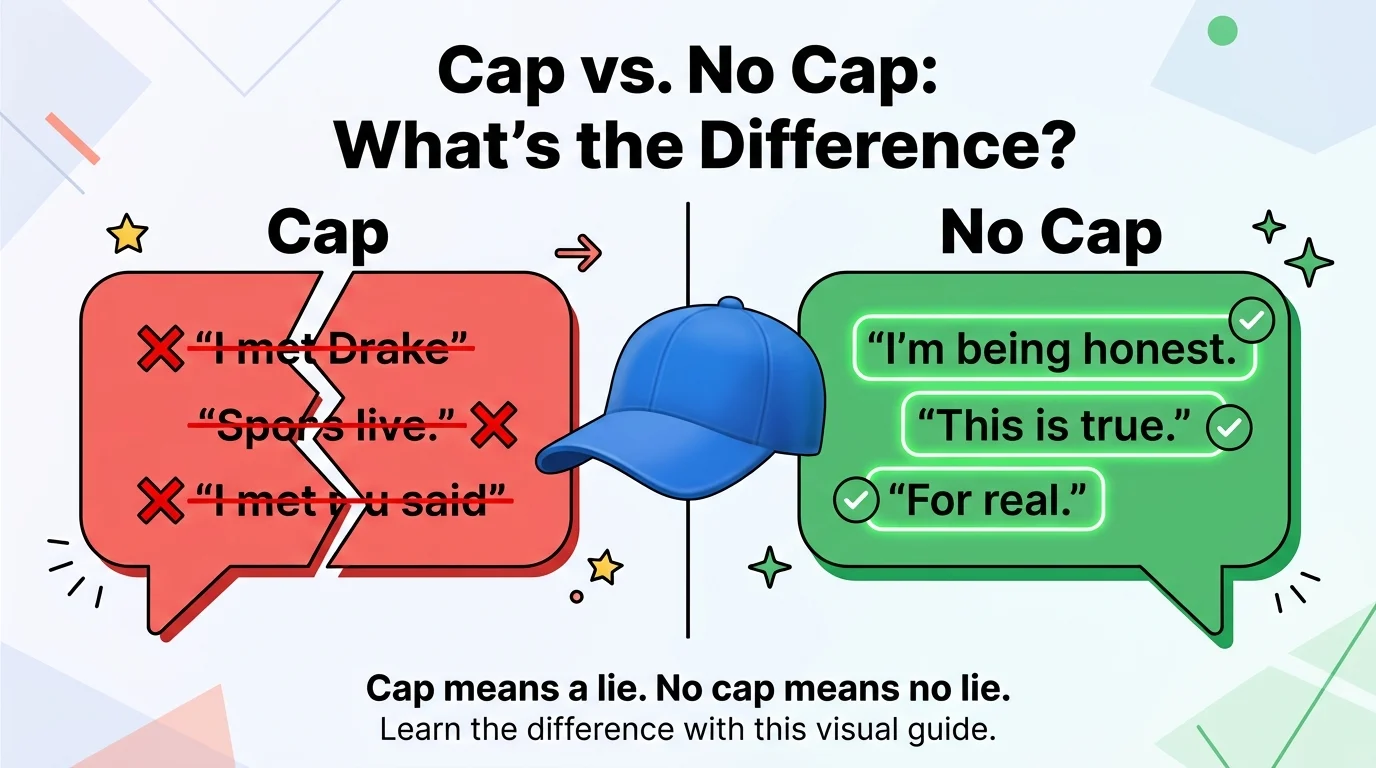

Cap is a slang term that means a lie, falsehood, or exaggeration. When someone says “that’s cap,” they are calling out a statement as untrue. No cap means “no lie” or “for real,” used to emphasize honesty and sincerity. The term originated in African American Vernacular English (AAVE) and hip-hop culture, with roots dating back to the early 1900s.
If you have spent any time on TikTok, Instagram, or around Gen Z, you have probably heard the word “cap” being used in ways that have nothing to do with hats. Maybe you saw someone comment “that’s cap” on a video, or heard a friend say “no cap, I’m serious” after making a bold claim. Understanding cap slang meaning is essential for anyone trying to keep up with modern internet culture.
This guide breaks down everything you need to know about cap slang meaning, including its definition, origins, how to use it, variations, platform-specific usage, and much more. By the end, you will be able to spot cap, call it out, and use no cap like a native internet user.
Quick Answer
| Element | Details |
|---|---|
| Meaning | A lie, falsehood, or exaggeration |
| Context | Informal, digital communication, social media, hip-hop |
| Usage | Noun (a lie), verb (to lie), or adjective (fake) |
| Platforms | TikTok, Instagram, Snapchat, Twitter/X, WhatsApp, text messaging |
| Example | “He said he met Drake. That’s cap.” |
| Tone | Casual, confrontational, playful, emphatic |
What Does Cap Mean in Slang?
At its core, cap slang meaning is simple: cap means a lie. When someone says “that’s cap,” they are saying “that’s a lie” or “that’s not true.” The term is used to call out falsehoods, exaggerations, or things that seem too good to be true.
The slang has evolved into a versatile term that can be used in several ways:
- Cap (noun): A lie or false statement. “Everything he said was cap.”
- Capping (verb): The act of lying. “Stop capping, bro.”
- That’s cap: A phrase used to call out a lie. “You got a 4.0 GPA? That’s cap.”
- No cap: Means “no lie” or “for real.” Used to emphasize truthfulness. “No cap, that was the best meal I’ve ever had.”
The term has become one of the most widely used slang expressions of the last few years, with widespread use across social networks, memes, and direct messages.
The Origins of Cap Slang
Understanding where cap slang meaning comes from adds depth to how you use it. The term has a rich history that stretches back much further than social media.
African American Vernacular English Roots
Cap originated in African American Vernacular English (AAVE) and has been used in hip-hop and street culture for decades. In Black slang, to “cap” about something meant to brag, exaggerate, or lie about it. This meaning dates back to at least the early 1900s.
The Dozens and Verbal Jousting
The term has even deeper roots. In the 1940s, Black Americans used the verb “to cap” when trading exaggerated insults in a ritualized exchange known as “the dozens” or “the dirty dozens”. This was a form of verbal competition where participants would try to outdo each other with increasingly creative insults.
Going back even further, “capping” was a way of competing by telling a better joke or story than someone else. By the 1800s, this was a known practice, and it can be traced all the way back to the 1500s when people would “cap” anecdotes, proverbs, or verses as part of verbal jousting games.
Hip-Hop Popularization
While the term has a long history, it was hip-hop that brought cap slang meaning into the mainstream. The first recorded instance of “capping” in song lyrics appears in a 1985 EP from California rapper Too Short. Mentions of “no cap” in hip-hop songs grew dramatically in 2017 and 2018, coinciding with its rise in mainstream popularity.
Artists like Future and Young Thug helped popularize the phrase in the 2010s with lyrics like “No for real, no cap, my money long like anacondas”. The term then spread from hip-hop to social media, online gaming, and everyday vocabulary.
Context and Usage
Cap slang meaning is context-dependent, and using it correctly requires understanding the situation and your audience.
When to Use Cap
You use “cap” when you want to call out something as false or exaggerated. It is appropriate in casual, informal settings among friends, on social media, or in text messages.
Examples:
- “You really think you can beat me in basketball? That’s cap.”
- “She said she has a million followers. Cap.”
- “Don’t listen to him, he’s capping.”
When to Use No Cap
You use “no cap” when you want to emphasize that you are telling the truth or being completely serious. It is a way of saying “for real” or “no joke”.
Examples:
- “No cap, I actually met LeBron James yesterday.”
- “This is the best pizza I have ever had, no cap.”
- “No cap, I studied for six hours straight.”
Where It Fits in Conversation
Cap and no cap often appear at the beginning or end of statements:
- Beginning: “No cap, I’m quitting my job today.”
- End: “That was the best movie ever, no cap.”
- Response: “You got a new car?” “No cap!”
The term functions as a kind of adverb, qualifying the truthfulness of the statement.
Real-Life Examples
To fully grasp cap slang meaning, it helps to see it in action. Here are five realistic conversation examples showing how cap and no cap are used in everyday communication.
1: Calling Out a Lie
Person A: “I can bench press 300 pounds, easy.”
Person B: “That’s cap. I saw you struggling with 135 last week.”
Person A: “Okay, okay, you got me.”
2: Emphasizing Truth
A: “I swear I saw a UFO last night.”
B: “Yeah, right.”
A: “No cap, I’m being serious. It was hovering over the field.”
3: Social Media Comment
User posts: “Just got back from Paris. Best trip ever!”
Comment 1: “No cap, Paris is amazing.”
Comment 2: “You went to Paris? That’s cap, you were at work yesterday.”
4: Text Message Exchange
A: “I got tickets to the concert!”
B: “No cap?”
A: “No cap, I swear. Front row.”
B: “Let’s go!”
5: Group Chat
Person A: “I heard Jake got a new car.”
Person B: “That’s cap. He doesn’t even have a license.”
Person C: “No cap, I saw him driving yesterday though.”
Person A: “Wait, so who’s capping?”
Platform-Specific Meaning
Cap slang meaning is used across virtually every social media platform, but the way it appears can vary slightly.
TikTok
On TikTok, “cap” is everywhere. Users comment “that’s cap” on videos they find unbelievable or exaggerated. The blue billed cap emoji ( ) is often used as a visual shorthand for calling out lies. If you scroll through the comments on a viral TikTok, you will likely see a mix of “cap” and the cap emoji being used to express disbelief.
TikTok usage: “This edit is fire, no cap” or “You really did that? Cap.”
Instagram users use “cap” in comments, DMs, and Stories. The term often appears in response to posts that seem too good to be true or when someone wants to emphasize the authenticity of their own post.
Instagram usage: “No cap, this view is unreal” or “Her story is cap.”
Snapchat
On Snapchat, “cap” is commonly used in quick chats and Snap responses. The ephemeral nature of Snapchat makes it a natural home for casual slang like cap.
Snapchat usage: “No cap, I’m on my way” or “That snap was cap.”
Twitter/X
Twitter users frequently use “cap” and “no cap” in tweets and replies. The character limit makes short, punchy slang like cap particularly useful.
Twitter usage: “No cap, this is the best take I’ve seen today” or “Everything in that thread is cap.”
WhatsApp and Text Messaging
In private messages, cap is used to call out friends or emphasize sincerity in a casual way.
WhatsApp usage: “No cap, I’m not coming tonight” or “You’re capping, I know you’re free.”
Alternative Meanings of Cap
While cap slang meaning is primarily about lying, the word “cap” has several other meanings depending on context. Being aware of these can help avoid confusion.
Cap as a Hat
The most traditional meaning of cap is a type of hat, typically with a brim. This is the original, literal meaning of the word.
Example: “I need to buy a new baseball cap.”
Cap as a Limit
Cap” can also mean a limit or ceiling, often used in financial or regulatory contexts.
Example: “There is a cap on how much you can spend” or “The government imposed a price cap.”
Cap as a Bullet
In some slang contexts, particularly in hip-hop, “cap” can refer to a bullet.
Example: “He caught a cap” (meaning he was shot).
Cap as a Drug Capsule
“Cap” can be shorthand for a capsule of a drug.
Example: “Do you want it in caps or liquid?”
Cap as “Captain”
In some regions, particularly in New England, “cap” can be short for captain.
Cap as a Time Period
In some niche uses, “cap” can refer to a 20-minute time period.
Cap as Semen (Slang)
Urban Dictionary also lists “cap” as slang for semen or male ejaculation. However, this usage is far less common than the “lie” definition.
Related Terms and NLP Variations
Cap slang meaning connects to a broader ecosystem of related terms and variations.
No Cap
The most important variation. “No cap” means “no lie” or “for real.” It is used to emphasize that you are telling the truth.
Example: “No cap, I’m being honest with you.”
Capping
The verb form of cap. “Capping” means lying or exaggerating.
Example: “Why are you capping right now?”
That’s Cap
A phrase used to call out a lie or express disbelief.
Example: “You got an A on the test? That’s cap.”
Stop Capping
A request or command telling someone to stop lying.
Example: “Stop capping, we know the truth.”
Capper
A person who lies or exaggerates frequently.
Example: “Everyone knows he’s a capper.”
Cap Emoji ( )
The blue billed cap emoji has become a visual representation of capping. It is often used in comments to indicate that something is a lie.
Example: “He said he has a private jet. “
Related Slang Terms
- Kizzy: A synonym for cap meaning a lie
- Bet: An expression of agreement or confirmation, often used similarly to “no cap”
- Facts: Used to agree with a statement, similar to “no cap”
- Real Talk: A phrase used to emphasize sincerity, similar to “no cap”
How to Respond to Cap
Knowing how to respond when someone uses “cap” or calls you out for capping is part of mastering the slang.
When Someone Says “That’s Cap”
If someone calls your statement “cap,” you have a few options:
- Admit it: “Okay, you caught me. That was cap.”
- Defend yourself: “No cap, I’m telling the truth!”
- Double down: “I swear, no cap. Look it up.”
- Deflect with humor: “Okay, maybe a little cap.”
When Someone Says “No Cap”
If someone says “no cap” to you, they are emphasizing their honesty. You can respond with:
- Trust: “Alright, I believe you.”
- Agreement: “Facts, no cap.”
- Skepticism: “You sure? That sounds like cap.”
- Acknowledgement: “Bet, I trust you.”
When to Challenge Cap
You should challenge cap when you genuinely believe someone is lying or exaggerating. However, be mindful of the context. Sometimes “cap” is used playfully among friends, and challenging it too aggressively can create tension.
Misinterpretations of Cap Slang
Because cap slang meaning is context-dependent, it is easy to misinterpret.
Misinterpretation 1: Taking It Literally
If you are unfamiliar with the slang, you might think someone is talking about a hat when they say “that’s cap.” In modern internet culture, they are almost certainly calling out a lie.
Misinterpretation 2: Thinking “No Cap” Means “No Hat”
“No cap” has nothing to do with hats. It means “no lie” or “for real.” If someone says “no cap,” they are not telling you to remove your hat.
Misinterpretation 3: Using It in Formal Settings
Cap and no cap are informal slang. Using them in professional or formal settings can come across as unprofessional or confusing.
Misinterpretation 4: Confusing It with Other Meanings
As noted above, cap has multiple meanings. Context is key to understanding which meaning is intended.
Misinterpretation 5: Overusing It
Like any slang, overusing cap can make you sound try-hard or out of touch. Use it naturally and in appropriate contexts.
When NOT to Use Cap Slang
While cap slang meaning is widely understood among younger generations, there are times when you should avoid using it.
Professional Settings
Avoid using cap in job interviews, professional emails, or workplace communication. It is informal and can undermine your professionalism.
Formal Writing
Do not use cap in academic papers, formal reports, or official documents.
When Speaking to Older Generations
If you are speaking to someone who may not be familiar with the slang, using cap can cause confusion. It is better to use clear, direct language.
When You Are Unsure of the Meaning
If you are not confident in how to use cap correctly, it is better to avoid it until you have a better understanding.
In Sensitive Conversations
Avoid using cap in serious or sensitive conversations where calling something a “lie” could escalate tensions.
Usage Tips
To use cap slang meaning effectively, keep these tips in mind.
Tip 1: Know Your Audience
Cap is widely understood by Gen Z and millennials, but older generations may not be familiar with it. Use it appropriately based on who you are talking to.
Tip 2: Use It Naturally
Don’t force cap into conversations where it doesn’t fit. It should feel organic, not forced.
Tip 3: Pair with the Cap Emoji
On social media, using the blue cap emoji ( ) alongside “cap” or “no cap” can add visual emphasis.
Tip 4: Understand the Tone
Cap can be used playfully or seriously. Pay attention to the tone of the conversation to use it appropriately.
Tip 5: Don’t Overuse It
Using cap too frequently can make you sound repetitive. Vary your language with other expressions.
Tip 6: Respect the Origins
Remember that cap originated in AAVE and hip-hop culture. Using it respectfully and understanding its roots is important.
FAQs
1. What does cap mean in slang?
Cap in slang means a lie, falsehood, or exaggeration. When someone says “that’s cap,” they are saying “that’s a lie.”
2. What does no cap mean?
No cap means “no lie” or “for real.” It is used to emphasize that you are telling the truth or being completely serious.
3. Where did cap slang originate?
Cap originated in African American Vernacular English (AAVE) and hip-hop culture, with roots dating back to the early 1900s. It was popularized by hip-hop artists in the 2010s.
4. Is cap still used in 2026?
Yes, cap remains a core part of Gen Z and internet language. It is widely used across social media platforms like TikTok, Instagram, and Twitter.
5. How do you use cap in a sentence?
You can use cap as a noun: “Everything he said was cap.” As a verb: “Stop capping.” Or as a response: “That’s cap.”
6. What is the difference between cap and no cap?
Cap means a lie or falsehood. No cap means no lie or for real. They are opposites.
7. What does the blue cap emoji mean?
The blue billed cap emoji ( ) is often used on social media to represent “cap,” meaning a lie or falsehood.
8. Is cap used outside the US?
Yes, cap has spread globally through social media and is used in many English-speaking countries and beyond.
9. What does capping mean?
Capping is the verb form of cap and means lying or exaggerating.
10. Can cap be used in formal writing?
No, cap is informal slang and should not be used in formal writing, academic papers, or professional communication.
Conclusion
Cap slang meaning has evolved from a centuries-old tradition of verbal competition to become one of the most recognizable slang terms of the digital age. Whether you are calling out a lie with “that’s cap” or emphasizing your honesty with “no cap,” understanding this term is essential for navigating modern internet culture.
The term’s journey from African American Vernacular English and hip-hop to mainstream social media reflects how language evolves and spreads. Using cap respectfully and understanding its roots adds depth to your communication and shows cultural awareness.
Now that you know what cap means in slang, you can confidently use it in your conversations, understand it when you see it online, and maybe even teach someone else what it means. No cap.