
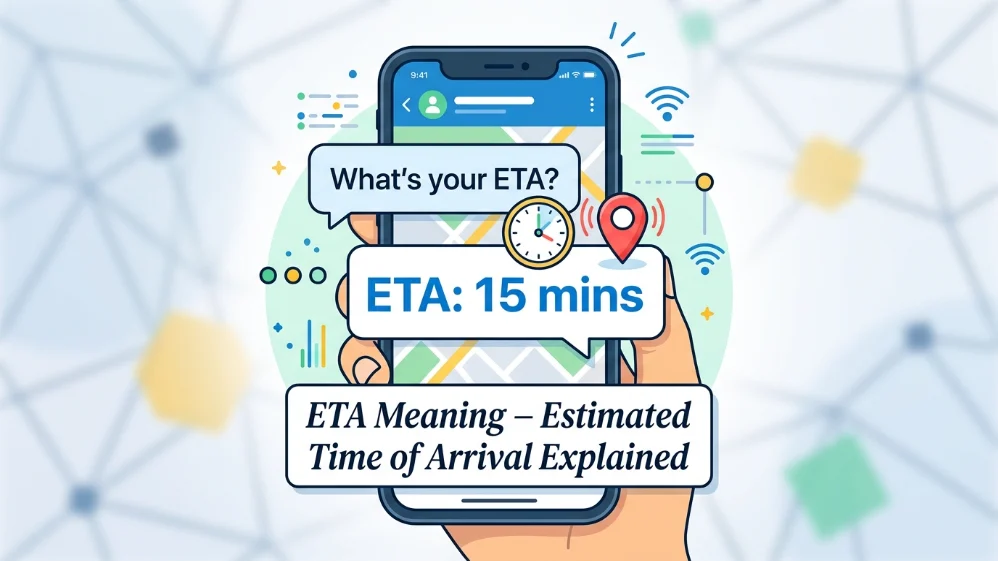

ETA stands for Estimated Time of Arrival. It is the predicted time when a person, vehicle, shipment, or deliverable is expected to reach a specific destination or be completed.
Originally used in aviation and shipping, ETA is now common in everyday conversation, business project management, and digital communication.
When someone asks “What’s your ETA?”, they want to know when you will arrive or when something will be ready.
You have probably seen the abbreviation ETA pop up in a text message, work email, or delivery tracking app. Maybe a friend texted “ETA?” while you were on your way to meet them, or a colleague asked for your ETA on a project. But what does ETA actually mean?
In short, ETA stands for Estimated Time of Arrival. It is a widely used acronym that helps people coordinate timing in both professional and casual settings. Whether you are tracking a flight, waiting for a package, or letting someone know when you will show up, ETA is the go to shorthand for answering the question: “When?”
This guide covers everything you need to know about ETA meaning, from its origins in the aviation industry to how it is used in texts, social media, business, and beyond. You will learn the full definition, see real conversation examples, understand how to use it across different platforms, and know exactly how to reply when someone asks for your ETA.
Quick Answer
| Element | Details |
|---|---|
| Meaning | Estimated Time of Arrival |
| Context | Travel, logistics, business, texting, social media |
| Usage | Asking or telling when someone or something will arrive or be ready |
| Platforms | WhatsApp, Instagram, TikTok, Snapchat, email, project management tools |
| Example | “What’s your ETA?” — “About 10 minutes.” |
| Tone | Neutral, professional, casual, or friendly depending on context |
What Does ETA Mean?
ETA is an abbreviation for Estimated Time of Arrival. It refers to the predicted time when a person, vehicle, shipment, or even a completed task is expected to reach a specific location or milestone.
At its core, ETA is about timing. It helps people plan, coordinate, and set expectations. When you give someone your ETA, you are providing your best guess about when you will show up or when something will be done. It is not a guarantee, it is an estimate based on available information.
For example, if a friend asks for your ETA and you reply “15 minutes,” you are telling them that you expect to arrive in about 15 minutes, assuming nothing unexpected happens along the way.
The Full Form
ETA stands for Estimated Time of Arrival.
- Estimated – Not exact, just a prediction.
- Time – The moment or duration.
- Arrival – When someone or something reaches a place.
Is It ETA or E.T.A.?
Both are correct. You will commonly see it written as ETA without periods, especially in texts and casual writing. In more formal contexts, you might see E.T.A. with periods, but ETA is the standard modern usage.
Origin and History of ETA
The term ETA originated in the aviation and military industries in the early 20th century. Pilots, air traffic controllers, and military commanders needed a standardized way to communicate expected arrival times quickly and clearly.
In the 1930s and 1940s, as commercial aviation expanded and global shipping networks grew, ETA became a standard term in transportation logistics. It was used to track flights, ships, trains, and cargo shipments.
Over time, ETA spread beyond transportation. By the late 20th century, it was being used in business and project management. With the rise of mobile phones and texting in the early 2000s, ETA naturally migrated into everyday language. Its simplicity made it ideal for short messages, and today it is fully embedded in digital culture.
What started as a technical term used by pilots and dispatchers is now a common part of how we communicate in daily life.
How to Use ETA in Everyday Conversations
Using ETA is simple. You can ask for someone’s ETA or give your own. Here are the most common ways ETA appears in conversation:
Asking for an ETA
- “What’s your ETA?”
- “ETA?”
- “Any ETA yet?”
- “What time should I expect you?”
- “Do you have an ETA on that?”
Giving Your ETA
- “My ETA is 6:30.”
- “ETA 10 minutes.”
- “Running late. New ETA is 7:15.”
- “I’ll be there around 8. That’s my ETA.”
- “ETA on the food is about 20 minutes.”
Common Situations Where ETA Is Used
- Travel and transportation – Asking when someone will arrive at a destination.
- Social plans – Coordinating meetups, parties, or events.
- Work and projects – Checking on task or project completion times.
- Delivery tracking – Knowing when a package or food order will arrive.
- Digital communication – Asking when a file, email, or response will be ready.
Real-Life Conversation Examples
1 – Friends Meeting Up
Jenna: “Hey, where are you? The movie starts in 20 minutes.”
Marcus: “On my way. What’s your ETA?”
Jenna: “I’m already here. You?”
Marcus: “ETA 10 minutes. Save me a seat.”
2 – Food Delivery
Alex: “I ordered pizza. Should be here soon.”
Taylor: “Sweet. What’s the ETA?”
Alex: “App says 25 minutes.”
Taylor: “Cool, I’ll set the table.”
3 – Work Project Update
Manager: “How’s the presentation coming along?”
Sofia: “Almost done. ETA on the final version is 3 PM.”
Manager: “Perfect. Send it over when it’s ready.”
4 – Ride Share
Passenger: “Just booked the ride. Driver’s ETA is 4 minutes.”
Friend: “Great, I’ll head downstairs.”
5 – Casual Texting
Person A: “You coming to the party tonight?”
Person B: “Yeah, what’s your ETA?”
Person A: “Probably around 9.”
Person B: “Same. See you there.”
Platform-Specific Meaning of ETA
ETA on WhatsApp
On WhatsApp, ETA is used casually and directly. People often send a simple “ETA?” to ask when someone will arrive. It is quick, efficient, and widely understood. You might also see it used in group chats to coordinate meetups.
Example: “ETA?” — “5 mins, just parking.”
ETA on Instagram
On Instagram, ETA is often used in direct messages. The tone tends to be casual or playful. It can also be used in captions or stories to build anticipation for a product launch, event, or content drop.
Example: “New collection dropping soon. ETA: Friday 6 PM EST.”
ETA on TikTok
On TikTok, ETA appears in comments and DMs. It is commonly used to ask creators when new content will be posted or when a live stream will start. The tone is informal and community driven.
Example: “ETA on part 2?” — “Tomorrow, I promise.”
ETA on Snapchat
On Snapchat, ETA is used in quick, informal exchanges. Since Snapchat is built around fast communication, ETA fits right in. It is often used when friends are coordinating to meet up or when someone is waiting for a snap reply.
Example: “What’s your ETA?” — “2 mins.”
ETA in Emails
In professional emails, ETA is used to set expectations about deadlines, deliverables, or arrivals. It is a formal but efficient way to communicate timing.
Example: “Hi team, what is the ETA for the Q4 report? Please let me know by end of day.”
ETA in Project Management
In project management, ETA refers to the predicted time when a task, milestone, or deliverable will be completed. Project managers use ETA to track progress, allocate resources, and communicate with stakeholders.
Example: “The development team’s ETA for the new feature is next Tuesday.”
Other Meanings of ETA
While Estimated Time of Arrival is the most common meaning, ETA has several other definitions depending on the context.
Edited To Add
In online forums and blog comments, ETA can mean “Edited To Add.” It is used when someone goes back to edit a post and wants to indicate that new information has been added after the original publication.
Example: “ETA: I forgot to mention that the event starts at 7 PM, not 8.”
Electronic Travel Authorization
ETA also stands for Electronic Travel Authorization. This is an online pre-travel authorization required for visa-exempt foreign nationals traveling to certain countries, including Canada and Australia. It is electronically linked to the traveler’s passport.
Euskadi Ta Askatasuna
ETA is the acronym for Euskadi Ta Askatasuna, which means “Basque Country and Freedom” in the Basque language. This was an armed Basque separatist group active in Spain and France from the 1950s until it declared a ceasefire in 2011 and formally dissolved in 2018.
Greek Letter Eta
Eta (Η, η) is the seventh letter of the Greek alphabet. In science and engineering, the lowercase eta (η) is often used as a symbol for efficiency.
Japanese Social Caste
In Japanese history, “eta” was a term used for a class of outcasts who performed menial and unclean tasks. This usage is outdated and considered offensive today.
How to Respond When Someone Asks for Your ETA
When someone asks “What’s your ETA?”, your response should be clear, honest, and specific enough to be helpful.
Casual Responses
- “10 minutes.”
- “ETA 6 PM.”
- “About 20 minutes. Traffic is a bit heavy.”
- “I’ll be there in 5.”
Professional Responses
- “My ETA for the meeting is 9:00 AM sharp.”
- “The report will be ready by 3 PM.”
- “I expect to arrive at the office by 8:30.”
When You Are Running Late
- “Running late. New ETA is 6:30.”
- “Stuck in traffic. ETA 15 minutes instead of 5.”
- “Sorry, delayed. I’ll be there around 7.”
When Someone Gives You Their ETA
- “Great, see you then!”
- “No problem, take your time.”
- “Perfect, I’ll be waiting.”
Misinterpretations and Common Mistakes
ETA Is Not a Deadline
One common misunderstanding is treating ETA like a hard deadline. ETA is an estimate, not a guarantee. Things change, traffic happens, and tasks take longer than expected. Using ETA as a firm commitment can lead to frustration. It is better to treat it as a helpful prediction.
ETA vs. ETD
ETA (Estimated Time of Arrival) and ETD (Estimated Time of Departure) are often confused. ETD refers to when something is expected to leave, while ETA refers to when it is expected to arrive.
Vs. ETR
ETR stands for Estimated Time of Resolution. While ETA focuses on arrival, ETR focuses on when a problem or issue will be fixed. For example, if your internet goes down, the provider gives you an ETR, not an ETA.
ETA vs. ATA
ATA stands for Actual Time of Arrival. This is the real time when something actually arrives, as opposed to the estimated time.
“ETA” vs. “Edit”
In forums, ETA can mean “Edited To Add.” If you see someone use ETA in a blog comment or discussion board, they might not be talking about arrival time at all. Always check the context.
When NOT to Use ETA
While ETA is widely useful, there are situations where it might not be the best choice.
Formal Documents
In highly formal legal or official documents, spelling out “Estimated Time of Arrival” is more appropriate than using the abbreviation.
When Precision Is Critical
If you are giving a time that must be exact, such as a court appearance or a medical appointment, avoid using ETA. Use a specific time instead.
With People Who Do Not Know the Term
Not everyone is familiar with acronyms. If you are communicating with someone who might not understand ETA, it is better to say “What time will you arrive?” or “When will this be ready?”
In Emotional or Sensitive Conversations
If someone is anxious or stressed about timing, using ETA might come across as cold or dismissive. In these cases, a fuller, more empathetic response is better.
Usage Tips for ETA
Be Realistic
When giving an ETA, be honest about how long things will actually take. It is better to give a slightly longer estimate and arrive early than to give a short estimate and arrive late.
Update Your ETA
If circumstances change, let people know. A quick text saying “New ETA is 6:45” keeps everyone informed and reduces frustration.
Consider the Context
The way you use ETA should match the situation. A casual “ETA?” works for friends, but a more formal “What is your estimated time of arrival?” might be better in a professional setting.
Use It With Emojis (Casually)
In casual chats, pairing ETA with an emoji can soften the tone.
Example: “ETA? 🕐” or “ETA 10 mins 🚗”
Be Clear About What You Are Asking
Are you asking for someone’s arrival time, or are you asking when a task will be done? Make sure the context makes it clear, or add a few extra words.
Example: “ETA on the project?” vs. “ETA on your arrival?”
Related Terms and NLP Variations
Synonyms for ETA
- Arrival time
- Expected arrival
- Predicted arrival
- Estimated arrival
- Time of arrival
- When you will get here
Related Acronyms
- ETD – Estimated Time of Departure
- ATA – Actual Time of Arrival
- ATD – Actual Time of Departure
- ETR – Estimated Time of Resolution
- ETC – Estimated Time of Completion
Common Phrases Using ETA
- “What’s your ETA?”
- “ETA on this?”
- “Give me an ETA.”
- “My ETA is…”
- “New ETA: …”
Frequently Asked Questions
What does ETA stand for?
ETA stands for Estimated Time of Arrival. It is the predicted time when a person, vehicle, shipment, or deliverable is expected to arrive or be completed.
What does ETA mean in texting?
In texting, ETA means Estimated Time of Arrival. It is a quick way to ask or tell someone when you or something else will arrive.
What does ETA mean on social media?
On social media platforms like Instagram, TikTok, and Snapchat, ETA usually means Estimated Time of Arrival. It is used to ask about arrival times or to build anticipation for content drops and launches.
How do you pronounce ETA?
ETA is pronounced as an initialism: “Eee Tee Ay.” Each letter is said individually.
What is the difference between ETA and ETD?
ETA stands for Estimated Time of Arrival (when something arrives). ETD stands for Estimated Time of Departure (when something leaves).
What is the difference between ETA and ETR?
ETA focuses on when something or someone will arrive. ETR (Estimated Time of Resolution) focuses on when a problem or issue will be fixed.
Can ETA mean “Edited To Add”?
Yes. In online forums and blog comments, ETA can mean “Edited To Add,” indicating that new information has been added to a post after it was originally published.
Is ETA only used for travel?
No. While ETA originated in travel and transportation, it is now widely used in business, project management, texting, and everyday conversation to refer to when a task, deliverable, or person will arrive or be ready.
How do you respond to “What’s your ETA?”
Give a clear, honest estimate. For example: “About 10 minutes,” “ETA 6 PM,” or “Running late, new ETA is 6:30.”
Why do people use ETA instead of saying the full phrase?
ETA is shorter, faster to type, and universally understood in many contexts. It saves time in texts, emails, and quick conversations.
Conclusion
ETA, or Estimated Time of Arrival, is one of the most useful abbreviations in modern communication. From its origins in aviation and shipping to its current role in texting, social media, and business, ETA helps people coordinate, plan, and stay informed.
Whether you are asking a friend when they will show up, tracking a package, or managing a project deadline, ETA is the simple, efficient way to talk about timing. Just remember that ETA is an estimate, not a guarantee. Be realistic, update people when things change, and always consider your context.
Now you know exactly what ETA means and how to use it like a pro. So next time someone texts you “ETA?”, you will know exactly what to say.