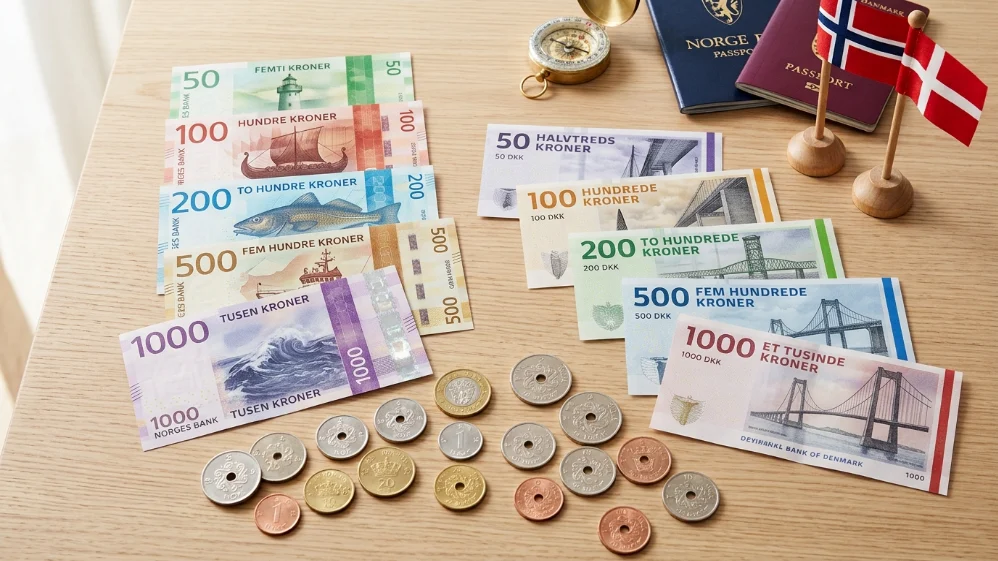

Kroner (pronounced KROH-ner) is the plural form of krone, the official currency of Norway and Denmark. The word comes from the Scandinavian term for “crown,” reflecting the monarchic heritage of these countries.
In slang, “kroner” is sometimes used informally to mean money or cash in general, similar to saying “bucks” in American English.
Ever come across the word “kroner” and wondered what it actually means? You are not alone. While it might sound like something from a fantasy novel or a trendy new slang term, kroner is actually the name of a very real currency used in two Scandinavian countries. But here is the thing: the meaning of kroner goes beyond just money.
Depending on where you encounter it, kroner can refer to Norwegian or Danish currency, the plural form of krone, a casual slang term for cash, or even a German surname. This guide breaks down everything you need to know about kroner meaning, from its historical roots to how people use it in everyday conversation, social media, and text messages.
Whether you are planning a trip to Norway, curious about international finance, or just trying to decode what someone meant when they said they needed “a few kroner,” this article has you covered.
Quick Answer Box
| Category | Details |
|---|---|
| Meaning | Plural of krone; currency of Norway and Denmark; slang for money |
| Context | Financial transactions, travel, casual conversation, social media |
| Usage | “I need to exchange 500 kroner.” / “That cost me a few kroner.” |
| Platforms | Banking apps, travel sites, TikTok, Instagram, text messages |
| Example | “The meal was 200 kroner at the cafe in Oslo.” |
| Tone | Formal in financial contexts; casual and playful in slang usage |
What Does Kroner Mean?
At its most basic level, kroner is the plural form of krone. Krone is the official currency unit used in two countries: Norway and Denmark.
Think of it this way: just as you would say “dollars” for the plural of “dollar,” you say “kroner” for the plural of “krone.” If you have one unit of currency, it is a krone. If you have more than one, you have kroner.
The word “krone” itself translates to “crown” in English. This is not a coincidence. Many European currencies were historically named after crowns because crowns were symbols of royal authority and sovereignty. The connection between currency and crowns goes back centuries, when coins often bore the image of a monarch wearing a crown.
Pronunciation Guide
Kroner is pronounced KROH-ner (rhymes with “owner”). Krone is pronounced KROH-nuh.
Full Definition of Kroner
As a Currency
Kroner is the standard monetary unit of:
| Country | Currency Code | Symbol | Subunit |
|---|---|---|---|
| Norway | NOK | kr | 100 øre |
| Denmark | DKK | kr | 100 øre |
The Norwegian krone (NOK) and Danish krone (DKK) are both divided into 100 øre, although øre coins are no longer in circulation in Norway.
The Norwegian krone was introduced in 1875 when Norway joined the Scandinavian Monetary Union, replacing the previous currency at a rate of 4 kroner = 1 speciedaler. The Danish krone was introduced around the same time.
Today, the Norwegian krone is a free-floating currency, meaning its value is determined by market forces. The Danish krone, however, is pegged to the Euro under the European Exchange Rate Mechanism (ERM II).
As a Plural Noun
In grammatical terms, kroner is simply the plural of krone. This is similar to how “feet” is the plural of “foot” or “mice” is the plural of “mouse.” You would use “krone” when referring to a single unit and “kroner” when referring to multiple units.
As a Surname
Kroner is also a German occupational surname derived from the Middle High German word “Krone,” which means crown. The name was often given to people who worked at the royal court or who were associated with making or wearing crowns. It could also refer to someone who lived near an inn with a crown sign.
Context and Usage
Financial Context
In financial and business contexts, kroner appears constantly in exchange rates, stock reports, and economic news. If you are reading about the Norwegian economy, you will see references to billions of kroner. For example, you might read that “Norway’s 20 billion kroner issue of new bonds attracted strong demand”.
If you are traveling to Norway or Denmark, you will need to exchange your dollars for kroner. The exchange rate fluctuates daily, but as a rough guide, 1 Norwegian krone is approximately 0.09 USD, and 1 Danish krone is approximately 0.14 USD.
Casual Conversation
In casual conversation, especially among younger people, “kroner” can be used as a slang term for money in general. This is similar to how Americans might say “bucks” or Brits might say “quid.” The slang usage likely stems from the word’s association with currency and cash flow.
For example:
- “I need a few kroner to grab dinner tonight.”
- “That new jacket was worth every kroner.”
- “Living my best life with a pocket full of kroner!”
In Popular Culture
Kroner has appeared in various cultural contexts. In some online spaces, the term is used jokingly to refer to money in general. It has also been featured in music lyrics and social media posts where creators reference spending or throwing kroner.
A study from the University of Copenhagen found that 65% of youth had encountered terms like “kroner” used in informal financial discussions on platforms such as TikTok and Instagram. Influencers often use the term in lifestyle posts related to fashion, travel, and nightlife, giving it an aspirational quality.
Real-Life Examples
1: Travel Scenario
- Person A: “How much is this souvenir?”
- Person B: “That will be 150 kroner.”
- Person A: “Let me check if I have enough. I only exchanged 500 kroner this morning.”
- Person B: “You should be fine. That leaves you with 350 kroner for the rest of the day.”
2: Business Context
- Person A: “What was the total cost of the project?”
- Person B: “We spent about 2 million kroner on development.”
- Person A: “That is more than we budgeted. Can we break down the expenses?”
- Person B: “Sure. Labor was 1.2 million kroner, and materials were 800,000 kroner.”
3: Slang Usage Among Friends
- Person A: “You coming to the concert tonight?”
- Person B: “I wish, but I am low on kroner right now.”
- Person A: “No cap? I can spot you a few hundred.”
- Person B: “Fr? That would be amazing. I will pay you back next week.”
4: Text Message Conversation
- Person A: “Just got paid 💰”
- Person B: “How many kroner we talking?”
- Person A: “Enough to hit the club this weekend ngl”
- Person B: “Bet. Save some kroner for food though”
5: Social Media Post
Caption: “Woke up feeling like a million kroner 💫”
Comment: “Looking good! How much was that fit?”
Reply: “Not too bad actually. Worth every krone.”
Platform-Specific Meaning
On WhatsApp and other messaging apps, kroner is typically used in its literal sense when discussing travel plans, splitting bills, or talking about purchases made in Scandinavia. However, among friend groups, it can appear as playful slang for money.
Example text: “How many kroner do I owe you for dinner?”
Snapchat
On Snapchat, kroner might appear in stories from users traveling in Norway or Denmark. It can also show up in slang usage when someone is showing off a purchase or talking about money.
Example snap: A photo of a receipt with the caption “200 kroner well spent fr”
TikTok
On TikTok, kroner appears in travel content, finance videos, and lifestyle posts. Creators might talk about the cost of living in Scandinavia, show currency exchanges, or use the term casually in skits about money.
Example TikTok caption: “POV: You just exchanged your dollars for kroner and feel rich”
On Instagram, kroner shows up in travel posts from Norway and Denmark, fashion hauls, and lifestyle content. Influencers might caption a photo with something like “Living my best life with a pocket full of kroner”.
Example post: A photo of a scenic view in Oslo with the caption “Worth every krone spent to get here”
Banking and Finance Apps
In banking apps, currency exchange platforms, and financial news sites, kroner appears in its formal context. Users checking exchange rates, transferring money, or reviewing transactions will see NOK and DKK prominently displayed.
Example: “Your balance: 4,500 NOK (Norwegian kroner)”
Alternative Meanings of Kroner
German Surname
As mentioned earlier, Kroner is a German occupational surname. It is derived from the word “Krone,” meaning crown, and was historically given to royal officials or those who worked with crowns.
Historical Currency
Krone (plural kronen) was also a former gold coin of Germany, worth ten marks. This usage is now historical and not commonly encountered in everyday conversation.
Icelandic Króna
Iceland uses a currency called the króna (plural krónur). While similar in name and origin to the Norwegian and Danish krone, it is a separate currency.
Swedish Krona
Sweden uses the krona (plural kronor). The term “krona” also means crown in Swedish. While similar to kroner, it is a distinct currency with its own exchange rate and history.
Related Terms and NLP Variations
Synonyms and Equivalents
- Krone – singular form
- NOK – Norwegian krone currency code
- DKK – Danish krone currency code
- Crown – English translation of krone
- Scandinavian currency – broader category
Paraphrases
- “Norwegian currency”
- “Danish money”
- “Nordic crowns”
- “Scandinavian kroner”
Contextual Rewording
- “The price is 200 kroner” → “The price is 200 Norwegian crowns”
- “I exchanged 500 kroner” → “I exchanged 500 units of Norwegian currency”
- “That cost me a few kroner” → “That cost me some money”
Related Entities
- Norges Bank – Central bank of Norway
- Danmarks Nationalbank – Central bank of Denmark
- Scandinavian Monetary Union – Historical monetary union between Norway, Sweden, and Denmark
- Øre – Subunit of the krone
- Euro – Currency to which the Danish krone is pegged
How to Respond or Reply
When Someone Mentions Kroner in a Financial Context
If someone mentions kroner in a financial or travel context, you can respond by acknowledging the amount or asking clarifying questions.
Response examples:
- “Oh, so that is about [X] dollars? Good to know.”
- “Are those Norwegian or Danish kroner?”
- “That sounds reasonable for [location].”
When Someone Uses Kroner as Slang
If a friend uses kroner as slang for money, you can play along with the casual tone.
Response examples:
- “Fr? How many kroner we talking?”
- “I am low on kroner too ngl”
- “Worth every kroner for sure”
When You Are Unsure
If you are not sure whether someone means actual currency or is using slang, it is perfectly fine to ask.
Response example:
- “Wait, do you mean actual kroner or are you just talking about money in general?”
Misinterpretations
Confusion Between Krone and Krona
One of the most common misunderstandings is confusing krone (Norway and Denmark) with krona (Sweden). While both words mean “crown” and sound similar, they refer to different currencies.
- Krone (plural kroner) = Norway and Denmark
- Krona (plural kronor) = Sweden
- Króna (plural krónur) = Iceland
Assuming Kroner Is Only One Country’s Currency
Many people assume kroner is only used in one country. In reality, both Norway and Denmark use kroner as their currency. They are separate currencies with different exchange rates and monetary policies.
Thinking It Is Always Slang
While kroner can be used as slang for money in casual contexts, it is first and foremost a real currency. If you are in a financial or travel context, assume the literal meaning unless the conversation is clearly casual.
Mispronunciation
Some people mispronounce kroner as “kro-ner” with a hard “o” or “kron-er.” The correct pronunciation is KROH-ner.
When NOT to Use Kroner
In Formal Writing About Swedish Currency
If you are writing about Swedish currency, use “krona” or “kronor,” not “kroner.” These are different currencies with different names.
When Referring to Other Currencies
Kroner specifically refers to Norwegian and Danish currency. Do not use it to refer to euros, dollars, pounds, or other currencies.
In Official Financial Documents
In official financial documents, it is better to use the currency code (NOK or DKK) rather than the word “kroner” to avoid ambiguity.
When Clarity Is Critical
If there is any chance of confusion between Norwegian and Danish kroner, specify which one you mean. For example: “200 Norwegian kroner (NOK)” or “200 Danish kroner (DKK).”
Usage Tips
For Travelers
If you are traveling to Norway or Denmark, here are some practical tips:
- Know the exchange rate before you go. Check current rates for NOK/USD and DKK/USD.
- Carry some cash but know that cards are widely accepted in both countries.
- Learn the symbol: kr is the symbol for both currencies.
- Remember the plural: one krone, multiple kroner.
For Business Professionals
If you are doing business with Norwegian or Danish companies:
- Use the correct currency code: NOK for Norway, DKK for Denmark.
- Be aware of exchange rate fluctuations, especially for NOK which is free-floating.
- Understand that DKK is pegged to the Euro, which provides more stability.
For Casual Conversation
If you want to use kroner as slang:
- Keep it casual. This is not appropriate for formal settings.
- Use it with friends who will understand the reference.
- Do not overuse it. Like any slang, too much can sound forced.
FAQs
1. What does kroner mean in English?
Kroner means “crowns” in English. It is the plural form of krone, which is the currency of Norway and Denmark.
2. Is kroner the same as krona?
No. Kroner is used in Norway and Denmark, while krona is used in Sweden. They are different currencies.
3. How do you pronounce kroner?
Kroner is pronounced KROH-ner (rhymes with “owner”).
4. What is the difference between krone and kroner?
Krone is the singular form, and kroner is the plural form. One krone, many kroner.
5. Is kroner a slang word?
In some contexts, yes. Kroner can be used as slang for money in general, similar to “bucks” in American English.
6. What countries use kroner?
Norway and Denmark use kroner as their official currency.
7. What is the symbol for kroner?
The symbol for both Norwegian and Danish kroner is “kr”.
8. How much is 1 kroner in US dollars?
The exchange rate fluctuates daily. As of late 2025, 1 Norwegian krone is approximately 0.09 USD, and 1 Danish krone is approximately 0.14 USD.
9. What does NOK stand for?
NOK is the ISO 4217 currency code for the Norwegian krone.
10. What does DKK stand for?
DKK is the ISO 4217 currency code for the Danish krone.
11. Is kroner used in Sweden?
No. Sweden uses the krona (plural kronor), not kroner.
12. Why is it called kroner?
The word comes from the Scandinavian word for “crown,” reflecting the monarchic heritage of these countries.
13. Can I use kroner in other countries?
Kroner is primarily used in Norway and Denmark. Some shops near the Norwegian border in Sweden and Finland may accept it.
14. What is the plural of krone?
The plural of krone is kroner.
15. Is kroner a common term in the US?
Kroner is not commonly used in everyday American conversation unless discussing travel, finance, or international business.
16. What does “a few kroner” mean in slang?
In slang, “a few kroner” means “some money” or “a bit of cash”.
17. How do you write kroner in a sentence?
Example: “I exchanged 500 kroner at the airport.” or “The hotel room cost 1,200 kroner per night.”
18. What is the history of the kroner?
The krone was introduced in 1875 when Norway and Denmark joined the Scandinavian Monetary Union.
19. Is the Danish krone pegged to the Euro?
Yes. The Danish krone is pegged to the Euro under the European Exchange Rate Mechanism (ERM II).
20. Is the Norwegian krone pegged to anything?
No. The Norwegian krone is a free-floating currency, meaning its value is determined by market forces.
Conclusion
Understanding kroner meaning is useful whether you are traveling to Scandinavia, following international finance, or just trying to keep up with casual conversation. At its core, kroner is the plural of krone, the currency of Norway and Denmark. But as we have seen, the term also works as slang for money, appears as a German surname, and connects to a broader family of Scandinavian currencies including the Swedish krona and Icelandic króna.
The word itself tells a story. Derived from “crown,” kroner reflects centuries of royal authority and monetary tradition. Today, it represents two distinct but related currencies: the free-floating Norwegian krone and the Euro-pegged Danish krone. Both play important roles in their respective economies and in global trade.
Whether you are exchanging dollars for kroner at the airport, reading about Norway’s oil-driven economy, or joking with friends about needing “a few kroner” for the weekend, you now have a complete understanding of what the term means and how to use it.
Next time someone mentions kroner, you will know exactly what they are talking about. No cap.