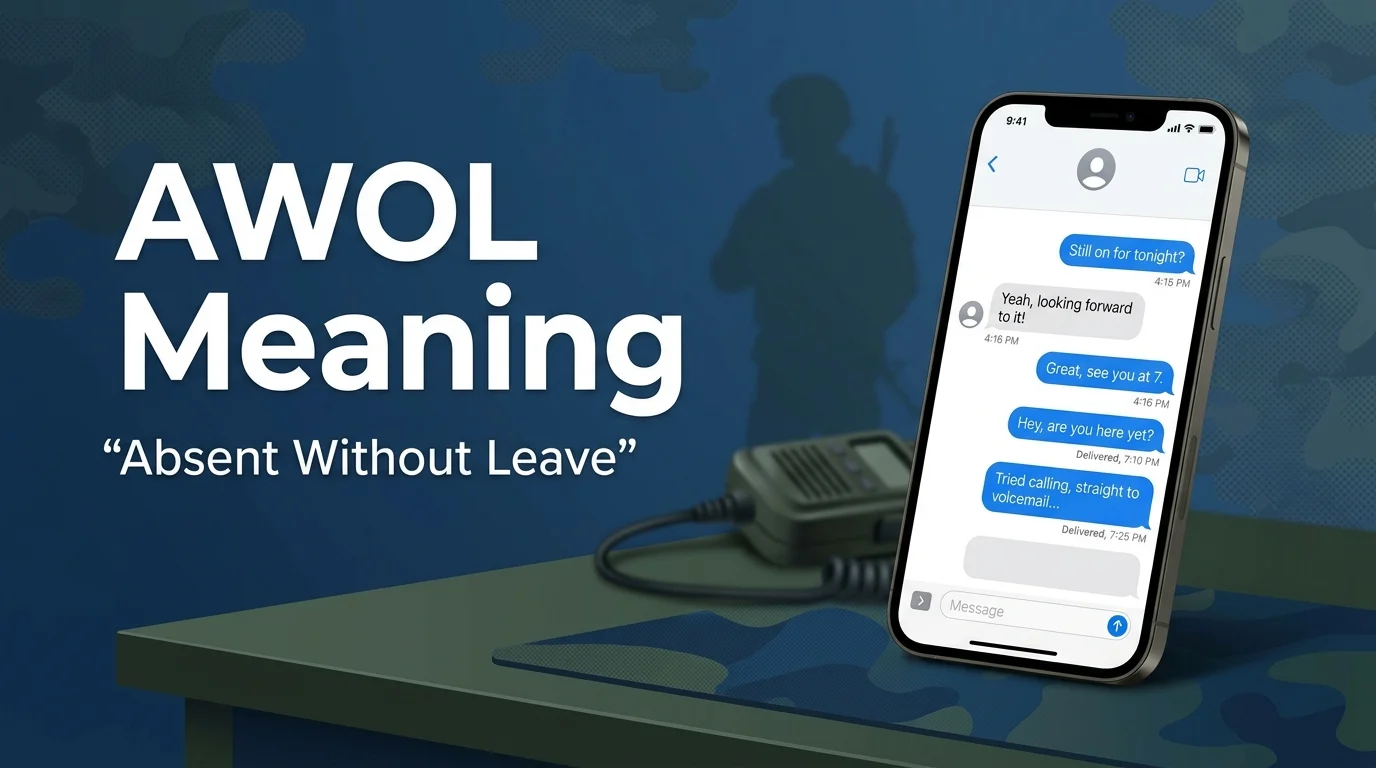

You may see someone text, “Where have you been? You went AWOL,” after disappearing from a group chat or going quiet for a few days. The AWOL meaning is usually “absent without leave,” originally referring to someone who is absent from military duty without permission. In everyday conversation, however, people often use AWOL more loosely to describe someone who suddenly disappears, stops responding, or becomes unavailable. The intended meaning is usually clear from context. Below, you’ll learn what AWOL stands for, how it is used in text and social conversations, what tone it carries, and how to respond naturally.
What Does AWOL Mean?
AWOL stands for “absent without leave.” In its original military sense, it describes someone who is absent from their assigned duties without authorization. In casual English, AWOL can describe anyone who unexpectedly disappears or stops communicating.
| Detail | Explanation |
|---|---|
| Most common meaning | Absent without leave |
| Full form | Absent Without Leave |
| Casual meaning | Suddenly absent, missing, or unreachable |
| Tone | Usually informal, sometimes humorous or critical |
| Formal or informal | Formal in military contexts; informal in everyday conversation |
For example, if a friend stops answering messages for several days, someone might say, “Sam has gone AWOL again.” Here, the speaker usually is not making a literal military reference; they mean Sam has disappeared from the conversation.
What Is the AWOL Meaning in Text?
In texting, AWOL generally means that someone has gone missing, stopped replying, or become unusually quiet.
If a friend says, “You’ve been AWOL all weekend,” they are probably pointing out that you have not been around or responding as usual. Depending on the relationship, the comment can sound concerned, teasing, or mildly annoyed.
The key difference is context. A military conversation can use AWOL in its original, specific sense, while a group chat might use it casually to mean “you disappeared.”
Why Do People Say Someone “Went AWOL”?
The phrase “went AWOL” is common because it describes a noticeable change in someone’s availability. It can suggest that the person was expected to be present or responsive but suddenly was not.
For example:
“I texted him three times, but he went AWOL.”
This means the person stopped responding or became unavailable. It does not necessarily mean they intentionally ignored the sender. They could simply be busy, offline, traveling, or dealing with something privately.
AWOL can therefore be more playful than saying someone “ignored me,” especially among friends.
How Context Changes the AWOL Meaning
The exact feeling behind AWOL depends on the surrounding conversation, relationship, punctuation, and reason for the absence.
- “You went AWOL 😂” — Usually playful teasing about disappearing.
- “Why did you go AWOL?” — Could express genuine confusion or mild frustration.
- “He’s been AWOL since Monday.” — A neutral description of someone’s absence.
- “The employee went AWOL from his post.” — Much closer to the serious or military sense.
Capitalization generally does not change the meaning. AWOL, awol, and “went AWOL” can all communicate the same idea, although uppercase AWOL reflects the conventional acronym.
Emojis can also soften the expression. A laughing emoji may make it clear that the speaker is joking rather than accusing someone of deliberately disappearing.
AWOL Meaning on Different Platforms
AWOL does not normally acquire a completely different definition on social platforms. Its casual meaning is broadly similar across texting, messaging apps, and social media.
Text Messages and WhatsApp
In private messages, AWOL usually means someone has stopped responding or has been unavailable.
Example:
“Sorry, I went AWOL yesterday.
The tone is generally casual and apologetic.
Snapchat and Instagram
Someone may use AWOL when a friend stops appearing in chats, replies, stories, or social interactions.
Example:
“You’ve been AWOL lately. Everything good?”
Here, the wording can sound concerned rather than critical.
TikTok and Social Media Comments
AWOL can be used casually when someone disappears from an online community or stops posting.
Example:
“Where did you go? You went AWOL!”
The tone is often playful, especially when directed at a creator, friend, or familiar online contact.
Discord and Gaming Chats
In gaming communities, AWOL may describe a player who suddenly leaves or stops participating.
Example:
“Chris went AWOL halfway through the match.”
This usually means Chris became inactive or disappeared from the session.
Real Conversation Examples
1: Friends
Person A: “You disappeared all weekend. Everything okay?”
Person B: “Yeah, sorry. I went AWOL because I needed some time offline.”
Meaning: Person B is using AWOL casually to explain being unavailable.
2: Group Chat
Person A: “Maya has gone AWOL again.”
Person B: “She said she’s studying for her exams.”
Meaning: Maya has been absent from the group conversation, not literally absent without military authorization.
3: Gaming
Person A: “Where’s Alex?”
Person B: “He went AWOL right after the game started.”
Meaning: Alex stopped participating or disappeared from the gaming session.
Is AWOL Rude?
AWOL is not inherently rude. In casual conversation, it is often humorous or mildly teasing.
However, the phrase can sound critical when someone uses it to complain about another person’s absence. Compare “You went AWOL 😂” with “You went AWOL again and never told anyone.” The first sounds playful, while the second suggests frustration.
Your relationship with the speaker also matters. A close friend can usually use AWOL jokingly, while the same phrase from a manager or unfamiliar person may sound more serious.
Is AWOL Offensive?
AWOL is generally not considered an offensive slang term. It is a recognized acronym with a military meaning that has also developed a common informal use.
Still, using it in a sensitive situation may come across as insensitive if someone has disappeared because of a serious personal problem. When you know someone may be dealing with something difficult, clearer and more considerate wording is often better.
How to Reply to AWOL
Your response should match why you disappeared and the tone of the original message.
Friendly Replies
- “Haha, yeah, I’ve been a little MIA lately.”
- “Sorry! I’ve just been super busy.”
- “I know, I’ve been off the radar.”
- “I’m back now!”
- “Yeah, life got hectic for a bit.”
Funny Replies
- “Reporting back for duty.”
- “AWOL status officially revoked.”
- “I have returned from the wilderness.”
- “Sorry, my disappearance was unplanned.”
Polite Replies
- “Sorry for going quiet. I had a lot going on.”
- “I apologize for being unavailable. Things have been hectic.”
- “Thanks for checking in. I’m okay, just needed some time away.”
If you are unsure whether the person is joking or genuinely concerned, a straightforward response works best: “Sorry, I’ve been unavailable. Is everything okay?”
When to Use AWOL
AWOL works naturally in casual conversations, especially when talking about someone disappearing from a chat, social activity, gaming session, or informal group.
You can use it with friends, familiar online communities, and people who understand the expression. It is particularly natural when the disappearance is noticeable and temporary.
For example, “Jake went AWOL from the group chat” sounds normal in an informal conversation.
When to Avoid AWOL
Although the acronym has a legitimate military meaning, its casual usage is not always the clearest choice in professional or sensitive situations.
Consider using more direct language in:
- Professional emails
- Job applications
- Academic writing
- Client communication
- Formal announcements
- Sensitive personal conversations
- Messages to unfamiliar people
Instead of saying, “The client went AWOL,” a professional message could say, “The client has not responded to our recent messages.”
Clear wording reduces the chance that your tone will be misunderstood.
Common Mistakes About AWOL
| Common Mistake | Correct Understanding |
| Assuming AWOL always means someone ignored you | It can simply mean someone was absent or unavailable. |
| Treating every use as military terminology | Casual English commonly uses AWOL figuratively. |
| Assuming AWOL is always negative | Among friends, it can be playful or humorous. |
Another common mistake is inventing an alternative full form. The established expansion is “absent without leave.” In casual texting, people usually focus on the idea of disappearing rather than the literal military terminology.
AWOL vs. Similar Terms
| Term | Meaning | Main Difference |
| AWOL | Absent or unexpectedly unavailable | Suggests someone has disappeared from an expected place or activity |
| MIA | Missing in action; casually missing or unavailable | Often emphasizes that someone cannot currently be found |
| Ghosting | Suddenly cutting off communication | Usually implies deliberately stopping contact |
| Offline | Not currently connected or available online | Does not necessarily imply unexplained disappearance |
| AFK | Away from keyboard | Usually refers to temporary absence from a device or game |
AWOL and MIA can overlap in casual conversation, but they are not identical. Emphasizes being absent from an expected duty, place, or activity, while MIA literally refers to someone missing in action and is also used informally for someone who cannot be located.
Ghosting is more specific because it generally suggests someone intentionally stopped communicating, especially in dating or personal relationships.
Where Did AWOL Come From?
AWOL is an established military acronym meaning “absent without leave.” The term refers to unauthorized absence from an assigned duty or place.
Its everyday figurative use comes from extending that idea to ordinary situations: someone is expected to be around, but they suddenly disappears or becomes unavailable. The casual meaning should not be confused with the precise military use.
There is no need to assign a special social-media origin to AWOL. It predates modern texting and has long been used beyond strictly military conversations.
Quick Recap
- AWOL means “absent without leave.”
- In casual texting, it usually means someone has disappeared, become unavailable, or stopped responding.
- The expression can be serious, neutral, teasing, or humorous depending on context.
- AWOL is different from ghosting because going AWOL does not necessarily imply intentional avoidance.
- In formal or sensitive communication, clearer wording is usually preferable.
Frequently Asked Questions
What does AWOL mean in text?
In text, AWOL usually means someone has disappeared, stopped responding, or become unexpectedly unavailable for some time.
Is AWOL rude?
AWOL is not inherently rude, but it can sound critical when used to complain about someone’s unexplained absence.
What does AWOL stand for?
AWOL stands for “absent without leave,” describing unauthorized absence from an assigned military duty or place.
How should you reply to AWOL?
Reply casually if appropriate, or briefly explain your absence when the other person sounds genuinely concerned about your disappearance.
Can AWOL have different meanings?
AWOL has a specific military meaning and a common informal meaning describing someone who has unexpectedly disappeared or become unavailable.
Final Thoughts
The AWOL meaning is straightforward: the acronym stands for “absent without leave,” while casual conversation often uses it to mean someone has disappeared or become unavailable. If a friend says you “went AWOL,” they are usually commenting on your absence rather than making a literal military reference. Context determines whether the phrase sounds funny, concerned, or mildly annoyed. AWOL works well in informal texts, group chats, gaming conversations, and social media, but clearer wording is usually better for professional or sensitive communication. When you understand the situation and tone, the meaning is usually easy to interpret.
Discover More Post:
Forsaken Meaning | Definition, Usage, Examples, and Context
HVAC Meaning | What HVAC Stands For and How It Works
Bugbear Meaning | Definition, Examples, and Usage