
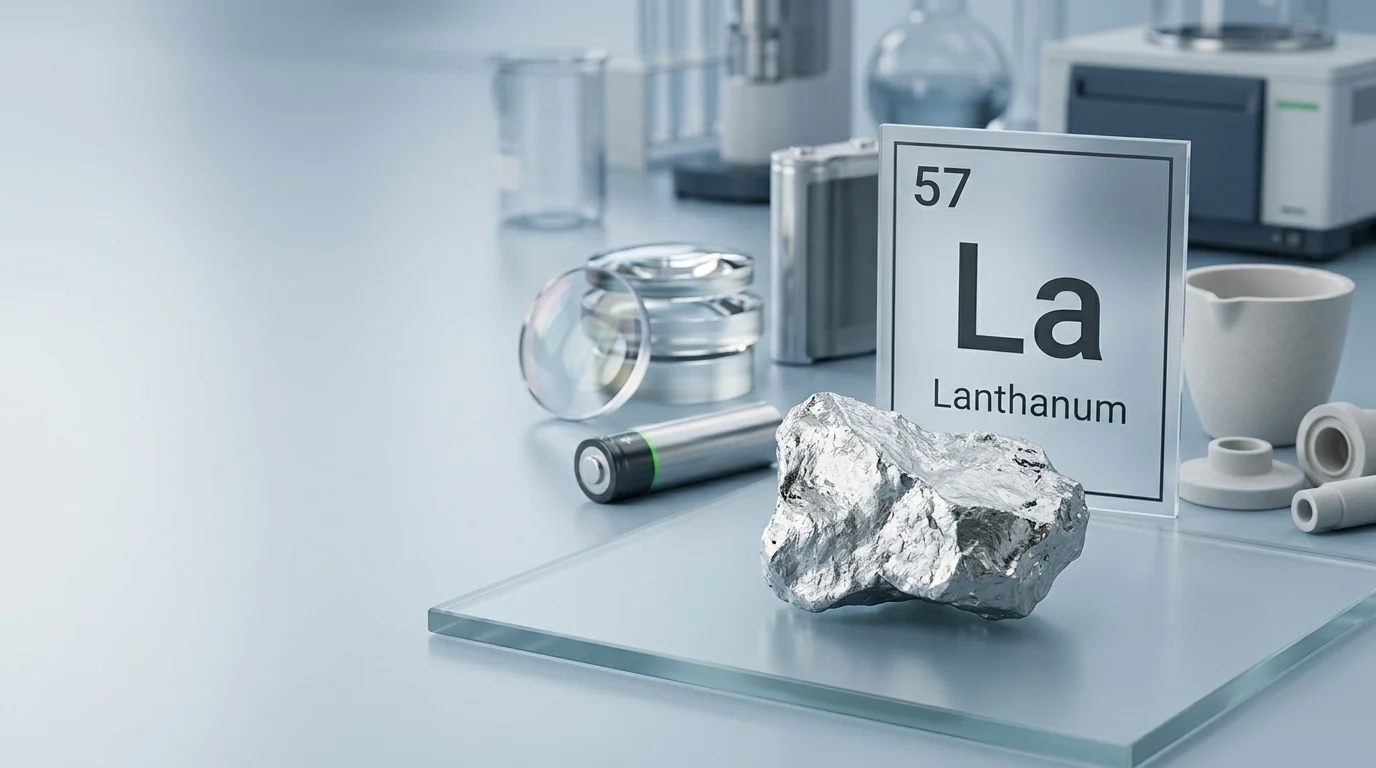

If you came across the word “lanthanum” in a chemistry lesson, periodic table, product specification, or science article, you may be wondering what it means. Lanthanum is a chemical element with the symbol La and atomic number 57. It is a soft, silvery-white metal commonly classified as a rare-earth element and is closely associated with the lanthanide series. The lanthanum meaning becomes clearer when you look at its properties and applications. From optical glass and camera lenses to rechargeable batteries and specialized catalysts, lanthanum has several important industrial uses. This guide explains what lanthanum is, where its name comes from, how it behaves, and why it is useful.
What Does Lanthanum Mean?
The lanthanum meaning refers to the chemical element lanthanum, a metallic element identified by the symbol La and atomic number 57.
Lanthanum is a relatively soft, malleable, silvery-white metal.
| Detail | Explanation |
|---|---|
| Element | Lanthanum |
| Symbol | La |
| Atomic number | 57 |
| Category | Rare-earth metal |
| Appearance | Soft, silvery-white metal |
| Standard atomic weight | About 138.91 |
| Main uses | Optical glass, batteries, catalysts, ceramics, and specialized alloys |
In simple terms, lanthanum is a reactive rare-earth metal used in several materials and technologies because of its distinctive chemical and physical properties.
What Is Lanthanum?
Lanthanum is a naturally occurring metallic element found in minerals that also contain other rare-earth elements. Its chemical symbol, La, comes from its name, while the number 57 identifies its position on the periodic table.
One notable characteristic of lanthanum is its reactivity. When exposed to air, its surface can gradually develop an oxide layer. It can also react with water, acids, and other substances under appropriate conditions.
Adding lanthanum oxide to glass can increase its refractive index while maintaining useful optical properties, making lanthanum-containing glass valuable for certain lenses and optical instruments.
Why Is Lanthanum Called a Rare-Earth Element?
The word “rare” can be misleading. Rare-earth elements are not necessarily extremely scarce in Earth’s crust. Instead, they often occur in relatively dispersed deposits and can be difficult to separate from one another because of their similar chemical behavior.
In many versions of the periodic table, lanthanum appears at the beginning of the row associated with the lanthanide series.
Both conventions appear in scientific and educational contexts, so the surrounding periodic-table format matters.
Lanthanum Meaning in Chemistry
In chemistry, lanthanum represents an element whose atoms contain 57 protons. A neutral lanthanum atom also has 57 electrons.
Its electron configuration is commonly written as:
[Xe] 5d¹ 6s²
This electron arrangement helps explain some of the element’s chemical behavior. Most commonly forms compounds in the +3 oxidation state, although its chemistry can be more nuanced in specialized compounds and coordination environments.
Lanthanum readily forms compounds with oxygen, halogens, acids, and other elements.
A simple example is lanthanum oxide in specialized optical glass. Its presence can alter the glass’s optical characteristics, which is useful when manufacturers need particular lens performance.
Key Properties of Lanthanum
Lanthanum has several characteristics that make it useful in industrial and scientific applications.
Physical Properties
Pure lanthanum is soft and relatively malleable. It has a silvery-white appearance when freshly prepared, although its surface can change when exposed to air.
Its melting point is about 920°C, while its boiling point is approximately 3,460°C. These values make lanthanum a solid metal under ordinary conditions.
Lanthanum also has a relatively high density compared with many common metals, although it is less dense than some other heavy rare-earth elements.
Chemical Properties
Lanthanum is chemically reactive. It can oxidize in air and reacts with water more readily than many less-reactive metals.
The element commonly forms La³⁺ ions, which is why many lanthanum compounds contain lanthanum in the +3 oxidation state.
Instead, its compounds and controlled additions to other materials are often more useful.
How Is Lanthanum Used?
Lanthanum has applications in optics, energy technology, ceramics, metallurgy, and chemical processing.
Optical Glass and Camera Lenses
One of the best-known uses of lanthanum compounds is in specialized optical glass. Lanthanum-containing glass can provide a high refractive index and useful optical characteristics.
This makes it valuable for certain camera lenses, eyeglass lenses, microscopes, telescopes, and other optical systems.
Lanthanum-containing alloys can act as hydrogen-absorbing materials. This property has made lanthanum relevant to rechargeable battery technology, including some battery designs historically used in consumer electronics and hybrid vehicles.
Petroleum Refining
Lanthanum can contribute to the stability and performance of certain catalyst formulations.
Ceramics and Electronic Materials
Certain lanthanum-containing oxides have useful electrical, optical, or thermal properties.
These materials can appear in applications involving capacitors, electronic components, coatings, and other engineered systems.
Lanthanum vs. Other Rare-Earth Elements
Lanthanum is sometimes confused with other rare-earth metals because these elements share many characteristics.
| Element | Symbol | Atomic Number | Main Difference |
| Lanthanum | La | 57 | Often associated with the beginning of the lanthanide series |
| Cerium | Ce | 58 | Follows lanthanum and has several important oxidation states |
| Praseodymium | Pr | 59 | Known for specialized magnetic, optical, and ceramic applications |
| Neodymium | Nd | 60 | Widely associated with powerful permanent magnets |
The key difference is the element’s atomic number and electron structure. Even closely related rare-earth elements can have significantly different practical applications.
How Context Changes the Meaning of Lanthanum
Unlike internet slang or abbreviations, lanthanum does not normally change meaning based on social-media platform or conversation tone. The context mainly determines which aspect of the element is being discussed.
Here are a few examples:
“Lanthanum has atomic number 57.”
Meaning: The statement concerns basic chemistry and the periodic table.
“Lanthanum glass is used in lenses.”
Meaning: The discussion concerns optical materials and manufacturing.
“Lanthanum is used in NiMH batteries.”
Meaning: The context is energy storage and materials science.
“Lanthanum belongs to the rare-earth elements.”
Meaning: The speaker is discussing elemental classification.
So, if you see the word in a scientific text, the surrounding subject usually tells you whether the writer is focusing on its chemistry, classification, properties, or applications.
Where Does the Name Lanthanum Come From?
The name lanthanum is derived from the Greek word lanthanein, associated with the idea of being hidden or lying unnoticed.
The name reflects the historical difficulty of identifying lanthanum separately from other substances. Lanthanum was recognized as a distinct element in the nineteenth century after being separated from compounds associated with cerium.
The naming history is particularly fitting because rare-earth elements often occur together and can be challenging to separate chemically.
Common Misunderstandings About Lanthanum
1: Assuming “rare-earth” means extremely rare
Rare-earth elements are not necessarily among the rarest elements in Earth’s crust. The term largely reflects their historical classification and the difficulty of finding and separating concentrated deposits.
2: Treating lanthanum as a precious metal
Lanthanum is a rare-earth metal, but it is not classified as a precious metal like gold, silver, or platinum.
3: Assuming lanthanum is mainly used by itself
Many practical applications rely on lanthanum compounds or lanthanum-containing alloys, glass, ceramics, and catalysts rather than large pieces of pure lanthanum metal.
Is Lanthanum Dangerous?
Lanthanum is a reactive chemical element, so its handling depends on its physical form and the specific compound involved. Pure lanthanum metal can react with air and moisture, while different lanthanum compounds have their own safety characteristics.
That means you should not assume that every lanthanum-containing material has identical hazards. Laboratory and industrial handling should follow the relevant safety information for the particular substance.
For everyday readers, the important point is that “lanthanum” describes an element, while a lanthanum compound can have very different properties and handling requirements.
Quick Recap of Lanthanum Meaning
- Lanthanum is a chemical element with the symbol La and atomic number 57.
- It is a soft, silvery-white rare-earth metal.
- It commonly occurs with other rare-earth elements in minerals.
- Lanthanum compounds are used in optical glass, batteries, catalysts, ceramics, and advanced materials.
- The word has a scientific meaning rather than a slang or social-media meaning.
- Context determines whether a discussion is focused on lanthanum’s chemistry, classification, properties, or applications.
Frequently Asked Questions
What does lanthanum mean in chemistry?
Lanthanum refers to the chemical element with symbol La, atomic number 57, and a common +3 oxidation state.
What is the full form of La?
La is the chemical symbol for lanthanum, so it does not represent an abbreviated phrase or conventional full form.
Is lanthanum a rare-earth element?
Lanthanum is commonly classified among the rare-earth elements and is closely associated with the lanthanide series.
What is lanthanum used for?
Lanthanum is used in optical glass, nickel-metal hydride battery materials, catalysts, ceramics, and specialized advanced materials.
Is lanthanum a metal?
Yes, lanthanum is a soft, reactive metal that belongs to the rare-earth group of elements.
Final Thoughts
The lanthanum meaning is straightforward: lanthanum is a chemical element identified by the symbol La and atomic number 57. It is a reactive, soft, silvery-white rare-earth metal with useful chemical and physical properties. Its compounds and alloys have applications ranging from optical glass and rechargeable batteries to catalysts and advanced ceramics. When you encounter the term, the surrounding subject usually indicates whether the focus is its place on the periodic table, chemical behavior, or practical applications. Understanding those distinctions makes it much easier to interpret lanthanum correctly in chemistry, science, engineering, and technology contexts.