
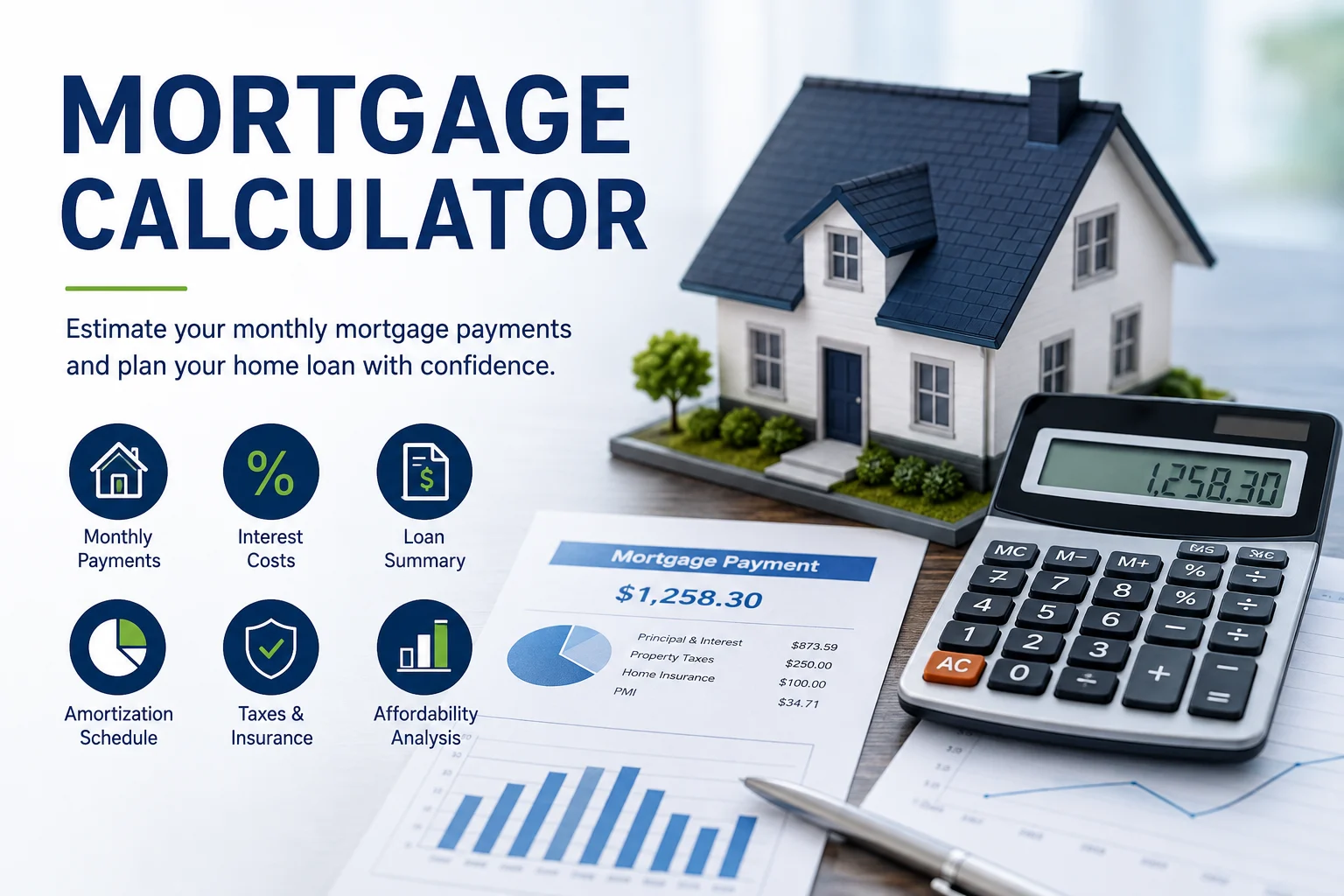

The Mortgage Calculator can be used to estimate your monthly mortgage payment, total interest, loan balance, and overall borrowing costs. It can help you compare different home prices, down payments, interest rates, loan terms, and mortgage options before applying for a home loan.
A mortgage calculator is useful when buying a home because the amount you borrow is only one part of the total cost of homeownership. Your monthly payment may also include property taxes, homeowners insurance, mortgage insurance, and other costs. The Consumer Financial Protection Bureau (CFPB) notes that the total monthly mortgage payment can be higher than the principal and interest payment shown by a basic calculator.
This calculator provides estimates to help you understand how different mortgage scenarios may affect your budget. Your actual payment and loan costs depend on the terms offered by your lender.
How the Mortgage Calculator Works
A Mortgage Calculator uses several pieces of information to estimate your monthly payment.
Common inputs include:
- Home price
- Down payment
- Loan amount
- Interest rate
- Loan term
- Property taxes
- Homeowners insurance
- Mortgage insurance
- HOA fees, when applicable
- Additional principal payments
For a typical fixed rate mortgage, the principal and interest payment depends mainly on the loan amount, interest rate, and loan term.
The calculator can then add estimated taxes, insurance, and mortgage insurance to provide a more realistic estimate of your total monthly housing cost.
What Is a Mortgage?
A mortgage is a loan used to purchase or refinance real estate. The property generally serves as security for the loan.
When you take out a mortgage, you agree to repay the borrowed amount, known as the principal, plus interest according to the terms of the loan.
A typical mortgage payment can include four major components:
| Component | Meaning |
|---|---|
| Principal | The amount borrowed that you repay |
| Interest | The lender’s charge for providing the loan |
| Taxes | Property taxes that may be collected through escrow |
| Insurance | Homeowners insurance and potentially mortgage insurance |
These four components are often referred to as PITI, meaning Principal, Interest, Taxes, and Insurance.
Your total monthly housing cost can also include other expenses, such as HOA dues.
Principal and Interest
The principal is the amount you borrowed to purchase the home.
For example, if you buy a $400,000 home and make a $80,000 down payment, your initial mortgage principal would generally be:
$400,000 − $80,000 = $320,000
The interest is the cost charged by the lender for lending you the money.
Each mortgage payment typically contains both principal and interest.
At the beginning of a standard amortizing mortgage, a larger portion of the payment generally goes toward interest because the outstanding loan balance is still high. As the balance decreases, more of each payment goes toward principal.
What Is a Down Payment?
A down payment is the portion of the home’s purchase price that you pay upfront rather than borrowing.
For example:
Home price = $400,000
Down payment = $80,000
Mortgage = $320,000
A larger down payment generally means you borrow less money.
This can reduce the amount of interest paid over the life of the loan. Depending on the loan type and down payment, it may also affect whether mortgage insurance is required.
However, putting more money down also means using more of your available cash for the purchase.
Loan Amount
The loan amount is the amount you borrow from the mortgage lender.
A simple calculation is:
Loan Amount = Home Price − Down Payment
For example:
| Home Price | Down Payment | Estimated Loan Amount |
|---|---|---|
| $300,000 | $60,000 | $240,000 |
| $400,000 | $80,000 | $320,000 |
| $500,000 | $100,000 | $400,000 |
| $600,000 | $120,000 | $480,000 |
The actual amount you can borrow depends on factors such as your income, debts, credit history, assets, lender requirements, and the property.
Mortgage Interest Rate
The interest rate is one of the most important factors affecting your mortgage payment.
A higher interest rate generally results in:
- Higher monthly principal and interest payments
- More interest paid over the loan term
- Higher total borrowing costs
A lower interest rate generally results in lower principal and interest payments, assuming the loan amount and term remain the same.
Even a relatively small difference in the interest rate can have a significant effect over a long mortgage term.
Mortgage Loan Term
The loan term is the length of time scheduled for repayment.
Common mortgage terms include:
- 10 years
- 15 years
- 20 years
- 25 years
- 30 years
A longer loan term usually produces a lower required monthly principal and interest payment because the repayment is spread over more months.
However, a longer term can result in substantially more total interest paid.
A shorter term generally produces higher monthly payments but can reduce total interest costs.
15 Year vs. 30 Year Mortgage
The difference between a 15 year and 30 year mortgage can be significant.
Consider a hypothetical $300,000 fixed rate mortgage at 6% interest, excluding taxes, insurance, and other costs.
| Loan Term | Approx. Monthly P&I | Approx. Total Interest |
|---|---|---|
| 15 years | $2,532 | $155,800 |
| 30 years | $1,799 | $347,500 |
These figures are illustrative estimates and assume the same interest rate for the entire loan term.
The 30 year mortgage has a lower required monthly payment, but the 15 year mortgage pays down the principal faster and results in considerably less total interest.
Mortgage Payment Formula
For a standard fixed rate mortgage, the monthly principal and interest payment can be calculated using an amortization formula.
The formula is:
M = P × [r(1 + r)ⁿ] ÷ [(1 + r)ⁿ − 1]
Where:
- M = monthly principal and interest payment
- P = principal loan amount
- r = monthly interest rate
- n = total number of monthly payments
To convert an annual interest rate into a monthly rate:
r = annual interest rate ÷ 12
To calculate the number of payments:
n = loan term in years × 12
For example, a 30 year mortgage has:
30 × 12 = 360 monthly payments
This formula is used for standard amortizing fixed rate mortgages. Lenders use mathematical formulas to calculate payments that allow the loan to be paid off over the scheduled term when all required payments are made.
Example Mortgage Calculation
Suppose you purchase a home for $400,000.
You make a 20% down payment.
Your down payment is:
$400,000 × 20% = $80,000
Your estimated mortgage amount is:
$400,000 − $80,000 = $320,000
Assume:
- Loan amount = $320,000
- Interest rate = 6%
- Loan term = 30 years
Your estimated monthly principal and interest payment would be approximately $1,919.
This is not necessarily your complete monthly housing payment.
You may also need to account for:
- Property taxes
- Homeowners insurance
- Mortgage insurance
- HOA dues
The CFPB recommends considering these additional costs when determining whether a mortgage is affordable.
What Is Amortization?
Mortgage amortization is the process of paying down a loan through scheduled payments over time.
At the beginning of a typical mortgage, your outstanding balance is large. Because interest is calculated based on the remaining balance, more of your payment initially goes toward interest.
As you make payments:
Loan balance decreases → Interest decreases → More payment goes toward principal
Near the end of the mortgage, most of the payment goes toward reducing the remaining principal.
This gradual shift is called amortization.
Mortgage Amortization Schedule
An amortization schedule shows how every payment affects your mortgage.
A simplified example might look like this:
| Payment | Monthly Payment | Interest | Principal | Remaining Balance |
|---|---|---|---|---|
| 1 | $1,919 | $1,600 | $319 | $319,681 |
| 2 | $1,919 | $1,598 | $321 | $319,359 |
| 3 | $1,919 | $1,597 | $322 | $319,037 |
| 12 | $1,919 | Lower | Higher | Lower |
The exact figures depend on the loan amount, interest rate, payment date, and loan terms.
Over time, the interest portion generally decreases while the principal portion increases.
Total Monthly Mortgage Payment
Your mortgage payment may be more than principal and interest.
A more complete calculation can be represented as:
Total Monthly Payment = Principal + Interest + Taxes + Insurance + Mortgage Insurance + Other Applicable Costs
The CFPB explains that total mortgage payments can include homeowners insurance, property taxes, and mortgage insurance when applicable.
Principal
Principal reduces the amount you owe.
Interest
Interest is the cost of borrowing money.
Property Taxes
Property taxes are generally assessed by state or local governments.
If taxes are included in escrow, part of each monthly payment may be set aside for future tax bills.
Homeowners Insurance
Homeowners insurance helps protect against covered property losses and other risks according to the policy.
Mortgage Insurance
Mortgage insurance may be required depending on the loan type, down payment, and lender requirements.
HOA Fees
If you purchase a property in a homeowners association, HOA dues may apply.
These fees are often separate from the mortgage payment itself.
Property Taxes and Mortgage Payments
Property taxes can have a significant effect on the cost of homeownership.
For example, suppose annual property taxes are $6,000.
The approximate monthly amount is:
$6,000 ÷ 12 = $500
If the mortgage principal and interest payment is $2,000, the estimated payment becomes:
$2,000 + $500 = $2,500
This still excludes homeowners insurance, mortgage insurance, and other applicable costs.
Property taxes can also change over time, so the amount included in an escrow payment may not remain constant.
Homeowners Insurance
Homeowners insurance is another cost that should be included when estimating your total housing expense.
Suppose annual homeowners insurance costs $1,800.
The monthly equivalent is:
$1,800 ÷ 12 = $150
If your principal and interest payment is $2,000 and property taxes are $500 per month, adding insurance would produce:
$2,000 + $500 + $150 = $2,650
This provides a more realistic estimate than looking only at the principal and interest payment.
Mortgage Insurance
Mortgage insurance may be required for certain mortgage loans, particularly when the down payment is relatively small.
The exact requirements depend on the loan program and lender.
Mortgage insurance is an additional cost, so it should be included when estimating the total monthly payment.
PITI Mortgage Payment
The term PITI stands for:
Principal + Interest + Taxes + Insurance
These are the four basic components of many mortgage payments.
For example:
| Cost | Monthly Amount |
|---|---|
| Principal | $350 |
| Interest | $1,550 |
| Property Taxes | $500 |
| Homeowners Insurance | $150 |
| Total PITI | $2,550 |
Mortgage insurance and HOA fees can create additional costs beyond PITI.
Fixed Rate Mortgage
A fixed rate mortgage has an interest rate that generally remains unchanged for the loan term.
For a standard fixed rate mortgage, the combined principal and interest payment generally stays the same throughout the loan when payments are made as scheduled. However, the total payment can change if property taxes, homeowners insurance, or other escrow costs change.
Advantages of a Fixed Rate Mortgage
- Predictable principal and interest payments
- Easier long term budgeting
- Protection from rising interest rates
- Straightforward amortization
- Easier comparison between loan offers
Disadvantages of a Fixed Rate Mortgage
- The initial rate may be higher than some adjustable rate mortgages
- Refinancing may be necessary to obtain a lower rate later
- You may pay more interest than with a shorter loan term
Adjustable Rate Mortgage
An Adjustable Rate Mortgage (ARM) has an interest rate that can change after an initial period.
For example, a 5/1 ARM generally means the initial interest rate remains fixed for five years and then adjusts according to the loan terms, commonly once per year.
The actual structure depends on the mortgage agreement.
The CFPB notes that ARM rates and payments can change based on factors such as the index, adjustment schedule, and rate caps.
Advantages of an ARM
- Potentially lower initial interest rate
- Lower initial payment in some situations
- May be useful for borrowers who expect to move before the adjustment period
- Can provide flexibility for certain financial situations
Risks of an ARM
- Monthly payments can increase
- Future interest costs can be uncertain
- Rate caps limit adjustments but do not eliminate payment risk
- Refinancing may not always be available when expected
Borrowers considering an ARM should understand the maximum potential rate and payment before accepting the loan.
Mortgage Calculator for Affordability
A mortgage calculator can help estimate how much home you may be able to afford.
However, the largest mortgage you qualify for is not necessarily the mortgage you can comfortably afford.
A practical affordability calculation should consider your complete monthly budget.
Include:
- Mortgage principal and interest
- Property taxes
- Homeowners insurance
- Mortgage insurance
- HOA fees
- Utilities
- Maintenance
- Other debts
- Emergency savings
- Retirement contributions
- Other regular expenses
The CFPB recommends estimating property taxes and homeowners insurance when deciding how much you can afford to spend on a home.
How Much House Can I Afford?
A mortgage calculator can work backward from a target monthly payment to estimate a potential loan amount.
For example, suppose you decide that you can comfortably allocate $2,500 per month toward housing.
If property taxes, insurance, and other required costs total $600 per month, you have approximately:
$2,500 − $600 = $1,900
available for principal and interest.
You can then use the mortgage calculator to estimate the loan amount that produces a principal and interest payment near $1,900.
This approach can be more useful than simply asking how much a lender is willing to lend.
How Interest Rates Affect Mortgage Payments
Interest rates can dramatically affect mortgage costs.
Consider a hypothetical $300,000, 30 year fixed rate mortgage:
| Interest Rate | Approx. Monthly P&I | Approx. Total Interest |
|---|---|---|
| 4% | $1,432 | $215,600 |
| 5% | $1,610 | $279,600 |
| 6% | $1,799 | $347,500 |
| 7% | $1,996 | $418,500 |
| 8% | $2,201 | $492,500 |
These are illustrative calculations and exclude taxes, insurance, mortgage insurance, and other costs.
The table demonstrates why comparing interest rates can be important when shopping for a mortgage.
How Down Payment Affects Mortgage Costs
A larger down payment reduces the amount you need to borrow.
Suppose a home costs $400,000.
| Down Payment | Down Payment Amount | Estimated Loan Amount |
|---|---|---|
| 5% | $20,000 | $380,000 |
| 10% | $40,000 | $360,000 |
| 20% | $80,000 | $320,000 |
| 30% | $120,000 | $280,000 |
A smaller loan generally means lower principal and interest payments.
However, using more cash for a down payment can reduce your available funds for closing costs, emergencies, repairs, and other expenses.
Extra Mortgage Payments
Making additional principal payments can potentially help you pay off a mortgage sooner and reduce interest costs.
For example, suppose your required payment is $2,000 per month. You might choose to make an additional $200 principal payment when permitted by your loan terms.
The additional payment can reduce the outstanding principal faster.
However, borrowers should check their mortgage agreement for prepayment penalties or other restrictions. Some mortgage loans may have a fee for paying the loan off early.
Mortgage Calculator With Extra Payments
A calculator can compare different payment strategies.
For example:
| Strategy | Required Payment | Extra Principal |
|---|---|---|
| Standard | $2,000 | $0 |
| Extra $100 | $2,000 | $100 |
| Extra $250 | $2,000 | $250 |
| Extra $500 | $2,000 | $500 |
Additional payments can shorten the repayment period and reduce the amount of interest paid, depending on the loan terms and how the lender applies the payment.
Closing Costs and Other Home Buying Expenses
Your mortgage payment is only one part of the cost of purchasing a home.
Other expenses can include:
- Loan origination charges
- Appraisal fees
- Inspection costs
- Title services
- Recording fees
- Prepaid taxes
- Prepaid insurance
- Discount points
- Escrow deposits
- Moving expenses
- Initial repairs
- Home improvements
A mortgage calculator should therefore be used as one part of the home buying process rather than as the only financial planning tool.
Mortgage Calculator vs. Loan Estimate
A mortgage calculator provides an estimate based on information you enter.
A Loan Estimate is a lender provided document that gives specific information about the loan being offered.
The CFPB recommends reviewing the Loan Estimate carefully, including projected payments, loan terms, and other costs.
Once you receive actual loan information, replace your calculator estimates with the lender’s figures when assessing affordability.
How to Use a Mortgage Calculator
Follow these steps to estimate your mortgage payment:
Step 1: Enter the Home Price
Enter the purchase price of the property.
Step 2: Enter Your Down Payment
Enter the amount or percentage you expect to pay upfront.
Step 3: Enter the Interest Rate
Use the interest rate you expect to receive or compare several possible rates.
Step 4: Select the Loan Term
Choose the expected repayment period, such as 15 or 30 years.
Step 5: Add Property Taxes
Enter your estimated annual property tax amount if the calculator supports it.
Step 6: Add Homeowners Insurance
Enter your estimated annual insurance cost.
Step 7: Add Mortgage Insurance
If applicable, include your estimated mortgage insurance cost.
Step 8: Review the Results
Look at:
- Monthly payment
- Principal and interest
- Total interest
- Total loan cost
- Remaining balance
- Amortization schedule
Step 9: Compare Scenarios
Change the interest rate, down payment, loan term, or home price to see how each variable affects your results.
Common Mortgage Calculator Mistakes
Looking Only at Principal and Interest
One of the most common mistakes is assuming the principal and interest payment represents the complete monthly housing cost.
Taxes, insurance, and mortgage insurance can increase the actual payment.
Ignoring Property Taxes
Property taxes can add hundreds of dollars per month depending on the property and location.
Forgetting Homeowners Insurance
Insurance should be included when estimating your total housing cost.
Choosing a Home Based Only on Maximum Qualification
A lender’s maximum loan amount does not necessarily represent a comfortable personal budget.
Ignoring Maintenance Costs
Homeowners are responsible for repairs and maintenance that renters may not pay directly.
Assuming an ARM Payment Will Stay the Same
An adjustable rate mortgage can change after the initial fixed period.
Ignoring Closing Costs
A down payment is not necessarily the only cash required to purchase a home.
FAQs About Mortgage Calculators
What does a mortgage calculator calculate?
A mortgage calculator can estimate your monthly mortgage payment, principal, interest, total interest, loan balance, and other housing costs depending on the calculator.
What information do I need for a mortgage calculator?
You generally need the home price, down payment, loan amount, interest rate, and loan term. Additional inputs may include property taxes, homeowners insurance, mortgage insurance, and HOA fees.
How is a mortgage payment calculated?
A standard fixed rate mortgage payment is calculated using the loan amount, monthly interest rate, and total number of payments. Additional costs can then be added to estimate the total monthly payment.
What is PITI?
PITI stands for Principal, Interest, Taxes, and Insurance. These are four common components of a mortgage payment.
Does a mortgage calculator include taxes and insurance?
Some calculators do and some do not. Always check the calculator’s inputs. A basic principal and interest calculation may significantly underestimate your total monthly housing cost if taxes and insurance are excluded.
Is a 15 year mortgage better than a 30 year mortgage?
Neither is automatically better for everyone. A 15 year mortgage generally has higher monthly payments but can result in lower total interest. A 30 year mortgage generally provides a lower required monthly payment but can cost more interest over the full term.
What happens when mortgage rates increase?
Higher interest rates generally increase the monthly principal and interest payment for a new mortgage and can increase the total interest paid over the loan term.
Can I use a mortgage calculator to determine how much house I can afford?
Yes, a mortgage calculator can help estimate affordability. However, you should include taxes, insurance, mortgage insurance, HOA fees, other debts, savings needs, and regular living expenses before deciding on a home price.
Does paying extra on a mortgage save interest?
Additional principal payments can reduce the outstanding balance faster and may reduce future interest. Check your loan terms for any prepayment penalties or restrictions.
What is mortgage amortization?
Mortgage amortization is the process through which scheduled payments gradually reduce the loan balance. Early payments generally contain a larger interest component, while later payments generally contain a larger principal component.
What is the difference between APR and interest rate?
The interest rate is the rate used to calculate interest on the loan. The Annual Percentage Rate (APR) is a broader measure that can incorporate certain interest and loan costs, making it useful for comparing some mortgage offers.
Final Thoughts
A Mortgage Calculator is a useful tool for estimating monthly mortgage payments and understanding the long term cost of borrowing.
By entering your home price, down payment, interest rate, and loan term, you can estimate your principal and interest payment. Adding property taxes, homeowners insurance, mortgage insurance, and other applicable expenses provides a more realistic picture of your total monthly housing cost.
The calculator can also help you compare 15 year and 30 year mortgages, fixed rate and adjustable rate mortgages, different down payments, interest rates, and extra payment strategies.
Remember that calculator results are estimates. Your actual mortgage payment depends on the terms of your loan, lender requirements, property costs, taxes, insurance, and other expenses. Before committing to a mortgage, review the lender’s official loan documents and make sure the complete payment fits comfortably within your budget.







Pingback: PTSO Meaning Slang |PTSO Meaning in Text, What It Really Means in Texts & Social Media
Pingback: Carom Meaning | Definition, Uses, Examples & Context
Pingback: Aura Meaning | What Does Aura Mean in Slang and Text?
Pingback: Sapiosexual Meaning | What Does Sapiosexual Mean?
Pingback: fsigma Meaning | What Does fsigma Mean in Text ?
Pingback: HVAC Meaning | What HVAC Stands For and How It Works
Pingback: ENM Meaning | What Does ENM Mean in Text and Dating?
Pingback: IMO Meaning | What Does IMO Mean in Text and Chat?
Pingback: Zionist Meaning | What Does Zionist Mean?
Pingback: SDIYBT Meaning | What Does SDIYBT Mean in Slang?
Pingback: Dipsy Meaning | What Does Dipsy Mean in Slang?
Pingback: Seaver Meaning | Definition, Uses, and Common Contexts Explained
Pingback: MYA Meaning | What It Means in Text, Slang, and Online Chats
Pingback: Gnarly Meaning | What It Means in Slang, Text, and Everyday Use