
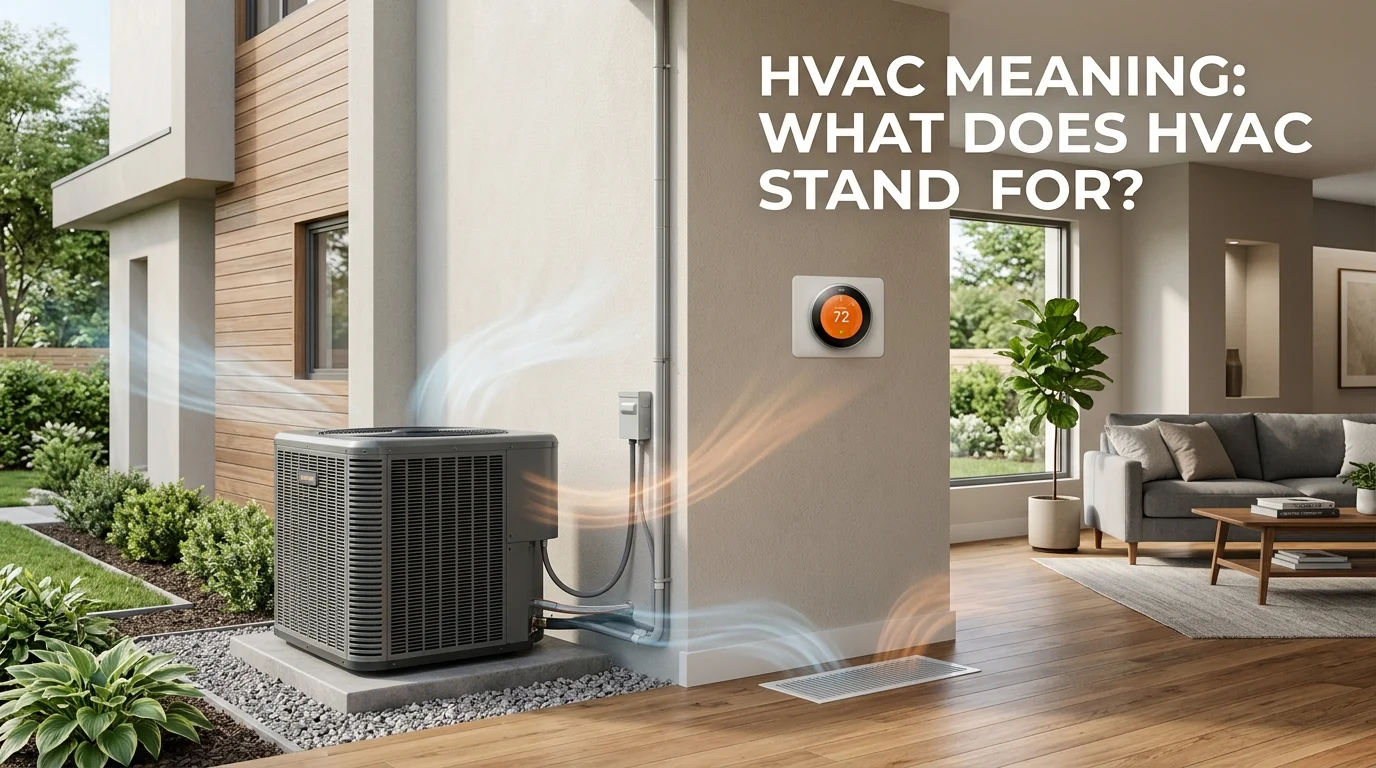

When you see HVAC on a home listing, service invoice, job description, or equipment label, you may wonder what the acronym actually means. HVAC stands for heating, ventilation, and air conditioning, a broad term for systems that help control indoor temperature, airflow, and air quality. The HVAC meaning is therefore more technical than slang or internet shorthand. Depending on the context, HVAC can refer to an entire climate-control system, a specific piece of equipment, or the industry and professionals who install and maintain these systems. Understanding the HVAC full form makes it much easier to interpret conversations about buildings, repairs, energy use, and indoor comfort.
What Does HVAC Mean?
HVAC means “heating, ventilation, and air conditioning.” It describes the technologies and systems used to heat or cool indoor spaces, move and filter air, and maintain comfortable indoor conditions.
| Detail | Explanation |
|---|---|
| Full Form | Heating, Ventilation, and Air Conditioning |
| Main Meaning | Systems that control indoor temperature and airflow |
| Common Contexts | Homes, offices, buildings, vehicles, and commercial facilities |
| Type | Technical acronym |
| Formal or Informal | Both, but primarily professional and technical |
The three parts of HVAC describe related functions. Heating keeps a building warm during cold weather. Ventilation moves indoor and outdoor air to improve circulation and help manage pollutants, moisture, and odors. Air conditioning cools and often dehumidifies indoor air.
For example, if someone says, “The HVAC needs to be serviced,” they usually mean the building’s heating and cooling system needs inspection or maintenance.
What Is the HVAC Full Form?
The HVAC full form is Heating, Ventilation, and Air Conditioning. Each word represents an important part of indoor climate control.
Heating
Heating systems raise indoor temperatures when outside conditions are cold. Common examples include furnaces, boilers, heat pumps, and electric heating systems.
Ventilation
Ventilation involves bringing in fresh outdoor air, removing stale indoor air, or circulating air through a building. Depending on the system, ventilation can also involve filtration and humidity management.
Air Conditioning
Air conditioning removes heat from indoor air to make a space cooler. Many air-conditioning systems also reduce humidity, making the indoor environment feel more comfortable.
Although these functions are described separately, modern systems can combine several of them. A central HVAC system, for example, may heat, cool, filter, and distribute air throughout an entire building.
How Does an HVAC System Work?
The exact process depends on the type of HVAC equipment, but the basic goal is to create and maintain comfortable indoor conditions.
A thermostat typically tells the system when heating or cooling is needed. The equipment then conditions the air before fans or ductwork distribute it through the building.
In a forced-air system, for example, air is pulled into the equipment, heated or cooled, and sent through supply ducts into different rooms. Return ducts bring air back toward the system so it can be conditioned again.
Ventilation can occur naturally through windows and building openings or mechanically through fans, ducts, and dedicated ventilation equipment. Modern systems may also use filters and other components to improve indoor air quality.
What Does HVAC Mean in Different Contexts?
The basic HVAC meaning stays largely the same across industries, but people may use the acronym to describe different things.
| Context | What HVAC Usually Refers To |
|---|---|
| Home maintenance | Heating and cooling equipment serving a house |
| Construction | Building climate-control systems and installation work |
| Repair service | Equipment requiring inspection, maintenance, or repair |
| Workplace | The building’s heating, cooling, and ventilation infrastructure |
| HVAC industry | The professional field involving climate-control systems |
Someone saying, “I work in HVAC,” usually means they work in the heating, ventilation, and air-conditioning industry. That could include installation, repair, maintenance, design, sales, or other technical work.
In contrast, “Our HVAC is broken” generally refers to equipment in a particular building rather than the industry itself.
HVAC Meaning in Text and Chat
Unlike many internet abbreviations, HVAC is not primarily a texting or social-media slang term. Its meaning in text messages, email, workplace chats, and online discussions is normally the same technical meaning: heating, ventilation, and air conditioning.
For example:
Person A: “The house feels freezing.”
Person B: “Maybe the HVAC isn’t working properly.”
Here, HVAC refers to the home’s heating and cooling system.
You may see the acronym in conversations about home repairs, apartments, construction projects, energy bills, maintenance appointments, or building temperatures. The surrounding conversation usually makes the meaning obvious.
Does HVAC Mean Something Different on TikTok or Snapchat?
Generally, HVAC does not have a separate standard slang meaning on TikTok or Snapchat. If the acronym appears in a social-media post about homes, construction, tools, repairs, careers, or climate control, it almost certainly refers to heating, ventilation, and air conditioning.
For example, a TikTok about replacing a furnace might use “HVAC” as a professional industry term. A Snapchat message saying “The HVAC guy is coming tomorrow” would likewise refer to a heating, ventilation, and air-conditioning technician or service provider.
Social platforms can contain niche abbreviations, but you should not assume HVAC has a secret slang definition simply because it appears in a casual post.
How Context Helps You Understand HVAC
Because HVAC is a technical acronym, context usually tells you exactly what the speaker means.
Consider these examples:
“The HVAC system isn’t cooling the house.”
Here, HVAC clearly refers to the home’s climate-control equipment.
“I’m studying HVAC at trade school.”
In this case, HVAC refers to the technical field or occupation.
“We need an HVAC contractor for the new building.”
Here, the term relates to professional installation or servicing.
“Check the HVAC settings before the meeting.”
The speaker is referring to the building’s heating, cooling, or ventilation controls.
The words surrounding HVAC are usually more useful than capitalization, emojis, or punctuation. Unlike slang that can change meaning based on tone, HVAC generally retains its technical definition across contexts.
Real Conversation Examples
1: Home Repair
Person A: “Why is the upstairs so hot?”
Person B: “The HVAC may need to be checked.”
Meaning: The person suspects there may be a problem with the home’s heating, cooling, or air-distribution system.
2: Workplace
Person A: “Can you lower the temperature in the conference room?”
Person B: “I’ll contact facilities about the HVAC.”
Meaning: The speaker is referring to the building’s climate-control system.
3: Career Conversation
Person A: “What kind of work are you looking for?”
Person B: “I’m training for a career in HVAC.”
Meaning: HVAC refers to the professional field involving heating, ventilation, air conditioning, and related systems.
What Is an HVAC System?
An HVAC system can include several pieces of equipment working together. The exact configuration depends on the building, climate, design, and desired functions.
Common HVAC components include:
- Thermostat: Measures or controls the desired indoor temperature.
- Furnace: Produces heat, commonly for forced-air heating systems.
- Air conditioner: Removes heat from indoor air.
- Heat pump: Transfers heat rather than simply generating it, allowing it to provide heating and cooling.
- Ductwork: Carries conditioned air through parts of a building.
- Air filters: Capture particles from circulating air.
- Fans or blowers: Help move air through the system.
- Ventilation equipment: Helps exchange or circulate indoor and outdoor air.
Not every HVAC system contains all of these components. For example, a building may use a system without traditional ductwork, while another may use separate equipment for ventilation and temperature control.
Common Types of HVAC Systems
Different buildings use different HVAC designs.
Central air systems use a centralized unit and typically distribute conditioned air through ductwork. They are common in many larger residential and commercial applications.
Ductless systems condition individual areas without requiring a traditional network of air ducts. Mini-split systems are a common example.
Heat pump systems can provide both heating and cooling by moving heat between indoor and outdoor spaces.
Furnace-based systems commonly use a furnace to heat air before distributing it through a building.
The best system depends on factors such as building size, climate, existing infrastructure, energy requirements, and installation constraints.
Is HVAC a Slang Term?
No. HVAC is primarily a technical acronym, not internet slang. You may encounter it in casual conversations, but its underlying meaning remains professional and industry-related.
This distinction matters when interpreting searches such as “HVAC meaning in text” or “HVAC meaning in chat.” Someone using HVAC in a message usually is not using a slang expression; they are simply shortening the technical phrase.
Common Mistakes About HVAC
| Common Mistake | Correct Understanding |
|---|---|
| Thinking HVAC only means air conditioning | HVAC includes heating, ventilation, and air conditioning |
| Assuming HVAC is internet slang | It is primarily a technical and professional acronym |
| Using HVAC to mean only a furnace | HVAC can refer to a complete climate-control system |
| Assuming every HVAC system uses ducts | Some systems, such as ductless systems, operate without traditional ductwork |
One of the most common misunderstandings is treating HVAC and air conditioning as identical. Air conditioning is only one component represented by the acronym.
HVAC vs. AC: What’s the Difference?
AC usually means air conditioning or an air conditioner, while HVAC is the broader term.
| Term | Meaning | Main Difference |
|---|---|---|
| HVAC | Heating, Ventilation, and Air Conditioning | Covers multiple climate-control functions |
| AC | Air conditioning | Primarily refers to cooling |
| Heating system | Equipment used to provide heat | Focuses on warming indoor spaces |
| Ventilation | Movement or exchange of air | Focuses on airflow and air exchange |
For instance, someone might say, “The AC isn’t working” when the cooling function has failed. Saying “The HVAC isn’t working” could refer to a broader problem involving heating, cooling, airflow, or another part of the system.
When to Use the Term HVAC
Use HVAC when you’re discussing heating, ventilation, air conditioning, or the systems and professionals associated with them.
The acronym is appropriate in:
- Home maintenance conversations
- Construction discussions
- Property management
- Workplace communication
- Technical education
- Repair appointments
- Equipment documentation
- Professional conversations within the industry
It is also perfectly normal in casual speech when everyone involved understands the term.
For a general audience unfamiliar with technical terminology, writing the full phrase once before using HVAC can make your explanation clearer.
When to Avoid the Term HVAC
There is usually no need to avoid HVAC in professional communication because it is a standard technical acronym. However, spelling it out can be helpful when communicating with someone who may not know the abbreviation.
For example, in a document intended for a broad audience, you might write “heating, ventilation, and air conditioning (HVAC)” the first time. After that, HVAC can be used throughout the rest of the document.
In highly technical settings, the acronym may be completely familiar and require no explanation.
HVAC Meaning: Quick Recap
- HVAC stands for heating, ventilation, and air conditioning.
- It describes systems used to control indoor temperature, airflow, and related indoor conditions.
- HVAC is a technical acronym rather than a standard internet slang term.
- The acronym can refer to equipment, a building system, or the professional HVAC industry depending on context.
- AC refers mainly to air conditioning, while HVAC is the broader term.
- On text messages and social platforms, HVAC normally keeps its standard technical meaning.
Frequently Asked Questions
What does HVAC mean in text?
HVAC means heating, ventilation, and air conditioning when used in text messages, chats, emails, or online conversations.
Is HVAC a slang term?
No, HVAC is a technical acronym used for heating, ventilation, and air-conditioning systems rather than conventional internet slang.
What does HVAC stand for?
HVAC stands for heating, ventilation, and air conditioning, covering systems that manage indoor temperature and airflow.
What does HVAC mean on TikTok?
HVAC generally has its standard technical meaning on TikTok, referring to heating, ventilation, air conditioning, or related work.
Is HVAC the same as AC?
No, AC generally refers to air conditioning, while HVAC is a broader term covering heating, ventilation, and air conditioning.
Final Thoughts
The HVAC meaning is straightforward: it stands for heating, ventilation, and air conditioning. The term describes systems and technology used to heat, cool, circulate, and manage air inside buildings. Unlike many abbreviations found in online conversations, HVAC is not normally slang, and its meaning usually stays consistent in text, chat, social media, and professional settings. Context can still clarify whether someone means a specific piece of equipment, an entire building system, or the HVAC industry. Once you know the full form, most references to HVAC are easy to understand.
Discover More Post:
Voila Meaning | What It Means and How to Use It Correctly
Elfin Meaning | Definition, Usage, Examples, and Context
Seles Meaning | What It Means in Text, Slang, and Online