
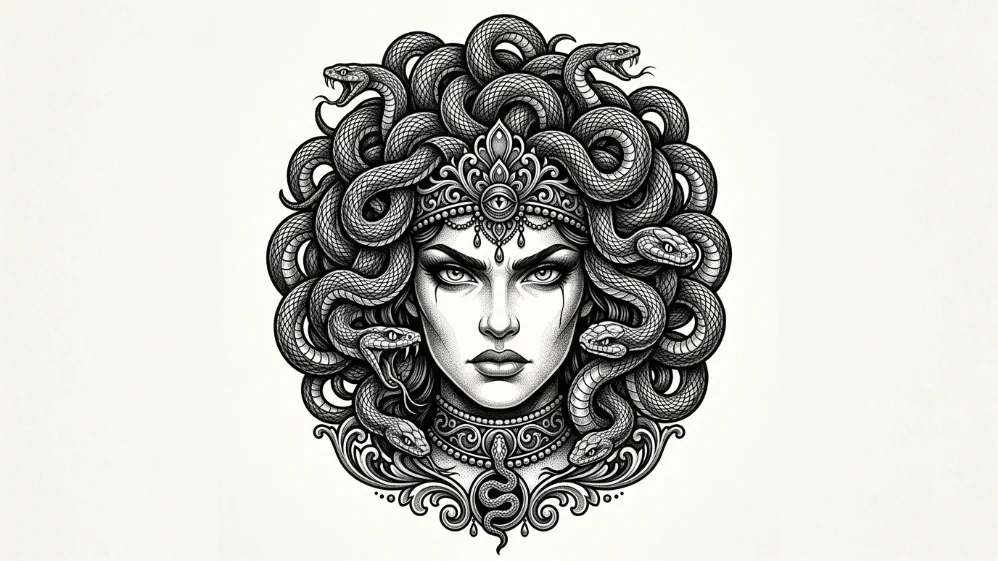

A Medusa tattoo is a powerful symbol representing strength, protection, and female empowerment. In modern culture, it has become an emblem for sexual assault survivors, symbolizing survival, reclaiming power, and combatting victim-blaming. Medusa’s image serves as an apotropaic symbol used to ward off negative forces and protect the wearer. The tattoo can also represent transformation, resilience, and fierce feminine energy.
If you have seen a striking tattoo of a woman with snakes for hair on social media or in real life, you might have wondered about the Medusa tattoo meaning. This ancient Greek mythological figure has experienced a remarkable transformation in popular culture. Once feared as a monstrous Gorgon, Medusa has become a powerful symbol of survival, strength, and female empowerment.
In recent years, the Medusa tattoo has gained significant attention, particularly on platforms like TikTok, where users share their personal stories and the deep significance behind their ink. The hashtag #medusatattoo has accumulated over 100 million views, highlighting the widespread interest in this powerful design.
This comprehensive guide explores everything you need to know about the Medusa tattoo meaning, from its mythological origins to its modern interpretations. Whether you are considering getting a Medusa tattoo yourself or simply curious about its significance, this article covers the full spectrum of meanings, symbolism, and cultural context.
Quick Answer Box
| Aspect | Details |
|---|---|
| Meaning | Strength, survival, protection, female empowerment, resilience, transformation |
| Primary Context | Sexual assault survivor symbol; feminist empowerment; protective emblem |
| Usage | Tattoo art, social media symbolism, personal empowerment statement |
| Platforms | TikTok, Instagram, Pinterest, tattoo culture |
| Example | A survivor getting a Medusa tattoo to reclaim their power and signify their journey |
| Tone | Empowering, protective, resilient, transformative |
What Does a Medusa Tattoo Mean?
The Medusa tattoo meaning is multifaceted and deeply personal. At its core, a Medusa tattoo represents strength, power, and female empowerment. However, the meaning extends far beyond these general interpretations.
Survival and Overcoming Adversity
For many individuals, particularly survivors of sexual violence, a Medusa tattoo symbolizes survival and the reclaiming of personal power. Medusa’s story in Greek mythology presents her as a victim who was wrongfully punished, making her a powerful emblem for those who have experienced similar injustices.
The tattoo serves as a visible reminder that the wearer has endured hardship and emerged stronger. It represents the journey from victimhood to survivorship and the refusal to be defined by past trauma.
Protection and Warding Off Evil
Historically, Medusa’s image was used as an apotropaic symbol, meaning it was believed to protect against and ward off negative forces. In ancient Greece, her face was often depicted on shields, temples, and armor to deter enemies and evil spirits.
This protective aspect carries into modern tattoo culture. Many choose a Medusa tattoo as a protective emblem, a shield against harm, and a warning to others not to cross their boundaries.
Female Empowerment and Strength
Medusa has become an iconic symbol of feminine power and strength. She represents a woman who refuses to be silenced, dismissed, or victimized. The Medusa tattoo meaning in this context is one of unapologetic self-assertion and fierce independence.
Transformation and Rebirth
Medusa’s story is fundamentally one of transformation. She was transformed from a beautiful maiden into a monstrous Gorgon with snakes for hair and a deadly gaze. This dramatic change represents the power of transformation in the face of adversity.
The snakes in her hair, which shed their skin, further symbolize rebirth, renewal, and the cyclical nature of life. A Medusa tattoo can therefore represent personal growth, metamorphosis, and the ability to reinvent oneself.
Reclaiming Power and Justice
The Medusa tattoo meaning also encompasses themes of justice and self-defense. It represents standing up for oneself, refusing to tolerate disrespect, and taking back power that was taken away. For many, getting a Medusa tattoo is an act of reclaiming agency and control over their own narrative.
The Mythological Origins of Medusa
To fully understand the Medusa tattoo meaning, it is essential to explore her origins in Greek mythology.
The Story of Medusa
Medusa was one of the three Gorgon sisters, daughters of Phorcys and Ceto. Unlike her immortal sisters, Medusa was mortal. She was originally a beautiful young woman who served as a priestess in the temple of Athena.
According to the Roman poet Ovid’s version of the myth, Medusa caught the attention of Poseidon, the god of the sea. Poseidon raped Medusa in Athena’s sacred temple. Enraged by the defilement of her temple, Athena punished Medusa by transforming her into a monster with snakes for hair and a gaze that turned anyone who looked at her into stone.
In some interpretations, Athena’s punishment was actually a form of protection, giving Medusa the power to defend herself from future harm. Regardless of the interpretation, Medusa’s story is one of victimization and unjust punishment.
Medusa’s Death
Medusa was eventually beheaded by the Greek hero Perseus, who used a bronze shield to avoid her deadly gaze. He used her severed head, which retained its petrifying power, as a weapon against his enemies. Perseus later gave Medusa’s head to Athena, who placed it on her shield, the Aegis.
The Apotropaic Symbol
In ancient Greek art, Medusa’s face was often used as an apotropaic symbol, an image believed to ward off evil. Her terrifying visage was thought to deter other dangerous threats, making her a powerful protective emblem.
Modern Interpretations and Significance
The #MeToo Movement and Survivor Symbolism
The Medusa tattoo meaning has evolved significantly in recent years, particularly in the context of the #MeToo movement. Medusa has become a powerful symbol for survivors of sexual assault and harassment, representing the strength to speak out and reclaim one’s power.
The tattoo serves as a visible declaration that the wearer is a survivor, not a victim. It challenges the culture of victim-blaming that often surrounds sexual violence and asserts that survivors should not be punished for the crimes committed against them.
The TikTok Trend
In late 2021 and again in mid-2022, sharing Medusa tattoos and their meanings became a significant trend on TikTok. Videos of users displaying their Medusa tattoos and explaining their personal significance garnered millions of views.
One TikTok user shared: “A lot of people didn’t realize the meaning of a Medusa tattoo. If you do, I am so sorry you went through this too. You are so strong”. Another explained: “That’s why a lot of people have this tattoo, because if they were victims, it is like empowering yourself, taking back your power type of thing”.
Feminist Symbolism
Medusa has long been a figure of interest in feminist discourse. Feminist theorist Hélène Cixous referenced Medusa in her 1975 manifesto, “The Laugh of the Medusa,” using her as a symbol of female creativity and liberation.
The Medusa tattoo meaning in a feminist context is one of resistance against patriarchal oppression, reclaiming the narrative of women who have been silenced, and embracing female rage as a legitimate and powerful emotion.
Medusa Tattoo Meaning: Key Themes
| Theme | Description |
|---|---|
| Survival | Enduring and overcoming trauma, particularly sexual assault |
| Protection | Warding off evil, defending against harm, setting boundaries |
| Empowerment | Reclaiming power, owning one’s identity, refusing to be silenced |
| Transformation | Personal growth, rebirth, metamorphosis through adversity |
| Resilience | Inner strength, mental fortitude, bouncing back from hardship |
| Feminine Strength | Fierce, unapologetic female energy and independence |
| Justice | Standing up for oneself, fighting against injustice and victim-blaming |
| Self-Defense | Protecting oneself, refusing to tolerate disrespect |
Different Design Styles and Their Meanings
The Medusa tattoo meaning can also be influenced by the specific design style chosen. Different artistic approaches can emphasize different aspects of her symbolism.
Traditional American Medusa Tattoos
Traditional American Medusa tattoos often depict her as a powerful figure who stands against adversity. These designs typically feature bold lines, vibrant colors, and a stylized interpretation of the Gorgon, emphasizing her strength and defiance.
Black and Grey Portrait Tattoos
Black and grey portrait tattoos of Medusa often present her with a modelesque face and haunting, pupil-less eyes. These designs emphasize her otherworldly, mysterious qualities and can convey a sense of melancholy or intensity.
Caravaggio-Inspired Medusa Tattoos
Inspired by the famous Baroque painting, Caravaggio-inspired Medusa tattoos depict her at the moment of her beheading. These designs emphasize the protective and defensive aspects of her symbolism, representing the ultimate shield against harm.
Medusa Statue Tattoos
These designs pay tribute to classical and modern sculptures of Medusa. They often emphasize her place in art history as a figure of power and prominence.
Weeping Medusa Tattoos
A weeping Medusa tattoo can represent themes of grief, loss, or unhealed wounds. This design reveals the depth of emotion hidden beneath her tough exterior and can symbolize the pain that often accompanies survival.
Perseus and Medusa Tattoos
Tattoos depicting the myth of Perseus beheading Medusa often focus on themes of strength, perseverance, and achieving impossible tasks. These designs can symbolize overcoming seemingly insurmountable odds.
Placement and Personal Expression
The placement of a Medusa tattoo can also influence its meaning and significance.
Large, Intricate Designs
Large, intricate Medusa tattoos on the chest or back can emphasize her role as a guardian and protector. These prominent placements make a bold statement and suggest that the wearer is fiercely protective of themselves.
Smaller, Delicate Tattoos
Smaller, more delicate Medusa tattoos can symbolize the complexity of her mystique, including her strength and vulnerability. These designs may be more personal and subtle, serving as a private reminder of the wearer’s journey.
Visible vs. Concealed Placement
Some survivors choose to get their Medusa tattoo in a visible location as a public declaration of their survival and empowerment. Others may prefer a more concealed placement, keeping the tattoo’s meaning private and personal.
What a Medusa Tattoo Does NOT Mean
It is important to clarify what a Medusa tattoo does not universally represent.
Not Always a Survivor Symbol
While many people get a Medusa tattoo to signify survival of sexual assault, not every person with a Medusa tattoo is a survivor. The significance of a tattoo is often highly personal, and many people choose Medusa simply for her aesthetic appeal or appreciation of Greek mythology.
Not a Sign of Evil or Monstrosity
Despite her monstrous appearance in mythology, a Medusa tattoo is not generally regarded as an offensive or evil symbol. Modern interpretations have largely reclaimed Medusa as a positive figure representing strength and empowerment.
Not a Single, Universal Meaning
The Medusa tattoo meaning is not fixed or universal. It can vary widely depending on the individual wearer’s intentions, experiences, and interpretations.
Medusa Tattoo Meaning: Real-Life Examples
Example 1: Survivor Empowerment
Scenario: A woman who survived sexual assault decides to get a Medusa tattoo on her forearm.
Meaning: The tattoo serves as a daily reminder of her strength and survival. It symbolizes her journey from victim to survivor and her refusal to be defined by her trauma. The visible placement allows her to share her story when she chooses and serves as a protective emblem.
Example 2: Feminist Statement
Scenario: A young woman gets a Medusa tattoo as a feminist symbol.
Meaning: The tattoo represents her rejection of patriarchal norms and her embrace of female power. Medusa’s image, once used to demonize women, is reclaimed as a symbol of strength, resistance, and unapologetic self-assertion.
3: Protection and Boundaries
Scenario: A person with a history of being taken advantage of gets a Medusa tattoo on their shoulder.
Meaning: The tattoo represents the wearer’s commitment to setting and maintaining strong boundaries. It serves as a warning to others not to cross the line and as a reminder to the wearer to trust their instincts and protect themselves.
Example 4: Transformation and Growth
Scenario: Someone who has overcome a difficult life transition gets a Medusa tattoo.
Meaning: The tattoo symbolizes the wearer’s transformation and personal growth. Just as Medusa was transformed from a beautiful maiden into a powerful figure, the wearer has undergone their own metamorphosis, emerging stronger and wiser.
Example 5: Appreciation of Mythology
Scenario: A fan of Greek mythology gets a Medusa tattoo simply because they love the story and imagery.
Meaning: The tattoo represents the wearer’s appreciation for classical mythology and art. While they may not have a personal connection to the survivor symbolism, they admire Medusa’s cultural significance and striking visual appeal.
Platform-Specific Meaning
TikTok
On TikTok, the Medusa tattoo has become a powerful symbol of survival and solidarity among sexual assault survivors. Users share their tattoos and personal stories, creating a community of support and empowerment. The hashtag #medusatattoo has millions of views, reflecting the widespread resonance of this symbolism.
On Instagram, Medusa tattoos are often showcased as works of art, with users sharing high-quality images of their designs. The platform emphasizes the aesthetic appeal of Medusa tattoos while also providing space for personal storytelling and meaning-making.
Pinterest serves as a source of inspiration for those considering a Medusa tattoo. Users can browse countless designs and styles, exploring different interpretations and finding ideas for their own tattoos.
On Reddit, discussions about Medusa tattoos often focus on the ethical considerations of getting one. Some users ask whether it is appropriate to get a Medusa tattoo if they are not a survivor, while others share their personal experiences and reasons for choosing the design.
How to Respond to Someone with a Medusa Tattoo
If you encounter someone with a Medusa tattoo, it is important to be respectful and considerate.
Do Not Assume
Do not assume that the wearer is a survivor of sexual assault. As noted, not everyone with a Medusa tattoo has that personal connection. The tattoo may have a different meaning for them.
Avoid Making Assumptions About Their Story
Avoid making assumptions about the wearer’s experiences or trauma. Everyone’s journey is unique, and it is not appropriate to pry or make insensitive comments.
If You Are a Fellow Survivor
If you are a survivor yourself, you might feel a sense of solidarity with someone who has a Medusa tattoo. A simple, respectful acknowledgment, such as a nod or a brief comment about appreciating their tattoo, can be a meaningful gesture without overstepping boundaries.
Respect Their Privacy
Remember that a tattoo is a personal expression. The wearer may not wish to discuss its meaning, and it is important to respect their privacy.
When NOT to Get a Medusa Tattoo
While Medusa tattoos are powerful and meaningful, they may not be appropriate for everyone in every situation.
If You Do Not Understand the Symbolism
It is important to understand the Medusa tattoo meaning and cultural significance before getting one. Getting a tattoo without understanding its symbolism can be disrespectful to those who carry it as a symbol of survival.
If You Are Not Prepared for Questions
Be prepared for questions about your tattoo. People may ask about its meaning, and you should be comfortable discussing it or politely declining to share.
If You Are Getting It Solely for Aesthetic Reasons
While it is perfectly fine to get a Medusa tattoo for its aesthetic appeal, it is important to be aware of its deeper meanings and to be respectful of those who have a personal connection to the symbolism.
If You Are Not Ready for the Commitment
Tattoos are permanent. Make sure you are fully committed to the design and its meaning before getting inked.
FAQs
1. What does a Medusa tattoo symbolize?
A Medusa tattoo symbolizes strength, protection, female empowerment, survival, transformation, and resilience. For many, it specifically represents survival of sexual assault and the reclaiming of personal power.
2. Is a Medusa tattoo only for sexual assault survivors?
No, a Medusa tattoo is not only for sexual assault survivors. While it has become a powerful symbol for survivors, many people get Medusa tattoos for other reasons, including appreciation of Greek mythology, feminist beliefs, or aesthetic appeal.
3. What is the meaning behind Medusa tattoo on TikTok?
On TikTok, the Medusa tattoo has become a symbol of survival and solidarity among sexual assault survivors. Users share their tattoos and personal stories, creating a community of support and empowerment.
4. What does Medusa represent in Greek mythology?
In Greek mythology, Medusa was one of the three Gorgons, a woman with snakes for hair whose gaze turned people to stone. She was originally a beautiful maiden who was raped by Poseidon and punished by Athena.
5. Why do people get Medusa tattoos?
People get Medusa tattoos for various reasons, including to symbolize survival of sexual assault, female empowerment, protection, transformation, or simply for aesthetic appreciation of the mythological figure.
6. Is a Medusa tattoo offensive?
No, a Medusa tattoo is generally not regarded as offensive. It has been reclaimed as a symbol of strength and empowerment, particularly for survivors of sexual violence.
7. What does a Medusa tattoo mean for a woman?
For a woman, a Medusa tattoo often symbolizes female empowerment, strength, and resilience. It can represent the refusal to be silenced or victimized and the embrace of powerful feminine energy.
8. What is the protective meaning of a Medusa tattoo?
The protective meaning of a Medusa tattoo stems from her use as an apotropaic symbol in ancient Greece, believed to ward off evil. The tattoo can serve as a shield against harm and a warning to others not to cross boundaries.
9. What does a Medusa tattoo mean in the context of #MeToo?
In the context of #MeToo, a Medusa tattoo represents solidarity with survivors of sexual assault and harassment, challenging victim-blaming culture and reclaiming power.
10. Can anyone get a Medusa tattoo?
Yes, anyone can get a Medusa tattoo. However, it is important to understand the symbolism and cultural significance of the design and to be respectful of those who have a personal connection to its meaning.
Related Terms and Variations
Understanding the Medusa tattoo meaning also involves familiarity with related terms and concepts that frequently appear in discussions about this symbol.
Apotropaic Symbol
An apotropaic symbol is an image or object believed to ward off evil. Medusa’s face was used as an apotropaic symbol in ancient Greece.
Gorgon
Medusa was one of the three Gorgon sisters, monstrous creatures with snakes for hair and the power to turn people to stone.
Gorgoneion
The Gorgoneion is the depiction of Medusa’s head, often used as a protective symbol.
Victim-Blaming
Victim-blaming occurs when the victim of a crime or wrongdoing is held partially or fully responsible for the harm they experienced. Medusa’s story is often used to challenge victim-blaming culture.
Reclaiming Power
Reclaiming power refers to the process of taking back control and agency after experiencing trauma or oppression. A Medusa tattoo can be a powerful act of reclaiming power.
#MeToo
The #MeToo movement is a social movement against sexual harassment and assault. Medusa has become a symbol for survivors within this movement.
Female Rage
Female rage refers to the anger and frustration experienced by women in response to injustice, oppression, and victimization. Medusa is often seen as a symbol of female rage.
Conclusion
The Medusa tattoo meaning is rich, complex, and deeply personal. From its origins in Greek mythology as a symbol of protection and danger to its modern interpretation as a powerful emblem of survival, female empowerment, and resilience, Medusa has undergone a remarkable transformation in cultural consciousness.
For many, particularly survivors of sexual assault, a Medusa tattoo is a visible declaration of strength, a reclaiming of power, and a refusal to be defined by trauma. For others, it represents feminist ideals, personal transformation, or simply an appreciation of classical art and mythology.
Regardless of the specific meaning, one thing is clear: the Medusa tattoo is far more than just a striking design. It is a symbol with deep historical roots and profound contemporary significance, carrying messages of protection, empowerment, and the indomitable human spirit.
If you are considering a Medusa tattoo, take the time to reflect on what the symbol means to you personally. Whether you are a survivor, a feminist, a mythology enthusiast, or simply someone who appreciates powerful imagery, a Medusa tattoo can be a meaningful and beautiful addition to your personal story.