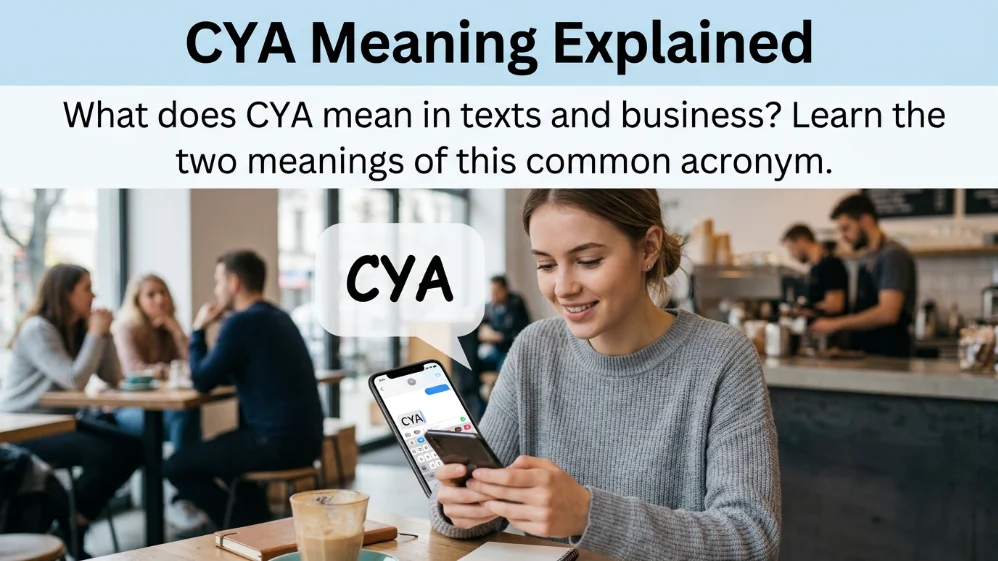

CYA stands for two things: “See You” (a casual goodbye in texts and chats) and “Cover Your Ass” (a workplace warning to protect yourself from blame). In texting and social media, CYA almost always means “See You” or “See Ya.” In business and professional settings, it means documenting everything to avoid responsibility for mistakes. Context is everything.
You are texting a friend and they drop a quick “CYA” before going offline. Or maybe your coworker sends an email with “CYA” in the subject line and you are not sure if they are saying goodbye or warning you about something.
What does CYA actually mean?
The short answer is that CYA has two completely different meanings. In casual digital communication, it is a friendly way to say goodbye. In professional environments, it is a warning to protect yourself from blame.
This guide breaks down everything you need to know about CYA meaning, including how to use it, where it comes from, and how to respond in any situation.
Quick Answer Box
| Element | Details |
|---|---|
| Meaning | “See You” (casual goodbye) or “Cover Your Ass” (protect yourself from blame) |
| Context | Texting, social media, workplace, business emails |
| Usage | Ending conversations casually; warning someone to document or protect themselves |
| Platforms | WhatsApp, Snapchat, Instagram, TikTok, text messages, work emails |
| Example | “Gotta go, CYA!” or “Always CYA with email receipts.” |
| Tone | Informal and friendly OR serious and cautionary |
What Does CYA Mean?
CYA is an acronym with two primary meanings depending on the context.
The first and most common meaning in everyday digital communication is “See You” (or “See Ya”). It is used as a casual farewell in text messages, social media DMs, and online chats. Think of it as a shorter way to say “goodbye” or “talk to you later.”
The second meaning is “Cover Your Ass.” This is a slang term used in professional, bureaucratic, or legal settings to describe actions taken to protect oneself from blame, criticism, or negative consequences. It is often used as a warning or piece of advice.
Full Definition
CYA as “See You”
When used as “See You,” CYA is an informal abbreviation that functions as a digital goodbye. It is similar to other farewell acronyms like TTYL (Talk To You Later) or BRB (Be Right Back), but it specifically indicates that the conversation is ending and you expect to see or talk to the person again soon.
Key characteristics:
- Friendly and casual
- Used among friends, family, and peers
- Common in text messages, DMs, and comments
- Often appears with emojis or extra letters for emphasis (e.g., “cyaaa”)
CYA as “Cover Your Ass”
As “Cover Your Ass,” CYA refers to the practice of protecting oneself from future criticism, legal trouble, or other repercussions. It originated in military slang in the 1950s and later became common in corporate and bureaucratic environments.
Key characteristics:
- Serious and cautionary
- Used in professional, legal, or risky situations
- Involves documentation, record-keeping, and accountability
- Can be viewed as defensive or self-protective behavior
Context and Usage
Understanding the context is the most important factor in interpreting CYA correctly. The same three letters can mean two entirely different things.
Casual Context (See You)
In casual settings like texting with friends, social media comments, or gaming chats, CYA almost always means “See You.” It is a quick and easy way to end a conversation without being rude.
When to use:
- Ending a text conversation
- Saying goodbye after a group chat
- Signing off from a social media live session
- Wrapping up a gaming session
When NOT to use:
- Formal emails or professional correspondence
- Job interviews or official documents
- Conversations with someone you do not know well
Professional Context (Cover Your Ass)
In professional settings, CYA takes on a completely different meaning. It refers to the practice of covering yourself by documenting decisions, keeping records, and ensuring you have evidence to protect yourself if something goes wrong.
When to use:
- Advising a colleague to document a conversation
- Reminding someone to get approval in writing
- Discussing risk management or compliance
- Warning about office politics or blame-shifting
When NOT to use:
- In front of clients or external stakeholders
- In formal presentations or official reports
- When it could be interpreted as admitting guilt or fear
Real-Life Examples
Here are five realistic conversation examples showing how CYA is used in different situations.
Example 1: Casual Goodbye Between Friends
Person A: “Alright, I am heading to the gym. Catch you later?”
Person B: “For sure. CYA!”
Person A: “CYA 👋”
Example 2: Ending a Group Chat
Person A: “Okay everyone, I am logging off for the night.”
Person B: “Same here. CYA tomorrow!”
Person C: “CYA guys, sleep well.”
Example 3: Workplace Warning
Person A: “My boss just asked me to approve that invoice without a PO.”
Person B: “Do not do it. Always CYA. Get it in writing first.”
Person A: “Good call. I will email him for confirmation.”
Example 4: Texting After a Meetup
Person A: “Great seeing you today! CYA soon.”
Person B: “CYA! Let us do it again next week.”
Example 5: Sarcastic or Playful Usage
Person A: “I cannot believe you ate the last slice of pizza.”
Person B: “CYA in court, my friend.”
Person A: “Haha, you are ridiculous.”
Platform-Specific Meaning
CYA is used differently across various platforms. Here is how it breaks down.
On WhatsApp, CYA is almost always used as a casual farewell meaning “See You” or “See You Around.” It is common in one-on-one chats and group conversations. People use it to end conversations quickly, often followed by emojis like 👋 or 😊.
Example: “Busy right now, CYA later!”
Snapchat
On Snapchat, CYA is used as a quick and friendly way to say goodbye, especially after sending a streak or ending a chat. The platform’s fast-paced nature makes abbreviations like CYA extremely popular.
Example: “Streak done, CYA tomorrow .”
On Instagram, CYA appears in comments, captions, and DMs. It is used to casually sign off or end a conversation. It fits the platform’s informal and visual-heavy vibe.
Example: “Great talking to you, CYA soon!”
TikTok
On TikTok, CYA is used in comments and DMs as a casual goodbye. It is also sometimes used in video captions or as a hashtag. The platform’s younger audience embraces slang and abbreviations.
Example: “That was hilarious, CYA in the next video!”
Text Messaging
In standard SMS and iMessage conversations, CYA is a common abbreviation for “See You.” It is used among friends, family, and acquaintances.
Example: “Class is over, CYA tomorrow .”
Alternative Meanings
While “See You” and “Cover Your Ass” are the two primary meanings, CYA can occasionally stand for other things depending on the context.
| Meaning | Context |
|---|---|
| Cover Your Assets | A more polite variation of “Cover Your Ass” |
| Cover Your Actions | Another euphemism for protecting yourself |
| See You Around | A slightly more casual version of “See You” |
| Cover Your Back | A synonym for protecting yourself |
| Cyanide | Rarely, in scientific or chemical contexts |
Some sources also list “Cover Your Arse” as the British version. In all cases, the meaning is about self-protection.
Related Terms and NLP Variations
Understanding related terms helps you grasp the full semantic ecosystem of CYA.
| Term | Meaning | Relationship to CYA |
|---|---|---|
| TTYL | Talk To You Later | Similar farewell acronym |
| BRB | Be Right Back | Similar short-term goodbye |
| CU | See You | Shorter version of “See You” |
| CYT | See You Tomorrow | Specific time-based farewell |
| Cover your butt | Polite version of “Cover Your Ass” | Euphemism |
| Cover your rear | Another polite version | Euphemism |
| CYA later | Expanded version of “See You” | Variation |
| CYA soon | Friendly goodbye | Variation |
How to Respond to CYA
Your response to CYA depends entirely on which meaning is being used.
Responding to “See You” CYA
If someone uses CYA as a goodbye, you can respond with:
- “CYA later!”
- “See you soon.”
- “Bye!”
- “Take care.”
- “CYA 👋”
Keep it casual and friendly. Match their tone. If they used emojis, feel free to use them too.
Responding to “Cover Your Ass” CYA
If someone uses CYA as a warning or piece of advice, your response should acknowledge the caution:
- “Good point, I will document everything.”
- “Got it, I will send that email right now.”
- “Thanks for the heads up.”
- “Already on it.”
- “Smart. I will cover myself.”
In professional settings, taking the advice seriously is the best response. Thank the person for looking out for you.
Misinterpretations
Because CYA has two very different meanings, misinterpretations are common. Here are some scenarios where things can go wrong.
Scenario 1: Professional Email Confusion
You send an email to your boss that ends with “CYA.” Your boss thinks you are saying “Cover Your Ass” and takes it as a sign that you are trying to avoid accountability. In reality, you meant “See You” as a casual sign-off.
Solution: Avoid using CYA in professional emails altogether. Use “See you” or “Talk soon” instead.
Scenario 2: Texting a Colleague
You text a colleague “CYA” after a work discussion. They interpret it as “Cover Your Ass” and think you are warning them about something. You actually meant “See You” as a casual goodbye.
Solution: If there is any ambiguity, spell it out. “See you later” or “Talk to you soon” is always clearer.
Scenario 3: Misreading Tone
A friend sends “CYA” after an argument. You think they are saying “Cover Your Ass” in a defensive way, but they are actually just saying goodbye.
Solution: Consider the relationship and the context. If you are unsure, ask for clarification.
When NOT to Use CYA
Knowing when NOT to use CYA is just as important as knowing when to use it.
Avoid CYA in:
- Formal emails to clients, executives, or people you do not know well
- Job applications or cover letters
- Academic writing or official reports
- Customer service communications
- Legal documents or contracts
- Conversations where the other person might not understand slang
Use Full Phrases Instead:
- “See you later” instead of “CYA”
- “Talk to you soon” instead of “CYA”
- “I will document that” instead of “CYA” (in professional contexts)
Usage Tips
For Casual Use
- Keep it friendly. CYA works best between friends and people you know well.
- Add emojis. A 👋 or 😊 can make it feel warmer.
- Do not overuse it. Using CYA in every conversation can feel repetitive.
- Match the tone. If the other person is formal, do not use slang.
For Professional Use
- Use it sparingly. Only use CYA with colleagues who understand the term.
- Mean it as advice. When you say “CYA,” you are warning someone to protect themselves.
- Do not use it in writing. Avoid putting “CYA” in emails or official documents.
- Explain if needed. If you use it verbally, make sure the other person understands.
FAQs
1. What does CYA mean in texting?
In texting, CYA most commonly means “See You.” It is a casual way to say goodbye or end a conversation.
2. What does CYA stand for?
CYA stands for either “See You” or “Cover Your Ass.” The meaning depends on the context.
3. Is CYA rude?
In casual contexts, CYA is not rude. It is a friendly and informal way to say goodbye. In professional contexts, it can be seen as crude or unprofessional.
4. What does CYA mean in business?
In business, CYA means “Cover Your Ass.” It refers to protecting yourself from blame by documenting decisions and keeping records.
5. Can CYA mean “See You Around”?
Yes, CYA is often used to mean “See You Around” or “See You Later” in casual conversations.
6. What is the difference between CYA and TTYL?
CYA means “See You” and is used as a goodbye. TTYL means “Talk To You Later” and implies you will continue the conversation at another time.
7. How do you pronounce CYA?
You can say it as “see ya” (/siː jə/) when using it as a goodbye, or spell it out letter by letter (/siː waɪ eɪ/) when referring to “Cover Your Ass”.
8. Is CYA used on Snapchat?
Yes, CYA is commonly used on Snapchat as a casual way to say goodbye.
9. What does CYA mean from a girl?
From a girl, CYA usually means “See You” as a casual goodbye. Extra letters or emojis can make it feel warmer or more affectionate.
10. What does CYA mean from a guy?
From a guy, CYA typically means a casual goodbye with no emotional depth unless context suggests otherwise.
11. Where did CYA originate?
CYA originated in military slang in the 1950s as “Cover Your Ass.” It later became popular in workplace culture and then in online messaging as “See You”.
12. What is a polite way to say CYA?
Polite alternatives include “See you later,” “Talk to you soon,” “Take care,” or “Have a good one.”
13. Can CYA be used in a formal email?
No, CYA should not be used in formal emails. Use full phrases like “See you” or “Talk soon” instead.
14. What does CYA mean in legal terms?
In legal terms, CYA refers to actions taken to protect oneself from liability or legal consequences.
15. Is CYA the same as “cover your butt”?
Yes, “cover your butt” is a more polite version of “Cover Your Ass”.
Conclusion
CYA is a versatile acronym with two very different meanings. In casual digital communication, it is a friendly and efficient way to say “See You.” In professional and bureaucratic settings, it is a serious warning to protect yourself from blame.
The key to using CYA correctly is understanding the context. When texting friends or posting on social media, CYA is perfectly fine. When writing a professional email or speaking with colleagues, it is better to avoid the acronym altogether.
Now that you know what CYA means, you can use it confidently in the right situations and avoid awkward misunderstandings. Whether you are saying goodbye to a friend or warning a coworker to document everything, CYA has you covered.