
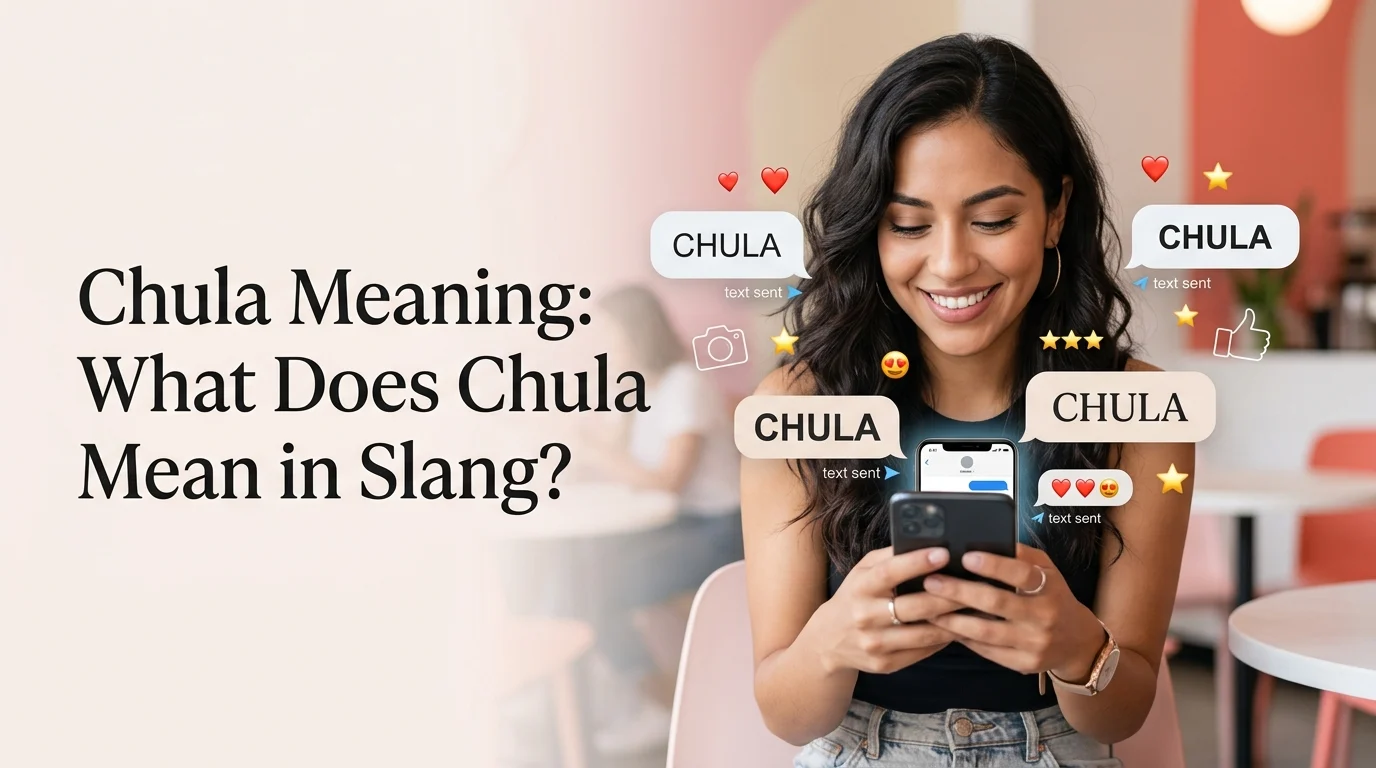

Someone may call you “chula” in a text, comment, or conversation, and the meaning can be unclear if you do not know Spanish slang. Chula usually means “cute,” “pretty,” “beautiful,” or “attractive,” especially when describing a woman or girl. It can also describe something stylish or charming. However, the exact feeling behind the word depends on the speaker, country, relationship, and surrounding conversation. In some Spanish-speaking regions, chula has meanings that are less positive or even vulgar. Understanding the context helps you tell whether someone is giving you a sweet compliment, flirting, or using a regional expression.
What Does Chula Mean?
The chula meaning is generally “pretty,” “cute,” “beautiful,” or “attractive.” It is the feminine form of chulo, a Spanish adjective that can describe a person or thing as appealing, charming, or stylish. It is not an acronym, so there is no standard “chula full form.”
| Detail | Explanation |
|---|---|
| Most common meaning | Cute, pretty, beautiful, or attractive |
| Full form | None; chula is a Spanish word |
| Tone | Usually friendly, affectionate, complimentary, or flirtatious |
| Common use | Casual conversations, social media, texts, and Spanish-speaking communities |
| Formal or informal | Mostly informal |
For example, someone might comment, “Qué chula!” under a photo. In a positive context, this can mean something like “How cute!” or “You look beautiful!”
Chula Slang Meaning Explained
In everyday informal Spanish, chula can be used to compliment a person, outfit, appearance, or even an object. Depending on the context, translations such as “cute,” “pretty,” “lovely,” “beautiful,” “attractive,” or “cool” may all work.
The word is especially useful because it can express more than physical beauty. Calling an outfit chula, for example, can suggest that it looks stylish or appealing. Calling a person chula may communicate affection as well as admiration.
Consider this example:
“Tu vestido está muy chula.”
The intended idea is that the dress looks cute, pretty, or attractive. In standard Spanish grammar, the adjective should agree with the noun, so a feminine noun such as vestido would normally take chulo, while falda would take chula. In casual online writing, however, learners and speakers sometimes use forms inconsistently.
When chula refers directly to a woman, the meaning can become more personal. “Eres muy chula” can be understood positively in many contexts as “You’re really cute” or “You’re lovely,” although regional usage matters.
Does Chula Have Different Meanings?
Yes. Although the positive “cute” or “pretty” meaning is common, chula is not interpreted identically in every Spanish-speaking region.
| Meaning | Context | Tone | Example |
| Pretty or cute | Casual Latin American Spanish | Positive | “Qué chula está tu foto.” |
| Attractive woman | Informal or romantic speech | Complimentary/flirty | “Ella es muy chula.” |
| Stylish or appealing | Describing clothing or objects | Positive | “Está chula esa chaqueta.” |
| Cocky or insolent | Some Spanish usage | Negative | “No te pongas chula.” |
| Regional vulgar meaning | Chilean usage | Vulgar | Meaning can differ substantially from the compliment |
Spanish dictionaries document positive meanings connected with beauty and attractiveness in countries including Mexico, Guatemala, and El Salvador, while Spanish usage also includes negative senses involving insolence or aggressive behavior.
In Chile, chula can also have a vulgar anatomical meaning, so using the word without knowing the local variety of Spanish can occasionally create an awkward misunderstanding.
How Context Changes the Chula Meaning
The surrounding words often tell you what someone means by chula. Look at the subject of the conversation, the relationship between the speakers, punctuation, emojis, and the way the word is used.
Here are a few examples:
“Qué chula tu nueva mochila 😍”
Here, chula clearly works as a compliment about an object. The heart-eyes emoji reinforces the positive tone.
“Estás bien chula hoy.”
When directed at a person, this can be a compliment about appearance and may sound flirtatious depending on the relationship.
“No te pongas chula conmigo.”
This is different. The expression can suggest “Don’t get smart with me” or “Don’t act cocky,” making the tone negative rather than affectionate.
“Mami chula ❤️”
This has a more romantic or sexualized flavor and can be understood roughly as “beautiful girl,” “hot girl,” or “hottie,” depending on context.
So, if you see chula in a message, do not translate it automatically as one fixed English word.
Chula Meaning in Text and on Social Media
There is generally no special TikTok, Snapchat, or Instagram definition that changes the basic Spanish meaning of chula. Online, people typically carry the same informal meanings into comments, captions, direct messages, and group chats.
On text messages, chula can be a casual compliment:
“That picture is chula!”
On Instagram, someone may use it to praise an outfit, appearance, or photo:
“Qué chula 😍”
On TikTok, it can appear in comments or captions when someone wants to describe a person or look as cute, attractive, or stylish.
On Snapchat, the meaning is similarly dependent on the conversation. A message such as “Te ves chula” is generally an appearance-based compliment in a positive Spanish-speaking context.
The platform itself usually matters less than the language and relationship between the people communicating.
Real Conversation Examples
Example 1: Friends
Person A: “Look at the jacket I bought.”
Person B: “Está chula!”
Meaning: Person B is saying the jacket looks cool, cute, or stylish.
Example 2: Dating Conversation
Person A: “I finally posted the picture from Saturday.”
Person B: “La vi. Estás muy chula 😍”
Meaning: The speaker is complimenting the person’s appearance, and the emoji makes the message sound warmer and potentially flirtatious.
Example 3: Argument
Person A: “I already told you I’m not doing that.”
Person B: “No te pongas chula.”
Meaning: Here, chula is connected with attitude or insolence rather than beauty, so the expression is closer to telling someone not to get smart or cocky.
Is Chula Rude?
Usually, no. When chula means cute, pretty, or attractive, it is generally a positive and informal expression.
However, the word can sound rude or confrontational when it appears in expressions about someone’s attitude. Regional differences also matter. A word that sounds completely harmless to one Spanish speaker may have a different association elsewhere.
If someone writes “Qué chula!” with a heart or smiling emoji, the intention is probably positive. If someone says “No te pongas chula,” the context points toward criticism or annoyance.
Is Chula Flirty?
It can be flirty, especially when someone uses chula directly toward a person while commenting on their appearance.
For example:
“Hola, chula 😉”
The word alone does not prove romantic interest. The relationship, previous messages, emoji, and overall conversation matter more. A friend may use chula affectionately without intending to flirt, while someone interested in you may use it as a casual compliment.
Expressions such as “mami chula” can carry a more openly romantic or sexual tone, depending on the speaker and setting.
How to Reply to Chula
Your best response depends on whether the person is complimenting you, being friendly, or flirting.
Friendly Replies
- “Aww, gracias!”
- “Thank you! 😊”
- “Qué lindo de tu parte.”
- “Gracias, tú también!”
Funny Replies
- “I’ll accept that compliment 😂”
- “Finally, someone noticed!”
- “Haha, gracias. I tried!”
Flirty Replies
If the message clearly feels romantic, you can respond with:
- “Gracias, guapo 😉”
- “You’re pretty cute yourself.”
- “Coming from you, I’ll take it 😏”
If you are unsure what the person means, ask directly rather than guessing:
- “What do you mean by chula?”
- “Is that a compliment? 😂”
When to Use Chula
Use chula mainly in casual settings where Spanish slang and informal conversation are already appropriate. It can work naturally with friends, family members, social-media interactions, dating conversations, and people who share the relevant Spanish-speaking culture.
It is also useful when you are speaking Spanish with someone who commonly uses the expression. Still, regional differences mean you should know roughly how the other person uses Spanish before adopting local slang yourself.
If you are learning Spanish, remember that chula is not simply a universal replacement for “pretty.” The meaning and naturalness can change by country and context.
When to Avoid Chula
You generally do not need chula in professional emails, job applications, academic writing, formal announcements, or other situations where precise standard language is expected.
You should also be cautious with unfamiliar people. Calling someone chula may sound affectionate in one situation but overly familiar or flirtatious in another.
Regional uncertainty is another reason to choose a clearer word. If you are speaking with someone from a Spanish-speaking country where the word has a different or vulgar association, using bonita, linda, or another appropriate expression may avoid confusion.
Common Mistakes With Chula
| Common Mistake | Correct Understanding |
| Assuming it is an acronym | Chula is a Spanish word, not a standard abbreviation with a full form. |
| Translating it only as “sexy” | It can mean cute, pretty, beautiful, attractive, or stylish depending on context. |
| Assuming it is always positive | Expressions about someone’s attitude can make it negative or confrontational. |
| Ignoring regional Spanish | Different countries can attach different meanings to the word. |
One particularly common mistake is treating an online slang definition as universal. Spanish varies considerably across countries, so a dictionary-style English translation cannot capture every local use.
Similar Slang Terms
| Term | Meaning | Main Difference |
| Bonita | Pretty, beautiful | More straightforward and broadly understood |
| Linda | Pretty, lovely | Often warm and affectionate |
| Guapa | Attractive, good-looking | Commonly focused on someone’s appearance |
| Chulo | Cute, cool, attractive, or other regional meanings | Masculine counterpart of chula |
| Mami chula | Attractive or sexy woman | More flirtatious or sexualized than chula alone |
Chula and chulo are grammatical counterparts: chula is feminine, while chulo is masculine when used as an adjective. Their exact sense still depends on regional usage.
Origin and Usage
Chula is not a newly created texting abbreviation. It is the feminine form of the Spanish word chulo, which has several established meanings in Spanish. Historical dictionary records show that chula has long-standing uses beyond modern internet slang.
The important point for someone encountering chula online is that its modern casual use is connected to established Spanish vocabulary rather than a single social-media invention. Its positive sense can describe beauty, charm, or appeal, while other regional senses can be quite different.
Because the word has multiple documented meanings, claims that chula has one universal translation or one fixed slang origin should be treated cautiously.
Quick Recap
- Chula usually means “cute,” “pretty,” “beautiful,” or “attractive.”
- It is the feminine form of chulo and is not an acronym.
- In casual messages, it can be a friendly, affectionate, or flirtatious compliment.
- Context and regional Spanish can significantly change the meaning.
- In some expressions and regions, chula can have negative or vulgar meanings.
- When replying, match the tone of the original message rather than assuming romantic intent.
Frequently Asked Questions
What does chula mean in text?
In casual text, chula usually means cute, pretty, attractive, or charming, especially when describing someone or something.
Is chula rude?
Chula is usually complimentary, but certain expressions and regional varieties can make it negative, confrontational, or vulgar.
What does chula mean on TikTok?
On TikTok, chula generally keeps its Spanish meaning of cute, pretty, attractive, or stylish rather than gaining a separate platform-specific definition.
How should you reply to chula?
Reply with thanks for a compliment, a friendly response, or a playful message if the conversation clearly feels flirtatious.
Can chula have different meanings?
Yes, chula has different regional and contextual meanings, ranging from a positive compliment to negative or vulgar usage.
Final Thoughts
The chula meaning is most commonly connected with being cute, pretty, beautiful, attractive, or charming. In casual Spanish conversations and social media, it can be a warm compliment, and sometimes it carries a flirtatious tone. However, chula does not have one identical meaning everywhere. Country, relationship, surrounding words, and tone can change how the expression is understood. If you encounter chula in a message, consider the complete conversation before deciding what the speaker intended. When you are using the word yourself, casual and familiar settings are generally safer than formal or unfamiliar situations.
Discover More post:
67 Meaning Slang: The Gen Alpha Term That Means Nothing …
Witherspoon Meaning Slang | Definition, Usage & Examples …
ABG Meaning Slang | The Complete Guide to Asian Baby Girl …




Pingback: FTM Meaning | What Does FTM Mean in Text and Chat?
Pingback: Ohana Meaning | What Does Ohana Mean?
Pingback: Trouper Meaning | What Does Trouper Mean in Text?
Pingback: AJA Meaning | What Does AJA Mean in Text and Online?
Pingback: Tonearm Meaning | What It Is and How the Term Is Used