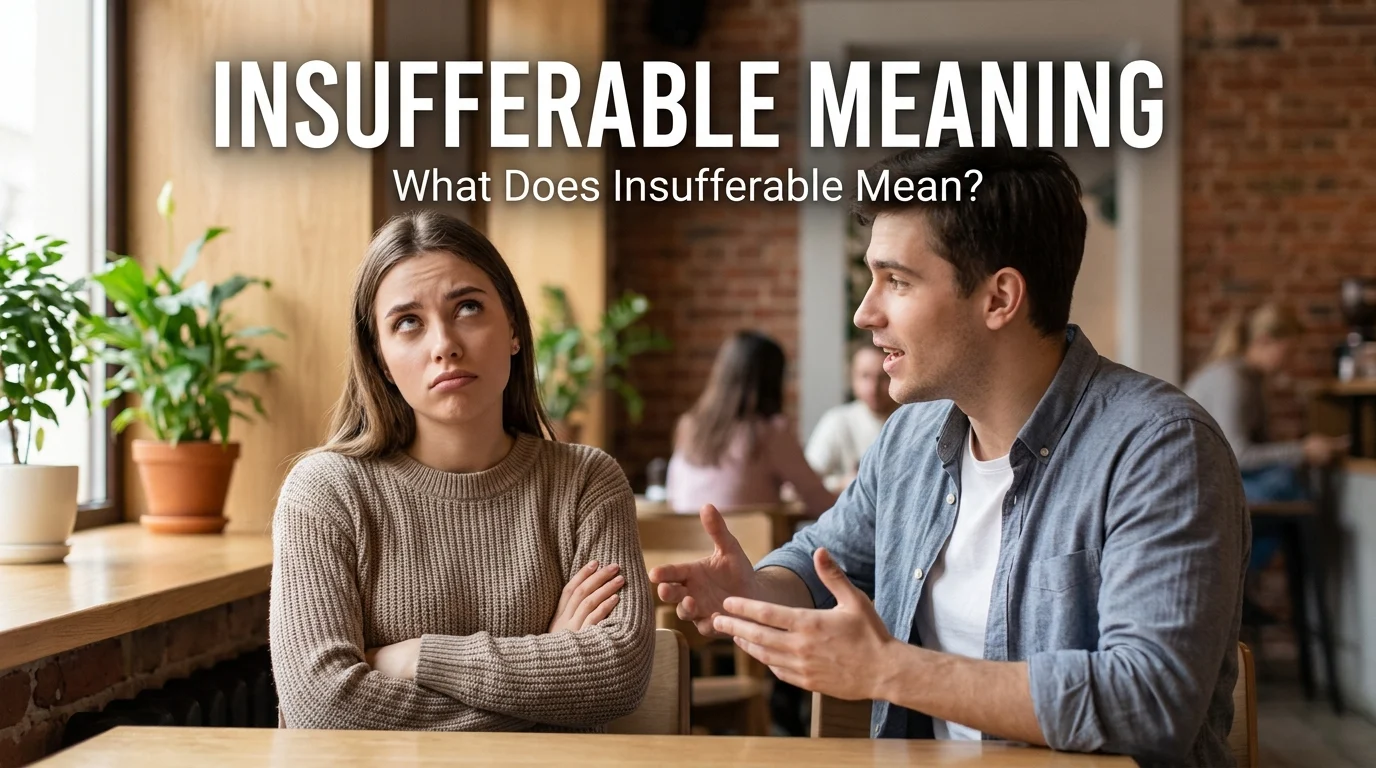

Someone may describe a person as “insufferable” after a conversation becomes frustrating, arrogant, or exhausting. The insufferable meaning is essentially “extremely unpleasant or difficult to tolerate.” It is a strong negative word used when someone’s behavior, attitude, or personality becomes so irritating that others struggle to put up with it. You might see it in texts, social media comments, everyday conversations, reviews, or descriptions of fictional characters. Context matters because calling someone insufferable is usually much harsher than simply calling them annoying. Below, you’ll see what the word means, how people use it, examples from real-life situations, similar terms, and appropriate ways to respond.
What Does Insufferable Mean?
Insufferable means extremely unpleasant, irritating, arrogant, or difficult to tolerate. It describes a person, behavior, attitude, or situation that feels unbearable because of how frustrating or obnoxious it is. In text and casual conversation, it is usually an insult or strong criticism rather than neutral slang.
| Detail | Explanation |
|---|---|
| Most common meaning | Extremely difficult or unpleasant to tolerate |
| Part of speech | Adjective |
| Tone | Strongly negative, sometimes sarcastic |
| Common use | Describing people, behavior, attitudes, or situations |
| Formal or informal | Standard English, used in both casual and formal contexts |
For example, if someone constantly interrupts others, brags about themselves, and refuses to listen, you might say, “He’s becoming insufferable.”
The word does not necessarily mean the person is objectively terrible. It expresses the speaker’s strong reaction to behavior they find unbearable.
The Main Insufferable Meaning in Everyday Conversation
When people call someone insufferable, they usually mean that person is so irritating or unpleasant that spending time around them has become difficult.
The behavior might involve:
- Constant bragging
- Acting superior to everyone else
- Repeatedly complaining
- Being overly argumentative
- Refusing to accept criticism
- Talking endlessly about themselves
- Showing off in an irritating way
- Acting smug or condescending
The word can also describe something other than a person. For example, someone might say, “That movie was insufferable,” meaning it was extremely unpleasant or frustrating to watch.
The key idea is intolerability. “Annoying” can describe a minor irritation, while “insufferable” suggests the irritation has become extreme.
Example
“His constant bragging is becoming insufferable.”
Here, the speaker is not simply saying that the person brags. They are emphasizing that the repeated behavior has become extremely difficult to tolerate.
Is Insufferable a Slang Word?
Not exactly. Insufferable is a standard English adjective, not an abbreviation or internet slang term.
However, people frequently use it in casual online conversations, including comments, posts, group chats, and messages. Online users may also use it humorously or sarcastically rather than as a completely serious insult.
For example:
“You two are actually insufferable 😂”
Depending on the relationship, this could be genuine criticism or playful teasing between friends.
That is why the surrounding conversation matters more than the word alone.
How Context Changes the Meaning
The basic definition stays the same, but the emotional force of insufferable can change depending on who says it, why they say it, and how they phrase it.
1. Serious criticism
“My manager has become completely insufferable.”
The speaker probably means their manager’s behavior has become genuinely difficult to tolerate.
2. Playful teasing
“You’re both insufferable when you start talking about your favorite team.”
Friends may use the word jokingly because they are exaggerating for humor.
3. Sarcasm
“Oh no, you got the highest score again. How insufferable.”
Here, the speaker may be joking rather than genuinely attacking the other person.
4. Social media criticism
“This influencer is getting more insufferable every week.”
The commenter is expressing strong disapproval of the person’s public behavior or content.
Look at punctuation, emojis, previous messages, and the relationship between the speakers. A laughing emoji can soften the statement, while words such as “completely,” “absolutely,” or “genuinely” can make the criticism sound more serious.
Insufferable in Text Messages and Social Media
The insufferable meaning in text is generally the same as in spoken English: someone or something is extremely difficult to tolerate.
On social platforms, however, the word is often used as an exaggerated reaction. Someone might call a celebrity, fictional character, sports fan, couple, or friend “insufferable” because they find their behavior irritating.
For example:
- “He’s so insufferable in the group chat.”
- “That character is intentionally insufferable.”
- “You guys are insufferable 😂.”
- “The comments are becoming insufferable.”
There is no special TikTok, Snapchat, Instagram, or texting definition that replaces the standard meaning. The platform may influence the style or tone, but the core definition remains the same.
Real Conversation Examples
Example 1: Friends
Person A: “Jake spent the entire dinner talking about his new car.”
Person B: “Seriously. He was being insufferable.”
Meaning: Person B thinks Jake’s constant discussion and bragging were extremely irritating.
Example 2: Group Chat
Person A: “We won the game!”
Person B: “Okay, you two are already insufferable about it 😂”
Meaning: Person B is probably teasing the friends for celebrating excessively.
Example 3: Workplace
Person A: “She keeps correcting everyone even when nobody asked.”
Person B: “Yeah, that attitude is becoming insufferable.”
Meaning: Person B genuinely finds the repeated behavior difficult to tolerate.
Is Insufferable Rude?
Insufferable can be rude, especially when you directly describe another person that way.
Calling someone “insufferable” is considerably stronger than saying they are “a little annoying.” It can imply that their personality or behavior is unbearable.
However, close friends sometimes use it playfully. Consider:
“You’re insufferable 😂”
This could be affectionate teasing if the relationship supports that interpretation.
By contrast:
“You are an insufferable person.”
This sounds much more hostile and personal.
If you are unsure how the other person will interpret it, choose a less aggressive word.
Is Insufferable Offensive?
The word is not inherently a slur or profanity, but it can still be offensive because it is a harsh personal criticism.
Whether it causes offense depends on the target, relationship, and situation. Calling a close friend insufferable jokingly may be harmless, while saying it to a coworker, customer, teacher, or stranger could create unnecessary conflict.
It is especially risky when you criticize someone’s personality rather than a specific behavior.
Compare:
“Your comments are becoming difficult to follow.”
with:
“You’re insufferable.”
The first criticizes a specific problem. The second attacks the person more broadly.
How to Reply to “Insufferable”
Your best response depends on whether the person is joking or genuinely criticizing you.
Friendly Replies
If a friend is teasing you, you can keep the exchange light:
- “You love me anyway.”
- “I prefer ‘entertaining,’ actually.”
- “You’re just jealous.”
- “Fair enough 😂.”
Funny Replies
If the conversation is clearly playful:
- “I’m proud of my consistency.”
- “Thank you for noticing.”
- “I was going for unforgettable.”
- “That sounds like a compliment to me.”
Polite Replies
If someone genuinely calls you insufferable, avoid escalating the argument:
- “What did I do that bothered you?”
- “I didn’t realize I was coming across that way.”
- “If something specific bothered you, you can tell me.”
These responses give you a chance to understand whether the criticism is serious and what behavior caused it.
When to Use the Word Insufferable
You can use insufferable when you want to strongly describe behavior that has become extremely irritating or difficult to tolerate.
It works naturally in:
- Casual conversations
- Text messages
- Social media comments
- Group chats
- Reviews and discussions
- Conversations about fictional characters
- Informal workplace conversations when appropriate
It can also appear in more formal writing because it is a standard English word. However, its strong judgmental tone means you should consider whether it is the right choice for the situation.
When to Avoid Insufferable
Avoid using the word when you need neutral, diplomatic, or highly professional language.
For example, in a workplace email, telling a colleague that they are “insufferable” would likely sound unnecessarily personal and confrontational.
A more specific description is usually better:
- “The repeated interruptions are making meetings difficult.”
- “The communication style has become challenging.”
- “The conversation has become unnecessarily confrontational.”
Specific language explains the actual problem without turning the criticism into a personal attack.
Common Mistakes About Insufferable
| Common Mistake | Correct Understanding |
| Thinking it means merely “annoying” | It usually describes someone or something extremely difficult to tolerate. |
| Assuming it is always serious | Friends may use it jokingly or sarcastically. |
| Treating it as internet-only slang | It is a standard English adjective that is also common online. |
| Assuming it describes only people | It can describe behavior, situations, characters, media, and other things. |
Another common mistake is assuming that calling someone insufferable automatically means you hate them. Sometimes the word is exaggerated for humor, especially among people who know each other well.
Similar Words and Their Differences
| Term | Meaning | Main Difference |
| Annoying | Causing irritation | Usually weaker than insufferable |
| Irritating | Causing frustration or annoyance | More neutral and less dramatic |
| Obnoxious | Extremely unpleasant or offensive | Often focuses on rude or showy behavior |
| Arrogant | Having an inflated sense of importance | Focuses specifically on superiority |
| Unbearable | Extremely difficult to tolerate | Very close in meaning, but broader |
These words overlap, but they are not interchangeable in every sentence. Someone can be arrogant without being insufferable, while “insufferable” emphasizes the listener’s inability or unwillingness to tolerate the person’s behavior.
Origin and Meaning of the Word
Insufferable comes from the idea of being unable to “suffer” or tolerate something. Its meaning developed around the sense of something being too unpleasant or difficult to endure.
Unlike many internet expressions, it did not originate as a modern social media term. It is an established English word that has long been used to describe intolerable people, behavior, or circumstances.
Its modern online use often adds humor, exaggeration, or sarcasm, but the underlying meaning remains unchanged.
Quick Recap
- Insufferable means extremely unpleasant, irritating, or difficult to tolerate.
- It is a standard English adjective rather than internet slang.
- Calling someone insufferable is usually a strong criticism, although friends may use it jokingly.
- Context, punctuation, emojis, and relationships can change the emotional tone.
- For professional or sensitive situations, describing the specific behavior is usually better.
Frequently Asked Questions
What does insufferable mean in text?
Insufferable means someone or something is extremely unpleasant, irritating, or difficult to tolerate in that conversation.
Is insufferable rude?
Insufferable can sound rude because it strongly criticizes someone’s behavior, personality, or overall presence.
What does insufferable mean on TikTok?
On TikTok, insufferable generally keeps its standard meaning and may describe irritating behavior, creators, characters, or content.
How should you reply to insufferable?
You can respond playfully to teasing or calmly ask what behavior caused the person to criticize you.
Can insufferable have different meanings?
The core meaning stays consistent, but context can make the word serious, sarcastic, humorous, or playfully insulting.
Final Thoughts
The insufferable meaning is straightforward: it describes someone or something that is extremely unpleasant or difficult to tolerate. In casual conversations and online posts, the word can be a serious criticism or playful exaggeration, so context matters. If someone calls you insufferable, consider their wording, relationship with you, and the behavior being discussed before deciding how to respond. Because the word is strong, use it carefully when addressing someone directly. In professional or sensitive situations, explaining the specific behavior is usually clearer and more respectful than labeling the person.
Discover More Post:
Inseam Meaning | What It Is and How to Measure It
Kroner Meaning | Currency, Slang & Complete Guide for 2026
GNG Meaning | What It Means in Text, Slang, and Social Media