
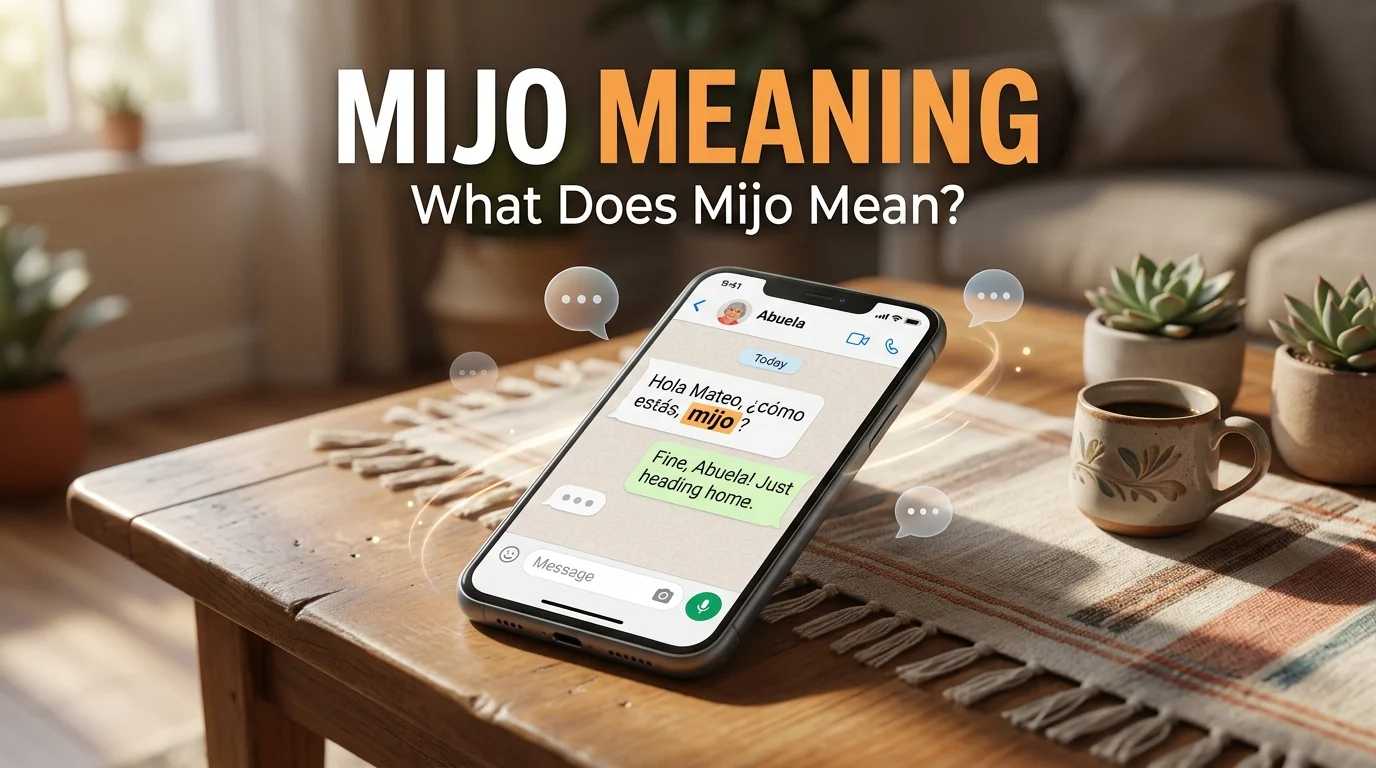

You may see someone write “mijo” in a text, comment, or casual conversation and wonder whether it is slang, a nickname, or an abbreviation. The most common mijo meaning is an affectionate Spanish form of “mi hijo,” meaning “my son.” However, people can also use it warmly toward someone who is not literally their child. The speaker’s age, relationship with you, wording, and tone can change how the expression feels. Understanding those details makes it easier to tell whether “mijo” sounds caring, playful, teasing, or slightly patronizing in a particular conversation.
What Does Mijo Mean?
Mijo is a common informal contraction of the Spanish phrase “mi hijo,” which literally means “my son.” It is often used as an affectionate form of address, especially by parents, relatives, older people, or people speaking warmly to someone younger. In casual conversation, it can also be used toward someone who is not actually the speaker’s son.
| Detail | Explanation |
|---|---|
| Most common meaning | “My son” or an affectionate way to address someone |
| Full form | “Mi hijo” |
| Tone | Usually affectionate, familiar, playful, or caring |
| Common use | Casual speech, texts, family conversations, social media |
| Formal or informal | Informal |
For example, someone might text, “Mijo, did you eat yet?” Here, the speaker is probably expressing concern or affection rather than making a literal statement about parentage.
The feminine counterpart is mija, from “mi hija,” meaning “my daughter.” Both expressions can be used affectionately beyond literal parent-child relationships.
The Main Mijo Meaning in Everyday Conversation
The simplest way to understand mijo meaning in text is as a warm way of addressing someone. A parent may call their son “mijo,” but the expression can also appear between relatives, close acquaintances, older and younger friends, or people who naturally use Spanish terms of affection.
It does not function like an acronym, so there is no hidden English “full form.” The phrase comes from combining mi (“my”) and hijo (“son”) in informal speech.
The emotional meaning is often more important than the literal translation. Depending on the situation, “mijo” can communicate affection, familiarity, reassurance, concern, humor, or playful teasing.
For example:
“Mijo, you better take a jacket. It’s cold outside.”
The speaker is not necessarily being formal or making a literal linguistic distinction. The word gives the sentence a familiar, caring quality.
Can Mijo Have Different Meanings?
Yes. The basic meaning remains connected to “my son,” but its practical use can vary depending on who says it and why.
| Meaning | Context | Tone | Example |
| My son | Parent speaking to son | Loving | “Mijo, come eat.” |
| Affectionate address | Relative or family friend | Warm | “Mijo, how have you been?” |
| Familiar nickname | Casual relationship | Friendly | “Good job, mijo.” |
| Playful or teasing address | Informal conversation | Humorous | “Mijo, what were you thinking?” |
| Patronizing address | Certain adult-to-adult situations | Condescending | “Listen, mijo, you don’t understand.” |
The last use is less about the word itself and more about delivery. A speaker can make an affectionate expression sound patronizing through sarcasm, dismissive wording, or an unequal social dynamic.
How Context Changes the Meaning
Context is especially important when you see mijo in chat because text removes many vocal clues.
Look at these factors:
- Relationship: A parent using “mijo” usually sounds affectionate, while a stranger may sound overly familiar.
- Wording: “Mijo, are you okay?” sounds caring, while “Sure, mijo…” could sound sarcastic.
- Emoji: A heart or smiling emoji can reinforce warmth, while certain sarcastic emojis can change the mood.
- Conversation topic: Advice, congratulations, teasing, and arguments can all give the same word different emotional effects.
- Age or familiarity: An older relative may naturally use “mijo,” whereas someone with no personal connection may use it differently.
Consider these examples:
“Mijo ❤️ I’m proud of you.”
This strongly suggests affection and encouragement.
“Mijo, what did you just do?”
This could be loving concern or playful frustration.
“Okay, mijo, whatever you say.”
The wording may suggest sarcasm or mild condescension.
“Come here, mijo.”
In a family setting, this is likely affectionate and familiar.
The surrounding message usually tells you more than the word alone.
Mijo Meaning on Text, TikTok, Snapchat, and Instagram
The basic meaning of mijo generally does not change just because it appears on a particular platform. You can encounter it in text messages, TikTok comments, Instagram conversations, Snapchat messages, WhatsApp chats, and other informal spaces.
On text messages, it commonly appears between family members or people who already have a familiar relationship.
On TikTok or Instagram, someone may use “mijo” in a comment or caption as an affectionate, humorous, or culturally familiar form of address. The surrounding post and relationship between users help determine the intended tone.
On Snapchat, the term can simply be part of casual conversation, especially when the people involved already use familiar nicknames or Spanish expressions.
For example:
“Mijo 😭 why would you post that?”
The expression here does not necessarily mean “my son” literally. It can add playful exasperation to the message.
Real Conversation Examples
1: Family
Person A: “Mijo, did you eat lunch?”
Person B: “Not yet. I’m about to.”
Meaning: A parent or relative is using “mijo” affectionately while checking on someone’s well-being.
2: Friendly teasing
Person A: “I accidentally deleted the whole file.”
Person B: “Mijo 😭 what did you do?”
Meaning: The speaker is using the word playfully while reacting to a mistake. The expression adds familiarity and humor.
3: Encouragement
Person A: “I finally passed my exam!”
Person B: “That’s what I’m talking about, mijo! Proud of you.”
Meaning: Here, “mijo” creates a warm, supportive tone rather than identifying the person literally as the speaker’s son.
Is Mijo Rude?
Mijo is not inherently rude. It is commonly affectionate or familiar, but the tone can change based on the relationship and situation.
When used by a parent, grandparent, relative, or close family friend, it will often sound warm and caring. Between people who are comfortable with one another, it can also be playful.
However, an unfamiliar person using “mijo” toward an adult may feel overly familiar or patronizing, particularly if the rest of the message sounds dismissive.
For example, “Mijo, I think you’re confused” could be gentle advice from someone close to you, but it could sound condescending from a stranger.
Is Mijo Flirty?
Mijo is not inherently a flirty expression. Its usual meaning is affectionate or familiar rather than romantic.
In a romantic conversation, however, any nickname can take on a more personal tone depending on the relationship. If someone you are dating calls you “mijo,” the surrounding messages, emojis, and established relationship matter more than the word itself.
You should not assume romantic interest solely because someone uses the term.
How to Reply to Mijo
Your best response depends on the tone and relationship.
Friendly Replies
If someone uses “mijo” warmly, you can respond naturally:
- “Haha, what’s up?”
- “Yes? 😂”
- “I’m listening.”
- “What did I do now?”
- “Thanks, I appreciate that.”
Funny Replies
If the conversation is clearly playful:
- “Yes, father? 😂”
- “What now, mijo?”
- “I have been summoned.”
- “Okay okay, I’m coming 😭”
These work best when you already have a joking relationship with the person.
Replies When You Are Confused
If you are unsure why someone called you “mijo,” you can ask directly:
- “Haha, why mijo?”
- “What do you mean by mijo?”
- “Is that your nickname for me now?”
A simple clarification is better than assuming the person intended something negative.
When to Use Mijo
Use mijo mainly in informal situations where a familiar, affectionate, or playful tone makes sense. It can work naturally in family conversations, casual texts, friendly chats, social media interactions, and other relaxed settings.
The expression is especially natural when you already share a relationship or conversational style with the other person.
If you are communicating with someone who is comfortable with Spanish expressions, “mijo” may feel completely natural. If you are unsure whether the person will understand it, clearer wording may be better.
When to Avoid Mijo
There is nothing inherently wrong with the word, but you should consider the audience before using it.
In professional emails, job applications, academic writing, formal announcements, or communication with unfamiliar people, a neutral form of address is usually clearer. The same applies to sensitive situations where an affectionate or familiar nickname could be misunderstood.
You should also be careful when addressing an adult stranger as “mijo.” Even if you intend it kindly, they may interpret it as overly familiar or patronizing.
Common Mistakes About Mijo
| Common Mistake | Correct Understanding |
| Treating it as an acronym | Mijo is an informal contraction of “mi hijo,” not an acronym. |
| Assuming it always means literal son | It can also be an affectionate way to address someone else. |
| Assuming it is always affectionate | Context can make it playful, sarcastic, or patronizing. |
| Assuming it is automatically romantic | Mijo is generally affectionate or familiar, not inherently flirty. |
Another common misunderstanding is believing that every use has exactly the same emotional meaning. Like many forms of address, its effect depends heavily on the relationship between the speakers.
Similar Terms to Mijo
Several Spanish terms may appear in similar situations, but they are not interchangeable in every context.
| Term | Meaning | Main Difference |
| Mijo | My son; affectionate address | Masculine form connected to “mi hijo” |
| Mija | My daughter; affectionate address | Feminine counterpart of “mijo” |
| Hijo | Son | Full noun rather than the contraction “mijo” |
| Hija | Daughter | Female equivalent of “hijo” |
| Mi amor | My love | More directly affectionate or romantic |
These terms can overlap in emotional tone, but their literal meanings and relationship implications differ.
Origin and Everyday Use
“Mijo” comes from the informal spoken combination of mi and hijo. In natural Spanish speech, words can contract or blend in ways that are reflected in familiar forms such as “mijo.”
The exact social meaning can vary across Spanish-speaking communities and individual families. That is why a dictionary-style translation of “my son” does not always capture how the word feels when someone uses it in everyday conversation.
The safest interpretation is to start with its core meaning—an affectionate form related to “my son”—and then use the surrounding context to determine the speaker’s intention.
Quick Recap
- Mijo is an informal contraction of “mi hijo,” meaning “my son.”
- It is often used affectionately toward a son or another familiar person.
- The word can sound caring, playful, teasing, or occasionally patronizing.
- Its meaning generally stays the same across texting and social platforms.
- If you are unsure about the tone, look at the relationship, wording, emojis, and surrounding conversation.
Frequently Asked Questions
What does mijo mean in text?
Mijo usually means “my son” or serves as an affectionate, familiar way to address someone in casual conversation.
Is mijo rude?
Mijo is usually affectionate, but it can sound patronizing when used dismissively or by someone who lacks familiarity.
What does mijo mean on TikTok?
On TikTok, mijo generally retains its affectionate meaning and may also be used humorously in comments or captions.
How should you reply to mijo?
Reply casually based on the relationship, using a friendly response, playful joke, or clarification if the meaning seems unclear.
Can mijo have different meanings?
Mijo can express affection, familiarity, teasing, or condescension depending on the speaker, relationship, wording, and conversational context.
Final Thoughts
The mijo meaning is most closely connected to the Spanish phrase “mi hijo,” or “my son.” In everyday conversation, though, it can function as a warm and familiar way to address someone without literally referring to them as a son. The expression is generally affectionate, but context matters: the speaker’s relationship with you, wording, emojis, and overall tone can make it playful or occasionally patronizing. When you see “mijo” in a text or social media conversation, focus on the surrounding message rather than assuming the word has one fixed emotional meaning.
Discover More Post:
TBD Meaning Slang | What It Means & How to Use It
Medusa Tattoo Meaning | Symbolism, History & Modern …
PMO Meaning Slang: What It Really Stands For in 2026






Pingback: YK Meaning | What It Really YK Meaning in Text, Chat & Social Media 2026
Pingback: DTM Meaning | DTM Meaning Slang & What Does DTM Mean in Text (Updated 2026)
Pingback: FN Meaning Slang | The Complete Guide to This Viral Internet Term
Pingback: Ohana Meaning | What Does Ohana Mean?
Pingback: Oui Meaning | What Does “Oui” Mean in Text?
Pingback: IKR Meaning | What Does IKR Mean in Texting?
Pingback: Penultimate Meaning | What Does Penultimate Mean?
Pingback: Jit Meaning | What Does Jit Mean in Slang?
Pingback: Inseam Meaning | What It Is and How to Measure It