
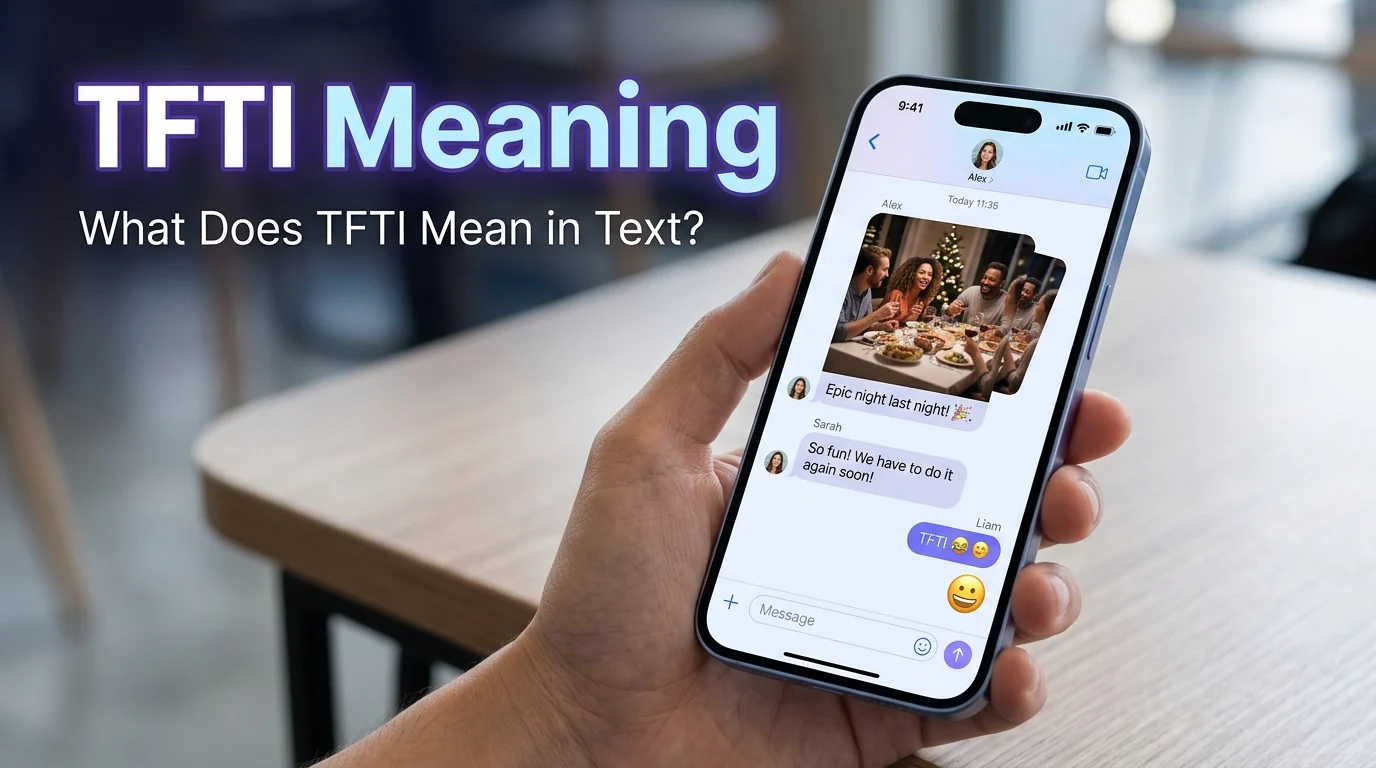

You see a friend post photos from a party you were never told about, and someone comments, “TFTI.” The TFTI meaning is usually “Thanks for the Invite,” often said sarcastically when someone feels left out.
In some conversations, TFTI can also mean “Thanks for the Information” or “Thanks for the Info,” but that interpretation is less common in casual social-media contexts. Context, punctuation, and the relationship between the people involved usually make the intended meaning clear.
What Does TFTI Mean?
TFTI most commonly stands for “Thanks for the Invite.” In texting and social media, it is often a playful or sarcastic way to point out that someone did something without inviting you.
| Detail | Explanation |
|---|---|
| Most common meaning | Thanks for the Invite |
| Alternative meaning | Thanks for the Information / Info |
| Typical tone | Sarcastic, playful, or mildly annoyed |
| Common use | Texts, social media, group chats |
| Formal or informal | Informal |
For example, if your friends post pictures from dinner and you were not invited, you might comment, “TFTI 😂.” You are not necessarily thanking them for an invitation; you are jokingly calling attention to the fact that there was no invitation.
TFTI Meaning in Text and Chat
When someone sends TFTI in a text, the safest interpretation is usually “Thanks for the Invite,” especially if the conversation involves plans, parties, trips, dinners, or other activities.
The phrase often carries a teasing message underneath it: “I noticed you didn’t invite me.”
For example:
Friend: “We all went out for burgers last night.”
You: “TFTI 😭”
Here, TFTI is probably sarcastic. The speaker is expressing disappointment while keeping the message light and humorous.
However, context matters. If someone gives you useful information, TFTI can mean “Thanks for the Information.” This usage is recognized as another meaning, so the surrounding conversation matters.
The Two Main Meanings of TFTI
TFTI has two established meanings in informal communication, although they are not equally common in every situation.
| Meaning | Context | Tone | Example |
| Thanks for the Invite | Someone was excluded from plans | Usually sarcastic or playful | “You guys went without me? TFTI.” |
| Thanks for the Information | Someone shares useful information | Usually appreciative or sometimes sarcastic | “The meeting moved to Friday? TFTI.” |
The first meaning is particularly associated with social situations where someone discovers they were left out. The second is more straightforward and depends heavily on the topic being discussed.
How Context Changes the TFTI Meaning
You can usually figure out what TFTI means by looking at what came before it.
1. A social event:
“Everyone went to the beach yesterday.”
“TFTI.”
Here, it almost certainly means “Thanks for the Invite.”
2. Useful information:
“The store closes at 8 tonight.”
“TFTI!”
Here, it can mean “Thanks for the Information.”
3. A social-media post:
“Looks like you guys had fun without me. TFTI 😂.”
The invitation meaning is clear, with a joking complaint.
4. Unexpected information:
“You know your favorite restaurant closed last month, right?”
“TFTI…”
Here, TFTI may mean “Thanks for the Information,” potentially with sarcasm.
Capitalization usually does not change the meaning. Tfti, and Tfti can all be understood the same way.
TFTI on Social Media
Especially easy to understand on social platforms because photos, Stories, posts, and group updates can reveal social plans that someone did not know about.
If a friend uploads pictures from a concert, road trip, dinner, or party, commenting “TFTI” can jokingly suggest that you noticed your absence from the guest list.
The same basic meaning can work across Instagram, Snapchat, Facebook, TikTok comments, and group chats. The platform itself generally does not create a completely different slang definition; the surrounding content determines what the acronym means.
For example:
Instagram: “Wow, nice party. TFTI 😂”
Group chat: “Y’all went bowling without me? TFTI.”
Snapchat: “Saw your snaps. TFTI 😭.”
The emojis can make the message feel more playful, although a short “TFTI.” without an emoji may sound more annoyed.
Real Conversation Examples
1: Friends
Person A: “We grabbed pizza after class.”
Person B: “Without me? TFTI 😂”
Meaning: Person B is jokingly complaining that the group went out without inviting them.
2: Social Media
Person A: “Posts photos from a weekend trip.”
Person B: “TFTI 😭”
Meaning: Person B is teasing the poster for taking the trip without including them.
3: Information
Person A: “The professor moved tomorrow’s class to 10 a.m.”
Person B: “Oh wow, TFTI.”
Meaning: Here, TFTI likely means “Thanks for the Information,” rather than “Thanks for the Invite.”
Is TFTI Rude?
TFTI is not automatically rude, but it can sound passive-aggressive. When used after someone excludes you, it can communicate genuine annoyance beneath the humor.
Between close friends, “TFTI 😂” may be completely harmless. With someone you do not know well, however, the same message could sound like an accusation.
Compare these:
- “TFTI 😂” — likely playful.
- “TFTI…” — possibly disappointed or annoyed.
- “TFTI.” — can sound colder or more serious.
- “TFTI 😭😂” — strongly suggests joking.
Your relationship with the other person matters just as much as the acronym itself.
Is TFTI Flirty?
TFTI is not inherently flirty. Its usual meaning is about an invitation or exclusion, not romantic interest.
That said, friends or people who are interested in each other can use it playfully. For example:
“You went to that new café and didn’t invite me? TFTI 👀”
The 👀 emoji could make the message feel teasing or suggest that the sender wants to spend time with the person. Still, the acronym alone does not establish romantic intent.
How to Reply to TFTI
Your best response depends on whether the person is joking, genuinely upset, or using the information meaning.
Friendly Replies
If you forgot to invite them but want to keep things light:
- “My bad 😂 You’re coming next time.”
- “I knew you’d say that 😭.”
- “Okay okay, next outing is yours.”
- “Sorry! We seriously forgot to tell you.”
- “You’re invited next time, promise.”
Funny Replies
If the relationship is playful:
- “The invitation got lost in the mail 😂.”
- “You were there spiritually.”
- “We thought you were busy living your best life 😭.”
- “TFTI right back.”
- “I accept your complaint.”
Polite Replies
If the person seems genuinely disappointed:
- “Sorry, we should have invited you.”
- “My bad, I didn’t realize you wanted to come.”
- “I understand why that bothered you. Sorry about that.”
If TFTI clearly means “Thanks for the Information,” a simple “No problem!”, “Anytime!”, or “Glad I could help” is more appropriate.
When to Use TFTI
TFTI works best in casual communication where the other person understands internet slang.
You can use it with:
- Close friends
- Group chats
- Social-media comments
- Familiar online communities
- Casual conversations
- Playful conversations about plans
It is particularly effective when you want to point out that you were left out without making a serious confrontation.
Still, consider the relationship before using it. If someone might interpret your sarcasm literally, a clearer message can prevent unnecessary tension.
When to Avoid TFTI
TFTI is generally better avoided when clarity and professionalism matter.
Use more direct wording in:
- Professional emails
- Job applications
- Client communication
- Academic writing
- Formal announcements
- Sensitive conversations
- Messages to unfamiliar people
For example, instead of writing “TFTI” to a coworker after learning about a meeting you missed, say, “I wasn’t aware of the meeting. Could you please include me in future updates?”
That communicates the issue without relying on sarcasm.
Common Mistakes About TFTI
| Common Mistake | Correct Understanding |
| Assuming TFTI always means “Thanks for the Invite” | It can also mean “Thanks for the Information,” depending on context. |
| Assuming TFTI is always angry | It is often playful or sarcastic between people who know each other. |
| Using TFTI in every situation involving information | The invite meaning is especially common when discussing social plans or exclusion. |
Another common mistake is assuming that the person genuinely wants an invitation whenever they say TFTI. Sometimes they are simply joking about seeing your plans online.
Similar Slang Terms
| Term | Meaning | Main Difference |
| FOMO | Fear of Missing Out | Describes anxiety or concern about missing an experience. |
| TMI | Too Much Information | Reacts to information that is excessive or unwanted. |
| FYI | For Your Information | Shares information rather than expressing thanks. |
| TY | Thank You | A general expression of gratitude without TFTI’s specific context. |
| LOL | Laughing Out Loud | Signals amusement rather than exclusion or appreciation. |
FOMO is particularly related to TFTI because being left out of plans can create a feeling of missing out, while TFTI directly comments on the lack of an invitation.
Origin and Popularity of TFTI
The exact origin of the slang use of TFTI is not firmly established. Informal acronym references document both “Thanks for the Invite” and “Thanks for the Information,” so it is better to avoid attributing the expression to a specific person or exact invention date.
Its meaning is also shaped by context. In social-media conversations, “Thanks for the Invite” is commonly associated with sarcastic comments about being excluded, while “Thanks for the Information” appears in information-sharing contexts.
Quick Recap
- TFTI most commonly means “Thanks for the Invite.”
- It is often used sarcastically when someone was left out of plans.
- TFTI can also mean “Thanks for the Information” or “Thanks for the Info.”
- Emojis, punctuation, and the conversation topic can change how the message sounds.
- Use TFTI mainly in casual conversations where the other person understands the intended tone.
- If the meaning could be misunderstood, spelling out your message is safer.
Frequently Asked Questions
What does TFTI mean in text?
TFTI usually means “Thanks for the Invite,” especially when someone feels excluded from social plans.
Is TFTI rude?
TFTI can sound rude or passive-aggressive when the recipient does not recognize the intended playful sarcasm.
What does TFTI mean on TikTok?
On TikTok, TFTI commonly means “Thanks for the Invite” when commenting about being left out.
How should you reply to TFTI?
Reply playfully if appropriate, or apologize directly when the person genuinely feels excluded from your plans.
Can TFTI have different meanings?
Yes, TFTI can mean “Thanks for the Invite” or “Thanks for the Information,” depending on context.
Final Thoughts
The main TFTI meaning is “Thanks for the Invite,” usually used as a sarcastic or playful comment when someone was left out of plans. It can also mean “Thanks for the Information,” so the surrounding conversation is essential when interpreting it. A laughing or crying emoji can make the phrase feel more playful, while a short, punctuation-heavy version may sound annoyed. Use TFTI with friends and familiar online contacts when the tone is clear, but choose straightforward wording in professional or sensitive situations to avoid confusion.