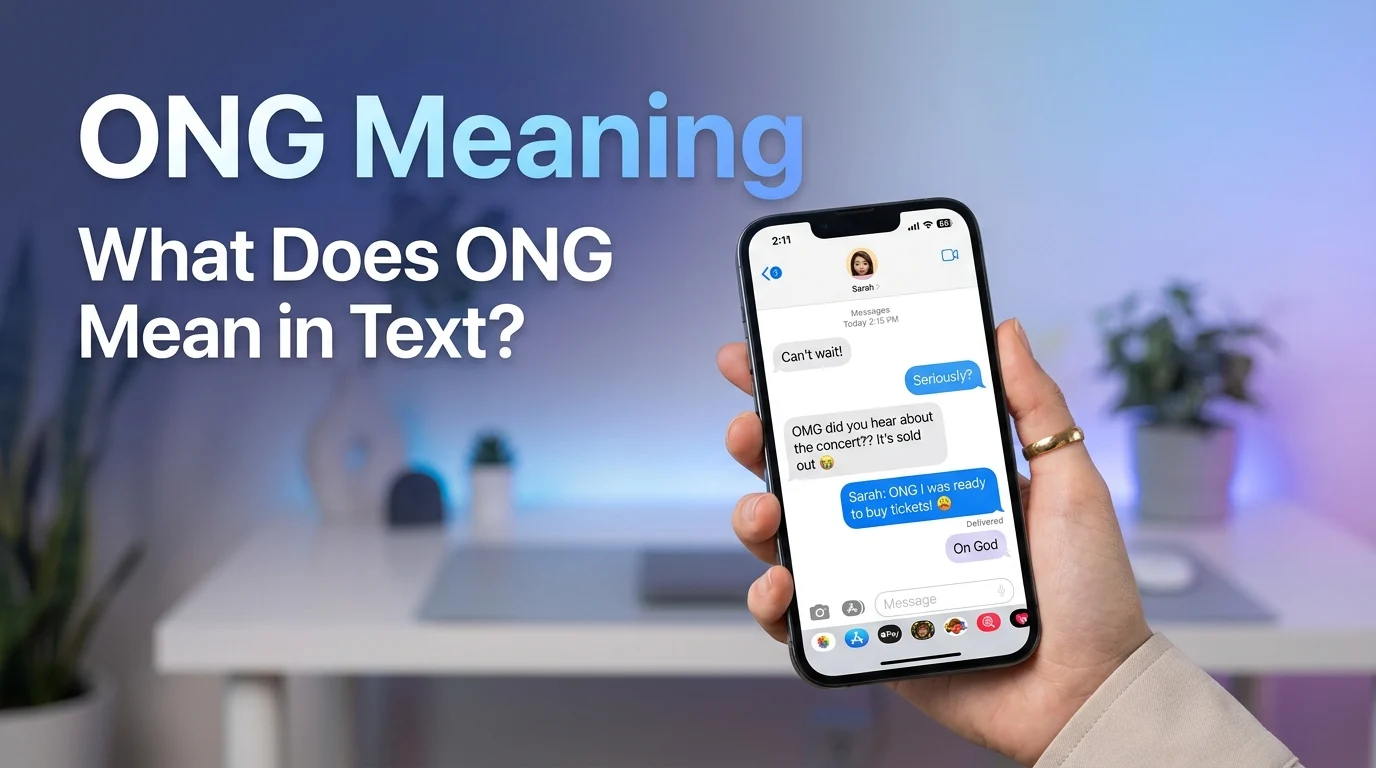

You may see someone type “ONG” during an argument, reaction, or casual chat and wonder what they actually mean. In texting and social media slang, ONG usually means “on God,” an expression used to emphasize that someone is being completely honest, serious, or sincere. It can be similar to saying “I swear,” “for real,” or “I’m telling the truth.” The exact tone depends on the conversation, punctuation, and relationship between the people talking. Below, you’ll see the ONG meaning in text, realistic examples, common replies, situations where it fits, and mistakes to avoid.
What Does ONG Mean?
The most common ONG meaning in texting and online slang is “on God.” People use it to strongly emphasize a statement, confirm that they are telling the truth, or show that they genuinely agree with something.
| Detail | Explanation |
|---|---|
| Most Common Meaning | On God |
| Tone | Emphatic, sincere, casual |
| Common Use | Texting, social media, group chats |
| Formal or Informal | Informal |
For example, if someone texts, “ONG, that movie was amazing,” they are strongly emphasizing that they genuinely thought the movie was great.
What Does ONG Stand For in Texting?
In casual internet slang, ONG stands for “on God.” The phrase is used as an intensifier rather than as a literal reference to religion.
When someone says “ONG,” they may be communicating:
- “I’m telling the truth.”
- “I seriously mean that.”
- “I completely agree.”
- “I swear.”
- “I’m being honest.”
For example:
Person A: “Did you really finish the whole assignment last night?”
Person B: “ONG, I didn’t sleep at all.”
Here, “ONG” emphasizes that Person B is insisting the statement is true.
The abbreviation is especially useful when someone wants to make their message sound more forceful without writing the entire phrase.
How Context Changes the ONG Meaning
Although “on God” is the standard slang meaning, the feeling behind ONG can change depending on the conversation. Look at the surrounding message rather than interpreting the abbreviation by itself.
1. Confirming the truth
“ONG, I saw him at the mall.”
The speaker is strongly insisting that their statement is true.
2. Showing strong agreement
“That restaurant is so good.”
“ONG.”
Here, ONG means something close to “Seriously, yes” or “I completely agree.”
3. Emphasizing an opinion
“ONG, this is the funniest video I’ve seen.”
The abbreviation adds emphasis to the speaker’s opinion.
4. Reacting emotionally
“ONG I’m exhausted.”
In this situation, ONG intensifies the feeling rather than serving as a formal statement of proof.
Capitalization does not usually change the meaning. Someone might write “ong,” “ONG,” or “onggg,” with the extended spelling adding extra emphasis.
ONG Meaning on Different Platforms
The basic meaning generally stays the same across social platforms and messaging apps. What changes is the surrounding style of communication.
Text Messages and WhatsApp
In private chats, ONG commonly emphasizes honesty, agreement, or a strong reaction.
Example: “ONG, I thought you were joking.”
The tone can be serious or playful depending on the conversation.
TikTok
On TikTok, ONG may appear in comments or captions when someone strongly agrees with a video, opinion, or relatable situation.
Example: “ONG this is exactly what happened.”
It often works as a quick reaction showing strong agreement.
Snapchat
Friends may use ONG casually when emphasizing a claim or reacting to something another person said.
Example: “ONG I wasn’t even there.”
The tone is usually informal and conversational.
ONG can appear in comments, DMs, captions, or replies when someone wants to emphasize agreement or sincerity.
Example: “ONG, this song never gets old.”
Across these platforms, the intended meaning is normally clear from the surrounding words.
Real Conversation Examples
1: Friends
Person A: “You actually watched the whole series?”
Person B: “ONG, I finished it in two days.”
Meaning: Person B is strongly confirming that they really watched the entire series.
2: Group Chat
Person A: “That exam was impossible.”
Person B: “ONG 😭”
Meaning: Person B strongly agrees and uses the crying emoji to make the reaction more expressive.
3: Social Media
Person A: “This is the best pizza place in town.”
Person B: “ONG, no one does it better.”
Meaning: Person B is enthusiastically agreeing with the statement.
What Tone Does ONG Have?
ONG is generally casual, emphatic, and conversational. It can sound sincere when someone is defending the truth of what they said, but it can also be playful when friends are exaggerating or agreeing with each other.
Emojis can influence the tone. For example, “ONG 😭” may sound humorous or dramatic, while “ONG, I’m serious” sounds much more direct.
The relationship also matters. Among close friends, ONG can feel completely natural. In a conversation with someone unfamiliar with internet slang, however, the abbreviation may be confusing.
Is ONG Rude?
ONG is not inherently rude. It is normally an informal way to emphasize honesty or agreement.
It could sound confrontational if someone uses it during an argument, especially alongside messages such as “ONG, you’re wrong.” In that case, the intensity comes from the whole sentence rather than the abbreviation itself.
Is ONG Flirty?
ONG is not specifically a flirty expression. Someone can use it in a romantic conversation, but the abbreviation itself does not communicate romantic interest.
If a person sends “ONG you look amazing,” the compliment may be flirty, friendly, or simply enthusiastic depending on the relationship and surrounding messages.
How to Reply to ONG
Your response should match what the other person is trying to emphasize.
Friendly Replies
If someone uses ONG to agree with you or emphasize something, you can respond naturally:
- “Exactly!”
- “I know, right?”
- “For real 😂”
- “That’s what I’m saying.”
- “Seriously!”
Funny Replies
When the conversation is playful, you can exaggerate the reaction:
- “You swear? 😂”
- “I believe you this time.”
- “Okay, okay, I get it 😭”
- “That serious, huh?”
Replies When You Are Confused
If you aren’t sure what the person means, simply ask:
- “What do you mean by ONG?”
- “ONG as in ‘on God’?”
- “Wait, what does ONG mean here?”
There is nothing wrong with asking for clarification when slang is unfamiliar.
When to Use ONG
ONG works best in casual communication where the other person is familiar with internet slang. You might see or use it in:
- Text messages with friends
- Group chats
- Social media comments
- DMs
- Casual gaming chats
- Informal conversations
Use it when you want to emphasize a statement, agreement, or reaction without sounding overly formal.
When to Avoid ONG
Because ONG is slang, clearer wording is usually better in professional or formal settings. Avoid relying on it in:
- Professional emails
- Job applications
- Academic writing
- Client communication
- Formal announcements
- Important or sensitive messages
- Conversations with people unfamiliar with internet slang
That does not mean slang is always inappropriate. The key issue is whether the audience will understand it and whether the tone fits the situation.
Common Mistakes About ONG
| Common Mistake | Correct Understanding |
| Assuming ONG has one universal meaning everywhere | “On God” is the common slang meaning, but context should still be considered. |
| Treating it as automatically religious | In casual slang, it is commonly an emphasis phrase rather than a literal religious statement. |
| Assuming it is always serious | Friends may use ONG playfully, sarcastically, or dramatically. |
Another common mistake is confusing ONG with other abbreviations simply because they contain similar letters. Always consider the complete sentence and conversation before deciding what the writer intended.
Similar Slang Terms
| Term | Meaning | Main Difference |
| IYKYK | If you know, you know | Refers to shared knowledge or an inside understanding. |
| FR | For real | Shows agreement or emphasizes sincerity, usually without the same “on God” wording. |
| ISTG | I swear to God | A stronger statement of sincerity or frustration. |
| TBH | To be honest | Introduces or emphasizes an honest opinion. |
| NGL | Not gonna lie | Signals that the speaker is about to give a candid opinion. |
ONG is closest in function to expressions such as “FR” and “ISTG,” but each has its own conversational feel.
Where Did ONG Come From?
The slang phrase “on God” predates the abbreviation and has been used as an emphatic expression of sincerity. The exact history of the internet abbreviation “ONG” is less clear, so it is better not to assign it to a specific creator or exact starting date without reliable evidence.
Today, ONG functions as a compact form of the phrase in casual digital communication.
Quick Recap
- ONG usually means “on God” in texting and internet slang.
- It emphasizes honesty, sincerity, agreement, or a strong reaction.
- The meaning generally stays consistent across texting, TikTok, Snapchat, and Instagram.
- It is informal and usually not rude by itself.
- The surrounding words, emojis, and relationship help determine the exact tone.
- “FR,” “ISTG,” and “NGL” can express similar ideas but are not interchangeable in every situation.
Frequently Asked Questions
What does ONG mean in text?
ONG usually means “on God,” an informal expression used to emphasize honesty, sincerity, agreement, or strong feelings.
Is ONG rude?
ONG is generally not rude, although it can sound intense or confrontational when used during an argument.
What does ONG mean on TikTok?
On TikTok, ONG usually means “on God” and commonly emphasizes agreement, sincerity, or a strong reaction.
How should you reply to ONG?
Reply with agreement, humor, or clarification depending on whether the sender is emphasizing a statement, joking, or expressing uncertainty.
Can ONG have different meanings?
ONG can have other meanings in specialized contexts, but “on God” is the common interpretation in internet slang.
Final Thoughts
The ONG meaning in texting is usually “on God,” a casual phrase used to emphasize that someone is being truthful, sincere, or strongly agreeing with something. It can appear in texts, group chats, TikTok comments, Snapchat messages, and other informal online conversations. The abbreviation itself is not normally rude or flirty, although the surrounding message can change its tone. If you use ONG, keep it for situations where casual slang feels natural. When someone sends it to you, read the entire message rather than treating the abbreviation as a standalone statement.
Discover More Post:
Yeoh Meaning | What It Means in Text, Chat, and Social Media
Limerence Meaning | Understanding Obsessive Infatuation
Contingent Meaning | Definition, Usage, and Real-Life …