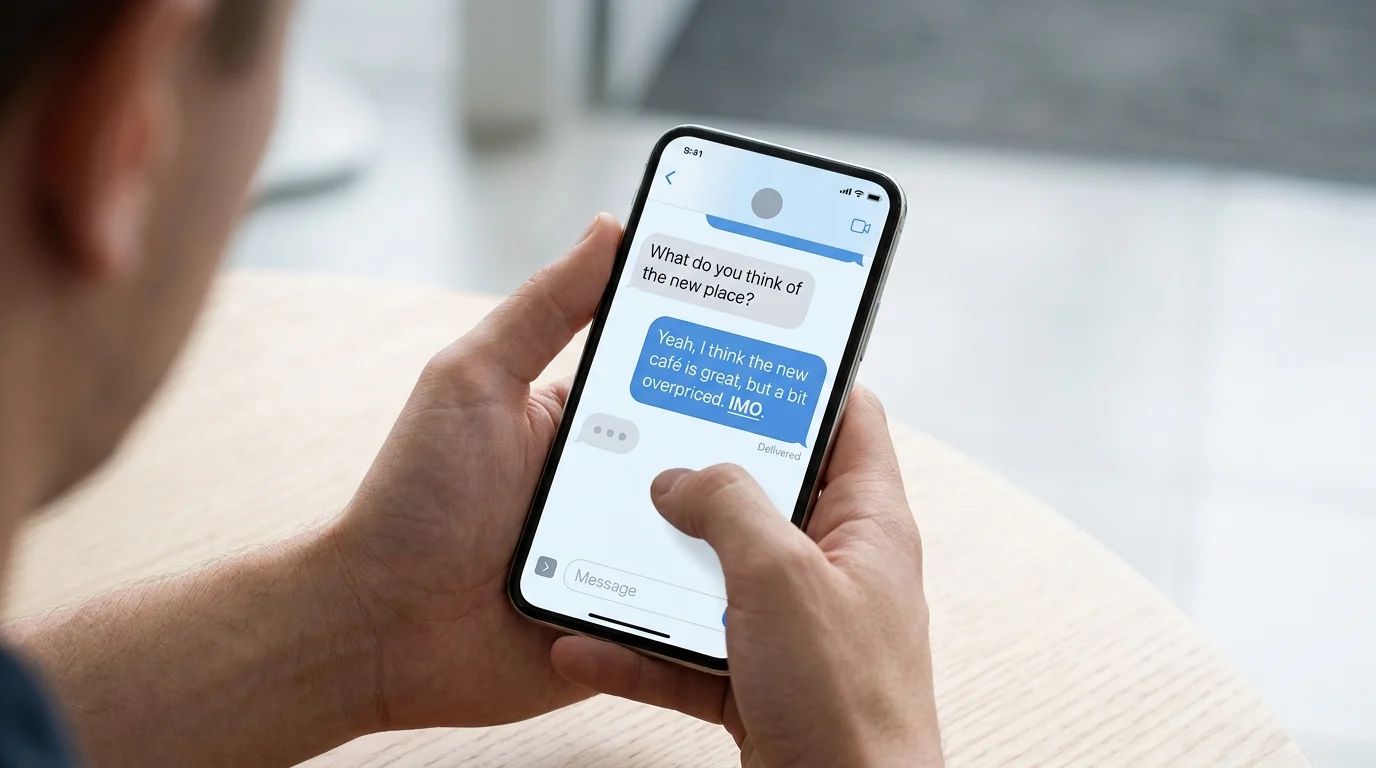

You may see someone end a message with “IMO” and wonder whether they are stating a fact or simply giving their personal view. The IMO meaning is usually “in my opinion.” People use it in texts, chats, comments, and social media to show that what follows is their personal judgment rather than an objective fact. For example, “IMO, the first movie was better” means “In my opinion, the first movie was better.” Understanding the surrounding conversation helps you recognize whether IMO sounds casual, respectful, argumentative, or humorous.
What Does IMO Mean?
IMO stands for “in my opinion.” It is a common internet abbreviation used before or after a personal view, recommendation, judgment, or preference. In text messages, IMO signals that the speaker is sharing an opinion rather than claiming something is universally true.
| Detail | Explanation |
|---|---|
| Most Common Meaning | In my opinion |
| Full Form | In my opinion |
| Tone | Usually casual and neutral |
| Common Platforms | Texts, chats, social media, forums |
| Formal or Informal | Mostly informal |
For example, someone might write, “IMO, that restaurant has the best burgers.” They are making it clear that this is their personal assessment, not an established fact.
IMO Meaning in Text and Chat
The IMO meaning in text is almost always “in my opinion.” It is especially useful when someone wants to express a preference without presenting it as an undeniable truth.
You might see IMO at the beginning of a sentence:
“IMO, this is the easiest way to do it.”
Or at the end:
“That was the better ending, IMO.”
Both versions communicate the same basic idea. The abbreviation simply makes the speaker’s perspective explicit.
IMO can also soften an opinion. Compare “That movie was boring” with “IMO, that movie was boring.” The second version emphasizes that the statement reflects the speaker’s personal reaction.
Is IMO Different From IMHO?
One abbreviation that is commonly compared with IMO is IMHO, which means “in my humble opinion.” Both introduce a personal opinion, but IMHO traditionally adds the word “humble.”
| Term | Meaning | Main Difference |
| IMO | In my opinion | Direct and neutral |
| IMHO | In my humble opinion | Can sound more self-conscious or playful |
| I think | Personal belief | Written as a normal phrase |
| IMOHO | In my honest opinion | Less standard and less common |
In ordinary online conversations, IMO and IMHO can often be used in similar situations. The exact tone comes from the wording around the abbreviation.
How Context Changes the Meaning of IMO
Although IMO has a straightforward definition, the surrounding conversation can change how it feels.
1. Friendly discussion:
“IMO, you should pick the blue one.”
Here, IMO sounds like a simple recommendation.
2. Debate:
“IMO, that argument doesn’t make sense.”
The abbreviation still means “in my opinion,” but the sentence may sound more argumentative.
3. Social media comment:
“IMO, this is their best song.”
The phrase presents a personal preference and can invite others to agree or disagree.
4. Casual disagreement:
“IMO, you’re overthinking it.”
This may sound dismissive depending on the relationship between the people and the rest of the conversation.
Emojis, punctuation, capitalization, and timing can also influence tone. “IMO 😂” may feel playful, while “IMO.” can appear more firm or blunt. A person using IMO after a long disagreement may be emphasizing that they are giving their perspective rather than claiming absolute authority.
Where Is IMO Used?
The abbreviation appears across many forms of informal online communication, and its core meaning generally stays the same.
Text Messages
In texting, IMO is often used when friends exchange recommendations or disagree about something.
Example: “IMO, you should just call her.”
The tone is usually casual and conversational.
Social Media
On platforms such as TikTok, Instagram, Reddit, and similar discussion spaces, IMO can introduce a personal reaction to a video, post, product, trend, movie, or opinion.
Example: “IMO, the original version is still better.”
It can make a comment sound less like a universal claim and more like an individual viewpoint.
Group Chats
IMO is useful when several people are discussing a choice.
Example: “IMO, Friday works better for everyone.”
The writer is offering a preference while leaving room for others to disagree.
Online Communities
Forums and gaming communities may use IMO during discussions about strategies, characters, updates, equipment, or other topics.
Example: “IMO, that strategy is safer for beginners.”
Again, the abbreviation identifies the statement as personal judgment.
Real Conversation Examples
1: Friends
Person A: “Which pizza place should we order from?”
Person B: “IMO, Tony’s is better.”
Meaning: Person B is giving a personal recommendation.
2: Group chat
Person A: “Should we meet at 6 or 7?”
Person B: “IMO, 7 is easier.”
Meaning: The speaker prefers 7 o’clock but is not presenting it as the only acceptable option.
3: Social media
Person A: “I think the sequel was way better.”
Person B: “IMO, the original had a stronger story.”
Meaning: Person B politely expresses a different personal opinion.
What Tone Does IMO Have?
IMO is generally neutral, casual, and conversational. It does not automatically make a message rude, sarcastic, flirty, or offensive.
However, the sentence surrounding it matters. “IMO, you’re wrong” can sound blunt even though IMO itself is neutral. “IMO 😂, that was hilarious” sounds much lighter because the wording and emoji create a playful tone.
The abbreviation can sometimes make disagreement feel less confrontational because it frames the statement as personal judgment. Still, it does not guarantee politeness.
Is IMO Rude?
No, IMO is not inherently rude. It simply introduces a personal opinion. A message can become rude because of the words that follow it, the situation, or the relationship between the speakers.
For example, “IMO, you could try this instead” sounds constructive, while “IMO, you have no idea what you’re talking about” can sound insulting.
Is IMO Flirty?
IMO is not normally a flirty abbreviation. It has no romantic meaning by itself. If a message containing IMO feels flirty, that impression usually comes from the surrounding words, emojis, or relationship between the people.
How to Reply to IMO
Because IMO usually introduces an opinion, your response can acknowledge the view, disagree respectfully, or ask for an explanation.
Friendly Replies
- “I can see why you think that.”
- “Honestly, I agree.”
- “That’s a fair opinion.”
- “I hadn’t thought about it that way.”
- “Yeah, I see your point.”
If You Disagree
- “I get what you mean, but I see it differently.”
- “Fair enough, but I actually prefer the other one.”
- “I disagree, but I can understand your reasoning.”
If You Want More Explanation
- “What makes you think that?”
- “Why do you prefer it?”
- “What makes that option better IMO?”
The best reply depends on whether the conversation is casual, argumentative, or simply asking for recommendations.
When to Use IMO
IMO works well in casual communication when you want to make your personal viewpoint clear. You can use it with friends, classmates, group chats, social media communities, gaming communities, and other familiar online audiences.
It is particularly useful when people are discussing subjective topics such as movies, music, food, fashion, games, travel choices, or personal preferences.
You do not need to use IMO every time you express an opinion. If the context already makes your viewpoint obvious, simply saying “I think” may sound more natural.
When to Avoid IMO
IMO is mainly an informal abbreviation, so clearer wording is usually better in professional or formal communication. Avoid relying on it in job applications, academic papers, formal reports, client communication, official announcements, or other situations where conventional language is expected.
That does not mean the abbreviation is inappropriate everywhere outside personal texting. Some workplaces have casual internal chats where abbreviations are normal. The audience and communication style should guide your choice.
Common Mistakes About IMO
| Common Mistake | Correct Understanding |
| Assuming IMO means a fact | It marks the statement as the speaker’s personal opinion. |
| Thinking IMO is rude | The abbreviation itself is neutral; the surrounding wording determines tone. |
| Assuming IMO is romantic slang | IMO means “in my opinion” and has no inherent romantic meaning. |
| Believing every opinion needs IMO | “I think” or direct wording can work just as naturally. |
One common misunderstanding is treating IMO as if it strengthens an argument. In reality, it does the opposite: it identifies the statement as a personal viewpoint.
Similar Slang and Abbreviations
Several expressions serve a similar purpose, although their meanings are not identical.
| Term | Meaning | Main Difference |
| IMHO | In my humble opinion | Adds “humble” and can sound more playful |
| TBH | To be honest | Emphasizes honesty rather than simply opinion |
| IIRC | If I recall correctly | Signals uncertainty about remembered information |
| AFAIK | As far as I know | Signals the limits of someone’s knowledge |
| IDK | I don’t know | Expresses uncertainty rather than an opinion |
For example, “IMO, that game is difficult” expresses a personal judgment, while “AFAIK, the update comes tomorrow” presents information with a qualification about the speaker’s knowledge.
Origin and Popularity
IMO is an established internet abbreviation formed from the initial letters of “in my opinion.” Its exact first use is difficult to pin down with certainty, so it is better not to assign it a specific creator or exact invention date.
The abbreviation fits naturally into online communication because it shortens a common phrase while preserving its meaning. It has also remained useful because people frequently need a concise way to distinguish personal opinions from factual claims.
Quick Recap
- IMO means “in my opinion.”
- It is mainly used to introduce a personal view, preference, judgment, or recommendation.
- The abbreviation is usually casual and neutral.
- IMO is not inherently rude or flirty; the surrounding wording determines the tone.
- It works well in informal chats and social media but may be unsuitable for formal writing.
Frequently Asked Questions
What does IMO mean in text?
IMO means “in my opinion,” and people use it to introduce a personal view, preference, judgment, or recommendation.
Is IMO rude?
IMO is not rude by itself, although the words surrounding it can make a message sound blunt or dismissive.
What does IMO mean on TikTok?
On TikTok, IMO normally means “in my opinion” when someone shares a personal reaction, preference, or judgment.
How should you reply to IMO?
You can agree, respectfully disagree, acknowledge the opinion, or ask the person to explain their reasoning further.
Can IMO have different meanings?
IMO usually means “in my opinion” in casual online communication, while context determines the tone and purpose.
Final Thoughts
The IMO meaning is simple: “in my opinion.” People use it in texts, chats, social media comments, group conversations, and online communities to show that they are sharing a personal viewpoint. The abbreviation itself is neutral, so whether a message sounds friendly, blunt, funny, or dismissive depends on the words surrounding it. If someone sends you “IMO,” you can usually read it as an invitation to consider their perspective rather than as a statement of absolute fact. For formal communication, spelling out the idea or using “I think” is often clearer.
Discover More Post:
What Does Soxer Mean in Slang? – TextingRoast.com –
Ennui Meaning | Why You Feel Empty Even When Life Seems …
What Does Feening Mean in Slang? – TextingRoast.com –