
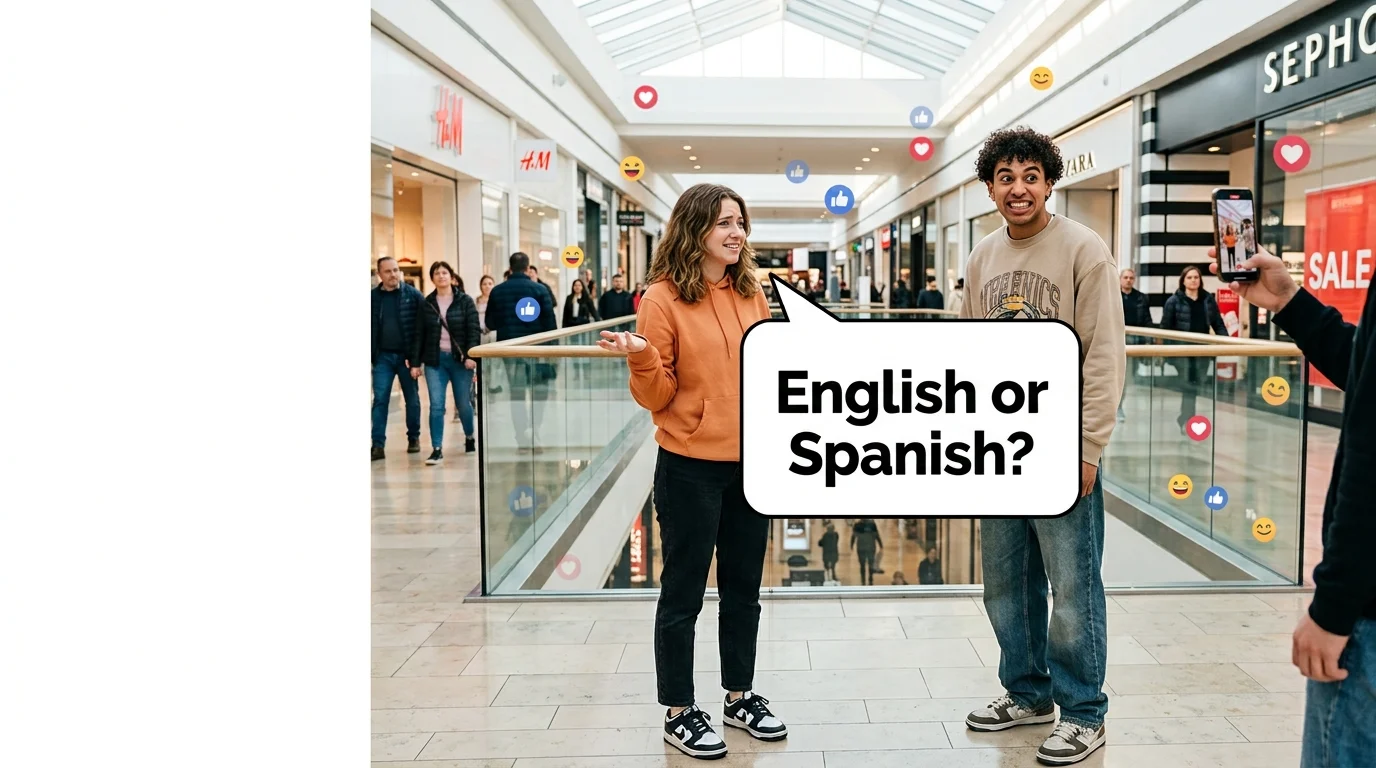

You may see someone type “English or Spanish?” in a comment or video and wonder why everyone suddenly starts talking about freezing. The English or Spanish meme refers to a 2024 TikTok prank in which someone asks a person to choose a language, then gives them a challenge involving whoever moves first being called gay. The target typically freezes and tries not to move. Over time, the phrase itself became a meme reference, even when the original prank was not shown. Understanding the setup, context, and tone makes the joke much easier to recognize.
What Does the English or Spanish Meme Mean?
The English or Spanish meme is a TikTok prank and internet meme built around the question “English or Spanish?” After someone chooses a language, the prankster says that whoever moves first is gay, causing the participants to freeze and wait for someone else to move.
| Detail | Explanation |
|---|---|
| Most Common Meaning | A reference to the freeze prank |
| Full Form | Not an abbreviation |
| Common Platform | TikTok, then other social platforms |
| Tone | Humorous, teasing, sometimes provocative |
| Formal or Informal | Highly informal |
The important point is that “English or Spanish?” does not normally have this meaning in everyday conversation. Outside the meme, it is simply a question about language preference.
In meme culture, however, the phrase can act as a signal that the joke is about to begin. Someone might say it to a friend and immediately expect them to freeze.
What Is the English or Spanish Meme About?
The original format is straightforward. A prankster approaches someone, asks “English or Spanish?”, and waits for the person to choose a language. The prankster then delivers the “whoever moves first is gay” challenge in that language.
The target usually becomes completely still. The humor comes from the unexpected transformation of an ordinary language question into an awkward staring contest.
For example:
Person A: “English or Spanish?”
Person B: “English.”
Person A: “Whoever moves first is gay.”
Person B: freezes
The joke is not that English or Spanish has a hidden translation. Instead, the language question became associated with the prank format.
Where Did the English or Spanish Meme Come From?
The trend originated on TikTok in 2024 and is associated with creator Alfonso Nieves, known online as @alfonsopinpon_. An early video in this format was posted on February 25, 2024, showing people being approached in a mall and given the freeze challenge. Later videos and edits helped turn the format into a recognizable meme.
By May 2024, the phrase had developed beyond the original videos. Creators began using “English or Spanish?” in reaction memes, POV posts, edits, and jokes where simply hearing the question was enough to make someone pretend to freeze.
Some popular edits also used Steve Lacy’s “Static,” which became strongly associated with versions of the trend.
The exact reason people found the format funny varied, but the basic appeal was simple: a normal question suddenly turned into a bizarre competition where nobody wanted to move first.
How Context Changes the Meaning
The phrase can mean different things depending on where and how you encounter it.
1. Someone says it before you freeze
If a friend says “English or Spanish?” and immediately starts standing still, they are probably referencing the meme.
2. It appears in a TikTok caption
A caption such as “POV: someone asks you English or Spanish” is likely referring to the prank rather than genuinely asking about language.
3. Someone uses it in a comment
A commenter may use the phrase as a quick meme reference, especially when a video shows people standing unusually still.
4. Someone genuinely asks about language
If the conversation is about translation, travel, school, or communication, “English or Spanish?” may simply be a literal question.
That last distinction matters. Not every use of the phrase is automatically a meme.
English or Spanish Meme on Different Platforms
The core reference generally stays the same across platforms, although the format changes.
TikTok: This is where the prank format originated and where the phrase became strongly associated with the freeze challenge. Videos may show the original setup, reactions, edits, or parody versions.
Instagram: The phrase can appear in Reels, captions, comments, and reposted meme content. Users often assume viewers already know the joke.
YouTube: Shorts and compilation-style videos may use the same freeze challenge or explain the trend to viewers who missed it.
Text and group chats: Friends may simply type “English or Spanish?” as a joke, expecting someone to respond by freezing, saying “I know this one,” or continuing the meme.
English or Spanish Meme Examples
1: Friends
Person A: “English or Spanish?”
Person B: “Bro, I know this meme.”
Meaning: Person A is referencing the freeze prank, and Person B recognizes the setup immediately.
2: Group Chat
Person A: “English or Spanish?”
Person B: “Neither. I’m moving first.”
Meaning: Person B is deliberately breaking the expected rules of the joke.
3: Social Media
Person A: “POV: someone asks you English or Spanish at the mall.”
Person B: “Stops moving”
Meaning: The post references the original prank without needing to recreate the entire conversation.
Why Do People Freeze in the Meme?
Freezing is the central visual gag.
Once the challenge is given, the participants try to avoid becoming the first person to move. This creates a silent standoff that can become increasingly awkward and exaggerated.
The humor often comes from the contrast between the ordinary opening question and the ridiculous reaction that follows. A simple choice between two languages suddenly turns into everyone standing motionless.
Later versions sometimes skip the challenge entirely. The words “English or Spanish?” alone can be enough to trigger the expected reaction among people familiar with the meme.
Is the English or Spanish Meme Rude or Offensive?
The phrase itself is not inherently rude. Asking someone whether they speak English or Spanish is completely ordinary.
The original joke, however, uses “being gay” as the consequence of moving first. Because the punchline relies on sexual orientation as something participants supposedly want to avoid being labeled as, some people view the meme as homophobic or uncomfortable.
That does not mean every person using the phrase intends to express hostility toward gay people. Often, users are simply repeating a recognizable meme format. Still, the underlying joke is worth understanding before using it around people who may not appreciate that type of humor.
Is the English or Spanish Meme Flirty?
Usually, no. The phrase is primarily a prank or meme reference rather than a flirting signal.
If someone sends it during a romantic conversation, the surrounding messages, emojis, and relationship between the two people matter more than the phrase itself. A playful exchange may simply be meme humor, while a genuinely flirtatious message would usually contain additional cues.
How to Reply to the English or Spanish Meme
Your best response depends on whether you want to continue the joke or make it clear that you recognize the reference.
Funny Replies
- “I’m not falling for that.”
- “Nice try. I’ve seen the meme.”
- “Neither. I choose chaos.”
- “You’re about three months too late.”
- “I know exactly where this is going.”
Playful Replies
- “English. Now what?”
- “Spanish, obviously.”
- “I’m staying perfectly still.”
- “You’re not getting me with that one.”
Replies When You Are Confused
- “Wait, what happens after I choose?”
- “Is this the TikTok meme?”
- “Why do I feel like I’m about to get pranked?”
When to Use the Meme
The English or Spanish meme works best in casual settings where everyone understands internet humor. Friends, group chats, comments, gaming communities, and informal social media conversations are the most natural places for it.
It is especially useful when the other person has already demonstrated that they recognize the meme. That prevents the reference from sounding random or confusing.
When to Avoid the Meme
There is little reason to use the phrase as a joke in professional emails, academic writing, job applications, formal announcements, or serious conversations.
You should also be cautious with unfamiliar people. Because the punchline involves sexual orientation, someone who does not know the meme may interpret the joke differently from what you intended.
If your goal is simply to ask which language someone prefers, say exactly that instead.
Common Mistakes About the English or Spanish Meme
| Common Mistake | Correct Understanding |
|---|---|
| Thinking “English or Spanish?” always means the meme | It can still be an ordinary question about language |
| Assuming the phrase is an abbreviation | It is a normal phrase that became a meme reference |
| Thinking everyone should freeze when they hear it | The freezing reaction belongs to the prank format |
| Assuming every use is meant as an anti-gay statement | Many uses simply reference the established joke, although the punchline can still be controversial |
Similar Meme Terms and References
| Term | Meaning | Main Difference |
|---|---|---|
| Whoever moves first is gay | The challenge at the center of the meme | Refers directly to the freeze challenge |
| If you move, you’re gay | Another wording of the same joke | More direct than the opening phrase |
| Do you speak English or Spanish? | The longer version of the setup | Sounds more like a genuine language question |
| Freeze challenge | A broader description of the behavior | Describes the action rather than the specific meme |
| POV meme | A format often used to parody the trend | Describes the presentation style, not the original joke |
Origin and Popularity of the Meme
The documented origin of the trend is TikTok in 2024, with Alfonso Nieves associated with the early prank videos. The format gained wider attention through subsequent videos, edits, and parody posts.
Its popularity also changed the phrase itself. Initially, “English or Spanish?” functioned as the setup for a prank. As more people recognized the format, the question became a standalone reference that could communicate the entire joke without showing the original video.
That distinction explains why someone might type the phrase in a completely unrelated conversation and expect others to understand the reference.
Quick Recap
- English or Spanish? is a normal language question that became the setup for a TikTok meme.
- The original prank involves a “whoever moves first is gay” challenge and people freezing in place.
- The trend originated on TikTok in 2024 and is associated with Alfonso Nieves.
- Later memes often use the phrase alone as a reference to the original prank.
- Context matters because the phrase can still be used literally.
- The joke is informal and may be uncomfortable for some people because of its sexual-orientation-based punchline.
Frequently Asked Questions
What does English or Spanish mean in text?
It usually references the TikTok freeze prank, although the phrase can still literally ask which language someone prefers.
Is English or Spanish rude?
The phrase itself is neutral, but the associated joke can feel offensive because its punchline uses sexual orientation as a label.
What does English or Spanish mean on TikTok?
On TikTok, it commonly refers to the 2024 prank where participants freeze after being given the “whoever moves first” challenge.
How should you reply to English or Spanish?
You can play along, joke about recognizing the meme, or ask what the person means if the context is unclear.
Can English or Spanish have different meanings?
Yes, it can be a literal language question or a meme reference depending on the conversation and surrounding context.
Final Thoughts
The English or Spanish meme turns an ordinary language question into a recognizable reference to a TikTok freeze prank. In the original format, someone chooses a language before receiving the “whoever moves first is gay” challenge, leading participants to stand completely still. Later versions shortened the joke so that simply saying “English or Spanish?” could trigger the reference. Context remains essential because the phrase can still be used literally. For casual conversations, recognizing the meme is usually enough to understand the joke, while more formal or unfamiliar situations call for clearer language.
Discover More Post:
Chopped Meaning Slang | What It Really Means & How to Use It
Sigma Meaning Slang | The Complete Guide to the Viral Term
Demure Meaning Slang | What It Really Means in Text and …






Pingback: PTSO Meaning Slang |PTSO Meaning in Text, What It Really Means in Texts & Social Media