
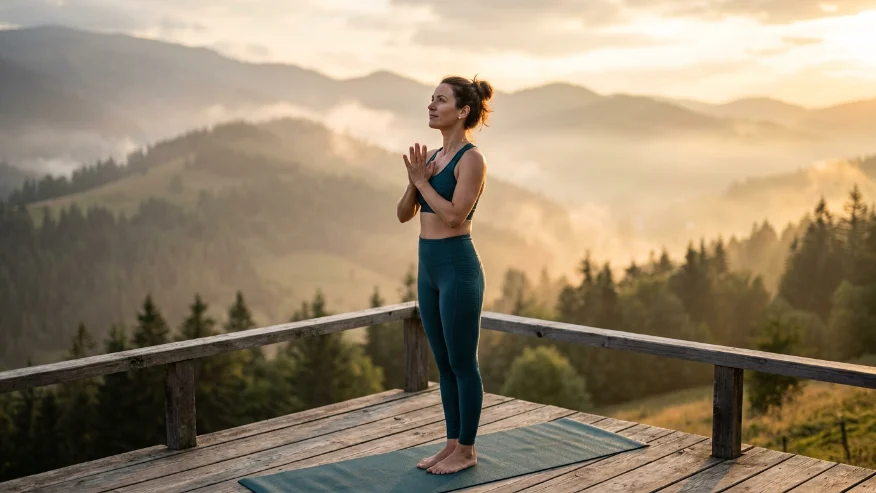

Namaste is a Sanskrit greeting that translates to “I bow to the divine in you.” It combines “namas” (bow/reverence) and “te” (to you), representing the recognition that the divine essence within one person honors the divine essence within another.
While commonly used as a greeting in yoga classes and Indian culture, its deep spiritual meaning connects to humility, respect, and the interconnectedness of all beings.
Have you ever ended a yoga class with palms pressed together, bowed your head, and said “namaste” without fully understanding what you were really saying? You’re not alone. This ancient Sanskrit word has traveled thousands of miles and thousands of years to become a global phenomenon, yet its true namaste meaning often gets lost in translation.
The word has become so mainstream that you’ll hear it in yoga studios across America, see it on trendy merchandise, and even encounter it in corporate wellness programs. But beneath this popular usage lies a profound spiritual concept that connects to the very essence of human connection and consciousness.
In this comprehensive guide, we’ll explore everything from the literal translation and correct pronunciation to the cultural context, spiritual significance, and appropriate usage in modern settings. Whether you’re a yoga practitioner, a traveler to India, or simply curious about this beautiful greeting, you’ll gain a deep understanding that goes far beyond the surface-level interpretation.
QUICK ANSWER
| Aspect | Details |
| Meaning | “I bow to the divine in you” / “The divine in me honors the divine in you” |
| Literal Translation | Namas (bow/reverence) + Te (to you) |
| Pronunciation | nuh-muh-STAY |
| Context | Spiritual greeting, yoga practice, Indian culture, respect |
| Common Usage | Yoga classes, greetings, farewells, meditation, cultural events |
| Example | Bringing palms together at heart center, bowing head slightly, and saying “namaste” at the end of a yoga session |
| Tone | Reverent, respectful, spiritual, humble |
WHAT DOES NAMASTE MEAN?
The Core Definition
At its most fundamental level, the namaste meaning revolves around recognition and respect. The word serves as both a greeting and a farewell, but unlike casual English equivalents like “hello” or “goodbye,” it carries a spiritual weight that acknowledges the sacred nature of human interaction.
When you say namaste, you’re essentially saying: “The divine light within me recognizes and honors the divine light within you.” This isn’t just polite conversation it’s a profound acknowledgment of shared consciousness and spiritual interconnectedness.
Breaking Down the Sanskrit
To truly understand namaste, we need to examine its Sanskrit roots:
Namas (नमस्): This root word means “bow,” “reverence,” or “adoration.” It’s the same root found in words like “namaskar” and carries connotations of humility and respect.
Te (ते): This translates to “to you” and represents the person being addressed.
When combined, these elements create a word that literally means “I bow to you.” However, the cultural and spiritual context transforms this simple translation into something far more meaningful.
Historical Origins
The namaste meaning finds its origins in ancient India, where Sanskrit served as the language of scholars, priests, and spiritual texts. This greeting appears in Vedic literature dating back thousands of years, where it was used not just as a casual greeting but as a formal expression of reverence.
In ancient Hindu culture, recognizing the divine in others was central to spiritual practice. The act of bowing represented humility before the divine presence that exists in all living beings. This wasn’t mere politeness it was a spiritual discipline that cultivated awareness of universal consciousness.
Common Misconceptions
Many people mistakenly believe namaste simply means “thank you” or “hello” in some bizarre language. Others think it’s exclusively a yoga term with no real-world application. Some even view it as a New Age affectation disconnected from authentic spiritual tradition.
In reality, the namaste meaning encompasses far more than these surface-level interpretations. While it can function as a greeting, its purpose extends to acknowledging the sacred connection between individuals a concept that transcends both casual conversation and specific spiritual practices.
THE SPIRITUAL AND CULTURAL CONTEXT
The Divine Connection
The most profound aspect of namaste lies in its acknowledgment of the divine. In Hindu philosophy, there exists a belief that the same universal consciousness dwells within every living being. This divine spark, often called the Atman, represents the true self beyond physical form and individual ego.
When you say namaste, you’re not just greeting a person you’re recognizing their essential nature as an expression of the divine. This creates an immediate shift in consciousness from seeing someone as separate to experiencing their fundamental unity with yourself and all of creation.
The Gesture That Accompanies the Word
While the word itself carries deep meaning, the traditional gesture that accompanies namaste adds another layer of significance:
Anjali Mudra: This is the hand position where palms press together at the heart center. It creates a physical representation of unity bringing together the left and right sides of the body, the masculine and feminine energies, and the duality of existence.
Bowing the Head: When combined with the hand gesture, bowing represents humility. It shows that you’re approaching the other person with openness and receptivity rather than ego or defensiveness.
Closing the Eyes: Many practitioners close their eyes while saying namaste, which deepens the inward focus and heightens awareness of the spiritual connection being acknowledged.
The Third Eye Connection
In some interpretations, pressing the thumbs to the bridge of the nose (where the third eye or Ajna chakra is located) while saying namaste represents intuitive connection. The third eye is associated with spiritual perception and the ability to see beyond surface appearances.
Namaste in Daily Indian Culture
While Westerners often associate namaste exclusively with yoga and spiritual practice, the word appears in various contexts throughout India:
- Formal Greetings: In many parts of India, namaste serves as a respectful greeting for elders, teachers, and respected figures.
- Religious Settings: Temples and spiritual gatherings frequently employ namaste as a form of showing reverence to deities and holy people.
- Everyday Courtesy: While urban Indians might use more casual greetings in daily life, namaste remains a polite and respectful option in many situations.
- Cultural Events: Traditional ceremonies and festivals often include the namaste gesture as part of their rituals.
REAL-LIFE EXAMPLES
Example 1: Yoga Class Setting
Context: A yoga instructor at a studio in Los Angeles
Instructor: “Thank you all for your practice today. As we come to a close, bring your palms together at your heart center. Bow your head slightly and join me in saying namaste.”
Students: “Namaste.” (In unison)
Instructor: “Remember that the light in me honors the light in each of you. Carry this awareness with you throughout your day.”
Example 2: Meeting an Elder
Context: A young Indian-American meeting their grandmother’s friend
Sarah: “Namaste, Auntie. How are you doing today?”
Elder: “Namaste, beta. It’s wonderful to see you. You’ve grown so much since our last meeting.”
Sarah: “I’ve missed you. Can I get you some tea?”
Example 3: International Yoga Festival
Context: Participants at a festival in Rishikesh, India
Attendee 1: “Namaste! I’m so excited to learn from Swami Vishwanand.”
Attendee 2: “Namaste, friend. This is my first time at the festival. Is yours as well?”
Attendee 1: “I’ve been coming for five years now. You’ll love it the energy here is transformative.”
Example 4: Meditation Group
Context: A meditation circle before beginning their session
Facilitator: “Let’s begin by grounding ourselves with a namaste. Turn to the person on your left and right, place your hands together, and offer this greeting.”
Participants: (Turning to neighbors) “Namaste.”
Facilitator: “Thank you. Now let’s set our intentions for today’s practice.”
Example 5: Virtual Meeting
Context: A culturally aware company’s team meeting starting with a grounding moment
CEO: “Before we dive into the agenda, I’d like to take a moment to ground ourselves. Place your hands together everyone in person and online and let’s say namaste together.”
Team: (Live and virtual participants joining) “Namaste.”
CEO: “Thank you. That simple recognition of our shared humanity is the perfect way to start our meeting.”
PLATFORM-SPECIFIC MEANINGS
Namaste Meaning on WhatsApp
On messaging platforms, namaste often appears as a respectful opening or closing to conversations, particularly when communicating with elders or in professional contexts. Users might type “Namaste 🙏” to show respect and maintain cultural appropriateness. In family groups, it frequently serves as a morning greeting. Among younger users, the term sometimes appears humorously in response to overly dramatic messages much like saying “hello” to someone acting shocked.
Snapchat
Namaste Meaning on Snapchat
Snapchat users often employ namaste through filters featuring the gesture or as a caption for spiritual, mindful, or yoga-related content. It’s commonly used with lotus, meditation, or sunrise themes. Some influencers use “Namaste” ironically to comment on wellness culture or what they consider overly spiritual content. The term frequently appears in stories from yoga studios, wellness retreats, or travel to spiritual destinations.
TikTok
Namaste Meaning on TikTok
The TikTok community uses namaste in various ways. Yoga instructors create videos demonstrating proper form while ending with the greeting. Meditation influencers use it as a sign-off. Trendy creators sometimes use it comically to end chaotic videos, creating contrast between the word’s seriousness and their content’s absurdity. Some controversy exists around cultural appropriation, with many creators discussing appropriate usage and respect for Indian traditions.
YouTube
Namaste Meaning on YouTube
On YouTube, namaste appears in countless contexts. Yoga channels prominently feature it in opening and closing sequences. Cultural educators create videos explaining the word’s history and proper usage. Travel vloggers show greetings in Indian villages. Meditation and mindfulness channels use it as a centering moment. Some creators highlight misappropriation discussions, creating a space for cultural exchange and understanding.
Namaste Meaning on Instagram
Instagram sees heavy use of namaste in hashtags like #namaste and #namasté. Wellness influencers feature it in yoga and mindfulness posts. Spiritual accounts use it for meditation content. Photography posts from India often include the caption. Brands selling yoga wear or meditation supplies regularly incorporate it. Some authenticity-focused users discuss appropriate usage and cultural respect.
Emoji Usage
Namaste Meaning in Emoji Context
The “folded hands” emoji (🙏) frequently serves as the visual representation of namaste on all platforms. Users employ it in various contexts:
- Literal Use: With yoga or meditation content
- Respect: When showing appreciation or gratitude
- Prayer: Religious or spiritual contexts
- Humorous: As sarcastic prayer or exaggerated thanks
- Cultural: With references to Indian culture
- Politeness: In polite requests or thank-you messages
ALTERNATIVE MEANINGS AND VARIATIONS
Namaskar
Namaskar represents a slightly more formal variation of namaste. While the core meaning remains identical, namaskar is often considered a more respectful form used in formal settings or when greeting multiple people. The literal breakdown offers “namas” (bow/reverence) combined with “kar” (maker/doer), essentially meaning “I make my bow” or “I pay my respects.”
In practice, you might use namaskar when entering a temple, greeting a large gathering, or showing particular reverence to an elder. Many yoga teachers use namaskar in their classes as a respectful introduction. In daily Indian usage, namaskar sometimes serves as a more formal alternative to the casual greeting.
Namo Namah
This variation, meaning “bow, bow” or “reverence, reverence,” represents an intensified form of respect. It’s commonly used in devotional contexts when addressing deities or spiritual teachers. The repetition emphasizes the depth of reverence being expressed. You might encounter this in prayers, mantras, or when showing exceptional respect to a spiritual guide.
Pranam
Pranam (sometimes spelled pranam) translates to “bow” or “prostration” and represents a more physical manifestation of reverence. While namaste involves the palms together at heart center, pranam might involve touching the feet of elders or completely prostrating before a deity. It carries a deeper sense of physical submission and respect.
The difference between namaste and pranam essentially comes down to the physical expression of the greeting. Namaste maintains some distance, while pranam involves greater physical contact with the revered person’s feet. Both recognize the divine in the other, but pranam shows a more complete humility.
Namaskaraha
This represents a slightly different grammatical form of the same greeting. In some regions of India, you might hear this version used in formal contexts. The meaning remains identical, but the pronunciation differs slightly, emphasizing the second syllable more strongly.
RELATED TERMS AND NLP VARIATIONS
Synonyms and Near-Synonyms
- Greetings of respect: Hello, salutations, reverence, homage
- Spiritual acknowledgments: The light in me honors the light in you, divine recognition, spiritual salutation
- Cultural greetings: Salam, shalom, aloha, sat sri akal
Collocations
- Common pairings: Say namaste, offer namaste, receive namaste, respond with namaste
- Phrases: Doing the namaste gesture, namaste pose, yoga namaste, hands in namaste
- Contextual usage: Namaste greeting, traditional namaste, spiritual namaste
Semantic Relationships
- Hypernyms: Greeting, salutation, acknowledgment, respect
- Hyponyms: Anjali mudra, yoga greeting, spiritual greeting, Indian greeting
- Related concepts: Divine recognition, spiritual humility, consciousness connection
BERT Contextual Variations
Search engines understand that “namaste meaning” can refer to:
- The translation and definition
- How to pronounce the word correctly
- The appropriate contexts for use
- The spiritual significance and background
- Cultural appropriation concerns
HOW TO RESPOND TO NAMASTE
Appropriate Responses
When someone says namaste to you, you have several culturally appropriate options. The most traditional response involves simply returning the greeting with your own “namaste” while performing the hand gesture. This creates a beautiful moment of mutual recognition and respect.
Other acceptable responses include:
- Returning the gesture: Bring your hands together and say “namaste” back
- Acknowledging with a smile: A warm smile and nod shows you received the greeting with respect
- Verbal acknowledgment: “Thank you” or “Same to you” works in casual settings
- Cultural awareness: “I honor the light in you too” shows deeper understanding
- Practical response: In a yoga class, a simple “namaste” back to the instructor is perfect
Matching the Context
Your response should match the context. In a yoga class, returning “namaste” is completely appropriate. In India, responding with namaste to an elder who greeted you this way shows respect. Western business setting where someone uses the greeting unexpectedly, a warm smile and acknowledgment might be more natural.
When Someone Bows to You
If someone performs the namaste gesture toward you without speaking, you can respond with the same gesture and a slight bow. This non-verbal exchange carries the same meaning as the spoken word and often feels more genuine and heartfelt.
Cultural Sensitivity
It’s important to recognize that while namaste is a beautiful greeting, using it inappropriately can feel disrespectful or cultural appropriation. When someone greets you with namaste, responding with respect shows you value their culture and understand the significance of the greeting.
MISINTERPRETATIONS AND WHEN NOT TO USE IT
Common Misunderstandings
The “Thanks” Confusion: One of the most common misinterpretations involves using namaste as a synonym for “thank you.” While the word carries gratitude, it’s fundamentally about recognizing divine presence rather than expressing thanks for a service.
The “Goodbye” Usage: Many Western yoga studios use namaste as a farewell to end classes, but traditionally it serves equally as a greeting and farewell. The spiritual meaning remains constant regardless of when you use it.
The “Casual Hello” Mistake: Using namaste as casually as you’d use “hey” misses its spiritual weight. This isn’t a word for grabbing someone’s attention at a party it’s a word for conscious acknowledgment of shared humanity.
The “Magic Word” Misconception: Some people treat namaste like a magical word that instantly makes them spiritual. The real power lies in the intention behind the word, not the word itself.
When NOT to Use Namaste
In Extreme Casual Settings: At a sports bar with friends watching a game, you probably shouldn’t greet your buddy with a serious namaste. It would feel out of place and slightly ridiculous.
With Close Friends: While you can use namaste with friends (especially if you share spiritual practice), using it too casually with close buddies might seem forced or pretentious.
In Professional Western Contexts: Unless you’re in a yoga studio or a company with intentional wellness culture, using namaste in a board meeting might confuse colleagues and feel unprofessional.
When Lacking Genuine Intention: Saying namaste without any understanding or feeling behind it reduces a profound spiritual practice to empty words. It’s better to skip it than to use it mindlessly.
When the Recipient is Uncomfortable: Not everyone feels comfortable with spiritual greetings. If someone seems unsure or uncomfortable with namaste, using a more conventional greeting might be more appropriate.
Cultural Appropriation Concerns
The increasing popularity of namaste in Western wellness culture has sparked conversations about cultural appropriation. Critics argue that adopting sacred words and practices without understanding their cultural context reduces them to trendy accessories.
To use namaste respectfully:
- Learn about its actual meaning and significance
- Understand its cultural and spiritual context
- Use it appropriately and with genuine intention
- Acknowledge and respect its origins
- Be mindful of power dynamics and cultural sensitivities
- Avoid using it simply to seem “bizarre” or “spiritual”
USAGE TIPS
For Yoga Practitioners
If you’re using namaste in your yoga practice, focus on the intention behind the word. The physical gesture is important, but the consciousness you bring to it matters more. When you end your practice with namaste, you’re not just completing a routine you’re acknowledging the shared journey and the transformation that occurred during your practice.
Tips for yoga practitioners:
- Say it with your whole heart, not just your voice
- Pause after saying it to feel the meaning
- Use the traditional hand gesture and bow
- Consider the instructor and fellow practitioners with genuine reverence
- Understand you’re acknowledging the divine in yourself and others
For Travelers to India
Visiting India offers a wonderful opportunity to use namaste authentically. As a traveler, your respectful use of the greeting will be appreciated and reciprocated. Namaste serves as a bridge between cultures when you approach it with genuine respect.
Tips for travelers:
- Use it when greeting elders and authority figures
- Combine it with the traditional gesture for more authenticity
- Learn other regional greetings in areas where namaste isn’t common
- Be aware that rural areas may use it more often than urban settings
- Practice the pronunciation to avoid turning it into something else
For Wellness Influencers
If you’re sharing content that uses namaste, you have a responsibility to present it accurately and respectfully. Your audience may learn about the meaning from your content, so getting it right matters both for cultural respect and for the spiritual integrity of the practice.
Tips for influencers:
- Explain the meaning, not just the usage
- Acknowledge the cultural origins
- Use it appropriately in relevant content (yoga, meditation, mindfulness)
- Consider creating content about cultural respect and proper usage
- Be transparent about your own understanding and cultural connection
For Everyday Use
Incorporating namaste into your daily life can enrich your interactions and cultivate a deeper awareness of human connection. It’s a reminder to see the sacred in ordinary encounters.
Tips for everyday use:
- Use it when you want to genuinely acknowledge someone’s presence
- Practice the gesture and word to develop comfort with them
- Pay attention to the response you receive
- Use it consciously, not as a casual afterthought
- Reflect on the meaning each time you say it
FAQ
What does namaste literally mean?
The literal translation of namaste from Sanskrit breaks down into two parts. “Namas” means “bow” or “reverence,” and “te” means “to you.” The literal translation is “I bow to you,” but the cultural meaning expands this to “I bow to the divine in you.”
How do you pronounce namaste correctly?
The correct pronunciation is nuh-muh-STAY. Each syllable should be clearly pronounced with the emphasis on the final “stay” sound. Many English speakers mistakenly pronounce it as “nah-mah-stay” or “nah-mah-stee,” but the proper pronunciation maintains the neutral “uh” sound in the first two syllables.
When should I say namaste?
You can say namaste as a greeting or farewell, particularly in yoga classes, meditation sessions, or when meeting someone in a spiritual context. It’s also appropriate when greeting elders or respected figures in Indian cultural settings. The key is to say it with genuine intention and awareness of its meaning rather than as a casual replacement for “hello” or “goodbye.”
Is namaste a religious word?
While namaste has roots in Hindu philosophy, it’s better understood as a spiritual rather than strictly religious term. It acknowledges the divine or essential consciousness in others without requiring specific religious beliefs. People from various spiritual backgrounds can use it authentically as a recognition of shared humanity and consciousness.
Can anyone say namaste?
Anyone can say namaste, provided they approach it with respect for its cultural origins and genuine understanding of its meaning. The word has spread globally and is used by people of various backgrounds. However, using it carelessly or without understanding can be seen as cultural appropriation.
What is the difference between namaste and namaskar?
Namaskar is considered a slightly more formal version of the same greeting. While the core meaning is identical, namaskar is often used in more formal settings or when greeting multiple people. Some traditions use namaskar for deities and namaste for people, but in practice they’re often used interchangeably.
Why do we put hands together when saying namaste?
The hand gesture (anjali mudra) represents unity bringing together the left and right sides of the body, the masculine and feminine energies, and the duality of existence. This physical gesture adds a tangible dimension to the spiritual meaning of the word, creating a complete experience of acknowledgment and reverence.
What should I say if someone says namaste to me?
The most appropriate response is to return the greeting with your own “namaste” and the accompanying gesture. This shows you understand and respect the greeting. Alternatively, a warm smile, nod, or simple acknowledgment like “thank you” can work in less formal settings.
Is it okay to use namaste outside of yoga classes?
Absolutely, as long as you use it appropriately and with understanding. Many people use namaste in meditation groups, spiritual gatherings, or when greeting elders in Indian cultural contexts. However, using it in extremely casual settings or without understanding its meaning might be inappropriate.
What is the emoji for namaste?
The folded hands emoji (🙏) is the most common emoji representation of namaste. People also use the person with folded hands emoji (🧎) in some contexts. These emojis can represent the greeting, a request, a thank you, or a prayer gesture, depending on context.
Why do people say namaste at the end of yoga class?
Yoga classes traditionally end with namaste as a way to thank the instructor and fellow practitioners while acknowledging the shared journey of practice. It serves as a moment of closure and gratitude, recognizing the divine light in all participants.
What does namaste mean in spirituality?
In spiritual contexts, namaste represents the recognition that the divine essence within one person honors the divine essence within another. It acknowledges that we’re all expressions of the same universal consciousness, helping to dissolve the illusion of separation.
CONCLUSION
Understanding the namaste meaning enriches not only your vocabulary but also your approach to human connection. This ancient Sanskrit greeting offers a powerful reminder that beneath our differences, we share a fundamental unity. In a world that often emphasizes division and separation, the wisdom of namaste calls us to see the sacred light in every person we encounter.
Whether you say it in a yoga class, offer it as a greeting in India, or use it as a spiritual practice in your daily life, approach namaste with the respect and understanding it deserves. The word itself is simple, but its meaning has the power to transform how you see others and yourself.