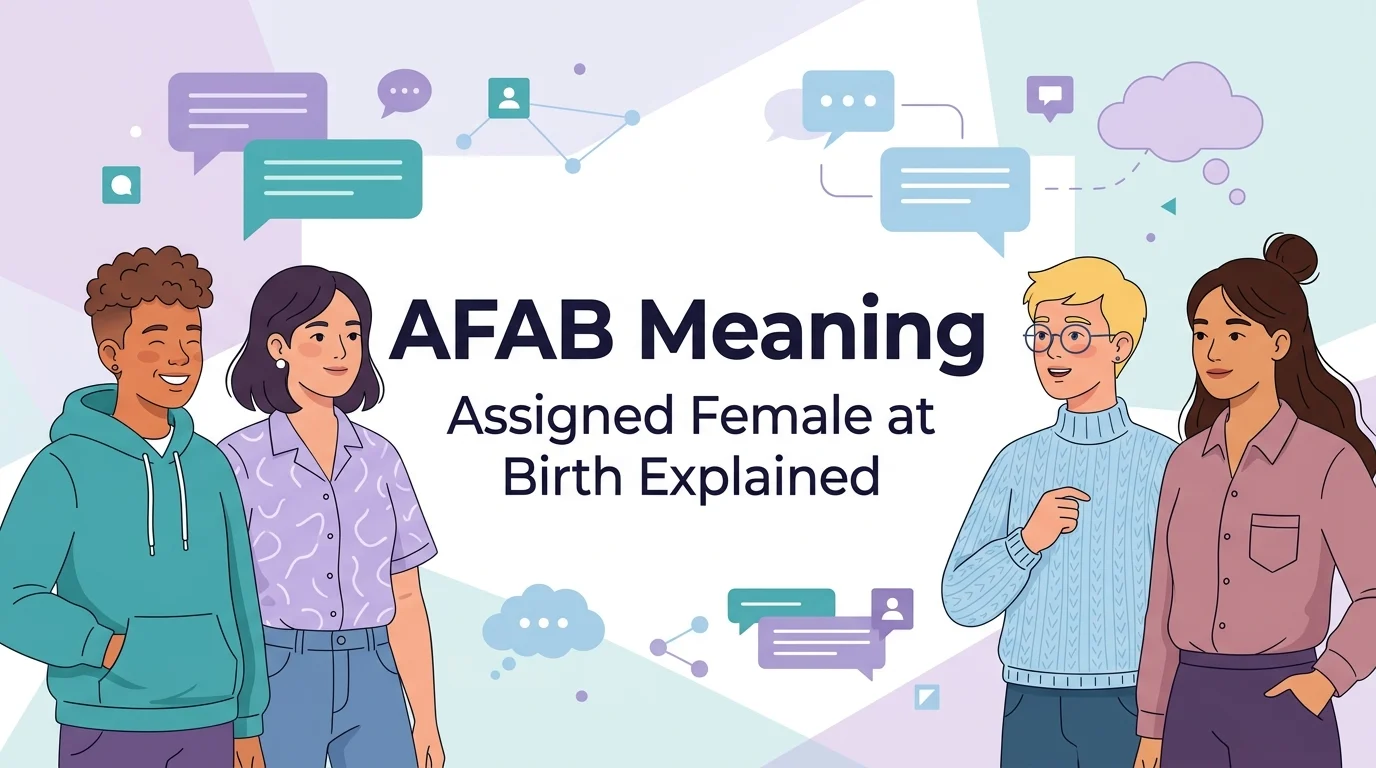

You may have seen someone describe themselves as “AFAB” in a social media bio, a discussion about gender identity, or an online conversation and wondered what it means. The short answer is that AFAB stands for Assigned Female at Birth. It refers to the sex designation a person received when they were born, based on physical characteristics, rather than their current gender identity.
Understanding the context matters because AFAB is not a slang insult or casual nickname. Instead, it’s a respectful descriptive term commonly used in conversations about gender, healthcare, identity, and lived experiences. Knowing how people use it can help you communicate more accurately and respectfully.
What Does AFAB Mean?
AFAB means Assigned Female at Birth. It describes a person who was identified as female when they were born based on physical characteristics. The term does not automatically describe someone’s current gender identity, gender expression, or sexual orientation.
| Detail | Explanation |
|---|---|
| Most Common Meaning | Assigned Female at Birth |
| Full Form | Assigned Female at Birth |
| Tone | Neutral and descriptive |
| Common Platforms | Text messages, Reddit, TikTok, Instagram, Discord |
| Formal or Informal | Suitable in both casual and educational discussions |
The Main Meaning of AFAB
The full form of AFAB is Assigned Female at Birth.
Healthcare professionals assign a baby’s sex at birth based on visible physical characteristics. Later in life, a person’s gender identity may or may not match that original assignment. Because of this distinction, many people use AFAB when discussing medical history, gender identity, or shared experiences without assuming how someone identifies today.
For example:
“I’m AFAB but identify as nonbinary.”
In this sentence, the speaker explains that they were assigned female at birth while also making it clear that their current gender identity is nonbinary. The term helps separate birth assignment from personal identity.
AFAB is commonly used by transgender, nonbinary, intersex, and cisgender people when discussing topics where birth assignment is relevant.
Alternative Meanings
AFAB overwhelmingly means Assigned Female at Birth. Unlike many internet abbreviations, it does not have multiple widely recognized slang meanings across different platforms.
Occasionally, you may see AFAB used in highly specialized professional or organizational contexts as an unrelated acronym, but those meanings are uncommon and usually obvious from the surrounding discussion. When AFAB appears in online conversations about identity, health, or social issues, it almost always refers to Assigned Female at Birth.
How Context Changes the Meaning
Although AFAB has one primary definition, the surrounding conversation helps explain why someone is using it.
Consider these examples:
- “Many AFAB people experience this medical condition.”
Here, AFAB refers to people assigned female at birth for healthcare purposes. - “I’m AFAB and use they/them pronouns.”
The speaker is distinguishing birth assignment from gender identity. - “The study included both AFAB and AMAB participants.”
The abbreviation is being used as demographic terminology in research. - “Most AFAB students shared similar experiences growing up.”
The focus is on shared social experiences rather than current identities.
The conversation topic usually tells you whether AFAB relates to medicine, identity, research, or personal experience.
AFAB Meaning on Different Platforms
Text Messages and Group Chats
In personal conversations, AFAB usually appears when someone is discussing identity, healthcare, or experiences.
Example:
“I’m AFAB, so my doctor recommended this screening.”
The tone is informative and personal.
TikTok and Instagram
Creators often include AFAB in bios or videos discussing gender identity, health, or personal experiences.
Example:
“AFAB nonbinary creator.”
The abbreviation quickly provides relevant background without explaining an entire identity.
Reddit and Discord
AFAB frequently appears in community discussions about gender, medical advice, social experiences, and support groups.
Example:
“Any AFAB people have experience with this?”
Here, the term helps identify people with similar lived experiences.
Real Conversation Examples
Person A: “What does AFAB mean in your profile?
Person B: “It means I was assigned female at birth.
Meaning: A straightforward explanation of the abbreviation.
Person A: “The event is open to AFAB participants.”
Person B: “Thanks for clarifying who it’s intended for.”
Meaning: AFAB is used to describe eligibility based on birth assignment.
Person A: “I’m AFAB but identify as a man.”
Person B: “Thanks for sharing.”
Meaning: Birth assignment and gender identity are being described separately.
Tone and Emotional Meaning
AFAB is generally a neutral and respectful term.
Unlike many internet abbreviations, it is not intended to be humorous, sarcastic, or trendy. People often use it because it provides accurate language when discussing identity or healthcare.
Is AFAB Rude?
No. AFAB is not considered rude when used correctly and respectfully. Problems arise only if someone ignores or dismisses another person’s stated gender identity after learning they are AFAB.
Is AFAB Offensive?
The abbreviation itself is not offensive. However, using it to invalidate someone’s identity or making assumptions about their experiences can be disrespectful.
Is AFAB Flirty?
No. AFAB has no romantic or flirtatious meaning. It is purely descriptive.
How to Reply to AFAB
If someone mentions they are AFAB, your response should fit the conversation rather than focusing on the abbreviation itself.
Friendly Replies
- “Thanks for explaining.”
- “I appreciate you sharing that.”
- “That makes sense.”
- “Got it, thanks.”
- I understand what you mean.”
Polite Replies
- “Thank you for letting me know.”
- “I appreciate the clarification.”
- “Thanks for sharing your perspective.”
- “I’ll keep that in mind.”
- “Thanks for explaining the context.”
Replies When You’re Confused
- “Can you tell me what AFAB stands for?”
- “I’m not familiar with that abbreviation. Could you explain it?”
- Do you mean Assigned Female at Birth?
These responses are respectful and encourage clear communication.
When to Use the Term
AFAB is appropriate when discussing topics where birth assignment is genuinely relevant, including:
- Conversations about gender identity
- Medical or healthcare discussions
- Educational content
- Research and surveys
- Support groups and community discussions
- Personal introductions when someone chooses to share that information
Use the term only when it adds useful context.
When to Avoid the Term
AFAB is not necessary in every conversation.
Consider using different wording when:
- Birth assignment is unrelated to the discussion.
- You’re writing professional documents where more specific language is appropriate.
- Someone has expressed a preference for different terminology.
- Mentioning birth assignment could invade someone’s privacy.
Always respect how people describe themselves rather than assigning labels to them.
Common Mistakes
| Common Mistake | Correct Understanding |
|---|---|
| Assuming AFAB means someone’s current gender | It refers only to the sex assigned at birth. |
| Thinking AFAB describes sexual orientation | It has nothing to do with who someone is attracted to. |
| Using AFAB when birth assignment is irrelevant | Mention it only when it adds meaningful context. |
Similar Terms
| Term | Meaning | Main Difference |
|---|---|---|
| AMAB | Assigned Male at Birth | Refers to people assigned male at birth. |
| AGAB | Assigned Gender at Birth | Broader term covering any birth assignment. |
| Cisgender | Gender identity matches birth assignment | Describes identity rather than birth assignment alone. |
| Transgender | Gender identity differs from birth assignment | Refers to identity, not the assignment itself. |
| Nonbinary | Gender identity outside the male-female binary | A gender identity, not a birth designation. |
Origin and Popularity
AFAB developed as inclusive language within healthcare, academic, and LGBTQ+ communities to distinguish birth assignment from gender identity. The exact origin of the abbreviation is not clearly documented, but its use has become increasingly common in discussions where that distinction improves clarity.
Today, AFAB is widely recognized across online communities, educational resources, and conversations about gender and health.
Quick Recap
- AFAB stands for Assigned Female at Birth.
- It describes birth assignment, not current gender identity.
- The abbreviation is neutral and respectful when used appropriately.
- Context helps explain why someone mentions being AFAB.
- Reply politely and respect how people identify themselves.
Frequently Asked Questions
What does AFAB mean in text?
It means Assigned Female at Birth and usually describes someone’s birth assignment rather than current gender identity.
What does AFAB stand for?
It stands for Assigned Female at Birth, referring to the sex designation given when someone was born.
What does AFAB mean on TikTok?
It usually identifies a creator’s birth assignment when discussing gender identity, health, or personal experiences.
How should you reply to AFAB?
Respond respectfully by acknowledging the information or politely asking for clarification if you do not understand the term.
Can AFAB have different meanings?
It almost always means Assigned Female at Birth, while other acronym uses are uncommon and context-specific.
Final Thoughts
AFAB meaning is straightforward once you understand the distinction between birth assignment and gender identity. It stands for Assigned Female at Birth and serves as a respectful way to describe someone’s original sex designation without making assumptions about who they are today. Whether you see AFAB in text messages, social media, or educational discussions, paying attention to context will help you interpret it correctly. Using the term thoughtfully and respecting how people identify themselves leads to clearer, more considerate communication.