

Solfege (also called solfeggio or sol-fa) is a musical system that assigns syllables to the notes of a scale to help musicians learn pitch, sight-singing, and ear training. The seven main syllables are do, re, mi, fa, sol, la, and ti.
There are two main systems: movable do, where “do” is always the first note of the scale, and fixed do, where “do” is always C. Solfege is widely used in music education worldwide, from elementary school classrooms to professional conservatories.
If you have ever watched The Sound of Music or taken a music class, you have probably heard someone sing “do, re, mi.” But those syllables are far more than just a catchy tune from a movie. They are part of a powerful musical system called solfege that has been helping musicians learn, remember, and perform music for over a thousand years.
Solfege is a method of naming musical pitches using specific syllables. Instead of calling notes by letters like C, D, E, or numbers like 1, 2, 3, solfege gives each note a name that is easier to sing and remember. The system transforms abstract musical concepts into something tangible and vocal, making it one of the most effective tools for ear training, sight-singing, and understanding music theory.
In this guide, you will learn everything you need to know about solfege meaning, including its history, how it works, the different systems used around the world, and why musicians of all levels continue to rely on it. Whether you are a complete beginner or an experienced musician looking to deepen your understanding, this article will give you a complete picture of what solfege is and how to use it.
Quick Answer Box
| Element | Details |
|---|---|
| Meaning | A musical system that uses syllables (do, re, mi, fa, sol, la, ti) to name the notes of a scale |
| Context | Music education, ear training, sight-singing, vocal exercises |
| Usage | Singing scales, learning melodies, transcribing music, teaching pitch |
| Platforms | Music schools, online courses, choir rehearsals, private lessons |
| Example | Singing a C major scale as “do re mi fa sol la ti do” instead of “C D E F G A B C” |
| Tone | Educational, practical, foundational |
What Does Solfege Mean?
At its core, solfege meaning refers to a system of assigning syllables to the notes of a musical scale. The word itself comes from the French solfège, which in turn derives from the Italian solfeggio – a combination of the syllables “sol” and “fa.”
Solfege is essentially a vocal tool. Instead of singing a melody using neutral sounds like “la” or “ah,” solfege gives each pitch a specific name. This helps musicians internalize the relationships between notes, making it easier to learn new music by ear, sight-read, and understand musical structure.
The syllables used in English-speaking countries are:
- Do (pronounced “doh”)
- Re (pronounced “ray”)
- Mi (pronounced “mee”)
- Fa (pronounced “fah”)
- Sol (pronounced “sohl”) – sometimes shortened to “so”
- La (pronounced “lah”)
- Ti (pronounced “tee”) – sometimes “si” in other countries
These seven syllables correspond to the seven notes of a major scale. When you sing them in order, you are singing a major scale using solfege.
Full Definition
Solfege (pronounced sohl-FEZH or SOLL-fej) is a pedagogical solmization technique used for teaching sight-singing, pitch recognition, and aural skills in music education.It is a form of solmization, which is the general term for any system that assigns syllables to musical pitches.
In practical terms, solfege works like this: every note in a scale is assigned a specific syllable. When you see a piece of sheet music, you can sing the melody using these syllables instead of the actual words or letter names. This trains your ear to recognize the relationships between notes (intervals) and helps you internalize the sound of different scale degrees.
Solfege is not just for singers. Instrumentalists also use it to improve their ear training, improvise more confidently, and better understand the harmonic structure of the music they play. Many professional musicians continue to use solfege throughout their careers as a mental tool for analyzing and remembering music.
The system has its roots in the 11th century, when the Italian music theorist Guido d’Arezzo developed a method for teaching sight-singing using a series of syllables derived from a Latin hymn.Over the centuries, the system evolved and spread across Europe, eventually becoming the standard method of pitch education in many parts of the world.
Context and Usage
Where Is Solfege Used?
Solfege is used in a wide variety of musical contexts:
- Music Education: Solfege is a foundational tool in elementary and secondary music programs. Teachers use it to help young students develop their singing voices and understand basic music theory.
- Choral Singing: Choir directors often use solfege during rehearsals to help singers learn their parts more quickly and accurately.
- Ear Training: Solfege is essential for developing relative pitch, the ability to identify and reproduce musical intervals and melodies by ear.
- Sight-Singing: Singers use solfege to read and perform music they have never seen before, relying on the syllables to guide their pitch.
- Songwriting and Improvisation: Musicians use solfege to map out melodies and harmonies in their minds, making it easier to create new music on the spot.
- Music Theory: Solfege provides a practical framework for understanding scales, chords, and harmonic progressions.
Who Uses Solfege?
Solfege is used by musicians of all levels, from complete beginners to world-class professionals. It is particularly common among:
- Vocalists and choir members
- Music teachers and educators
- Music students in schools and conservatories
- Instrumentalists seeking to improve their ear
- Composers and arrangers
- Conductors
In many non-English-speaking countries, solfege syllables are used as the primary way to name musical notes, replacing letter names like C, D, E.
Real-Life Examples
Example 1: Singing a Major Scale
The most basic use of solfege is singing a major scale. In the key of C major, the notes are C, D, E, F, G, A, B, C. Using solfege, you would sing:
“Do, re, mi, fa, sol, la, ti, do”
Each syllable corresponds to a specific note in the scale, and the pattern stays the same no matter what key you are in.
Example 2: Learning a Melody by Ear
Imagine you hear a simple melody like “Twinkle, Twinkle, Little Star.” Using solfege, you can figure out the notes by listening to the intervals between them. The first two notes are the same (do, do), followed by sol, sol, la, la, sol. This makes the melody easier to remember and reproduce.
Example 3: Sight-Singing a New Piece
A choir singer is handed a new piece of music at rehearsal. Instead of trying to guess the pitches, they sing through their part using solfege syllables. This allows them to learn the melody quickly without relying on a piano or other instrument.
Example 4: Transcribing Music
A musician hears a song on the radio and wants to write it down. They use solfege to identify the intervals between notes, making the transcription process faster and more accurate.
Example 5: Teaching Children Music
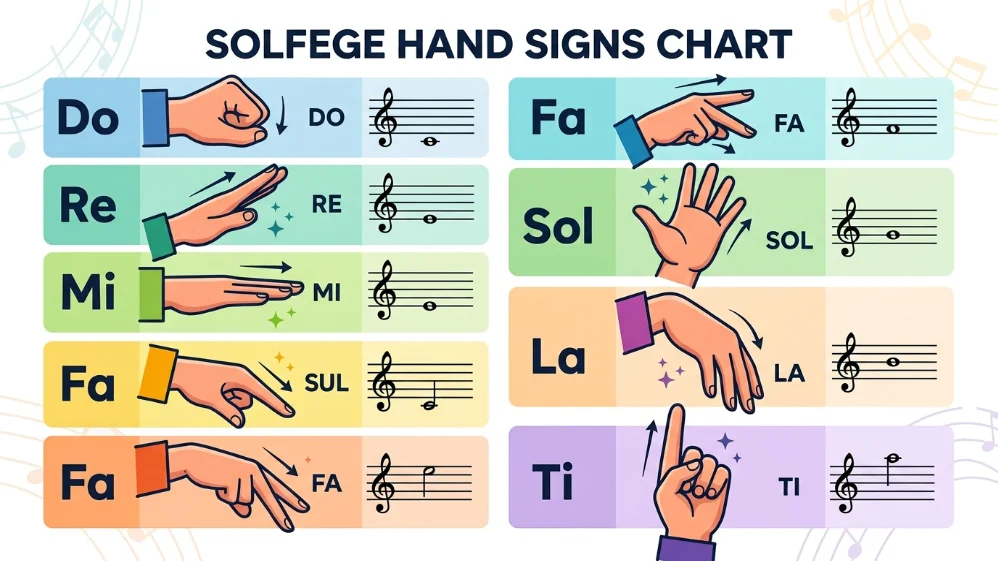
In a preschool music class, the teacher leads the children in singing “do re mi” while using hand signs. The children learn to associate each syllable with a specific pitch and hand movement, building a strong foundation for future music study.
Platform-Specific Meaning
Solfege in Formal Music Education
In schools and conservatories, solfege is taught as a core skill. Students learn to sing scales, intervals, and melodies using solfege syllables. They also practice sight-singing, where they read sheet music and sing the notes using solfege without hearing them first.
Many music programs use the Kodály method, which incorporates solfege along with hand signs and rhythm syllables to create a comprehensive approach to music education.The Kodály method, developed by Hungarian composer Zoltán Kodály, emphasizes singing as the foundation of musicianship and uses solfege as a primary teaching tool.
Solfege in Choral Settings
Choir directors frequently use solfege during rehearsals to help singers learn their parts. By singing through a piece using solfege, singers can focus on pitch and intonation without being distracted by the lyrics. Once the pitches are solid, the choir can add the text.
Solfege in Ear Training Apps and Online Courses
With the rise of music education technology, solfege has found a new home in apps and online courses. Platforms like Musical U, EarMaster, and various YouTube channels offer solfege training for musicians of all levels. These tools often include interactive exercises that help users practice identifying intervals, singing scales, and sight-reading.
Solfege in Professional Music Settings
Professional musicians use solfege as a mental tool for analyzing and performing music. In recording sessions, studio musicians might use solfege to quickly learn a melody or harmony part. In jazz and improvisation, solfege helps musicians navigate chord changes and create melodic lines on the fly.
Solfege in Popular Culture
Solfege has made its way into popular culture through movies, TV shows, and songs. The most famous example is “Do-Re-Mi” from The Sound of Music, which teaches the solfege syllables in a fun and memorable way. The song has introduced generations of people to the basic concept of solfege, even if they never study music formally.
Alternative Meanings and Variations
Fixed Do vs. Movable Do
There are two main systems of solfege used around the world:
Movable Do: In this system, “do” is always the first note of the scale (the tonic). If you are in the key of G major, G is “do.” If you are in the key of F major, F is “do.” This system emphasizes the relationships between notes and is the most common approach in English-speaking countries.
Fixed Do: In this system, “do” is always C, “re” is always D, and so on, regardless of the key. This is similar to using letter names and is more common in Romance-language countries like France, Italy, and Spain.
Both systems have their advantages, and the choice between them often depends on the educational tradition of a particular country or institution.
Chromatic Solfege
For music that uses notes outside the major scale, musicians use chromatic solfege. This system adds modified syllables for sharp and flat notes. For example, “di” is a raised “do” (C-sharp), and “ra” is a lowered “re” (D-flat). Chromatic solfege allows musicians to sing and understand music in any key, including minor keys and modal scales.
Solfege in Other Cultures
Many cultures have their own systems of solmization. In India, the sargam system uses the syllables “sa, re, ga, ma, pa, dha, ni,” which are similar to solfege.In Japan, the shōga system uses solfege-like syllables for teaching traditional music. These systems serve the same basic purpose as solfege: helping musicians learn and remember pitches.
Related Terms and NLP Variations
Solmization
Solmization is the general term for any system that assigns syllables to musical pitches. Solfege is a specific type of solmization, but the terms are sometimes used interchangeably.
Solfeggio
Solfeggio is the Italian equivalent of solfege. The two terms are often used interchangeably, though “solfeggio” can also refer to vocal exercises that use solfege syllables.
Tonic Sol-Fa
Tonic sol-fa is a specific system of solfege developed in England in the 19th century. It uses movable do and incorporates rhythm syllables as well as pitch syllables.
Sight-Singing
Sight-singing is the practice of singing a piece of music that you have never seen before. Solfege is the primary tool used in sight-singing, as it allows singers to navigate pitches without relying on an instrument.
Ear Training
Ear training is the process of developing your ability to identify and reproduce musical sounds by ear. Solfege is one of the most effective tools for ear training, as it helps you internalize the sound of different intervals and scale degrees.
How to Respond or Reply
If Someone Asks You “What Is Solfege?”
If a friend or fellow musician asks you about solfege, you can give them a simple explanation:
“Solfege is a system that uses syllables like do, re, and mi to name the notes of a musical scale. It helps musicians learn pitch, sing by sight, and train their ears.”
Someone Says “I Don’t Get Solfege”
If someone is struggling to understand solfege, you can help by:
- Singing a scale together – Show them how “do re mi fa sol la ti do” sounds.
- Using a familiar song – Point out that “Do-Re-Mi” from The Sound of Music is all about solfege.
- Explaining the benefits – Emphasize that solfege makes learning music easier and more intuitive.
- Being patient – Solfege can take time to internalize, especially for beginners.
If Someone Asks “Why Should I Learn Solfege?”
You can explain that solfege helps with:
- Recognizing patterns in music
- Improving pitch accuracy
- Learning music faster
- Understanding music theory
- Developing relative pitch
- Singing and playing with better intonation
Misinterpretations
Misinterpretation 1: “Solfege Is Just for Singers”
While solfege is primarily a vocal tool, it is used by instrumentalists as well. Guitarists, pianists, and other instrumentalists use solfege to improve their ear training and understanding of music theory. Learning solfege can make you a better musician regardless of your instrument.
Misinterpretation 2: “Solfege Is Only for Children”
Solfege is often taught to children in music classes, but it is a lifelong tool for musicians of all ages. Professional musicians use solfege regularly in their practice and performance.
Misinterpretation 3: “Solfege Is the Same as Letter Names”
Solfege is different from letter names. Letter names (C, D, E) identify specific pitches, while solfege identifies scale degrees and relationships between notes. Solfege is more about understanding the function of a note within a scale than about its absolute pitch.
Misinterpretation 4: “Fixed Do and Movable Do Are the Same”
These are two different systems with different applications. Movable do emphasizes relationships between notes and is more common in English-speaking countries. Fixed do is more like letter names and is common in Romance-language countries. Understanding the difference is important for musicians who study or perform internationally.
When NOT to Use It
Solfege is a powerful tool, but it is not always necessary or appropriate:
- In casual singing – If you are just singing for fun with friends, you probably do not need to use solfege.
- When performing with lyrics – In a performance, you sing the actual words of the song, not solfege syllables. Solfege is a practice tool, not a performance tool.
- With very young children – While solfege is great for children, very young kids (under age 4) may not be ready to grasp the concept. Starting with simple singing games is often more effective.
- If you are already fluent in another system – If you already have a strong ear and understand music theory using another system, you may not need to learn solfege from scratch.
- In some non-Western musical traditions – Solfege is based on Western tonal music. In other musical traditions, different systems of solmization may be more appropriate.
Usage Tips
Tip 1: Start with a Major Scale
The best way to learn solfege is to start with a major scale. Sing “do re mi fa sol la ti do” slowly and clearly, paying attention to the sound of each note. Practice in different keys to internalize the syllables.
Tip 2: Use Hand Signs
Hand signs are a great way to reinforce solfege learning. Each syllable has a specific hand sign that represents its function in the scale.Using hand signs while singing helps you connect the physical movement with the pitch, making the learning process more effective.
Tip 3: Practice with Familiar Songs
Take a song you know well, like “Twinkle, Twinkle, Little Star” or “Happy Birthday,” and try to sing it using solfege. This helps you apply the system to real music and makes it more practical.
Tip 4: Be Patient
Learning solfege takes time and practice. Do not expect to master it overnight. Consistent practice, even just a few minutes a day, will lead to steady improvement.
Tip 5: Use Technology
There are many apps and online resources that can help you practice solfege. Ear training apps, solfege practice videos, and interactive websites can make the learning process more engaging and effective.
FAQs
1. What does solfege mean in music?
Solfege is a system that uses syllables like do, re, mi to name the notes of a musical scale. It is used for teaching pitch, sight-singing, and ear training.
2. What are the 7 solfege syllables?
The 7 solfege syllables are do, re, mi, fa, sol, la, and ti. These correspond to the 7 notes of a major scale.
3. What is the difference between solfege and solfeggio?
Solfege and solfeggio are essentially the same thing. Solfege is the French-derived term used in English, while solfeggio is the Italian original.
4. What is movable do solfege?
In movable do solfege, “do” is always the first note of the scale (the tonic), regardless of the key. This system emphasizes the relationships between notes.
5. What is fixed do solfege?
In fixed do solfege, “do” is always C, “re” is always D, and so on, regardless of the key. This system is more common in Romance-language countries.
6. Why is solfege important?
Solfege is important because it helps musicians develop relative pitch, improve sight-singing skills, understand music theory, and learn music faster.
7. Can instrumentalists use solfege?
Yes, instrumentalists use solfege to improve their ear training, understand music theory, and navigate chord changes. It is not just for singers.
8. How do you pronounce solfege?
Solfege is pronounced “sohl-FEZH” in American English and “SOLL-fej” in British English.
9. What are solfege hand signs?
Solfege hand signs are specific hand gestures that correspond to each solfege syllable. They were developed by music educators like John Curwen and Zoltán Kodály to help students connect physical movement with pitch.
10. Is solfege the same as solmization?
Solfege is a type of solmization. Solmization is the general term for any system that assigns syllables to musical pitches, while solfege specifically refers to the do-re-mi system used in Western music.
Conclusion
Solfege is far more than a set of nonsense syllables from a beloved movie. It is a powerful, time-tested system that has helped musicians learn, perform, and understand music for over a thousand years. Whether you are a beginner picking up an instrument for the first time or a professional musician looking to refine your skills, solfege can transform the way you hear and make music.
By learning the solfege syllables, understanding the difference between movable and fixed do, and practicing with hand signs and familiar songs, you can develop a stronger ear, better sight-singing abilities, and a deeper appreciation for the structure of music. The system is simple enough for a child to learn but deep enough to support a lifetime of musical growth.
So the next time you hear someone sing “do re mi,” you will know exactly what it means and why it matters. And if you are ready to take your musicianship to the next level, solfege is one of the best places to start.