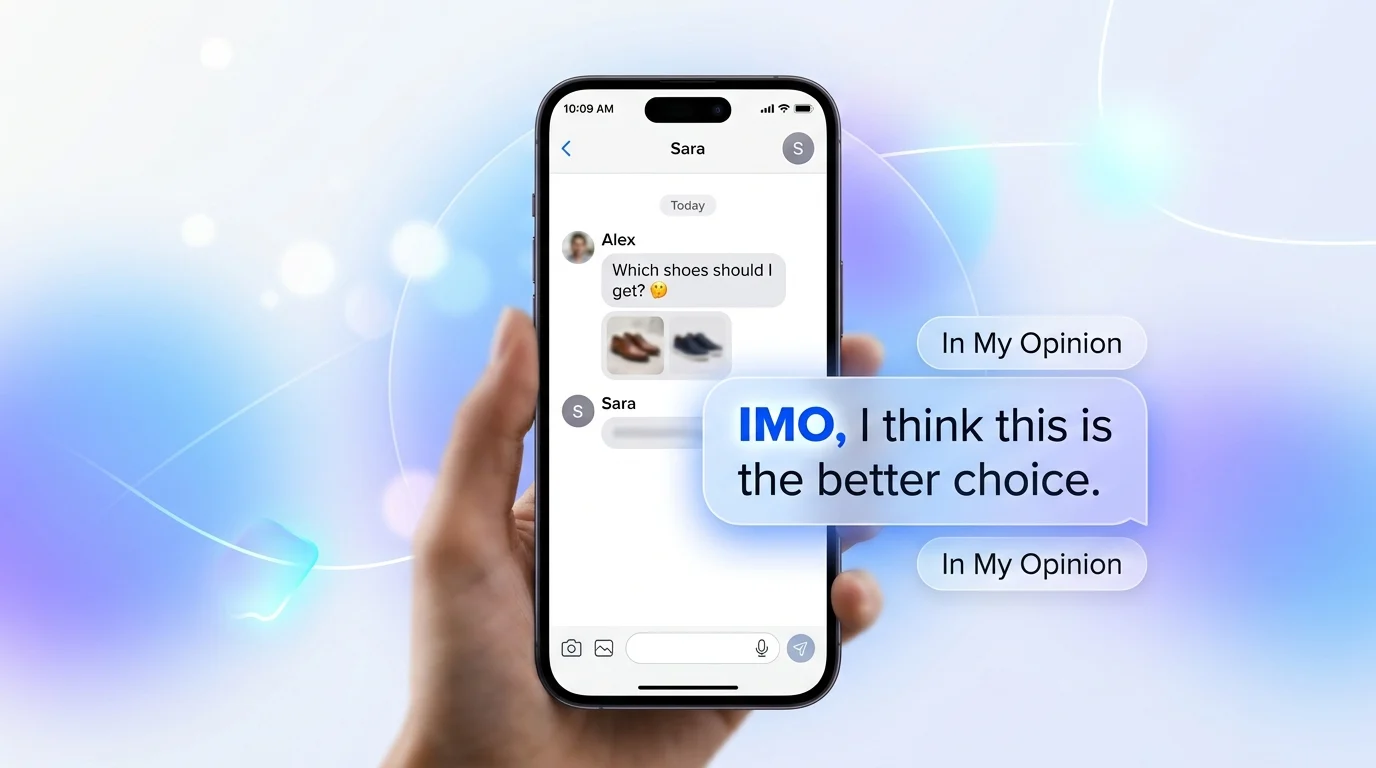

You’re reading a text that says, “IMO, that was the better choice,” and you may wonder what the first three letters mean. IMO meaning in text is “in my opinion.” People use it to introduce a personal view, judgment, or preference without presenting it as an absolute fact.
You’ll commonly see IMO in texts, group chats, comments, and social media conversations. Although the meaning usually stays the same across platforms, the surrounding words and tone can affect how strongly the opinion sounds. Knowing the context helps you understand whether the person is simply sharing a preference, disagreeing politely, or emphasizing a personal viewpoint.
What Does IMO Mean in Text?
IMO stands for “in my opinion.” It is an informal abbreviation people use before or after stating a personal belief, preference, judgment, or recommendation. The expression signals that the statement reflects the speaker’s viewpoint rather than an objective fact.
| Detail | Explanation |
|---|---|
| Most Common Meaning | In my opinion |
| Full Form | In my opinion |
| Tone | Usually casual, neutral, or conversational |
| Common Platforms | Texts, chats, social media, forums, comments |
| Formal or Informal | Informal |
For example:
“IMO, the second movie was better.”
Here, the writer is making it clear that “the second movie was better” is their personal judgment.
What Is the IMO Slang Meaning?
The IMO slang meaning is simply “in my opinion.” Despite being called slang in many searches, IMO is more accurately described as an internet abbreviation or initialism used in casual communication.
You might see it at the beginning of a sentence:
“IMO, we should leave earlier.”
You can also find it later in a sentence:
“That was the best option, IMO.”
In both cases, the writer is marking the statement as their own opinion.
IMO can make a statement sound less absolute because it explicitly frames the idea as a personal perspective. However, it does not automatically make the statement polite. The rest of the message determines whether the overall tone feels friendly, blunt, sarcastic, or argumentative.
How Context Changes the Meaning of IMO
The basic IMO meaning in text does not usually change, but context changes how the opinion should be interpreted.
Consider these examples:
1. Friendly preference
“IMO, pizza is better than burgers.”
This sounds like a casual personal preference.
2. Polite disagreement
“IMO, I think we should try the other restaurant.”
The writer is offering a different viewpoint without directly attacking someone else’s choice.
3. Strong personal judgment
“IMO, that was a terrible decision.”
IMO identifies the statement as an opinion, but the wording still sounds blunt.
4. Casual recommendation
“IMO, you should watch the original first.”
Here, the speaker is giving advice based on personal judgment.
When interpreting IMO, pay attention to the words around it, the relationship between the people talking, punctuation, emojis, and the subject being discussed. A smiling emoji can soften an opinion, while an abrupt sentence may make the same abbreviation feel more forceful.
IMO Meaning on Texts and Social Media
IMO generally keeps the same meaning across major communication platforms. The main difference is how casually people use it.
Text Messages and Group Chats
In texting, IMO usually introduces a personal opinion or preference.
“IMO, we should order takeout tonight.”
The tone is normally casual and conversational.
TikTok and Instagram
In comments or captions, IMO can be used when someone wants to give a personal judgment about a video, trend, product, song, or other topic.
“IMO, the first version was better.”
It can also appear when someone is disagreeing with another person’s view.
Snapchat and WhatsApp
IMO may appear in quick conversations when someone wants to distinguish their personal opinion from a fact.
“IMO, that outfit looks great.”
The meaning remains “in my opinion.”
Online Forums and Gaming Chats
People may use IMO when discussing strategies, characters, games, updates, or other topics where different viewpoints are common.
“IMO, the older map was more fun.”
Across these platforms, you generally do not need to interpret IMO as a different abbreviation unless the surrounding context clearly points to another subject.
IMO Examples in Real Conversations
1: Friends
Person A: “Which restaurant should we try?”
Person B: “IMO, the Thai place is better.”
Meaning: Person B is giving a personal recommendation.
2: Classmates
Person A: “Do you think we should present first?”
Person B: “IMO, going second gives us more time to prepare.”
Meaning: The speaker is offering their reasoning and personal preference.
3: Social Media
Person A: “The new design looks better than the old one.”
Person B: “IMO, the old design was cleaner.”
Meaning: Person B is politely expressing a different opinion.
What Tone Does IMO Have?
IMO is usually neutral, casual, and conversational. It does not inherently sound rude, sarcastic, or offensive.
However, the rest of the message matters. Compare:
“IMO, that’s probably the better option.”
with:
“IMO, that’s the worst idea ever.”
Both use IMO correctly, but the second statement is much more negative because of the words surrounding the abbreviation.
IMO can also soften disagreement slightly by making it clear that the speaker is sharing a personal viewpoint. Still, adding IMO does not guarantee that the message will sound polite.
Is IMO Rude?
IMO is not inherently rude. It usually signals that someone is sharing a personal opinion rather than stating an unquestionable fact.
A rude tone can come from the actual opinion, insults, dismissive wording, or the way the message is directed at another person.
For example, “IMO, we should choose another option” is relatively neutral, while “IMO, you clearly have no idea what you’re doing” is insulting despite containing IMO.
How to Reply to IMO
Your response should match the opinion being shared and the tone of the conversation.
Friendly Replies
- “I can see why you think that.”
- “Yeah, I agree with you.”
- “Honestly, I feel the same way.”
- “That’s a fair point.”
- “I hadn’t thought about it that way.”
When You Disagree
- “I see your point, but I think the opposite.”
- “Fair enough, although I prefer the other option.”
- “I get that, but I’d probably choose differently.”
When You Want More Explanation
- “What makes you prefer that one?”
- “Interesting—what’s your main reason?”
- “Why do you think so?”
These replies work because they respond to the actual opinion instead of treating IMO as something that requires a special response.
When to Use IMO
IMO works best in casual, informal communication where abbreviations are already normal.
You can use it when:
- Sharing an opinion with friends
- Discussing movies, music, food, or games
- Commenting on social media
- Participating in casual group chats
- Giving an informal recommendation
- Disagreeing without presenting your view as an absolute fact
It is especially useful when several people are discussing subjective topics and you want to clearly mark your statement as your personal view.
When to Avoid IMO
IMO is less suitable when clarity and formality matter more than conversational shorthand.
Consider avoiding it in:
- Job applications
- Formal business correspondence
- Academic assignments
- Client-facing communication
- Official announcements
- Professional reports
- Sensitive conversations where wording should be especially clear
That does not mean IMO is always inappropriate at work. In a casual workplace chat where abbreviations are normal, it may be perfectly understandable. The audience and communication style matter.
Common Mistakes About IMO
| Common Mistake | Correct Understanding |
| Assuming IMO is always rude | IMO is normally neutral; the surrounding wording determines the tone. |
| Treating every opinion as a fact | IMO specifically signals that the statement represents a personal viewpoint. |
| Thinking the abbreviation changes meaning on every platform | Its common chat and social-media meaning remains “in my opinion.” |
Another common mistake is confusing IMO with similar-looking abbreviations. The surrounding conversation usually makes the intended meaning clear.
IMO vs. Similar Slang Terms
| Term | Meaning | Main Difference |
| IMO | In my opinion | Directly introduces a personal viewpoint. |
| IMHO | In my humble opinion | Similar to IMO, with “humble” added. |
| IME | In my experience | Refers to personal experience rather than simply an opinion. |
| IIRC | If I remember correctly | Signals uncertainty about remembered information. |
| TBH | To be honest | Introduces a candid statement, which may or may not be an opinion. |
IMO and IMHO are especially easy to confuse because both introduce personal viewpoints. The main difference is that IMHO literally includes “humble,” while IMO simply says the statement is the speaker’s opinion.
IMO Full Form and Other Possible Meanings
For the IMO full form in casual texting and internet conversations, “in my opinion” is the standard interpretation.
IMO can also appear as an acronym in specialized contexts, including the International Maritime Organization, a United Nations agency concerned with international shipping. That meaning is relevant in maritime, governmental, academic, or technical discussions rather than ordinary texting.
So if someone writes, “IMO, that song is underrated,” the intended meaning is almost certainly “in my opinion.” If a conversation discusses maritime regulations or international shipping, the acronym may refer to the organization instead.
The surrounding topic is the best way to distinguish these meanings.
Quick Recap
- IMO means “in my opinion” in ordinary texting and online conversations.
- It introduces a personal belief, preference, judgment, or recommendation.
- The abbreviation is usually casual and neutral rather than rude.
- Context and surrounding wording determine the emotional tone.
- IMO is common in texts, chats, comments, forums, and other informal communication.
- In specialized maritime contexts, IMO can refer to the International Maritime Organization.
Frequently Asked Questions
What does IMO mean in text?
IMO means “in my opinion,” signaling that the following statement expresses the writer’s personal viewpoint or judgment.
Is IMO rude?
IMO is not rude by itself, although harsh wording surrounding the abbreviation can make the overall message sound blunt.
What does IMO mean on TikTok?
On TikTok, IMO usually means “in my opinion” when users share personal judgments about videos, trends, products, or topics.
How should you reply to IMO?
Reply by agreeing, respectfully disagreeing, asking for reasoning, or acknowledging the person’s viewpoint based on your conversation.
Can IMO have different meanings?
Yes, IMO can mean “in my opinion” in chats or the International Maritime Organization in specialized maritime contexts.
Final Thoughts
The IMO meaning in text is straightforward: it stands for “in my opinion.” People use it to signal that what follows represents their personal view, preference, judgment, or recommendation. The abbreviation is generally casual and neutral, but the rest of the message determines whether the opinion sounds friendly, blunt, or argumentative.
When you see IMO in a text, chat, or social media .comment, read the surrounding words before judging the tone. In ordinary online conversation, “in my opinion” is almost always the meaning, making IMO a simple way to distinguish a personal viewpoint from an objective claim.
Discover More Post:
What Does AWOL Mean in Text and Chat? – TextingRoast.com –
Ayes Meaning | What It Means in Text, Chat, and Everyday Use
What Does ISTG Mean in Text? – TextingRoast.com –