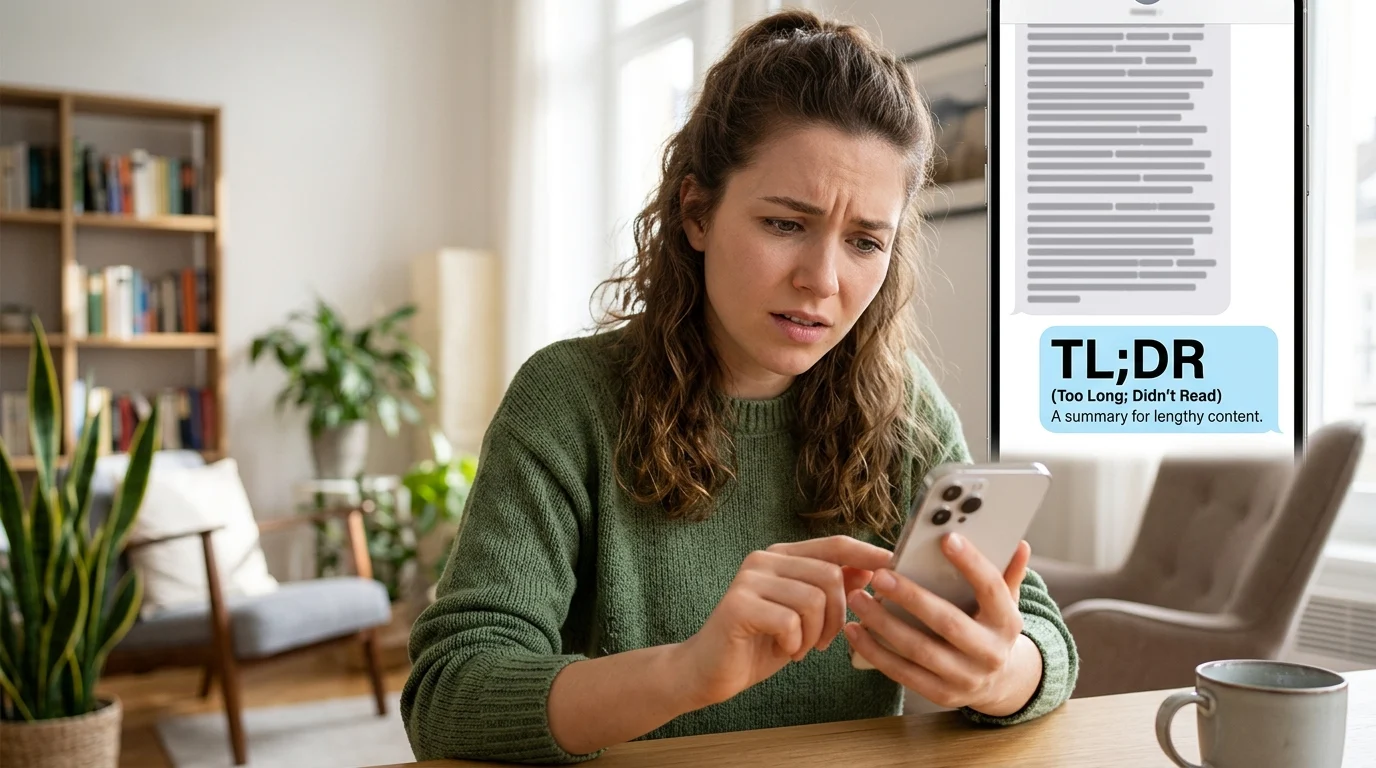

TLDR stands for “too long; didn’t read.” It is an internet slang initialism used in two main ways: to introduce a brief summary of a longer piece of content, or to comment that a block of text has been ignored due to its excessive length.Commonly found on Reddit, in emails, text messages, and social media posts, TLDR helps people quickly grasp the main point without reading everything.
Ever scrolled through a massive wall of text online and thought, “I don’t have time for all this”? Or maybe you’ve seen someone drop a “TLDR” at the end of a lengthy post and wondered what it meant. You are not alone.
Internet slang evolves fast, and keeping up can feel like a full-time job. But some terms stick around because they solve a real problem. TLDR is one of those terms. It has become a staple of digital communication, helping people save time, cut through clutter, and get to the point.
In this guide, you will learn exactly what TLDR means, where it came from, how to use it correctly, and what it signals across different platforms. Whether you are navigating Reddit threads, sending work emails, or just trying to understand what your friends are texting, this guide has you covered.
Quick Answer
| Aspect | Details |
|---|---|
| Meaning | Too Long; Didn’t Read |
| Context | Online communication, forums, texting, emails |
| Usage | Summarizing long content or dismissing overly long text |
| Platforms | Reddit, TikTok, Instagram, WhatsApp, Slack, Email |
| Example | “TLDR: The movie was terrible, don’t waste your time.” |
| Tone | Informal, can be neutral, helpful, or dismissive depending on context |
What Does TLDR Mean?
TLDR is an abbreviation that stands for “too long; didn’t read.” It is one of the most recognizable pieces of internet slang, used across the web to handle information overload.
At its core, TLDR has two primary functions:
- To summarize: It introduces a short, digestible version of a longer piece of content. Think of it as a cheat sheet for a long article, email, or social media post.
- To dismiss: It signals that someone found a piece of text too long and chose not to read it. This usage can be rude or playful, depending on the tone and relationship between the people communicating.
Technically, TLDR is an initialism, not an acronym. You pronounce each letter individually: “Tee El Dee Are.” An acronym (like NASA) is pronounced as a single word, while an initialism (like BBC) is pronounced letter by letter.
The Semicolon Question: TL;DR vs. TLDR
You will see this term written in two main ways: TL;DR (with a semicolon) and TLDR (without). Both are correct and widely used.
The version with the semicolon (“TL;DR”) is considered the original and more traditional form. The semicolon separates “too long” from “didn’t read,” mimicking the structure of a written sentence. Over time, as people started typing faster and autocorrect got involved, the semicolon often got dropped, resulting in “TLDR.”
Today, you can use either version. “TLDR” is more common in casual texting and social media, while “TL;DR” is still frequently seen in formal writing and on platforms like Reddit. You will also see it in all lowercase (“tldr” or “tl;dr”) and all uppercase (“TLDR” or “TL;DR”). Case does not matter.
Full Definition and Origins
What the Experts Say
Merriam-Webster defines TLDR as:
- “too long; didn’t read — used to say that something would require too much time to read”
- “a briefly expressed main point or key message that summarizes a longer discussion or explanation”
The Cambridge Dictionary echoes this, noting it is “used to comment on something that someone has written, for example on social media.”
A Brief History
The phrase “too long; didn’t read” dates back to at least 2002. The earliest known use was in a message posted on the Usenet newsgroup rec.games.video.nintendo.
In 2003, it was added to Urban Dictionary. By 2009, the term had gained enough traction to appear in a book based on Urban Dictionary slang and in a tweet anthology by David Pogue.
The term was officially added to Oxford Dictionaries Online in 2013. Merriam-Webster followed suit in 2018, officially recognizing TL;DR as a word.
Context and Usage
Understanding the context is critical when using TLDR. The same abbreviation can mean very different things depending on how and where it is used.
As a Summary (Helpful)
This is the most constructive use of TLDR. When someone writes a long post, they might include a TLDR at the top or bottom to give readers the main takeaway in one or two sentences.
Example: A blogger writes a 2,000-word review of a new smartphone. At the very end, they add:
“TLDR: The camera is amazing, but the battery life is terrible. Skip it.”
This helps busy readers decide if they want to read the full review or just walk away with the key info.
As a Request (Polite or Impatient)
Someone might ask for a TLDR when they do not have time to read a long message. This can be polite or pushy depending on how it is phrased.
Polite: “I’m heading into a meeting. Can you share a quick TLDR of the proposal?”
Impolite: “TLDR?” (with no other context)
As a Dismissal (Rude)
Replying with just “TLDR” to someone’s lengthy post is often seen as rude and dismissive. It essentially says, “What you wrote was not worth my time.” On platforms like Reddit, this kind of response is usually unnecessary and can get you downvoted.
Real-Life Examples
Here are five realistic conversations showing how TLDR is used in everyday digital communication.
1: Summarizing a Long Story (Helpful)
User A: “Okay so I went to the store today and I saw this guy and he was wearing a really weird hat and I thought it was funny so I took a picture but then he saw me and got mad and started yelling and I didn’t know what to do so I just ran away and now I’m home and I think he might have been famous or something idk it was wild.”
User A (adding a TLDR): “TLDR: I took a photo of a guy with a weird hat, he got mad, I ran away. Might have been a celebrity.”
2: Asking for a Summary (Polite)
Colleague A: “I sent you the 50-page report on the Q3 projections. Let me know your thoughts.”
Colleague B: “I’m swamped today. Can you give me a TLDR before our meeting?”
Colleague A: “TLDR: We are 15% over budget and need to cut costs in marketing.”
3: Dismissing a Long Text (Rude)
A: [sends a 500-word text about their day]
B: “TLDR.”
A: “Wow, okay. Nevermind then.”
4: Self-Awareness (Humorous)
User: “I know this is a super long post, but I promise it’s worth it. TLDR: I adopted a cat and my life is better.”
5: Professional Setting (Neutral)
Manager: “Here is the meeting recap from yesterday. TLDR: The project is on track, but we need to finalize the budget by Friday.”
Platform-Specific Meaning
TLDR behaves differently depending on where you encounter it. Here is how it works on major platforms.
Reddit is where TLDR truly thrives. Long-form storytelling is common on the platform, and users frequently include a TLDR at the end of their posts as a courtesy.
- Original Poster (OP) use: The person who writes a long post adds a TLDR summary so others can engage with the content without reading everything.
- Commenter use: Replying “TLDR” to someone else’s post is generally considered impolite and unnecessary.
- Subreddit: There is even a subreddit called r/tldr that serves as a daily recap of Reddit’s most notable threads.
TikTok
On TikTok, TLDR is often used in captions or comments to summarize video content. A creator might post a long video and add a TLDR in the caption so viewers can get the gist without watching the whole thing. Users might also comment TLDR if they did not watch the video but still want to participate in the discussion.
Similar to TikTok, TLDR appears in captions and comments on Instagram. It is less common than on Reddit but still used, especially in long caption posts or in the comments section of lengthy discussions.
WhatsApp and Texting
In private messaging, TLDR serves the same purposes: summarizing a long message or politely (or impolitely) asking someone to get to the point.
- Polite use: “TLDR: Dinner is at 8 pm at the usual place.”
- Impolite use: Replying “TLDR” to a friend who sent a heartfelt long message.
Slack and Professional Email
TLDR has crossed over into the professional world. You will often see it in internal company communications, project updates, and even client emails.
- Best practice: Use TLDR to summarize a long document or email. It shows respect for your colleagues’ time.
- Worst practice: Use TLDR as a dismissive reply to a coworker. It can damage professional relationships.
Snapchat
While less common due to the platform’s ephemeral nature, TLDR can appear in Snapchat stories or chats when someone shares a screenshot of a long text or news article.
Alternative Meanings and Variations
While “too long; didn’t read” is the primary meaning, there are a few variations and alternative interpretations you might encounter.
Some people also use TLDR to mean “too long; don’t read” as a warning that content is not worth the time.
Related Terms and NLP Variations
Understanding TLDR also means understanding the ecosystem of similar terms and concepts.
- Executive Summary: The professional, formal equivalent of a TLDR. Used in business reports.
- Abstract: The academic equivalent. A concise summary of a research paper.
- Spoiler: A summary that reveals key plot points, often used in entertainment contexts.
- Cliff Notes: A reference to the study guides that summarize books. Often used to mean a quick summary.
- Bottom Line: The main point or most important takeaway.
- In a Nutshell: A phrase meaning “summarized briefly.
- Gist: The main or essential part of a matter.
Semantic Relationships
- TLDR ↔ Summary: TLDR is often used as a synonym for “summary” in digital contexts.
- TLDR ↔ Dismissal: The term can signal that content is not worth reading.
- TLDR ↔ Efficiency: Using TLDR shows you value time and brevity.
- TLDR ↔ Information Overload: The term exists because there is too much content to consume.
How to Respond to TLDR
If someone sends you a TLDR, your response depends on the context and your relationship with the person.
Scenario 1: Someone Asks You for a TLDR (Polite Request)
Best response: Provide a concise summary.
“Sure! TLDR: We are launching the product next month, and we need final designs by Friday.”
Scenario 2: Someone Replies “TLDR” to Your Long Message (Dismissive)
Option A (Graceful): “Fair enough. The short version is [summary].”
Option B (Direct): “If you’re not going to read it, that’s fine. Let me know when you have time.”
Option C (Humorous): “Wow, rude. But here is the TLDR anyway.”
Scenario 3: You Want to Ask for a TLDR Without Being Rude
Polite phrasing:
- “I’m a bit short on time. Could you give me a quick summary?”
- “Would you mind sharing the TLDR?”
- “What is the main takeaway?”
Avoid just saying “TLDR?” as a standalone message, as it can come across as dismissive.
Misinterpretations
Despite its widespread use, TLDR is sometimes misunderstood.
1: It Is Always Rude
Reality: TLDR is not inherently rude. It depends entirely on tone and context. When used by a writer to summarize their own content, it is helpful and courteous. When used by a reader to dismiss someone else’s content, it can be rude.
2: It Means the Content Is Bad
Reality: TLDR does not necessarily mean the content is bad. It simply means it is long. Even excellent content can benefit from a TLDR summary.
3: It Is Only for Young People
Reality: While TLDR originated in internet culture, it is now used by people of all ages, including in professional settings.
4: You Must Include a Semicolon
Reality: Both “TL;DR” and “TLDR” are acceptable.
When NOT to Use TLDR
There are times when using TLDR is inappropriate or counterproductive.
1. Formal Writing
Do not use TLDR in academic papers, legal documents, or official reports. Use “executive summary” or “abstract” instead.
2. Sensitive Conversations
If someone is sharing something personal or emotional, replying with TLDR is cruel. It signals that you do not care about what they are saying.
3. When You Need to Provide Full Context
Sometimes, a summary is not enough. If the details matter, do not rely on a TLDR. Encourage people to read the full text.
4. As a Dismissive One-Word Reply
As mentioned earlier, replying with just “TLDR” is usually rude. Add context or explain why you are asking for a summary.
Usage Tips
Here are some practical tips for using TLDR effectively.
For Writers
- Put it at the top or bottom. Both placements work. Putting it at the top lets readers know immediately that a summary is available.
- Keep it short. One or two sentences is ideal. The whole point is brevity.
- Be accurate. The TLDR should accurately reflect the main point of the longer content.
- Use it as a hook. A clever or intriguing TLDR can encourage people to read the full post.
For Readers
- Ask politely. Instead of just saying “TLDR?”, try “Could I get a quick TLDR?”
- Use it sparingly. Constantly asking for TLDRs can make you seem lazy or uninterested.
- Read the full thing when it matters. Some content deserves your full attention.
General Best Practices
- Know your audience. TLDR is fine for casual and professional settings, but avoid it in formal writing.
- Match the tone. If someone sent a serious message, do not reply with a flippant TLDR.
- Lead with empathy. Consider how the other person might feel before using TLDR.
Frequently Asked Questions
1. What does TLDR stand for?
TLDR stands for “too long; didn’t read.”
2. Is it TLDR or TL;DR?
Both are correct. TL;DR is the original form with a semicolon, while TLDR is a common simplified version.
3. Is TLDR rude?
It can be. Using TLDR to summarize your own content is helpful. Using it to dismiss someone else’s content is often rude.
4. What does TLDR mean on Reddit?
On Reddit, TLDR means “too long; didn’t read.” It is used by original posters to summarize their long posts. Replying with just TLDR is considered impolite.
5. What does TLDR mean in texting?
In texting, TLDR means “too long; didn’t read.” It can be a response to a long text or a summary of a long text you wrote.
6. How do you pronounce TLDR?
You pronounce each letter individually: “Tee El Dee Are.”
7. When was TLDR added to the dictionary?
TL;DR was added to Oxford Dictionaries Online in 2013 and to Merriam-Webster in 2018.
8. What is a professional alternative to TLDR?
“Executive summary,” “bottom line,” or “in summary” are professional alternatives.
9. Can I use TLDR in an email?
Yes, but use it carefully. It is acceptable in internal emails and casual professional communication. Avoid it in formal external emails.
10. What does TLDR mean on TikTok?
On TikTok, TLDR is used in captions or comments to summarize video content or to indicate someone did not watch the full video.
11. Is TLDR an acronym or initialism?
It is an initialism because you pronounce each letter individually.
12. What is the difference between TLDR and a summary?
A TLDR is a type of summary, but it is specifically a very brief, informal summary of a longer piece of digital content.
13. Why do people use TLDR?
People use TLDR to save time, communicate efficiently, and help others quickly grasp the main point of lengthy content.
14. Can TLDR be used as a noun?
Yes. You can say “What is the TLDR of this article?” to ask for a summary.
15. Is TLDR only used online?
Primarily, yes. However, it has crossed over into spoken language in informal settings, especially among younger generations.
Conclusion
TLDR is more than just an internet abbreviation. It is a reflection of how we consume information in the digital age. With endless content competing for our attention, TLDR offers a simple way to cut through the noise and get to the point.
Whether you are using it to summarize a long post, asking someone for a quick summary, or encountering it in a Reddit thread, understanding the nuance of TLDR is essential. Use it wisely. When you are the writer, offer a TLDR as a courtesy to your readers. When you are the reader, ask for one politely. And remember: sometimes, the full story is worth the time.
Now that you know what TLDR means, you can navigate online conversations with confidence. No cap.