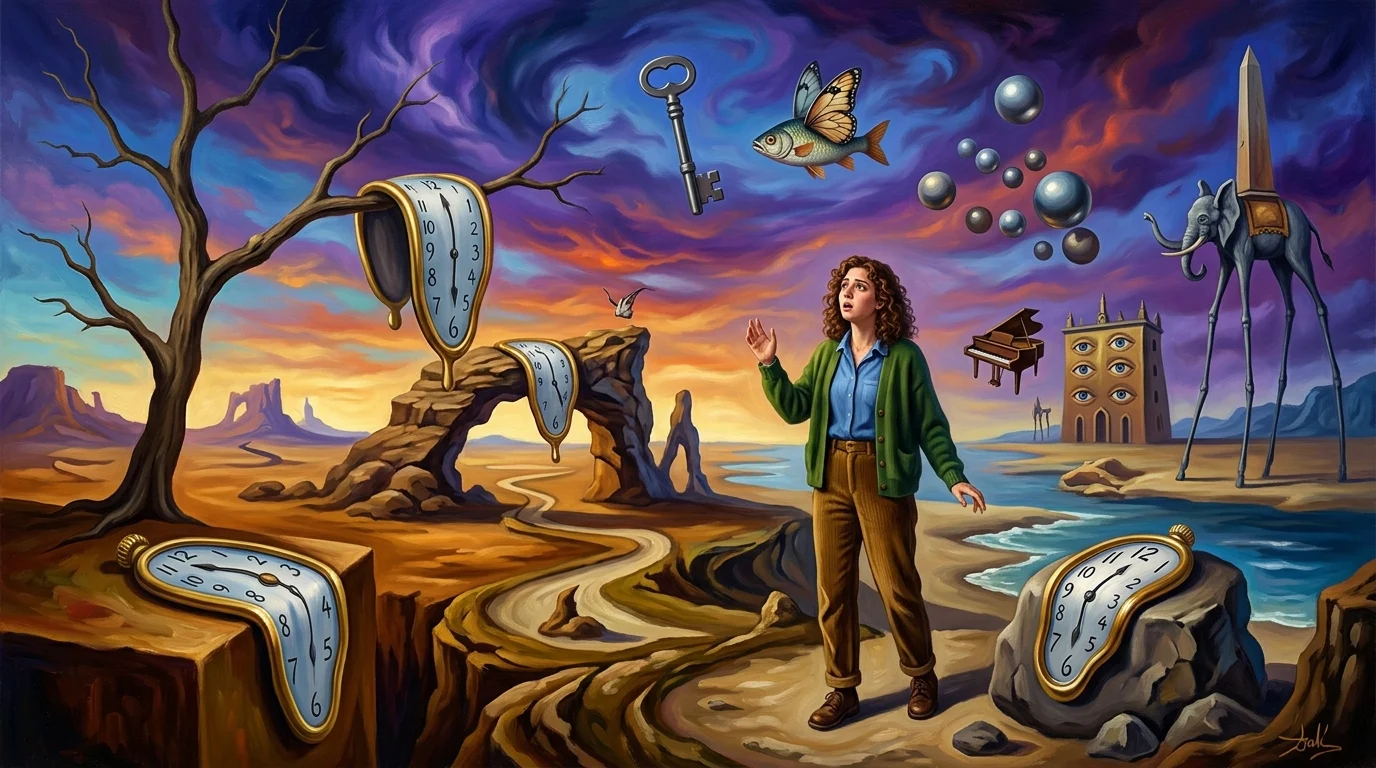

Surreal describes something that is very strange, unusual, or dreamlike, often feeling disconnected from normal reality. The word comes from the Surrealist art movement of the early 20th century and is used to describe experiences, images, or situations that seem bizarre, uncanny, or hard to believe, as if they belong in a dream rather than real life.
Have you ever experienced something so strange or extraordinary that you had to stop and ask yourself, “Is this really happening?” That feeling of disbelief, where reality seems to blur into a dream, is exactly what the word “surreal” captures.
Whether you are watching a breathtaking sunset, achieving a lifelong goal, or witnessing something completely unexpected, the word surreal has become a go-to expression in modern English. But what does surreal really mean? Where did it come from? And how can you use it naturally in conversations, texts, and social media?
This guide breaks down everything you need to know about the meaning of surreal, from its dictionary definition to its modern usage across different platforms. By the end, you will know exactly how to use this powerful word to describe those moments that feel bigger than life itself.
Quick Answer
| Aspect | Details |
|---|---|
| Meaning | Very strange, unusual, or dreamlike; having the quality of a dream |
| Context | Describing experiences, images, or situations that feel unreal or hard to believe |
| Usage | Casual conversations, texts, social media, storytelling |
| Platforms | WhatsApp, Snapchat, TikTok, Instagram, Discord, everyday speech |
| Example | “Watching the sunrise over the Grand Canyon was absolutely surreal.” |
| Tone | Expresses amazement, disbelief, wonder, or confusion |
What Does Surreal Mean?
At its core, surreal means something that feels dreamlike, bizarre, or beyond normal reality. When you describe an experience as surreal, you are saying it feels so strange or extraordinary that it almost seems like it belongs in a dream rather than in real life.
The dictionary definition of surreal is “very strange or unusual: having the quality of a dream.” Britannica Dictionary defines it as “very strange or unusual: having the quality of a dream,” with examples like “a surreal atmosphere” or “The whole thing was completely surreal.”
But surreal is more than just a synonym for “weird” or “strange.” It carries a deeper emotional weight. When something is surreal, it often feels:
- Disorienting – like you are not fully grounded in reality
- Unbelievable – as if your mind is struggling to accept what is happening
- Dreamlike – with a quality that feels magical, illogical, or fantastical
- Extraordinary – beyond what you would normally expect in everyday life
The word can describe both positive and negative experiences. Winning the lottery feels surreal in a good way. Witnessing a traumatic event can also feel surreal, but in a disturbing way.
Full Definition
Dictionary Definitions
| Dictionary | Definition |
|---|---|
| Merriam-Webster | “Very strange or unusual: having the quality of a dream” |
| Britannica | “Very strange or unusual: having the quality of a dream” |
| Vocabulary.com | “A bizarre mix of elements, often jarring and seemingly nonsensical” |
| Collins | “Of or like a dream; fantastic, hallucinatory, bizarre” |
| Oxford | Very strange; more like a dream than reality, with ideas and images mixed together in a strange way” |
Pronunciation
Part of Speech
- Adjective (surreal)
- Noun (surrealism, surreality)
- Adverb (surreally)
Synonyms
Antonyms
Origin & History
The word surreal has fascinating roots in the art world. It comes from the French word surréalisme, which literally means “above reality” (sur = above, réal = real).
The term was first coined in 1917 by the French poet Guillaume Apollinaire to describe a new kind of artistic expression that went beyond traditional realism. However, it was André Breton, the founder of the Surrealist movement, who popularized the term in his 1924 “Manifeste de Surréalisme.”
Surrealism was an artistic and literary movement that sought to unlock the power of the subconscious mind through dreamlike, irrational, and bizarre imagery. Artists like Salvador Dalí (famous for his melting clocks in “The Persistence of Memory”), René Magritte, and Max Ernst created works that defied logic and challenged viewers’ perceptions of reality.
The word “surreal” entered the English language in the 1920s and 1930s. Over time, it moved beyond the art world and became part of everyday vocabulary. Today, people use surreal to describe any experience, image, or situation that feels dreamlike, strange, or hard to believe.
Context & Usage
When to Use Surreal
You can use surreal whenever you want to describe something that feels:
- Dreamlike – as if you are in a dream
- Bizarre – strange in a way that is hard to explain
- Unbelievable – so extraordinary that it is hard to accept as real
- Disorienting – leaving you feeling confused or disconnected
Common situations where people use surreal include:
- Experiencing a major life event (wedding, graduation, birth of a child)
- Achieving a long-term goal or dream
- Witnessing something unexpected or shocking
- Visiting a place that feels magical or otherworldly
- Watching a movie or viewing art that challenges reality
When NOT to Use Surreal
Avoid using surreal in:
- Formal or professional settings – it may sound too casual or dramatic
- Describing ordinary, everyday events – it loses its impact
- Scientific or technical writing – where precision is required
- Situations where you need to be taken seriously – it can sound exaggerated
Positive vs. Negative Usage
Surreal is a neutral word. Its meaning becomes positive or negative based on the context.
Positive examples:
- Achieving a dream: “Winning the championship felt absolutely surreal.”
- Beautiful experiences: “The Northern Lights were a surreal display of color.”
Negative examples:
- Traumatic events: “The accident was surreal; I could not believe it was happening.”
- Confusing situations: “The meeting was surreal; nobody knew what was going on.”
Real-Life Examples
1: Catching Up with a Friend
Friend 1: “Guess what? I ran into our old high school teacher at the grocery store yesterday.”
Friend 2: “No way! Which one?”
Friend 1: “Mr. Thompson. He remembered my name and everything. It was so surreal seeing him after all these years.”
Friend 2: “That is wild. I can only imagine how strange that must have felt.”
2: Achieving a Goal
Person 1: “I just got the acceptance letter from my dream university.”
Person 2: “That is amazing! Congratulations!”
Person 1: “Thank you. Honestly, it feels so surreal. I have been working toward this for years, and now it is actually happening.”
Person 2: “You deserve it. Enjoy every moment of this.”
3: A Strange Experience
1: “You will not believe what happened to me today.”
2: “What happened?”
1: “I was walking down the street, and a parrot landed on my shoulder and just stayed there for like five minutes.”
2: “That is so surreal. Did you take a picture?”
1: “Of course I did. I still cannot believe it actually happened.”
4: Texting About a Concert
Person 1: “Just got back from the concert. Still processing everything.”
Person 2: “Was it good?”
Person 1: “Good does not even cover it. It was surreal. I was standing ten feet from my favorite artist. I almost cried.”
Person 2: “That sounds incredible. I am so jealous.”
5: Online Chat (Gen Z Style)
User1: “ngl, that view from the mountain was surreal fr”
User2: “no cap? i need to see pics”
User1: “lowkey looked like a painting. i could not believe my eyes”
User2: “that is the dream right there”
Platform-Specific Meaning
On WhatsApp, surreal is often used in personal conversations to express disbelief or amazement about something that happened. It is a quick way to convey that an experience felt extraordinary or dreamlike without needing a long explanation.
Example: “Just saw my childhood best friend after 10 years. This is so surreal.”
Snapchat
On Snapchat, surreal is frequently used in captions for photos and videos that capture unusual or beautiful moments. Users might describe a sunset, a strange street performer, or an unexpected encounter as surreal. The visual nature of Snapchat makes it a perfect platform for sharing surreal experiences.
Example: “This sunset is surreal. I cannot believe I am actually here.”
TikTok
On TikTok, surreal has become part of the vocabulary for describing content that feels dreamlike, bizarre, or mind-bending. The platform is full of videos that could be described as surreal, from optical illusions to unexpected life moments. The “Lamp Looks Weird” trend, for example, refers to surreal or dreamlike experiences where reality feels off or unreal.
Example: “This whole week has been surreal. I feel like I am in a movie.”
On Instagram, surreal is a popular caption word for travel photos, artistic shots, and moments that feel extraordinary. It adds a layer of depth and emotion to the image, suggesting that the moment was not just beautiful but almost magical.
Example: “Exploring the ancient ruins felt surreal. Like stepping back in time.”
Discord
In Discord communities, surreal is often used in gaming and meme culture to describe absurd or bizarre situations. It can also refer to surreal memes, which are a popular genre of internet humor featuring strange, nonsensical, or dreamlike content.
Example: “That boss fight was surreal. I still do not know how we won.”
Alternative Meanings & Related Terms
Surreal vs. Surrealism
While surreal describes a quality (dreamlike, bizarre), surrealism is the name of the artistic and literary movement that gave us the word. Surrealism is a specific style and philosophy that emerged in the early 20th century, characterized by dreamlike imagery, irrational juxtapositions, and an exploration of the subconscious mind.
Key difference:
- Surreal – an adjective describing something dreamlike or bizarre
- Surrealism – a noun referring to the art movement
Related Terms
How to Respond When Someone Says “Surreal”
When someone shares a surreal experience with you, they are often expressing a mix of amazement, disbelief, and emotion. Your response should acknowledge the significance of what they are sharing.
Appropriate Responses
- “That sounds incredible. I can only imagine how that must have felt.”
- “Wow, I bet that was a moment you will never forget.”
- “That is amazing. Did you take any pictures?”
- I know exactly what you mean. I had a similar experience once.”
- “That is wild. I am so happy for you.”
- “Honestly, I would probably cry if that happened to me.”
Casual/Gen Z Responses
- “lowkey jealous rn”
- “that is so surreal, i can’t even”
Misinterpretations & Common Mistakes
1: Using Surreal as a Synonym for “Weird”
While surreal does mean strange, it is not interchangeable with “weird” in all contexts. Surreal carries a specific connotation of dreamlike or unreal quality. Something can be weird without being surreal.
Incorrect: “This sandwich tastes surreal.” (Unless the sandwich is somehow dreamlike, this does not make sense.)
Correct: “The way the fog rolled through the forest was surreal.”
2: Overusing Surreal
Surreal is a powerful word. Using it too often dilutes its impact. Reserve it for moments that truly feel extraordinary or dreamlike.
3: Confusing Surreal with “Surrealism”
Remember, surreal is an adjective describing a quality, while surrealism is the name of the art movement.
Incorrect: “That painting is very surrealism.”
Correct: “That painting is very surreal.” or “That painting is a great example of surrealism.”
4: Using Surreal for Realistic Things
Surreal should only describe things that feel unreal or dreamlike. If something is completely realistic and ordinary, it is not surreal.
When NOT to Use Surreal
There are certain situations where using surreal is inappropriate or ineffective:
- Formal business reports – stick to more precise language
- Academic writing – unless discussing art or literature
- Describing everyday routines – “My commute was surreal” sounds exaggerated
- Scientific descriptions – precision is more important than emotion
- When you need to be taken seriously – can come across as dramatic
Usage Tips
1: Use It for Memorable Moments
Save surreal for moments that genuinely feel extraordinary. The word works best when describing experiences that leave a lasting impression.
2: Pair It with Visual Descriptions
Surreal works well when describing visual scenes. Paint a picture with your words: “The abandoned amusement park looked surreal, with rusty rides half-hidden in overgrown vegetation.”
3: Use It to Express Emotion
Surreal is not just about describing what happened; it is about expressing how you felt. Use it to convey amazement, disbelief, or wonder.
4: Know Your Audience
While surreal is widely understood, it may not be the best choice in very formal settings. In casual conversation, texts, and social media, it is perfectly natural.
Tip 5: Practice with Examples
The best way to get comfortable using surreal is to practice. Think of moments in your own life that felt dreamlike or hard to believe, and describe them using the word.
Frequently Asked Questions
1. What does surreal mean in simple words?
Surreal means something that feels dreamlike, strange, or unreal, as if it belongs in a dream rather than in real life.
2. Is surreal a positive or negative word?
Surreal is neutral. It can describe positive experiences (like achieving a dream) or negative ones (like witnessing something shocking).
3. Can surreal be used in text messages?
Yes, surreal is commonly used in text messages to express amazement or disbelief about something that happened.
4. What is the difference between surreal and weird?
Surreal specifically describes something that feels dreamlike or unreal, while weird is a more general term for something strange or unusual.
5. Where does the word surreal come from?
Surreal comes from the French word surréalisme, coined by poet Guillaume Apollinaire in 1917. It was later popularized by the Surrealist art movement led by André Breton.
6. What are some synonyms for surreal?
Common synonyms include dreamlike, bizarre, unreal, otherworldly, fantastical, and uncanny.
7. Can you describe a person as surreal?
It is more common to describe experiences, situations, or images as surreal. Describing a person as surreal would suggest they have a dreamlike or unreal quality, which is unusual but possible in creative writing.
8. Is surreal still used by young people?
Yes, surreal remains relevant and is commonly used by younger generations, especially in social media contexts.
9. What does “surreal experience” mean?
A surreal experience is a situation or event that feels dreamlike, bizarre, or hard to believe, often leaving you feeling disoriented or amazed.
10. How do you pronounce surreal?
Surreal is pronounced suh-REEL (/səˈriːəl/) in American English.
Conclusion
The word surreal has come a long way from its origins in the early 20th century art movement. Today, it is a versatile and powerful adjective that helps us describe those moments in life that feel bigger than reality itself. Whether you are talking about a breathtaking view, an unexpected encounter, or a major life achievement, surreal captures the dreamlike quality of experiences that leave us in awe.
Understanding the true meaning of surreal allows you to use it with confidence and precision. Remember that surreal is not just about strangeness; it is about that disorienting, magical feeling when reality and dreams seem to blur together. Use it sparingly for maximum impact, and you will find it is one of the most expressive words in your vocabulary.
The next time you find yourself in a moment that feels too extraordinary to be real, you will know exactly what to say: “This is surreal.”