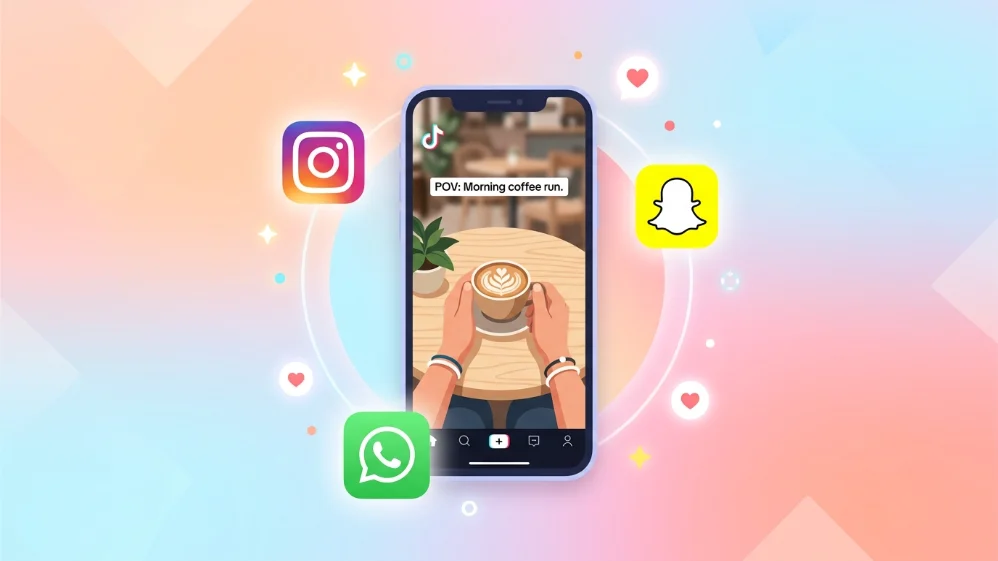

POV stands for “point of view.” It refers to the perspective from which someone observes a situation, expresses an opinion, or tells a story. In social media, POV is used as a caption to frame videos as if the viewer is experiencing a scenario firsthand. On TikTok and Instagram, POV content puts the audience in the creator’s shoes, making the experience more immersive and relatable.
You have probably scrolled through TikTok or Instagram and seen countless videos captioned with “POV:” followed by a scenario. Maybe you have received a text message where someone said “from my POV” and wondered exactly what they meant. The term POV has exploded in popularity across social media, texting, and everyday conversation. But what does POV actually mean?
POV is one of those acronyms that seems simple on the surface but carries multiple layers of meaning depending on the context. Whether you are a parent trying to decode your teen’s social media posts, a content creator looking to use POV effectively, or just someone who wants to understand modern digital communication, this guide covers everything you need to know.
In this comprehensive guide, you will learn the core definition of POV, how it is used across different platforms, real conversation examples, common misinterpretations, and practical tips for using POV correctly in your own communication.
Quick Answer Box
| Aspect | Details |
|---|---|
| Meaning | Point of View |
| Context | Digital communication, social media, film, literature, everyday conversation |
| Usage | To indicate perspective, opinion, or to frame a scenario |
| Platforms | TikTok, Instagram, Snapchat, texting, online forums |
| Example | “POV: You just got a new haircut and everyone notices” |
| Tone | Casual, relatable, conversational |
What Does POV Mean?
POV is an acronym that stands for “point of view.” At its most basic level, it describes the perspective from which someone sees or experiences something. This could be a physical perspective, like what you see with your own eyes, or a mental perspective, like your opinion or attitude toward a topic.
The term has been around for decades, originating in film and literature long before it became a social media staple. In cinema, a POV shot shows the audience exactly what a character is seeing, creating a first-person viewing experience. In literature, POV determines who is telling the story and how much the reader knows about the characters and events.
Today, POV has taken on new life in digital communication. On platforms like TikTok and Instagram, creators use POV as a caption to set up a scenario and invite viewers to imagine themselves in that situation. The meaning has expanded beyond its traditional definitions to become a versatile tool for storytelling, humor, and connection.
Full Definition
According to Dictionary.com, POV has several distinct meanings:
Standpoint or Manner of Consideration: A specified way of looking at or appraising something. For example, “From a financial POV, this investment makes sense.”
Opinion, Judgment, or Attitude: A personal belief or perspective on a topic. For example, “Her POV on the new policy is that it will create more problems than it solves.”
Narrative Perspective in Literature: The position of the narrator in relation to the story, indicating whose eyes the reader sees the events through. This can be first-person (“I”), second-person (“you”), or third-person (“he/she/they”).
Cinematic Technique: A method of shooting a scene or film that shows events from a character’s perspective, making the viewer feel like they are experiencing the action firsthand.
Social Media Format: A caption style used on TikTok, Instagram Reels, and other short-form video platforms to frame content as if the viewer is experiencing a specific scenario.
Context and Usage
POV in Everyday Conversation
In daily life, POV is often used to express an opinion or standpoint. When someone says “from my POV,” they are essentially saying “in my opinion” or “from where I stand.” This usage helps clarify that what follows is a subjective perspective rather than an objective fact.
For example, in a workplace discussion, someone might say “From my POV, we should prioritize the marketing campaign over product development right now.” In a personal relationship, a person might say “I understand your POV, but I see things differently.”
This conversational use of POV serves an important function: it acknowledges that different perspectives exist and invites dialogue rather than presenting opinions as absolute truth.
POV in Digital Communication
In texting and online chat, POV serves a similar purpose. It is often used to preface a statement with the understanding that it represents a personal viewpoint. This can soften potentially controversial statements or simply add clarity to a message.
POV also appears in comment sections and discussion forums where users share their perspectives on various topics. It creates a sense of personal investment in the conversation and can encourage others to share their own viewpoints.
POV as a Creative Tool
Beyond expressing opinions, POV has become a powerful creative tool. Content creators use POV to craft immersive narratives that draw viewers into a specific experience. By framing a video with “POV: [scenario],” creators invite their audience to participate mentally in the scene, making the content more engaging and shareable.
This creative use of POV has given rise to countless memes, relatable skits, and storytelling formats that resonate with audiences because they feel personal and immediate.
Real-Life Examples
Conversation Example 1: Sharing an Opinion
Person A: “I can’t believe they chose that design for the new logo.”
Person B: “From my POV, it actually works well with their brand identity. What don’t you like about it?”
Person A: “I guess from a customer POV, it just doesn’t feel as approachable as the old one.”
Conversation Example 2: Discussing a Movie
Person A: “Did you finish the series yet?”
Person B: “Just the finale. The POV shifts in the last episode caught me off guard.”
Person A: “Right? Going from the detective’s POV to the killer’s POV changed everything.”
Conversation Example 3: Workplace Discussion
Manager: “We need to decide on the new software by Friday.”
Employee: “From an IT POV, we should go with the option that offers better security features.”
Manager: “Good point. From a budget POV, we need to consider the long-term costs too.”
Conversation Example 4: Texting About Relationships
Person A: “He said he didn’t mean to hurt my feelings.”
Person B: “But from your POV, it still stung, right?”
Person A: “Yeah, exactly. I know his intentions were good, but my POV is that he could have been more thoughtful.”
Conversation Example 5: Social Media POV Format
Caption: “POV: You’re the designated driver at a party”
Video: A person holding a water bottle while others dance around them, looking slightly bored but content.
Comment: “This is literally me every weekend”
Reply: “POV: we appreciate you fr”
Platform-Specific Meaning
TikTok
TikTok is where POV has arguably had its biggest impact. The platform has over 68 million videos tagged with #POV, making it one of the most popular formats on the app. On TikTok, POV serves as a caption that sets up a scenario for the viewer to imagine themselves in.
TikTok POV videos typically follow a pattern: the creator acts out a situation while the caption invites viewers to imagine they are experiencing it. For example, “POV: You’re a cashier confronting a Karen”.
The format has become so popular that it has spawned countless sub-genres and memes. Some creators use POV to tell emotional stories, others use it for comedy, and still others use it to share relatable everyday experiences.
On Instagram, POV works similarly to TikTok. Creators use POV in captions for Reels and posts to frame content from a specific perspective. The goal is the same: to make viewers feel like they are part of the experience.
Instagram POV content often includes “hands-in-frame” shots where the creator’s hands appear in the video, simulating the viewer’s own hands. This technique enhances the first-person illusion and makes the content feel more personal.
Snapchat
Snapchat has integrated POV directly into its platform features. Users can create POV voice messages and stories that simulate a first-person experience. The platform’s lenses and filters can also be used to create POV effects, making Snapchat a natural home for this type of content.
Snapchat’s POV feature allows users to share their perspective with friends in a more immersive way, whether through video, audio, or text overlays.
WhatsApp and Texting
In messaging apps like WhatsApp, POV is used more conversationally. It typically appears in phrases like “from my POV” or “my POV is” to express an opinion or perspective. This usage is less about creating immersive experiences and more about clarifying that a statement represents a personal viewpoint.
Twitter and Online Forums
On Twitter and in online forums, POV serves a similar conversational function. Users might tweet “POV: we need to rethink how we approach this issue” or use POV in thread discussions to share their perspective. The acronym helps signal that what follows is subjective and invites others to engage with the viewpoint.
Alternative Meanings
While “point of view” is by far the most common meaning of POV, the acronym has other interpretations in specific contexts:
Privately Owned Vehicle: In military and government contexts, POV can refer to a personally owned vehicle used for official purposes.
Pre-Owned Vehicle: In the automotive industry, POV sometimes appears as shorthand for pre-owned vehicles.
Percentage of Volume: In finance, POV can refer to a trading strategy based on percentage of volume.
Purpose of Visit: In medical coding, POV is used to indicate the reason for a patient’s visit.
Persistance of Vision: In some technical contexts, POV refers to the optical phenomenon that allows the brain to perceive continuous motion from a series of still images.
Psychology of Vision: In some therapeutic contexts, POV relates to psychological perspectives on vision and perception.
However, in everyday digital communication, POV almost always means point of view. The context usually makes the meaning clear.
Related Terms and NLP Variations
Synonyms and Close Equivalents
- Perspective: The way someone views or thinks about something
- Standpoint: A particular attitude or way of considering a matter
- Viewpoint: A person’s point of view or general attitude toward something
- Angle: A particular way of approaching or considering an issue
- Outlook: A person’s point of view or general attitude toward life
- Stance: The position or viewpoint of a person or group
Related Internet Slang
- IMO/IMHO: In My Opinion / In My Humble Opinion – Used to preface a personal viewpoint
- TBH: To Be Honest – Used to express an honest opinion
- NGL: Not Gonna Lie – Used to preface an honest statement
- FR: For Real – Used to emphasize sincerity
- No Cap: No lie / for real – Used to emphasize truthfulness
POV vs Opinion vs Perspective
While these terms are related, they have subtle differences:
Opinion is a personal judgment or belief that may not be based on facts. It is subjective and can vary from person to person.
Perspective is a broader term that encompasses not just opinion but also the background, experiences, and context that shape how someone sees things.
POV (point of view) sits somewhere between the two. It can refer to a specific opinion on a topic or a broader perspective shaped by experience and context.
How to Respond to POV
Responding to POV depends on the context in which it is used:
When POV expresses an opinion: Acknowledge the other person’s perspective before sharing your own. Phrases like “I see your POV” or “That’s an interesting POV” show respect for their viewpoint even if you disagree.
When POV frames a social media post: Engage with the scenario. Comment on how relatable it is, share your own similar experience, or play along with the role-play. For example, if someone posts “POV: You’re the designated driver,” you might comment “This is me every weekend” or “I feel seen.”
When POV is used in a discussion: Ask clarifying questions to understand the other person’s perspective better. “Can you help me understand your POV on this?” invites deeper conversation.
When you disagree with someone’s POV: Acknowledge their perspective before offering your own. “I understand your POV, and from my perspective, I see it differently because…” maintains respect while expressing disagreement.
The key to responding well to POV is recognizing that it signals a subjective perspective. Engaging with that perspective respectfully, whether you agree or not, leads to better communication.
Misinterpretations
The Social Media POV Confusion
One of the most common misinterpretations of POV comes from its use on social media. Many users caption videos “POV:” when the video actually shows someone in the third person, not from a first-person perspective.
For example, a video titled “POV: You just got a new haircut” might show the person with the new haircut in the center of the frame, not a first-person view of what that person sees. Strictly speaking, this is not a true point of view shot. However, language evolves, and the meaning of POV on social media has shifted.
As linguists point out, there is no divine authority determining what is “correct” in language. How people use language is what the language is. The new social media meaning of POV has become something like “imagine this is you” or “this is what it’s like when” — more of a “fly on the wall” perspective than a literal point of view.
POV vs Literal Point of View
Another common misunderstanding is treating POV as strictly literal. While POV can mean a physical perspective (what someone literally sees with their eyes), it more often refers to a mental or emotional perspective. Someone can share their POV on a political issue without physically seeing anything related to it.
POV as Always First-Person
While POV often implies first-person perspective, it can also be used in second-person (addressing the viewer directly as “you”) and third-person (describing someone else’s perspective). The flexibility of POV is part of what makes it so useful in communication.
When NOT to Use POV
While POV is versatile, there are situations where it might not be appropriate:
Formal or professional writing: In academic papers, business reports, or legal documents, spelling out “point of view” is usually preferable to using the acronym POV.
When clarity is critical: If your audience might not be familiar with the acronym, especially in international or cross-generational communication, it is better to use the full phrase.
In very serious or sensitive contexts: Using slang or casual acronyms in discussions about serious topics like tragedy, illness, or trauma can come across as insensitive. Assess the tone of the conversation before using POV.
When you mean something else: If you are referring to a privately owned vehicle, pre-owned vehicle, or one of the other alternative meanings, be aware that your audience will likely assume you mean “point of view.”
Usage Tips
For Social Media Content
Be clear about the scenario: The best POV captions set up a clear, relatable situation. “POV: You’re trying to study but your cat won’t stop sitting on your keyboard” is more effective than a vague caption.
Match the visual to the caption: If your caption says “POV: You’re at a concert,” the video should look like what someone would see at a concert. Even if you are not using a true first-person shot, the content should align with the scenario you are describing.
Use POV sparingly: Like any trend, overusing POV can make your content feel repetitive. Mix up your caption styles to keep your content fresh.
For Everyday Communication
Use POV to invite dialogue: When you say “from my POV,” you are signaling that you are open to hearing other perspectives. This can make conversations more collaborative.
Be specific: Instead of just saying “my POV,” explain what shaped that perspective. “From my POV, having grown up in a small town…” gives more context.
Respect others’ POV: Acknowledging that everyone has their own point of view is key to healthy communication. You do not have to agree with someone to respect their POV.
Frequently Asked Questions
What does POV stand for?
POV stands for “point of view.” It refers to the perspective from which someone sees or experiences something.
What does POV mean on TikTok?
On TikTok, POV is used in captions to frame videos as if the viewer is experiencing a specific scenario firsthand. It creates an immersive experience where the audience feels like they are part of the action.
What does POV mean in texting?
In texting, POV means “point of view” and is used to express an opinion or perspective on something. For example, “From my POV, we should wait until next week.”
Is POV the same as opinion?
POV and opinion are related but not identical. An opinion is a personal judgment or belief. POV is a broader term that encompasses not just opinion but also the perspective, experiences, and context that shape how someone sees something.
What does POV mean in books?
In literature, POV refers to the narrative perspective from which a story is told. This can be first-person (“I”), second-person (“you”), or third-person (“he/she/they”), and it determines how much the reader knows about the characters and events.
What does POV mean in film?
In film, POV refers to a shot or sequence that shows what a character is seeing, putting the audience in that character’s visual perspective. This technique creates intimacy and allows viewers to experience events as the character does.
Why do people use POV wrong on social media?
Many social media users caption videos “POV:” even when the video shows a third-person perspective rather than a first-person view. This usage has become so common that it has developed its own meaning: “imagine this is you” or “this is what it’s like when.”
How do you use POV in a sentence?
You can use POV in a sentence to express a perspective: “From my POV, this is the best option.” Or as a caption: “POV: You’re meeting your favorite celebrity for the first time.”
What is a POV video?
A POV video is content filmed from a perspective that puts the viewer in the creator’s shoes. On social media, POV videos typically use a caption starting with “POV:” to frame a relatable scenario.
What does POV mean in slang?
In internet slang, POV is used as a caption to set up scenarios in videos and memes. It invites viewers to imagine themselves in a specific situation, making the content more relatable and engaging.
What is the difference between POV and perspective?
While often used interchangeably, perspective is a broader term that encompasses a person’s overall outlook shaped by experience and background. POV is more specific, often referring to a particular stance on a specific issue or a literal visual perspective.
Can POV be used in verbal conversation?
Yes, POV is commonly used in verbal conversation to express an opinion or perspective. For example, someone might say “From my POV, we should take the other route.”
Conclusion
POV, short for “point of view,” is a versatile acronym that has evolved from its origins in film and literature to become a cornerstone of digital communication. Whether you are expressing an opinion in a text message, framing a video on TikTok, or discussing a character’s perspective in a book, POV helps clarify whose eyes we are seeing through.
The social media evolution of POV has given it new life as a creative tool for storytelling and connection. While some argue that the new usage is “incorrect,” language is always evolving, and the way people use POV today reflects the dynamic nature of communication in the digital age.
Understanding POV in all its contexts whether as a perspective, an opinion, or a creative format empowers you to communicate more effectively across platforms and generations. The next time you see “POV:” on your feed or hear someone say “from my POV,” you will know exactly what they mean and how to respond.
Remember that at its heart, POV is about understanding that everyone sees the world differently. Embracing that diversity of perspective makes for richer conversations, more engaging content, and deeper connections with the people around you