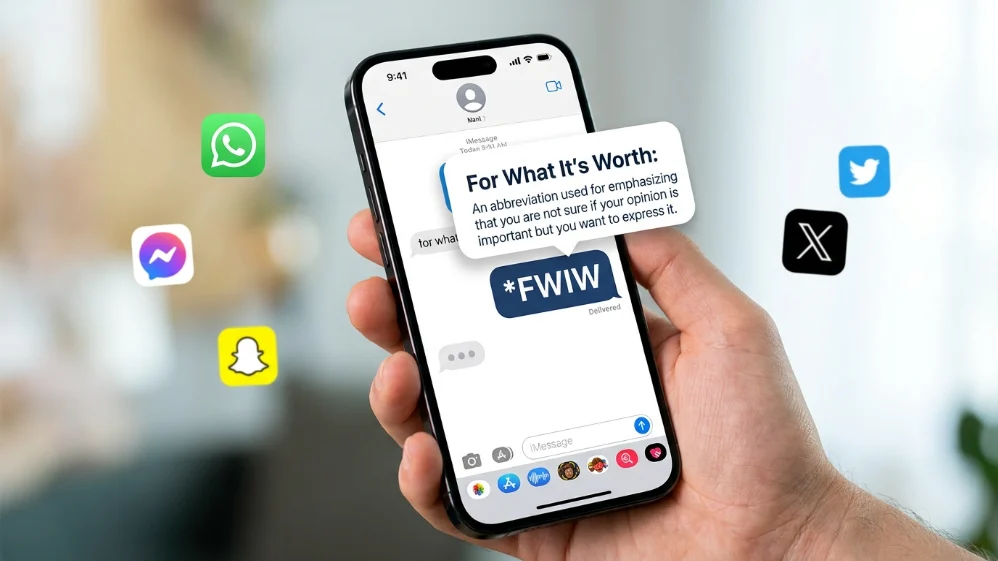

FWIW stands for “for what it’s worth.” It is an acronym used to preface an opinion, fact, or piece of advice when you want to share your perspective without sounding pushy or demanding agreement. People use FWIW to politely contribute to a conversation, soften disagreements, or add context. You can think of it as saying, “Here is my take, take it or leave it.”
You are scrolling through a Twitter thread or reading a Reddit comment, and suddenly you see it: FWIW. Your brain starts spinning. “For whatever I want?” “Five wizards in wardrobe?” “For when I’m wrong?”
You are not alone. FWIW is one of those internet acronyms that does not give away its meaning easily. Unlike LOL or BRB, the letters do not obviously connect to a common phrase. But once you know what it stands for, you will start noticing it everywhere, in text messages, work chats, social media replies, and even emails.
This guide breaks down everything you need to know about FWIW. You will learn what it means, where it came from, how to use it in different situations, and how to respond when someone sends it to you. By the end, you will be using FWIW like a pro, no cap.
Quick Answer Box
| Category | Details |
|---|---|
| Meaning | For What It’s Worth |
| Context | Prefaces an opinion, fact, or advice |
| Usage | To politely share a perspective without demanding agreement |
| Platforms | Text messages, WhatsApp, Snapchat, TikTok, X/Twitter, Reddit, Discord, work chats, emails |
| Example | “FWIW, I think the blue one looks better on you.” |
| Tone | Polite, humble, cooperative, sometimes snarky |
What Does FWIW Mean?
FWIW is an acronym that stands for “for what it’s worth.” It is a phrase people use to introduce an opinion, piece of information, or advice. The speaker is essentially saying, “This might be useful, or it might not be. Take it or leave it.”
Think of FWIW as a verbal shrug. You are putting an idea out there without insisting that anyone agrees with you or acts on it. It is a way to contribute to a conversation while staying humble about your input.
For example, if a friend is deciding between two restaurants and you say, “FWIW, I have been to both and the Italian place has better pasta,” you are offering your experience without pushing them to choose that spot. You are just sharing what you know in case it helps.
The Core Meaning
At its heart, FWIW is about softening your delivery. It changes how your words land, not what they mean. Compare these two statements:
The second version sounds more cooperative. It reads like input, not an order. That is why FWIW shows up so often in peer reviews, group problem-solving, and casual advice-giving.
Similar Acronyms
FWIW belongs to a family of opinion-prefacing acronyms. Here is how they compare:
- FWIW (For What It’s Worth): Low pressure. “This might help, take it or leave it.”
- IMO (In My Opinion): More direct. Can feel debate-ready.
- IMHO (In My Honest Opinion or In My Humble Opinion): Still direct, but with a softer edge.
If a conversation is tense, FWIW often comes off as the calmest option.
Full Definition and Origin
What Does FWIW Stand For?
FWIW stands for “for what it’s worth.” It is an initialism, meaning you say each letter individually (F-W-I-W) rather than pronouncing it as a word. It is informal and used primarily in written communication like texts, chats, and social media posts.
The History of FWIW
The phrase “for what it’s worth” has been around for centuries. It originally had a literal economic meaning. When people bought land or livestock, they would offer to pay “for what it’s worth,” meaning the amount they believed the item was truly valued at.
Over time, the phrase took on a more subjective and sometimes sarcastic twist. An early example appears in William Henry Oxberry’s 1844 play Newton Foster, or the Merchant Service, where one character says to another, “Consequently, your opinion goes for what it’s worth, nothing.”
The abbreviation FWIW emerged much later. Linguists trace the earliest use to the 1980s. The Oxford English Dictionary points to 1986, specifically in a Usenet post titled “Re: UNIX v.3 Query.”
It took decades for the acronym to enter mainstream dictionaries. Merriam-Webster officially added FWIW in September 2022. Google Trends shows the acronym gaining significant popularity starting around 2020, possibly due to increasing political and social disagreements online.
Capitalization and Spelling
FWIW can be written in all caps (FWIW) or all lowercase (fwiw). Both are correct and common. Avoid mixed cases like “FWiw” or “fWiW.” The lowercase version often feels more casual and is popular in quick text exchanges.
Context and Usage
When to Use FWIW
FWIW is versatile. You can use it in many situations where you want to share a perspective without sounding like you are demanding agreement. Here are the most common scenarios:
To Politely Disagree
Someone shares an opinion, and you see it differently. FWIW lets you offer your view without starting an argument.
- “FWIW, I actually think the earlier version was better.”
To Add Context
You have information that might help someone make a decision, but you are not sure if it is relevant.
- “FWIW, I heard that restaurant has a new menu now.”
To Soften Advice
You want to give a recommendation, but you do not want to sound bossy.
- “FWIW, you might want to double-check those dates before booking.”
To Share Personal Experience
Your experience might not apply to everyone, but it could still be useful.
- “FWIW, I tried that diet and it worked for me.”
To Inject Snark or Humor
Depending on context and tone, FWIW can also be used sarcastically. If you can replace FWIW with “FYI” and the sentence sounds snarky, that is the vibe.
- “FWIW, toothpaste kills bad breath germs.” (Said to someone with obvious bad breath.)
Where FWIW Is Most Common
FWIW appears in all kinds of digital spaces. You will find it:
- Text messages: Group chats and direct SMS conversations
- Social media: X/Twitter reply chains, Reddit communities, Instagram comments, Facebook posts, TikTok captions, and Snapchat
- Messaging apps: WhatsApp, Discord channels, Slack
- Emails: Informal work emails and personal correspondence
- Online forums: Message boards, product help threads, and community discussions
How FWIW Changes Tone
FWIW does not change the substance of your point. It changes how that point lands.
Without FWIW, a statement can feel like a command or a criticism. With FWIW, the same statement feels like a suggestion or an observation.
- Without: “You should pick the red one.”
- With: “FWIW, the red one is on sale right now.”
The second option gives the same useful information but lets the other person feel like they are still in control of their decision.
Real-Life Examples
Conversation Example 1: Giving Advice
Alex: I cannot decide which phone to buy. The new one is so expensive though.
Jordan: FWIW, I got the previous model and it works great. You might not need the latest one.
Alex: That is actually helpful. Thanks.
Conversation Example 2: Polite Disagreement
Sam: That movie was terrible. Worst acting I have ever seen.
Taylor: FWIW, I thought the lead actor did a pretty good job with what they had.
Sam: Really? Hmm, maybe I was too harsh.
Conversation Example 3: Work Context
Manager: We need to launch this feature by Friday.
Employee: FWIW, the testing team said they need at least two more days to run all the checks.
Manager: Good to know. Let us see if we can adjust the timeline.
Conversation Example 4: Casual Chat
Chris: I am thinking of dyeing my hair pink.
Riley: FWIW, pink fades really fast. You will be re-dyeing it every two weeks.
Chris: Ugh, never mind then.
Conversation Example 5: Supportive Context
Jamie: I feel like I messed up that presentation.
Casey: FWIW, I thought you handled the tough questions really well.
Jamie: Thanks, that makes me feel a bit better.
Conversation Example 6: Snarky Use
Morgan: I am basically a coffee expert.
Quinn: FWIW, instant coffee exists and people still drink it.
Morgan: Okay, fair point.
Platform-Specific Meaning
FWIW on WhatsApp
On WhatsApp, FWIW appears in both one-on-one chats and group conversations. People use it to share opinions casually, often when responding to a friend’s dilemma or venting session. It softens the message and keeps the conversation light.
Example: “FWIW, I think you should take the job offer. The commute is worth it for that salary.”
FWIW on Snapchat
Snapchat conversations are fast and ephemeral. FWIW shows up in quick replies, often as “fwiw” in lowercase. It is used to add a quick opinion or fact before the chat disappears.
Example: “fwiw that place closes at 9”
FWIW on TikTok
On TikTok, FWIW appears in comments and captions. Users drop it before sharing a take on a video, often to disagree with the creator politely or to add a different perspective.
Example (comment): “FWIW, I tried this hack and it did not work for me.”
FWIW on X/Twitter
Twitter (now X) reply chains can get heated. FWIW is a useful tool for jumping into a discussion without escalating tension. It signals that you are offering a perspective, not picking a fight.
Example: “FWIW, I think both sides have valid points here.”
FWIW on Reddit
Reddit thrives on discussion and debate. FWIW is common in comment sections, especially in advice threads, product reviews, and opinion-based subreddits. Users share their experiences with the caveat that their mileage may vary.
Example: “FWIW, I bought this monitor and had no issues with ghosting.”
FWIW on Discord
Discord servers often have channels for advice, feedback, or general chat. FWIW helps members share opinions without sounding like they are talking down to anyone.
Example: “FWIW, the new update broke a few mods for me.”
FWIW in Work Chats (Slack, Teams)
In professional settings, FWIW is used to offer input during brainstorming or decision-making. It is a polite way to contribute without overstepping.
Example: “FWIW, the client mentioned they preferred the first design.”
Alternative Meanings
While “for what it’s worth” is the primary and most widely accepted meaning, FWIW has a couple of alternative interpretations:
For Whoever Is Wondering
Some people use FWIW to mean “for whoever is wondering.” This version is less common but appears occasionally in public forums or group chats where someone is answering a question that multiple people might have.
From What I’ve Witnessed
Another rare variation is “from what I’ve witnessed.” This meaning emphasizes personal observation rather than general opinion.
Forgot Where I Was
In some contexts, FWIW has been used humorously to mean “forgot where I was.” This is not standard and is more of an inside joke or playful misuse.
In almost all cases, however, when someone types FWIW, they mean “for what it’s worth.” The alternative meanings are outliers and not widely recognized.
Related Terms and NLP Variations
FWIW exists within a larger ecosystem of internet acronyms and conversational phrases. Understanding these related terms helps you grasp the full semantic landscape.
Opinion-Prefacing Acronyms
- IMO (In My Opinion): Direct opinion statement.
- IMHO (In My Honest Opinion / In My Humble Opinion): Opinion with a humility cue.
- AFAIK (As Far As I Know): Qualifies information as limited to your knowledge.
- IIRC (If I Recall Correctly): Flags that your memory might be fuzzy.
- TBH (To Be Honest): Signals candor, often used before a blunt statement.
Similar Phrases
- “Take it or leave it”: The core attitude behind FWIW.
- “Here are my two cents”: Offering an opinion without expecting agreement.
- “For your information (FYI): Shares information, but can feel more direct or even passive-aggressive.
- “With a grain of salt”: Suggests the information should not be taken too seriously.
Semantic Relationships
FWIW sits at the intersection of several communication functions:
- Politeness marker: Softens the impact of what you are saying.
- Epistemic qualifier: Signals that you are not claiming absolute truth.
- Social lubricant: Keeps conversations cooperative and reduces conflict.
- Hedge: Protects you from being held fully accountable for the advice you give.
How to Respond to FWIW
When someone sends you a message with FWIW, they are offering their perspective. Your response depends on the context and your relationship with the person.
Acknowledge the Input
The simplest and most polite response is to acknowledge that you heard them.
- “Got it, thanks.”
- “Good to know.”
- “I appreciate that.”
Engage with the Point
If the FWIW message contains useful information, engage with it directly.
- “That is a good point. I had not thought of that.”
- “Interesting. Why do you say that?”
- “Thanks for the heads up. I will look into it.”
Disagree Respectfully
If you disagree, you can use FWIW yourself to keep the tone civil.
- “FWIW, I see it a bit differently.”
- “Fair enough. FWIW, here is why I think that might not work.”
Use Humor
If the FWIW was snarky, a playful response can defuse any tension.
- “Noted. FWIW, I still think I am right.”
- “Touché.”
Ignore It
Sometimes, FWIW is just a passing comment that does not require a response. If the information is not relevant or you have nothing to add, it is fine to let it go.
Misinterpretations and Common Mistakes
Taking It as a Weakness
Some people mistake FWIW for a lack of confidence. They think the speaker is unsure or apologetic. In reality, FWIW is often a strategic choice. It signals humility and respect for the other person’s autonomy. It does not mean you lack conviction.
Using It Too Often
FWIW loses its effect if you use it in every sentence. It can make you sound perpetually unsure or overly hesitant. Save it for moments when you genuinely want to soften your delivery.
Using It in Formal Situations
FWIW is informal. In formal client messages, official policy statements, or anything that requires firmness, skip it. It can make you sound like you are not fully confident, even when you are.
Confusing It with FYI
FWIW and FYI both introduce information, but they have different tones. FYI is more direct and can come off as a command or a correction. FWIW is softer and more collaborative.
- FYI: “FYI, the meeting was moved to 3 PM.” (Informational, neutral.)
- FWIW: “FWIW, I think 3 PM works better for everyone.” (Opinion-based, softer.)
Using It Without a Clear Point
Dropping “FWIW” with no real substance after it is pointless. The acronym is a preface, not a substitute for content. Always follow it with a clear opinion, fact, or suggestion.
When NOT to Use FWIW
In Formal Writing
Academic papers, business reports, legal documents, and official correspondence are not the place for FWIW. Stick to full phrases or more formal language.
In Emergency or Urgent Situations
If something is time-sensitive or critical, do not soften your message with FWIW. Be direct.
- Wrong: “FWIW, the server might be down.”
- Right: “The server is down. Please investigate immediately.”
When Giving Direct Instructions
If you are the one in charge and need someone to do something specific, skip the qualifier.
- Wrong: “FWIW, you should submit the report by 5 PM.”
- Right: “Please submit the report by 5 PM.”
When You Are the Expert
If you are the recognized authority on a topic, FWIW can undermine your credibility. Your opinion carries weight, and you do not need to hedge.
In Sensitive Conversations
When discussing deeply personal or emotional topics, FWIW can feel dismissive. It can sound like you are downplaying the other person’s feelings. In those cases, direct empathy is usually better.
Usage Tips for FWIW
Keep It Natural
FWIW should fit seamlessly into your message. Do not force it. If it feels awkward, you probably do not need it.
Pair It with a Clear Point
Always follow FWIW with a specific observation, opinion, or fact. Vague statements waste the softening effect.
- Good: “FWIW, I had the same issue and restarting fixed it.”
- Weak: “FWIW, just saying.”
Match the Tone of the Conversation
In a heated debate, FWIW can be a calming influence. In a lighthearted chat, it can add a playful or self-deprecating vibe. Pay attention to the room.
Use It Sparingly
Overusing FWIW makes you sound hesitant or insecure. Use it when you genuinely want to soften your delivery, not as a verbal tic.
Consider Your Audience
FWIW is widely understood among internet users, but not everyone knows what it means. If you are texting someone older or less online, consider spelling out “for what it’s worth” instead.
FAQs
1. What does FWIW mean in texting?
FWIW in texting stands for “for what it’s worth.” It is used to preface an opinion or piece of advice, signaling that the recipient can take it or leave it.
2. Is FWIW rude?
No, FWIW is generally polite. It softens your message and shows respect for the other person’s perspective. However, it can be used sarcastically depending on context.
3. What is the difference between FWIW and FYI?
FWIW introduces an opinion or advice with a humble tone. FYI introduces factual information more directly. FWIW is softer; FYI can feel more like a command or correction.
4. Can I use FWIW in a professional email?
Yes, but only in informal or internal emails. Avoid it in formal correspondence, client-facing messages, or official documents.
5. What does FWIW mean on Snapchat?
On Snapchat, FWIW means “for what it’s worth.” It is used in quick chats to share an opinion or observation before the message disappears.
6. Is FWIW the same as IMO?
No. FWIW is softer and more humble. IMO (in my opinion) is more direct and can feel debate-ready. FWIW says “take it or leave it”; IMO says “this is what I think.”
7. What does FWIW mean on Reddit?
On Reddit, FWIW is used in comments to share personal experiences or opinions without claiming to have the definitive answer. It is common in advice threads and discussion posts.
8. How do you pronounce FWIW?
You say each letter individually: F-W-I-W. It is an initialism, not an acronym pronounced as a word.
9. Where did FWIW come from?
The phrase “for what it’s worth” dates back centuries with economic origins. The abbreviation FWIW emerged in the 1980s on Usenet and gained mainstream popularity in the 2020s.
10. Can FWIW mean something else?
Rarely, FWIW can mean “for whoever is wondering” or “from what I’ve witnessed,” but “for what it’s worth” is the standard and most widely recognized meaning.
11. Is FWIW appropriate for all ages?
FWIW is informal internet slang. It is widely understood by younger generations and digital natives. Older or less tech-savvy individuals may not recognize it, so consider your audience.
12. Should I use FWIW in a job interview?
No. Job interviews are formal settings. Stick to full phrases and professional language.
13. What is a good reply to FWIW?
Acknowledge the input with something like “Got it, thanks” or engage with the point directly. If you disagree, you can use FWIW yourself to keep the tone civil.
14. Does FWIW mean I am unsure?
Not necessarily. FWIW is often a strategic choice to show humility and respect. It does not mean you lack conviction.
15. How can I remember what FWIW stands for?
Think of it as “For What It’s Worth” = “Here is my take, take it or leave it.” The phrase is a humble way to share your perspective.
Conclusion
FWIW is one of those internet acronyms that, once you know it, you see everywhere. It stands for “for what it’s worth” and serves as a polite, humble way to share an opinion, offer advice, or add context to a conversation.
Whether you are texting a friend, replying to a tweet, or chiming in on a work chat, FWIW helps you contribute without sounding pushy. It softens disagreements, keeps discussions cooperative, and signals that you respect the other person’s autonomy.
The key to using FWIW well is knowing when and how to deploy it. Use it sparingly, pair it with a clear point, and match the tone of the conversation. Avoid it in formal settings, urgent situations, or when you need to be direct.
FWIW, this guide has given you everything you need to understand and use this acronym with confidence. Now go forth and drop it into your next text, no cap.