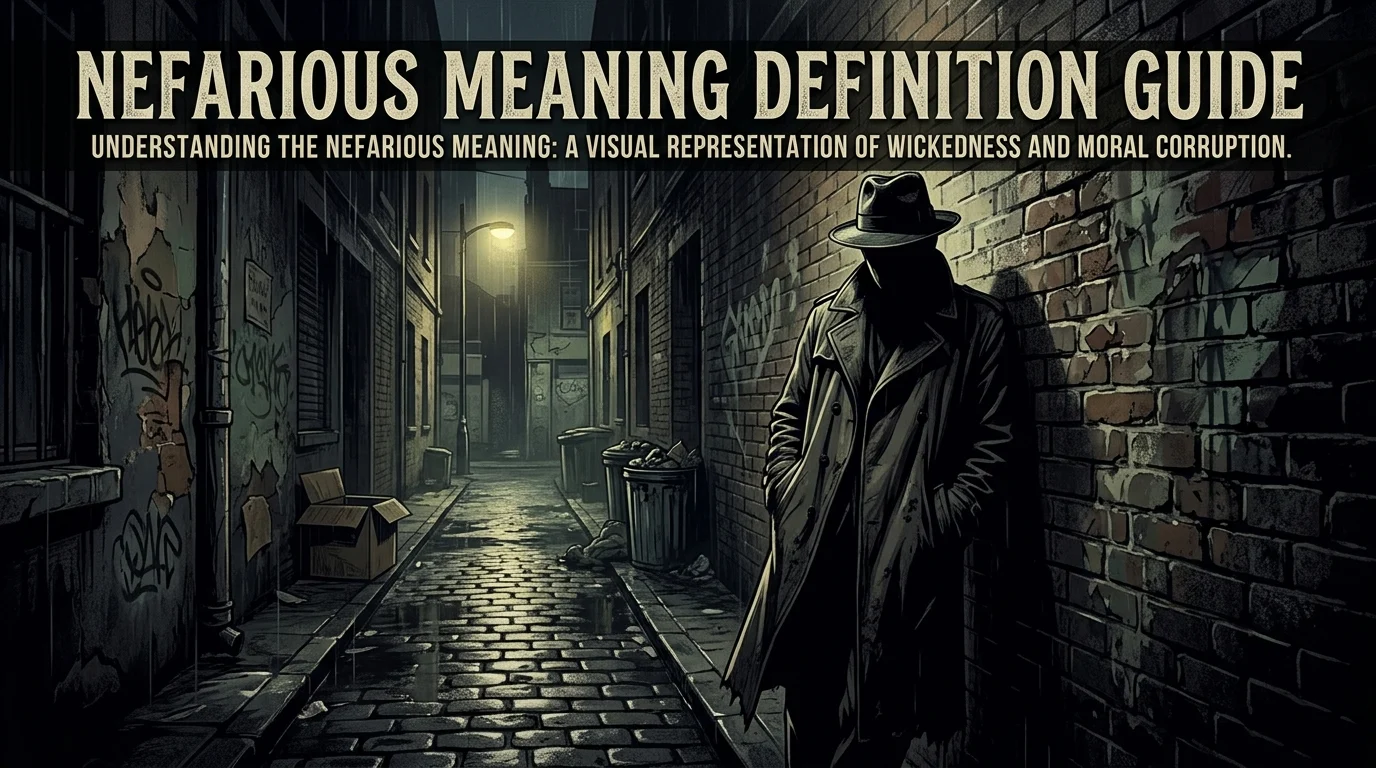

Nefarious (pronounced ni-FAIR-ee-us) is an adjective that means extremely wicked, evil, or criminal. It describes actions, schemes, or people that are morally reprehensible and often involve deliberate wrongdoing. Common synonyms include villainous, heinous, iniquitous, and corrupt. The word originates from the Latin nefarius, meaning “wicked” or “abominable,” which comes from nefas — “crime against divine or moral law.”
Have you ever read a news story or watched a movie where someone was described as nefarious and wondered what it really meant? You’re not alone. Many people search for the nefarious meaning, nefarious definition, or ask what does nefarious mean because it’s a powerful English word that often appears in crime reports, books, and everyday conversations.
Simply put, nefarious describes something that is extremely wicked, evil, or criminal. In this guide, you’ll learn the definition of nefarious, discover the meaning of nefarious with simple examples, understand what is nefarious, and see the nefarious meaning in English in real-life situations.
We’ll also define nefarious, explain the nefarious def in plain language, and help you use this advanced vocabulary word with confidence. By the end, you’ll know exactly when and how to use nefarious correctly in both writing and conversation.
Quick Answer
What Does Nefarious Mean?
Core Definition
At its heart, the nefarious meaning is simple: extremely wicked or villainous. When you call something nefarious, you are saying it is not just mildly wrong or slightly bad. You are saying it is deeply immoral, often criminal, and deserving of strong condemnation.
The Merriam-Webster dictionary defines nefarious as “flagrantly wicked or impious” — in other words, openly and obviously evil. Vocabulary.com puts it even more plainly: if something is nefarious, it is “criminal, evil, malicious and wicked”.
The Latin Root
To truly understand the nefarious meaning, you need to look at its origins. The word comes from the Latin nefarius, meaning “wicked” or “abominable”. This, in turn, comes from nefas, which means “crime, wrong, or impiety.
Here is the fascinating part: nefas is formed from two Latin parts:
- Ne- meaning “not”
- Fas meaning “divine law,” “right,” or “that which is divinely spoken”
So literally, nefarious means “against divine law” or “contrary to what is right.” This origin explains why the word carries such a heavy moral weight. It is not just about breaking human laws; it is about violating fundamental principles of right and wrong.
The word first appeared in English around 1600, and it has retained its powerful meaning for over four centuries.
Pronunciation Guide
Wondering how to say nefarious correctly? Here is the breakdown:
The stress falls on the second syllable: ni-FAIR-ee-us. Think of it like “fair” in the middle: ne-FAIR-ee-us.
Synonyms and Antonyms
Synonyms for Nefarious
If you want to vary your vocabulary, here are the most common synonyms for nefarious, along with their subtle differences:
| Synonym | Nuance |
|---|---|
| Villainous | Evokes a classic villain; suggests evil, depraved, or vile conduct |
| Heinous | Emphasizes the shocking, hateful nature of the act |
| Iniquitous | Implies a complete lack of justice or fairness |
| Wicked | A more general term for moral badness |
| Corrupt | Focuses on moral decay and betrayal of trust |
| Vicious | Suggests cruelty, malignancy, or destructive violence |
| Sinful | Religious or moral overtones of sin |
| Atrocious | Highlights the horrifying or brutal nature |
| Flagitious | A rare but powerful synonym meaning deeply criminal |
Antonyms for Nefarious
On the opposite end of the moral spectrum, these words are antonyms of nefarious:
- Virtuous — morally excellent
- Honorable — deserving respect and admiration
- Righteous — morally right and just
- Good — the simplest opposite
- Noble — having high moral principles
- Honest — truthful and trustworthy
Choosing the Right Word
While all these synonyms convey “badness,” nefarious is unique in its emphasis on calculated, deliberate wickedness that violates moral or divine law. It is not a word for minor misdeeds. It is reserved for actions that are truly shocking in their immorality.
Context and Usage
When to Use Nefarious
The nefarious meaning is best applied in situations involving:
- Criminal activity — “The organization was involved in nefarious activities such as money laundering and human trafficking.”
- Deception and manipulation — “The hacker used nefarious methods to access sensitive data”.
- Morally reprehensible schemes — “The villain’s nefarious plot threatened to destroy the city”.
- Corruption and abuse of power — “The politician’s nefarious dealings were finally exposed”.
Common Collocations
Certain nouns frequently appear alongside nefarious. These are called collocations, and using them makes your English sound more natural and sophisticated:
- Nefarious activities — “The police investigation revealed a range of nefarious activities.”
- Nefarious purposes — “The stolen data was used for nefarious purposes”.
- Nefarious plot — “The spy uncovered a nefarious plot to assassinate the ambassador.”
- Nefarious scheme — “The con artist devised a nefarious scheme to defraud people”.
- Nefarious character — “The novel features a nefarious character who will stop at nothing.”
- Nefarious deeds — “The pirate was hanged for his nefarious deeds”.
- Nefarious behavior — “The CEO was unaware of her subordinate’s nefarious behavior”.
Formal vs. Informal Usage
Nefarious is primarily a formal word. You will most often encounter it in:
- News articles — journalists use it to describe crimes and scandals
- Legal documents — lawyers and judges use it to characterize serious offenses
- Literature — authors use it to create memorable villains
- Academic writing — scholars use it in discussions of ethics and morality
It is less common in casual conversation, but it can be used effectively for dramatic effect or humor (e.g., “My cat has a nefarious plan to steal my breakfast”).
Tone and Intensity
Nefarious carries a strongly negative tone. It is not a word you use lightly. When you describe something as nefarious, you are making a serious moral judgment. The word implies that the action or person is not just wrong but fundamentally evil.
Real-Life Examples
Example Sentences
Here are nefarious used correctly in sentences, drawn from real sources:
- “The hair and the face and the poise unscathed from the nefarious effects of alcohol”.
- “The most nefarious cults sometimes are the ones hidden in plain sight”.
- “A nefarious hacker could have easily installed a virus on to my machine without me having to do anything”.
- “Siegal told the Journal that she was unaware of Epstein’s nefarious behavior”.
- “Sport has a history of being used for nefarious purposes”.
- “Bay has taken the first Moon landing in 1969 and turned it to his own nefarious purposes”.
- “People kept walking in and out of doors with nefarious purpose”.
- “The exchange itself is not thought to be responsible for nefarious activity”.
- “Speaking on BBC Radio 5 Live, Transport Secretary Heidi Alexander said the tanker had ‘a pretty nefarious history'”.
- “To mitigate the risk of their systems being used for nefarious purposes, companies deploy numerous safeguards”.
Conversation Examples
Here are five realistic dialogues that show how nefarious might be used in everyday conversation:
1 — Office Setting
Sarah: “Did you hear about the data breach at the company?”
Mark: “Yeah, apparently someone on the inside was selling customer information.”
Sarah: “That is seriously nefarious. People’s personal data could be used for identity theft.”
Mark: “I know. The CEO is furious. They are launching a full investigation.”
2 — Watching a Movie
Jake: “What did you think of the new thriller?”
Emma: “I loved it! The villain had this whole nefarious scheme to take over the city’s power grid.”
Jake: “Right? And the way he manipulated everyone was so creepy.”
Emma: “Definitely one of the most nefarious characters I have seen in a while.”
3 — News Discussion
Tom: “Did you see the story about the charity scam?”
Lisa: “The one where they pocketed all the donations?”
Tom: “Yeah, they raised over two million dollars for ‘children’s education’ and spent it on luxury cars.”
Lisa: “That is beyond awful. That is genuinely nefarious. Those people are the worst.”
4 — True Crime Podcast
Host: “Welcome back to Crime Files. Today we are looking at one of the most nefarious criminal enterprises in modern history.”
Guest: “It is shocking how organized and deliberate their operations were.”
Host: “Exactly. This was not a crime of passion. This was calculated, nefarious activity that ruined hundreds of lives.”
5 — Casual Chat
Alex: “My brother keeps trying to get me to invest in his ‘business opportunity.'”
Riley: “Oh no. What is it?”
Alex: “I don’t know, but it sounds sketchy. He keeps talking about offshore accounts and tax loopholes.”
Riley: “That sounds lowkey nefarious. I would stay away from that.”
Platform-Specific Meaning
Nefarious in News Media
In journalism, nefarious is frequently used to describe criminal or unethical behavior by individuals, corporations, or governments. Reporters use it to convey the seriousness of wrongdoing without relying on more technical legal language. For example, a news outlet might report on “nefarious interests” influencing policy decisions or “nefarious activity” in the financial sector.
Nefarious in Legal Contexts
In legal settings, nefarious appears in court documents, legal opinions, and statutes to characterize particularly serious offenses. While not a formal legal term of art, it is used to emphasize the moral gravity of a crime. Legal dictionaries define it as “wicked in the extreme” and “atrociously villainous”.
Nefarious in Literature and Entertainment
Authors and screenwriters love nefarious because it instantly creates a vivid picture of a villain. From classic literature to modern superhero films, the word is a shorthand for “evil mastermind.” Think of characters like Moriarty, Lex Luthor, or any Bond villain — they are all engaged in nefarious plots.
Nefarious in Academic Writing
Scholars use nefarious in philosophy, ethics, political science, and criminology to discuss moral failure, corruption, and systemic injustice. The word’s weighty Latin origin makes it suitable for serious academic discourse.
Nefarious in Social Media and Slang
While nefarious is not typically considered slang, it has found a home in certain online communities. On platforms like Reddit, Twitter, and TikTok, users might describe a particularly devious prank or a shady business practice as “nefarious.” It is often used with a hint of irony or exaggeration. For example:
- “My roommate has a nefarious plan to steal my leftovers.”
- “That new terms of service update looks nefarious if you ask me.”
However, the word remains relatively formal even in these contexts. It is not Gen Z slang like “no cap” or “fr” — it is a sophisticated word that adds dramatic flair.
Nefarious in Business and Corporate Settings
In the business world, nefarious is used to describe unethical practices, fraud, embezzlement, and corporate espionage. A company might investigate “nefarious activities” within its ranks or warn employees about “nefarious actors” trying to infiltrate the organization.
Alternative Meanings and Variations
Related Words
The nefarious meaning extends to several related forms:
- Nefariously (adverb) — “He acted nefariously, hiding his true intentions.”
- Nefariousness (noun) — “The nefariousness of the crime shocked the community”.
- Unnefarious (adjective) — “The unnefarious nature of her actions was a relief”.
Words Often Confused with Nefarious
People sometimes confuse nefarious with similar-sounding or similarly intense words:
| Word | Meaning | Difference |
|---|---|---|
| Nefarious | Extremely wicked, evil | Emphasizes violation of moral/divine law |
| Notorious | Famous for something bad | Focuses on reputation, not necessarily evil |
| Infamous | Well-known for a bad quality | Similar to notorious; not as intense as nefarious |
| Malicious | Intending to do harm | Can be less severe; does not imply criminality |
| Sinister | Giving the impression of evil | Often about appearance or suggestion, not action |
Misinterpretations to Avoid
- Nefarious does not mean “mysterious” or “secretive.” While nefarious plans are often hidden, the core meaning is about wickedness, not secrecy.
- Nefarious is not a synonym for “illegal.” Something can be illegal but not nefarious (e.g., a minor traffic violation). Nefarious implies deep moral wrongness, not just legal violation.
- Nefarious is not used for minor misdeeds. Calling someone nefarious for stealing a cookie is an exaggeration. The word is reserved for serious wrongdoing.
- Nefarious does not mean “dangerous” in a physical sense. A dangerous animal is not nefarious; a person who deliberately sets a trap to harm others is.
How to Respond or Reply
When Someone Uses “Nefarious”
someone uses nefarious in conversation, here is how you might respond:
you agree:
- “Absolutely. That is truly wicked.”
- “I could not agree more. That is evil.”
- “Exactly. There is no other word for it.”
If you are unsure:
- “What makes you say that? Help me understand.”
- “That is a strong word. What did they do exactly?”
- “Can you give me more context?”
If you disagree:
- “I think that is a bit strong. Maybe they made a mistake rather than being evil.”
- “I would not go that far. It was wrong, but not nefarious.”
- “I see where you are coming from, but I think that is an exaggeration.”
How to Respond to a Nefarious Accusation
someone accuses you or someone else of nefarious behavior, here is how to respond appropriately:
If the accusation is false:
- I understand why you might think that, but let me explain what really happened.
- “That is a serious accusation, and I want to address it directly.”
- “I can see how it looks that way, but my intentions were completely different.”
If the accusation is true:
- “You are right. That was wrong, and I take full responsibility.”
- “I made a terrible mistake, and I am deeply sorry.”
- “There is no excuse for what I did.”
When NOT to Use Nefarious
Situations to Avoid
- Minor annoyances — Your neighbor’s loud music is annoying, not nefarious.
- Accidents — Forgetting a friend’s birthday is forgetful, not nefarious.
- Honest mistakes — A miscalculation at work is an error, not a nefarious scheme.
- Differences of opinion — Someone who disagrees with you is not nefarious.
- Everyday mischief — Children playing pranks are mischievous, not nefarious.
Alternatives for Milder Situations
| Situation | Better Word |
|---|---|
| Minor wrongdoing | Wrong, bad, improper |
| Mischief | Mischievous, playful |
| Annoyance | Irritating, frustrating |
| Dishonesty | Deceptive, dishonest |
| Carelessness | Negligent, careless |
Cultural Sensitivity
Because nefarious carries such strong moral judgment, be careful when using it across cultures. What one culture considers “nefarious” might be viewed differently elsewhere. The word implies a universal moral standard that may not always apply.
Usage Tips
1: Use It Sparingly
Nefarious is a powerful word. Using it too often dilutes its impact. Reserve it for situations that genuinely deserve such strong condemnation.
2: Pair It with Specific Nouns
As noted earlier, nefarious works best with nouns like activities, purposes, plot, scheme, and deeds. These pairings sound natural and authoritative.
3: Consider Your Audience
Nefarious is formal. It works well in professional writing, academic papers, and serious discussions. In casual conversation, it might sound overly dramatic or pretentious. Use your judgment based on the context.
4: Pronounce It Correctly
Mispronouncing nefarious can undermine your credibility. Practice saying it: ni-FAIR-ee-us. Emphasize the second syllable.
5: Know When to Use “Nefariously”
The adverb form is useful when you want to describe how an action is done: “The funds were nefariously diverted to offshore accounts.” Use it to add precision to your writing.
Frequently Asked Questions
1. What does nefarious mean in simple terms?
Nefarious means extremely evil, wicked, or criminal. It describes actions or people that are morally wrong and often illegal.
2. Is nefarious a bad word?
Yes, nefarious has a strongly negative meaning. It is used to condemn actions or people as deeply immoral or evil.
3. What is the origin of the word nefarious?
Nefarious comes from the Latin nefarius, meaning “wicked,” which comes from nefas — “crime against divine law”. The *ne-* prefix means “not,” and fas means “divine law”.
4. What is the difference between nefarious and notorious?
Nefarious means evil or wicked, while notorious means famous for something bad. A person can be notorious for a minor scandal but not be nefarious.
5. Can a person be described as nefarious?
Yes, a person can be described as nefarious if they are deeply wicked or villainous. However, the word is more commonly used to describe actions, schemes, or activities.
6. What is an example of a nefarious activity?
Examples include fraud, embezzlement, human trafficking, money laundering, corporate espionage, and organized crime.
7. Is nefarious used in legal contexts?
Yes, nefarious appears in legal documents and court opinions to describe particularly serious crimes.
8. What is the noun form of nefarious?
The noun form is nefariousness, meaning the quality of being wicked or evil.
9. What is the adverb form of nefarious?
The adverb form is nefariously, meaning in a wicked or evil manner.
10. How do you pronounce nefarious?
Nefarious is pronounced ni-FAIR-ee-us in American English and nih-FAIR-ee-us in British English.
11. What are some synonyms for nefarious?
Common synonyms include villainous, heinous, wicked, iniquitous, corrupt, and vicious.
12. What are some antonyms for nefarious?
Antonyms include virtuous, honorable, righteous, good, and noble.
13. Can nefarious be used humorously?
Yes, nefarious can be used ironically or humorously to describe minor mischief, as in “My cat has a nefarious plan to knock over my coffee cup.” However, this is a deliberate exaggeration.
14. Is nefarious a common word?
Nefarious is moderately common in formal English. It appears frequently in news, literature, and academic writing.
15. What is the opposite of nefarious?
The opposite of nefarious is virtuous, honorable, or righteous — words that describe moral goodness.
Conclusion
The nefarious meaning is clear: it describes the darkest kind of wickedness, the kind that violates not just human laws but fundamental principles of right and wrong. From its Latin roots in nefas — “crime against divine law” — to its modern usage in news, law, and literature, this word has retained its powerful moral weight for over four centuries.
Understanding nefarious is not just about adding a fancy word to your vocabulary. It is about having the right tool to describe genuine evil when you see it. Whether you are reading about corporate fraud, watching a thriller, or having a serious conversation about ethics, nefarious gives you the precision and impact you need.
Remember to use it wisely. This is a word for the worst of the worst — the schemes, the plots, and the activities that truly deserve condemnation. Use it too often, and you lose its power. Use it correctly, and you command attention and respect.
So the next time you encounter something truly wicked, you will know exactly what to call it. That is the nefarious meaning, and now it is yours to use with confidence.