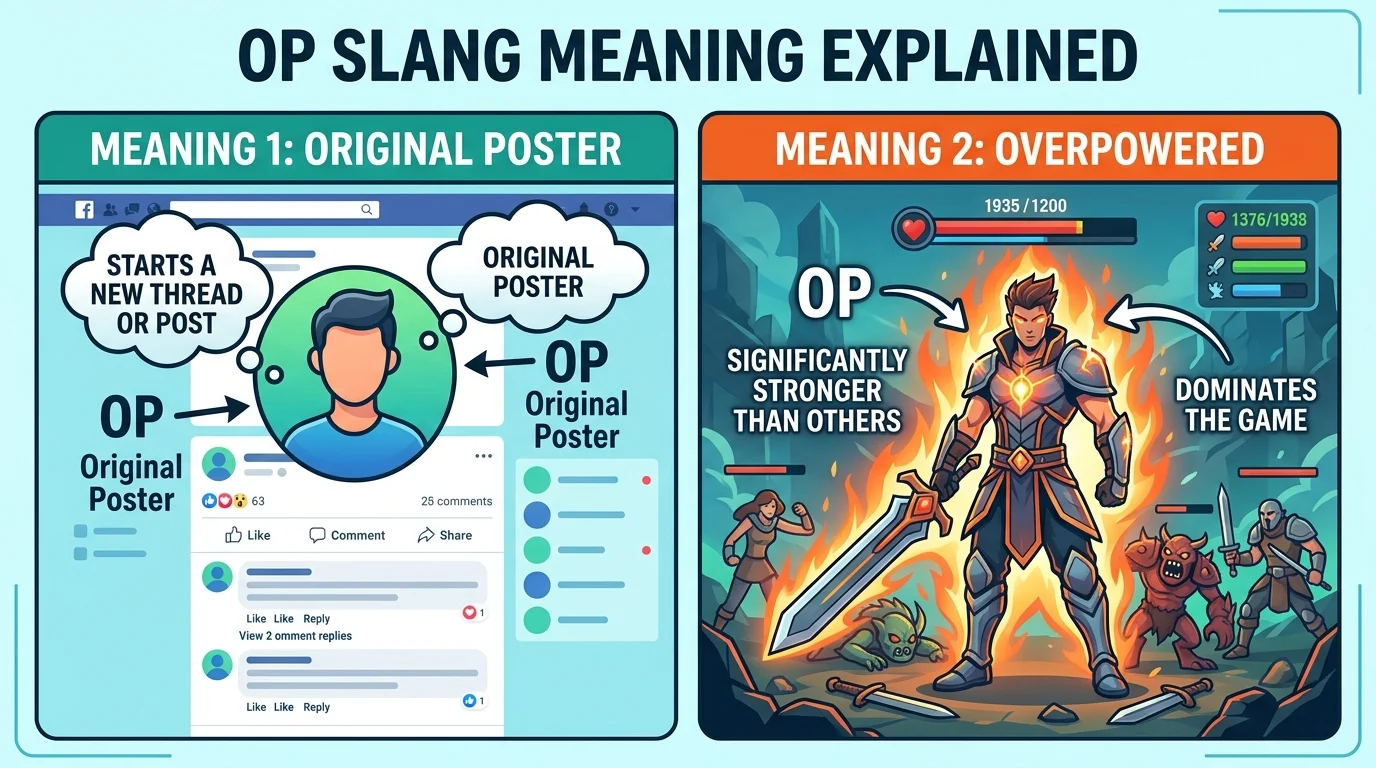

OP is a versatile slang abbreviation with two primary meanings: “original poster” (or “original post”) refers to the person who started an online discussion thread on platforms like Reddit, while “overpowered” describes a character, weapon, or ability in video games that is excessively strong and disrupts game balance. The correct meaning depends entirely on the context of the conversation.
If you have spent any time online recently, you have probably come across the abbreviation “OP.” It appears in comment sections, gaming chats, social media posts, and text messages. But depending on where you see it, OP can mean two very different things.
The duality of this slang term can be confusing, especially for anyone new to internet culture. One moment you are reading a Reddit thread where someone says “OP delivered,” and the next you are in a gaming lobby hearing “that character is so OP.” These two uses have nothing in common, yet both are completely correct.
This guide breaks down everything you need to know about the slang term OP. You will learn what it means, how to use it correctly, where it comes from, and how to avoid embarrassing misunderstandings. Whether you are a social media user, a gamer, or just someone trying to keep up with modern internet lingo, this article covers it all.
Quick Answer
| Element | Details |
|---|---|
| Meaning | Original Poster / Original Post OR Overpowered |
| Context | Social media, forums, Reddit (Original Poster) / Video games, competitive scenarios (Overpowered) |
| Usage | Refer to the person who started a thread, or describe something too strong in a game |
| Platforms | Reddit, Twitter, Instagram, TikTok, Discord, gaming platforms |
| Example | “The OP made a great point” or “That weapon is way too OP” |
| Tone | Neutral to informal |
What Does OP Mean in Slang?
The Two Core Definitions
The abbreviation OP has two primary definitions in modern internet slang. Both are widely used, and both are completely valid. The key to understanding OP lies in recognizing which definition applies to your situation.
Definition 1: Original Poster (or Original Post)
In forums, social media, and online discussions, OP stands for “original poster.” This refers to the person who created the initial post or started the thread that everyone else is commenting on. It can also refer to the original post itself.
Definition 2: Overpowered
In gaming and competitive contexts, OP stands for “overpowered.” This describes a character, weapon, ability, or strategy that is excessively strong and gives an unfair advantage.
Understanding which meaning is being used requires paying attention to the context of the conversation. If people are discussing a social media post or forum thread, OP means original poster. If they are talking about a video game, OP means overpowered.
Full Definition and Origins
Where Did OP Come From?
The term OP has been part of internet culture for decades. Its origins trace back to the early days of online communication, long before social media platforms like Reddit or Twitter existed.
The Original Poster Meaning
The use of OP to mean “original poster” dates back to the mid-1990s, when Usenet newsgroups were the primary way people discussed topics online. As discussion forums grew in popularity, the need for a shorthand way to refer to the person who started a thread became essential. Forums like Reddit, Something Awful, and 4chan helped popularize the term in the late 1990s and early 2000s.
Today, OP is used across virtually every platform that supports threaded discussions, including Reddit, Twitter, Instagram, TikTok, Facebook, and Discord.
The Overpowered Meaning
The gaming use of OP emerged as multiplayer video games became more popular. Players needed a way to describe characters, weapons, or abilities that felt too strong and disrupted fair play. The term “overpowered” was quickly shortened to OP, following the pattern of other gaming abbreviations like “noob” and “gg”.
Why OP Has Two Meanings
Language evolves to meet the needs of its users. In the early days of the internet, different communities developed their own shorthand. Forum users needed a way to refer to thread creators. Gamers needed a way to critique game balance. Both groups settled on the same two-letter abbreviation, creating a term that is now used by millions of people across completely different contexts.
Context and Usage
How to Identify Which Meaning Is Being Used
The context of a conversation is the single most important factor in determining what OP means. Here is how to tell them apart:
| Context | Meaning | Example |
|---|---|---|
| Forum or social media discussion | Original Poster | “I agree with the OP’s take on this” |
| Video game chat | Overpowered | “That new hero is so OP, they need to nerf her” |
| Comment section | Original Poster | “OP hasn’t responded to any comments yet” |
| Gaming strategy talk | Overpowered | “This build is OP against tanks” |
| Thread about a post | Original Post | “Can you link the OP so I can see it?” |
Common Usage Patterns
As Original Poster:
- Used to refer to the person who created a post or thread
- Often appears in comments like “OP said…” or “Thanks OP”
- Helps avoid repeatedly typing out usernames
- Can be used as a noun (“the OP”) or a direct address (“Thanks, OP!”)
As Overpowered:
- Used as an adjective to describe something too strong
- Often paired with requests for a “nerf” (a reduction in power)
- Can refer to characters, weapons, abilities, strategies, or even players
- Sometimes used positively (“that play was OP”) or negatively (“this game is ruined by OP weapons”)
Real-Life Conversation Examples
1: Reddit Thread Discussion
A: “I just tried the new recipe from that cooking video and it turned out great!”
B: “OP, can you share the link to the video?”
C: “The OP already posted it in the comments, look again.”
B: “Found it, thanks OP!”
In this example, OP refers to the original poster who started the thread by sharing their cooking experience.
2: Gaming Lobby Chat
1: “Did you see how fast that character moves?”
2: “Yeah, that speed boost is completely OP.”
3: “They need to nerf that ability, it’s way too strong.”
1: “Fr, I can’t even hit them.”
Here, OP means overpowered, describing a game mechanic that feels unfair.
3: Social Media Comment
Post: A user shares a photo of their new puppy.
1: “OP, what’s the puppy’s name?”
2: “OP said in another comment it’s called Milo.”
3: “Milo is such a cute name, OP!”
OP refers to the original poster of the photo.
4: Game Strategy Discussion
1: “What’s the best weapon for the final boss?”
2: “Use the legendary sword, it’s OP against that boss.”
1: “But isn’t it getting nerfed next patch?”
2: “Yeah, so use it now while it’s still OP.”
OP means overpowered, describing a weapon that is currently very strong.
5: Twitter Thread
Tweet: A user posts a hot take about a movie.
1: “OP is speaking facts.”
2: “I disagree with OP, the movie was terrible.”
3: “OP, have you even read the book?”
OP refers to the original poster of the tweet.
Platform-Specific Meaning
On Reddit, OP almost exclusively means “original poster.” The platform even adds a special “OP” tag or microphone icon next to the username of the person who created a post. This visual indicator makes it easy for commenters to identify who started the discussion. Reddit users frequently reference the OP in comments, often saying things like “OP delivered” when the original poster follows up with additional information.
Discord
Discord servers use OP in both ways, depending on the channel. In general discussion channels, OP usually means original poster when referencing a message or thread. In gaming-focused servers, OP more commonly means overpowered when discussing game mechanics, characters, or strategies. Some Discord bots even use “OP” in their names, like the “Power Op” bot.
TikTok
On TikTok, OP typically means “original poster” or “original post.” Users often reference the OP when responding to videos that have been stitched, dueted, or shared. For example, someone might comment “OP is so funny” on a video they are reacting to, referring to the creator of the original content.
Twitter / X
On Twitter, OP is used to refer to the person who created the original tweet in a thread. When users reply to a tweet and reference the original poster, they might say “OP said…” or “Thanks OP”. This is especially common in long tweet threads where multiple people are replying.
Instagram users employ OP to refer to the original poster of a photo, video, or Reel. In comment sections, you might see “OP, where did you get that?” or “OP’s caption is everything”. The term helps commenters address the content creator directly without needing to tag their username.
Gaming Platforms (Steam, Xbox, PlayStation)
In gaming contexts, OP almost always means “overpowered.” Players use it to describe anything that feels too strong, from weapons and abilities to entire character classes. The term is common in both competitive and casual gaming communities and is often followed by calls for a “nerf”.
Alternative Meanings of OP
Less Common Definitions
While “original poster” and “overpowered” are by far the most common uses of OP, the abbreviation has several other meanings in specific contexts.
Other People’s Cigarettes
In older slang, OP (or OPs) referred to cigarettes begged or borrowed from other people. Someone asking for a cigarette might be called an OP. This usage is much less common today but still appears in some circles.
Out of Pocket
In some text messaging contexts, OP can mean “out of pocket” or “outta pocket,” describing someone who is acting over the top or making absurd comments.
Observation Post
In military terminology, OP stands for “observation post”. This is a professional usage rather than slang.
Opponent
In some contexts, particularly in British slang, “opp” (short for opponent) is used to describe enemies or rivals. This has been popularized on TikTok and is sometimes confused with OP.
Related Slang Terms
Nerf: The opposite of OP in gaming. When something is too powerful (OP), developers “nerf” it to make it weaker.
No Cap: Means “no lie” or “for real.” Often used alongside OP in sentences like “No cap, that character is OP.”
FR (For Real): Used to emphasize agreement, as in “FR, OP is speaking facts.”
Lowkey: Means “somewhat” or “secretly,” as in “I lowkey agree with OP.”
GG (Good Game): Another gaming abbreviation often used alongside OP.
How to Respond to OP
When OP Means Original Poster
Acknowledge the original poster: If you are replying to someone who started a thread, it is common to address them as OP. For example, “Thanks for sharing this, OP” or “OP, can you clarify what you meant?”
Build on their point: You can reference what the OP said to add your own perspective. For example, “To add to what OP mentioned, I think…”
Ask for clarification: If the OP’s post was unclear, you can ask them directly. For example, “OP, could you explain this part in more detail?”
When OP Means Overpowered
Agree or disagree: If someone says something is OP, you can agree (“Yeah, it’s way too strong”) or disagree (“I don’t think it’s that OP, you just need to counter it”).
Suggest a nerf: If you think something is too powerful, you can call for a nerf. For example, “They really need to nerf that ability, it’s OP.”
Use it as praise: In some contexts, calling something OP can be a compliment. For example, “That play was OP, nice job!”
Misinterpretations to Avoid
Common Mistakes
Assuming OP always means the same thing: The biggest mistake is assuming OP has only one meaning. Always check the context before responding.
Using OP incorrectly in gaming: In a gaming context, using OP to mean “original poster” will confuse other players. Stick to “overpowered” when discussing games.
Using OP incorrectly on social media: On social media, using OP to mean “overpowered” in a non-gaming context will confuse readers. Stick to “original poster.”
Confusing OP with OPP: OPP is a related term that means “opponent” or “enemy” in some slang contexts. It is not the same as OP.
How to Avoid Misunderstandings
The simplest way to avoid confusion is to pay attention to the conversation. If the discussion is about a social media post, forum thread, or any kind of online content, OP means original poster. If the discussion involves video games, competition, or balance, OP means overpowered. When in doubt, ask for clarification.
When NOT to Use OP
Formal Situations
OP is informal slang and should not be used in professional or formal writing. Avoid using OP in:
- Work emails
- Academic papers
- Professional reports
- Formal presentations
- Job applications
Unclear Contexts
If the context is unclear and people might not understand which meaning you intend, it is better to spell out the full term. Say “original poster” or “overpowered” instead of using the abbreviation.
First-Time Interactions
When communicating with someone who may not be familiar with internet slang, avoid using OP. Not everyone knows what it means, and using it without explanation can create confusion.
Usage Tips
Social Media
- Use OP to refer to the person who created a post
- Write “Thanks OP” to show appreciation
- Use “OP said…” when referencing the original poster’s words
- Avoid using OP to mean overpowered on social media unless the context is clearly gaming-related
For Gaming
- Use OP to describe anything that feels too powerful
- Pair OP with “nerf” when discussing game balance
- Use OP as an adjective (“that weapon is OP”)
- Avoid using OP to mean original poster in gaming chats
For Text Messages
- OP works well in informal text conversations
- Make sure the recipient understands the context
- Spell out the full term if there is any chance of confusion
General Best Practices
- Always consider the context before using OP
- When in doubt, spell it out
- Pay attention to how others are using the term in the same conversation
- Remember that OP has two completely different meanings
Frequently Asked Questions
1. What does OP mean in text slang?
In text slang, OP usually means “original poster” when referring to someone who started a conversation or posted content. In gaming-related texts, it can mean “overpowered.”
2. What does OP mean on Reddit?
On Reddit, OP stands for “original poster,” meaning the person who created the post or started the thread. Reddit even adds a special tag next to the OP’s username.
3. What does OP mean in gaming?
In gaming, OP stands for “overpowered.” It describes characters, weapons, abilities, or strategies that are excessively strong and create an unfair advantage.
4. What does OP mean on TikTok?
On TikTok, OP typically means “original poster” or “original post,” referring to the creator of the content being discussed or shared.
5. What does OP mean in Discord?
On Discord, OP can mean either “original poster” (in general discussion channels) or “overpowered” (in gaming channels), depending on the context.
6. Is OP a positive or negative term?
It depends on the context. As “original poster,” OP is neutral. As “overpowered,” OP can be positive (praising something strong) or negative (criticizing poor game balance).
7. What is the opposite of OP in gaming?
The opposite of OP in gaming is “nerf,” which means to reduce the power of something that is too strong.
8. Can OP mean something else?
Yes, OP has other less common meanings, including “other people’s cigarettes,” “out of pocket,” and “observation post.” However, these are rarely used in everyday internet slang.
9. How do you use OP in a sentence?
As original poster: “The OP made a great point.” As overpowered: “That character is so OP, they need to nerf him.”
10. Is OP still used in 2026?
Yes, OP remains one of the most commonly used slang abbreviations on the internet. Its dual meaning makes it versatile across social media, forums, and gaming platforms.
Conclusion
OP is one of the most versatile and widely used abbreviations in internet slang. Its two primary meanings, “original poster” and “overpowered,” serve completely different purposes but are equally important in online communication.
Understanding the difference between these meanings is essential for anyone who spends time on social media, forums, or gaming platforms. The key is always context. If you are in a discussion thread, OP means the person who started it. If you are in a game, OP means something is too strong.
By mastering the use of OP, you can communicate more effectively online, avoid embarrassing misunderstandings, and participate confidently in conversations across all platforms. Whether you are acknowledging the original poster on Reddit or calling out an overpowered weapon in your favorite game, OP is a term that will serve you well in the digital world.