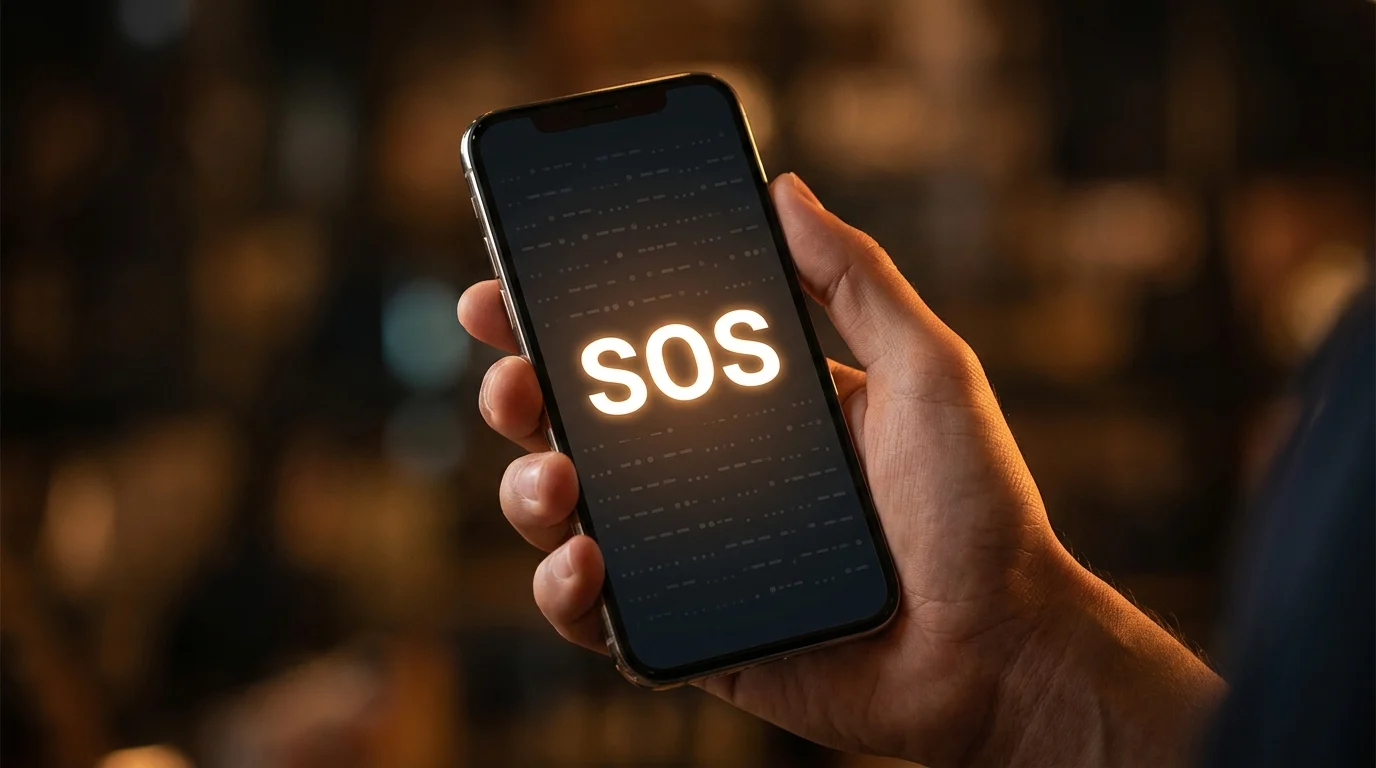

SOS is an internationally recognized distress signal originally developed for Morse code communication. Contrary to popular belief, SOS does not stand for “Save Our Souls” or “Save Our Ship.” It was chosen simply because its Morse code sequence (three dots, three dashes, three dots) is easy to transmit and recognize. Today, SOS is used both as a serious emergency signal and as casual slang in texting and social media to express overwhelm, frustration, or a playful cry for help.
You have probably seen the letters SOS countless times. Maybe you have spotted them on a phone screen, in a text message, or even on a T-shirt. But what does SOS actually mean? The answer might surprise you.
Most people assume SOS stands for “Save Our Souls” or “Save Our Ship.” In reality, SOS does not stand for anything at all. It is a Morse code distress signal that was adopted internationally in the early 1900s because its pattern of three dots, three dashes, and three dots is simple and unmistakable.
Today, SOS has evolved far beyond its maritime origins. It appears in texting slang, social media posts, iPhone emergency features, and even popular music. This guide covers everything you need to know about SOS: its true meaning, how to use it in different contexts, and why it remains one of the most recognized signals in the world.
Quick Answer
| Aspect | Details |
|---|---|
| Meaning | International distress signal (Morse code: …—…) |
| Common Misconception | Often thought to stand for “Save Our Souls” or “Save Our Ship” |
| Primary Context | Emergency situations requiring immediate assistance |
| Texting/Slang Use | Expressing overwhelm, frustration, or playful urgency |
| Example | “SOS, I have three exams tomorrow and I haven’t studied!” |
| Tone | Can be serious (emergencies) or casual/meme-y (texting) |
What Does SOS Mean?
The letter sequence SOS is a Morse code distress signal. It is represented as three dots, three dashes, and three dots (…—…). This pattern was chosen not because it stands for any specific words, but because it is easy to transmit and nearly impossible to misinterpret.
The Morse Code Connection
Morse code is a system that uses dots (short signals) and dashes (long signals) to represent letters and numbers. In this system:
- The letter S is represented by three dots (…)
- The letter O is represented by three dashes (—)
When you put them together, you get …—…, which is SOS.
The True Origin
The SOS signal was adopted at the 1906 International Telegraphic Radio Conference in Berlin. Before SOS, different countries used different distress signals. The British used CQD, the Germans used SOE, and the Americans used NC. The conference standardized SOS because its simple, rhythmic pattern was easy to remember and transmit, even in poor conditions.
The first SOS transmission in the United States occurred in 1909 from the vessel Arapahoe. It gained worldwide fame when the Titanic used it alongside CQD during its sinking in 1912.
Full Definition
Official Definition
An SOS is an internationally recognized radiotelegraphic distress signal used especially by ships and aircraft. It consists of the letters SOS spelled out in Morse code (…—…).
Broader Meaning
Beyond its technical definition, SOS has come to mean any urgent call for help. Dictionary.com defines it as “any call for help,” with examples like “We sent out an SOS for more typists.”
What SOS Does NOT Stand For
Despite what many believe, SOS does not stand for:
- Save Our Souls
- Save Our Ship
- Save Our Spirits
- Send Out Someone
These are all backronyms—phrases created after the fact to make the letters memorable. The U.S. officially adopted SOS after the Titanic disaster, and the phrases “Save Our Souls” and “Save Our Ship” became popular through widespread use outside marine communication.
Context and Usage
Serious Emergency Context
In its original and most serious form, SOS is used to signal life-threatening emergencies. This includes:
- Ships sinking or in distress at sea
- Aircraft in trouble
- Hikers or explorers lost in dangerous terrain
- Any situation where immediate rescue is needed
When used this way, SOS is not a casual expression. It is a genuine call for help that should be taken seriously.
Casual and Playful Context
In modern texting and social media, SOS has taken on a much lighter meaning. People use it to express:
- Feeling overwhelmed by schoolwork or deadlines
- Being in an awkward or embarrassing situation
- Needing advice or emotional support
- Reacting dramatically to minor inconveniences
For example, a student might text “SOS, I have no idea what to write for this essay!” This is not a literal emergency but a playful way of saying “I need help.”
The Slang Evolution
SOS has become what linguists call a “versatile acronym”—a term that carries different meanings depending on context. In texting, it often functions as a shorthand for “Help!” or “I cannot handle this right now.”
The shift from serious distress signal to casual slang reflects how language evolves in digital spaces. What was once a life-or-death signal is now a go-to expression for everyday frustrations—and that is okay, as long as the context is clear.
Real-Life Examples
1: Serious Emergency
Person A: “The engine is dead and we are taking on water. SOS. SOS. We are three miles off the coast.”
Person B: “Message received. Rescue is on the way. Stay calm and keep signaling.”
2: Academic Overwhelm
Alex: “I have three papers due tomorrow and I have not even started the research.”
Jamie: “SOS same. I am literally drowning in citations. Send coffee.”
Alex: “Coffee is the only thing keeping me alive right now, ngl.”
3: Relationship Drama
Mia: “He said he is ‘busy’ but I just saw him post a story from the gym. SOS, what do I do?”
Ella: “Girl, SOS indeed. That is suspicious. Ask him about it directly.”
Mia: “I am scared to. What if he gets mad?”
4: Workplace Warning
Colleague A: “Did you hear what happened in the meeting this morning?”
Colleague B: “SOS, the boss is right behind you. Maybe save that conversation for later.”
5: Group Chat Reaction
Jordan: “Just found out my ex is dating my roommate. No cap.”
Taylor: “SOS noooooo! That is actually terrible.”
Jordan: “I know, fr. I do not even know how to process this.”
Platform-Specific Meaning
SOS on WhatsApp
On WhatsApp, SOS most commonly refers to a distress signal indicating a need for help. It can also be playfully interpreted as “Someone On Shoulder” in informal contexts, warning that another person is nearby and might see the conversation.
WhatsApp also has an actual SOS feature that allows users to send a text message with their location to emergency contacts quickly and easily.
SOS on Snapchat
On Snapchat, SOS is often used in a playful, dramatic way. Users might type “SOS” in response to an overwhelming situation, a shocking update, or just to be funny. It can also appear as a playful filter or sticker.
Hashtags like #SOS are used both for serious pleas and for lighter, attention-grabbing purposes.
SOS on TikTok
TikTok has embraced SOS as a reaction term. People flood comment sections with “SOS” to react to eye-roll-worthy trends, epic plot twists in videos, or any content that triggers a strong emotional response.
On TikTok, SOS usually means “Send help!”—often in response to being overwhelmed by an annoying problem, a ridiculously tough situation, or something unexpectedly funny.
SOS on iPhone
When your iPhone displays “SOS” or “SOS Only,” it means the device is in a state where it can only make emergency calls. This typically happens when you are outside your carrier’s network range but can still connect to other networks for emergency services.
In texting on iPhone, SOS carries the same casual meaning as on other platforms: a dramatic cry for help or attention.
Alternative Meanings
Same Old Stuff
In casual conversation, SOS can mean “Same Old Stuff.” This is used to describe routine, unchanging situations. For example:
Person A: “How is your day going?”
Person B: “Oh, you know, SOS. Same old stuff.”
Someone On Shoulder / Someone Over Shoulder
In workplace or social settings, SOS can be a coded warning that someone is nearby and might be able to see or hear what is being said. It is a discreet way to tell someone to be careful about their words.
Save Our Ship / Save Our Souls
These are the most common backronyms. While technically incorrect as the original meaning, they are widely understood and accepted in popular culture.
Shit on a Shingle
In military slang, SOS can refer to “Shit on a Shingle”—a euphemism for a common military meal of creamed chipped beef on toast. The euphemistic initialism is used to avoid explicit vulgarity.
Same Old Shit
In prison slang, SOS stands for “Same Old Shit,” often used to describe repetitive, unpleasant routines like prison meals.
Screenshots on Sale
In some online contexts, SOS humorously stands for “Screenshots on Sale,” referring to sharing or selling screenshots, typically in a meme-related way.
Short on Time
SOS can also mean “Short on Time,” indicating that someone is busy or has limited availability.
Medical Usage
In medical contexts, SOS (from Latin si opus sit) means “if necessary” and is used in prescriptions to indicate medication should be taken only when needed.
Related Terms and NLP Variations
Synonyms and Variations
| Term | Meaning | Context |
|---|---|---|
| Help | Request for assistance | General |
| Distress signal | Emergency communication | Maritime/Aviation |
| Mayday | International voice distress call | Aviation/Maritime |
| Pan-pan | Urgent but not emergency | Aviation/Maritime |
| CQD | Predecessor to SOS | Historical maritime |
| S.O.S. | With periods for emphasis | Formal writing |
Related Slang Terms
- NGL (Not Gonna Lie): Often used with SOS for emphasis
- FR (For Real): Used to confirm sincerity
- No Cap: Means “no lie” or “for real”
- Lowkey: Means “sort of” or “secretly”
- SMH (Shaking My Head): Expresses disappointment or disbelief
These terms often appear alongside SOS in casual digital conversations, creating a distinctive Gen Z and millennial communication style.
Semantic Relationships
The meaning of SOS shifts based on context:
- Meaning ↔ Usage: Serious in emergencies, playful in texts
- Slang ↔ Context: Casual in social media, formal in official communications
- Platform ↔ Behavior: Different connotations on TikTok versus WhatsApp
How to Respond to an SOS
In Emergency Situations
If someone sends an SOS in a genuine emergency context:
- Take it seriously—assume the person is in danger
- Ask for details—location, nature of the emergency, number of people involved
- Call emergency services—911 in the USA, or the local emergency number
- Stay on the line—keep communicating until help arrives
- Do not panic—stay calm and follow instructions from emergency responders
In Casual Texting
If a friend sends “SOS” in a casual context:
- Assess the tone—are they being dramatic or genuinely stressed?
- Ask what they need—advice, emotional support, or just someone to listen?
- Respond with empathy—acknowledge their stress
- Offer practical help—if appropriate, suggest solutions
- Match their energy—if they are being playful, respond playfully
Examples of Good Responses
Casual SOS: “SOS, I have so much homework I do not know where to start.”
Good Response: “Same, honestly. Want to work on it together? We can suffer through it as a team.”
Playful SOS: “SOS noooooo, I just texted my crush by accident!”
Good Response: “LMAO, what did you say? This is going to be good.”
Serious SOS: “SOS. The car broke down on the highway and I am alone.”
Good Response: “Where are you exactly? I am calling for help right now. Stay in the car and lock the doors.”
Misinterpretations
Common Misunderstandings
- “SOS stands for something” —Many people believe SOS is an acronym. It is not. It is a Morse code sequence chosen for simplicity.
- “SOS only means Save Our Souls” —While this is a common backronym, it is not the original meaning. The signal was not designed to represent any words at all.
- “SOS is only for maritime use” —Today, SOS is used in many contexts, from iPhone emergency features to casual texting.
- “Using SOS casually is disrespectful” —While overusing it can dilute its urgency, using SOS playfully in appropriate contexts is widely accepted in digital communication.
- “SOS and Mayday mean the same thing” —Both are distress signals, but Mayday is a voice call used in aviation and maritime contexts, while SOS is a signal that can be transmitted via Morse code, light, or written text.
When to Avoid Using SOS
- In formal or professional communications—unless it is a genuine emergency
- When the recipient might take it literally—some people do not know the casual usage
- In situations where real help is needed—do not cry wolf; it can cause confusion
- When overused—spamming SOS every other message makes it lose its impact
When NOT to Use SOS
In Professional Settings
Unless you are in a genuine emergency, avoid using SOS in work emails, professional chats, or formal correspondence. It can come across as unprofessional or overly dramatic.
With People Who Do Not Understand Slang
Older generations or people less familiar with internet culture might take SOS literally. If you are texting a parent, grandparent, or someone who might not know the casual usage, consider using clearer language.
For Trivial Issues
If you use SOS for every minor inconvenience, it loses its power. Reserve it for situations where you actually need help or want to emphasize that you are genuinely overwhelmed.
In Emergency Situations (Don’t Cry Wolf)
If you use SOS casually in a context where someone might think it is a real emergency, you could cause unnecessary panic or, worse, divert attention from actual emergencies.
Usage Tips
How to Use SOS in Texting
- Match the tone—if your friend is being dramatic, SOS works perfectly. If they are being serious, consider clearer language.
- Add context—SOS alone can be ambiguous. Pair it with an explanation: “SOS, I just realized I double-booked myself this weekend.”
- Use emojis—emoji like 🆘 or 😰 can reinforce the playful or urgent tone.
- Know your audience—make sure the person you are texting understands the casual usage.
- Do not overuse it—if you use SOS in every other message, it stops being effective.
How to Use SOS on Social Media
- Hashtag it—using #SOS can help your post get noticed in relevant conversations.
- Use it for relatable content—SOS works well for posts about everyday struggles, funny situations, or moments of overwhelm.
- Be mindful of the context—using SOS in a post about a serious topic might be inappropriate.
- Pair with visual content—a meme or video with “SOS” in the caption is often more engaging.
FAQs
Q1: Does SOS actually stand for anything?
No, SOS does not stand for any words. It is a Morse code distress signal chosen because its pattern (…—…) is easy to transmit and recognize.
Q2: What does SOS mean in texting?
In texting, SOS is often used as a casual way to say “Help!” or to express that you are overwhelmed, frustrated, or in an awkward situation.
Q3: What does SOS mean on iPhone?
On iPhone, SOS can refer to the emergency SOS feature that allows you to quickly call emergency services. It can also appear as “SOS Only” when you are outside your carrier’s network but can still make emergency calls.
Q4: What does SOS mean on Snapchat?
On Snapchat, SOS is often used playfully to express distress, overwhelm, or a dramatic reaction to something. It can also appear as a playful filter or sticker.
Q5: What does SOS mean on TikTok?
On TikTok, SOS is used to react to content that is overwhelming, funny, or shocking. It is often left in comments as a quick way to say “This is too much” or “Send help!”
Q6: Is SOS still used as an emergency signal today?
Yes, SOS is still recognized internationally as a distress signal, especially in maritime and aviation contexts. However, modern systems like the Global Maritime Distress and Safety System (GMDSS) have largely replaced manual Morse code signaling.
Q7: What is the difference between SOS and Mayday?
SOS is a signal that can be transmitted via Morse code, light, or written text. Mayday is a voice distress call used in radio communications, particularly in aviation and maritime contexts.
Q8: Can I use SOS casually?
Yes, in appropriate contexts like texting friends or posting on social media, SOS is widely used as casual slang. Just be mindful of your audience and avoid overusing it.
Q9: What does SOS mean in a relationship context?
In relationships, SOS can be used playfully to express romantic distress or overwhelm. For example, “I am in need of a serious cuddle session—SOS!”
Q10: What are some other meanings of SOS?
Other meanings include “Same Old Stuff,” “Someone On Shoulder,” “Shit on a Shingle” (military slang), “Same Old Shit” (prison slang), and in medical contexts, “if necessary” (from Latin si opus sit).
Conclusion
SOS is one of the most recognized signals in the world, but its true meaning is often misunderstood. It is not an acronym for “Save Our Souls” or “Save Our Ship.” It is simply a Morse code distress signal—three dots, three dashes, three dots—chosen for its simplicity and clarity.
Over time, SOS has evolved far beyond its maritime origins. Today, it is a versatile term used in emergency situations, casual texting, social media, and even popular culture. Whether you are signaling a real emergency or just playfully telling a friend you are overwhelmed, SOS remains a powerful and universally understood way to say, “I need help.”
The key is knowing your context. In an emergency, SOS is a life-saving signal. In a text message, it is a playful expression of overwhelm. Understanding the difference ensures you use SOS appropriately and effectively—whether you are on a sinking ship or just drowning in homework.