
You may come across the word “masque” in a poem, history lesson, theater discussion, or product description and wonder whether it simply means “mask.” The masque meaning is broader and more specialized than the everyday word “mask.” Most commonly, a masque refers to a formal theatrical entertainment involving music, dancing, costumes, elaborate scenery, and performers, especially in historical English theater. It can also refer to a mask or masking-related item in certain contexts. Understanding where you saw the word is essential because “masque” has several established uses.
What Does Masque Mean?
Masque most commonly means a type of elaborate dramatic entertainment that combines acting, music, dance, costumes, poetry, and visual spectacle. The form became particularly associated with Renaissance and early modern England. In other contexts, “masque” may refer to a mask or a cosmetic treatment, depending on the subject.
| Detail | Explanation |
|---|---|
| Most Common Meaning | A historical theatrical performance combining drama, music, dance, and spectacle |
| Full Form | Not an abbreviation, so it has no full form |
| Tone | Formal, literary, historical, or specialized |
| Common Contexts | Theater, literature, history, cosmetics |
| Formal or Informal | Generally formal or specialized |
The word is pronounced like “mask” in many contexts. That similarity is one reason people sometimes assume the two words are interchangeable, but their meanings are not always identical.
The Main Masque Meaning Explained
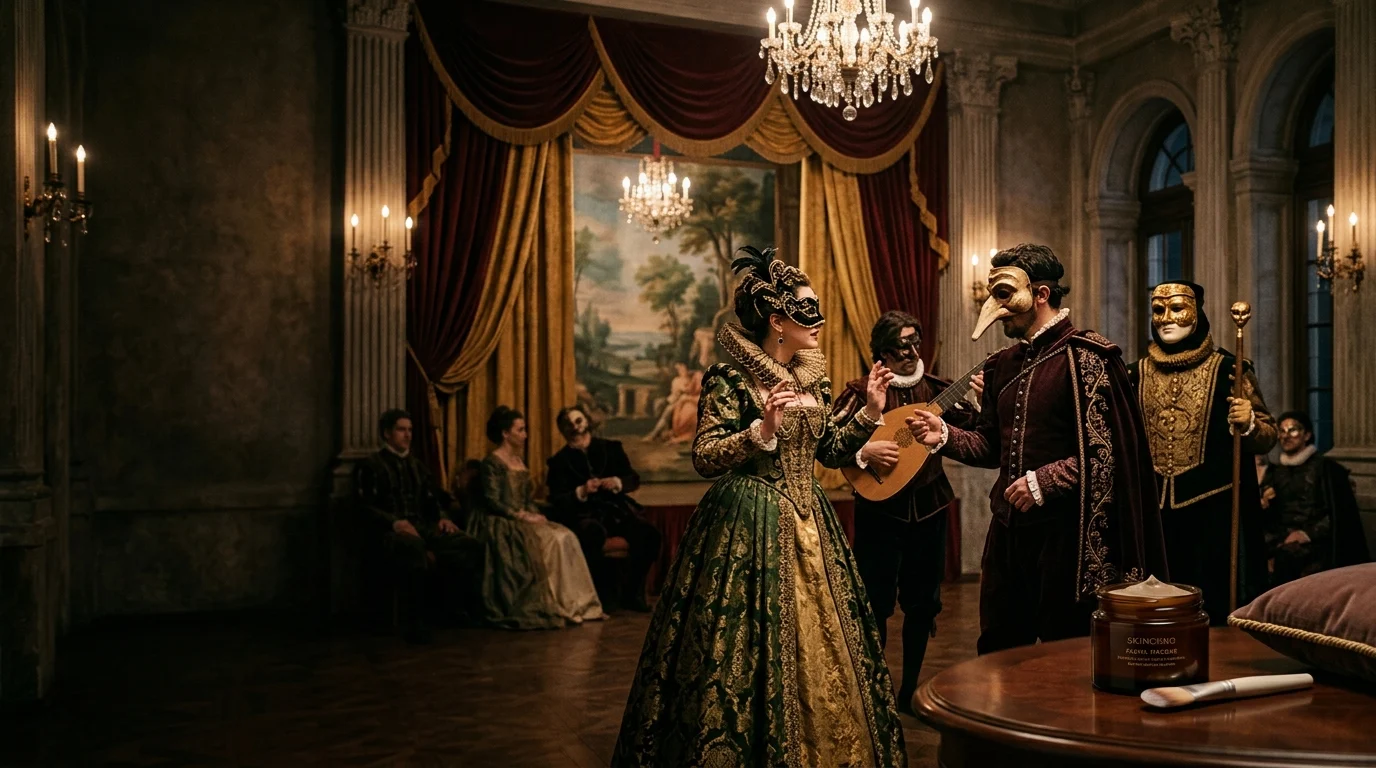
The most important meaning of masque is a form of courtly entertainment that developed in Europe and became especially prominent in England during the Renaissance and early seventeenth century.
A traditional masque could feature actors wearing masks or costumes, but the performance was much more than people simply putting on masks. It often combined spoken poetry, music, singing, dancing, elaborate scenery, costumes, and symbolic storytelling.
Masques were frequently associated with royal courts and wealthy patrons. They could celebrate weddings, political occasions, holidays, royal events, or other important gatherings.
For example:
“The king’s court presented an elaborate masque during the celebration.”
Here, masque refers to a theatrical spectacle rather than an object worn over the face.
The term is especially relevant when reading English literature or studying theater history. Writers and playwrights used the masque as a way to combine performance, symbolism, music, and visual design.
Masque vs. Mask: What Is the Difference?
Although masque and mask look and sound similar, they should not automatically be treated as the same word.
Mask is the ordinary modern English term for an object that covers part or all of the face. It can also have figurative meanings, such as hiding someone’s true feelings.
Masque, by contrast, has a more specialized meaning. Its most distinctive use refers to the historical theatrical form. It can also appear in specialized contexts where it refers to a facial covering or cosmetic treatment.
| Term | Meaning | Main Difference |
| Masque | Historical theatrical entertainment; specialized uses also exist | Usually literary, theatrical, or specialized |
| Mask | Something that covers the face or hides something | Common everyday English |
| Masquerade | A gathering or activity involving disguises or masks | Refers to an event, disguise, or act of pretending |
So if someone says, “Wear a mask,” they normally mean a face covering. If a literature textbook discusses “a masque,” it is probably referring to the theatrical tradition.
How Context Changes the Masque Meaning
Context is particularly important because masque appears in several fields.
1. Literature or theater
If the surrounding words include court, performance, dance, music, stage, or Renaissance, the word almost certainly refers to the theatrical form.
Example:
“The masque featured music, dancing, and elaborate costumes.”
The context clearly describes a performance.
2. History
A historical passage may use “masque” when discussing royal celebrations or court entertainment.
Example:
“The queen attended a masque at the palace.”
Here, the word describes an organized theatrical entertainment.
3. Cosmetics or skincare
In beauty-related writing, masque can be used as a specialized or stylistic term for a facial treatment or face mask.
Example:
“She applied a hydrating masque before bed.”
The skincare context makes the intended meaning clear.
4. Everyday conversation
In ordinary modern conversation, people usually use mask, not masque, when talking about something worn over the face.
Example:
“Don’t forget your mask before leaving.”
Using “masque” in this situation could sound unusually formal, literary, or specialized.
Is Masque a Slang Term?
No. Masque is not generally internet slang, texting slang, or a common chat abbreviation.
If you searched for the “masque slang meaning” because you saw it in a message, do not automatically assume it has a hidden social-media definition. The intended meaning is more likely to come from the ordinary dictionary meanings of the word or from the specific context where it appeared.
If someone typed “masque” in a casual text, they may have been referring to a theatrical performance, a cosmetic treatment, or simply using an unusual spelling of mask.
For example:
“I bought a new masque for my skin.”
The skincare context suggests a facial treatment.
By contrast:
“We studied a masque in English class.”
The academic context points to the theatrical meaning.
Does Masque Have a Meaning in Text Messages?
There is no widely established texting full form for masque. It is a normal word rather than an acronym, so there is no standard expansion such as a phrase represented by its letters.
If you see “masque” in a text, look at the words around it. A message about skincare, theater, literature, costumes, or masks can reveal the intended meaning quickly.
For instance:
Friend: “I’m trying this new clay masque tonight.”
Meaning: A cosmetic facial treatment.
But:
Classmate: “Did you finish reading the masque?”
Meaning: A literary or theatrical work.
The same spelling can therefore point to different established meanings.
Masque Meaning on Different Platforms
The word does not have a major platform-specific definition on social media. Its meaning generally stays connected to the context in which it appears.
Text Messages and WhatsApp
In private messages, “masque” may refer to skincare, theater, literature, or a mask-related subject. The surrounding conversation matters more than the messaging platform.
Example: “This masque made my skin feel so soft.”
Here, it refers to a skincare product or treatment.
TikTok and Instagram
On social platforms, the word may appear in beauty, fashion, theater, historical, or literary content. It does not automatically take on a separate TikTok or Instagram slang meaning.
Example: “Trying a new overnight masque.”
The beauty context identifies the meaning.
Snapchat
A Snapchat message using “masque” is likely to retain its ordinary contextual meaning. If the conversation concerns makeup or skincare, it may refer to a facial treatment.
Reddit and Discussion Forums
In literature, theater, history, or beauty communities, users may use “masque” in its specialized sense. The subject of the discussion is usually enough to identify the meaning.
Masque Examples in Real Conversations
Person A: “What was the masque we talked about in class?”
Person B: “The one with music, costumes, and courtly performances.”
Meaning: A historical theatrical entertainment.
Person A: “I’m doing a skincare masque tonight.”
Person B: “Nice. What kind did you get?”
Meaning: A facial skincare treatment.
Person A: “Why does the book call it a masque instead of a mask?”
Person B: “Because it’s describing a theatrical form.”
Meaning: The speaker is discussing the specialized literary meaning.
Is Masque Formal or Informal?
Masque generally sounds more formal or specialized than mask. In everyday American English, “mask” is overwhelmingly more natural when referring to something that covers the face.
The word “masque” can sound literary when used in ordinary conversation. That does not make it wrong; it simply signals a more specific context.
In literature, theater history, or a specialized beauty context, however, “masque” can be completely natural.
How to Reply When Someone Uses “Masque”
Your response should match the context rather than treating the word as slang.
When the Meaning Is Clear
You can respond naturally:
- “Oh, you mean the skincare treatment?”
- “Right, the theatrical performance.”
- “Got it. That makes sense.”
When You Are Unsure
If the context is unclear, ask for clarification:
- “Do you mean a face mask or the theatrical kind?”
- “Are you talking about skincare?”
- “Do you mean the masque from the literature class?”
A short clarification is better than assuming an unusual meaning.
When to Use the Word Masque
Use masque when you are discussing its established specialized meanings, especially:
- Historical theater
- Renaissance or early modern literature
- Court performances
- Literary criticism
- Certain beauty or skincare products
- Specialized descriptions involving masks
If you are writing about a historical theatrical production, “masque” may be the precise word you need.
When to Avoid the Word Masque
You generally do not need “masque” when ordinary English already uses mask.
For example, in a workplace email, saying “Please wear a mask” is clearer than “Please wear a masque.” Similarly, academic, medical, safety, and everyday instructions should use the standard term appropriate to the subject.
The issue is not that “masque” is incorrect. The issue is that readers may interpret it as an unusual spelling or become unsure about what you mean.
Common Mistakes About Masque
| Common Mistake | Correct Understanding |
| Assuming masque is always the same as mask | Its best-known specialized meaning is a theatrical form |
| Treating masque as an acronym | It is a word, not a standard abbreviation with a full form |
| Assuming it is internet slang | It is not generally recognized as texting or social-media slang |
| Using it interchangeably with mask everywhere | Context determines whether the specialized spelling is appropriate |
One especially common mistake is searching for a “masque full form.” Because the word is not an acronym, it does not have a standard full form.
Similar Terms Readers May Confuse With Masque
| Term | Meaning | Main Difference |
| Mask | Face covering or something that conceals | Standard everyday word |
| Masquerade | Disguise, masked event, or act of pretending | Often describes an event or deception |
| Masquer | A person wearing a mask or participating in a masquerade | Refers to a participant |
| Pageant | Public display or ceremonial performance | Broader and not specifically a masque |
These words share historical or conceptual connections, but they are not interchangeable in every sentence.
Origin and Use of Masque
The theatrical masque has a long history in European court entertainment and became particularly important in England during the Renaissance and early modern period. It developed as a highly visual form that brought together poetry, music, dance, costumes, scenery, and performance.
The exact history of the form is more complicated than simply saying it was “a play with masks.” Some masques emphasized spectacle and symbolic performance as much as conventional drama.
The word therefore has a strong connection with literary and theatrical history rather than modern internet culture.
Quick Recap
- Masque most famously refers to a historical theatrical entertainment involving music, dance, costumes, poetry, and spectacle.
- It is not normally a slang term or texting abbreviation.
- In skincare contexts, “masque” can refer to a facial treatment.
- The ordinary word mask is usually better for everyday face coverings.
- Context, surrounding words, and the subject of the conversation reveal which meaning is intended.
- Because “masque” is not an acronym, there is no standard “masque full form.”
Frequently Asked Questions
What does masque mean in text?
Masque usually refers to a theatrical performance or specialized facial treatment, depending on the surrounding conversation.
Is masque a slang word?
No, masque is primarily a standard specialized word rather than recognized internet slang or a texting abbreviation.
What does masque mean on TikTok?
On TikTok, masque generally retains its ordinary meaning, often referring to skincare, theater, costumes, or literature.
How should you reply to masque?
Reply according to context, or ask whether the person means a theatrical masque, skincare treatment, or something else.
Can masque have different meanings?
Yes, masque can describe historical theater and may also refer to a facial treatment in specialized beauty contexts.
Final Thoughts
The masque meaning is usually connected to a specialized form of theatrical entertainment, particularly the elaborate court performances associated with historical English theater. In beauty contexts, the word can also describe a facial treatment, while everyday face coverings are normally called masks. Since “masque” is not a common slang abbreviation, context is the best way to understand it in a message or post. Look at the surrounding words and subject before assuming what the writer means. Once you distinguish the theatrical, cosmetic, and ordinary mask-related contexts, the word becomes much easier to understand and use correctly.
Discover More Post:
25+ Funny Responses to Have a Good Day (Clever, Witty, and …
Funny Responses to Better Late Than Never
25+ Funny Responses to Do I Know You? (Clever and …