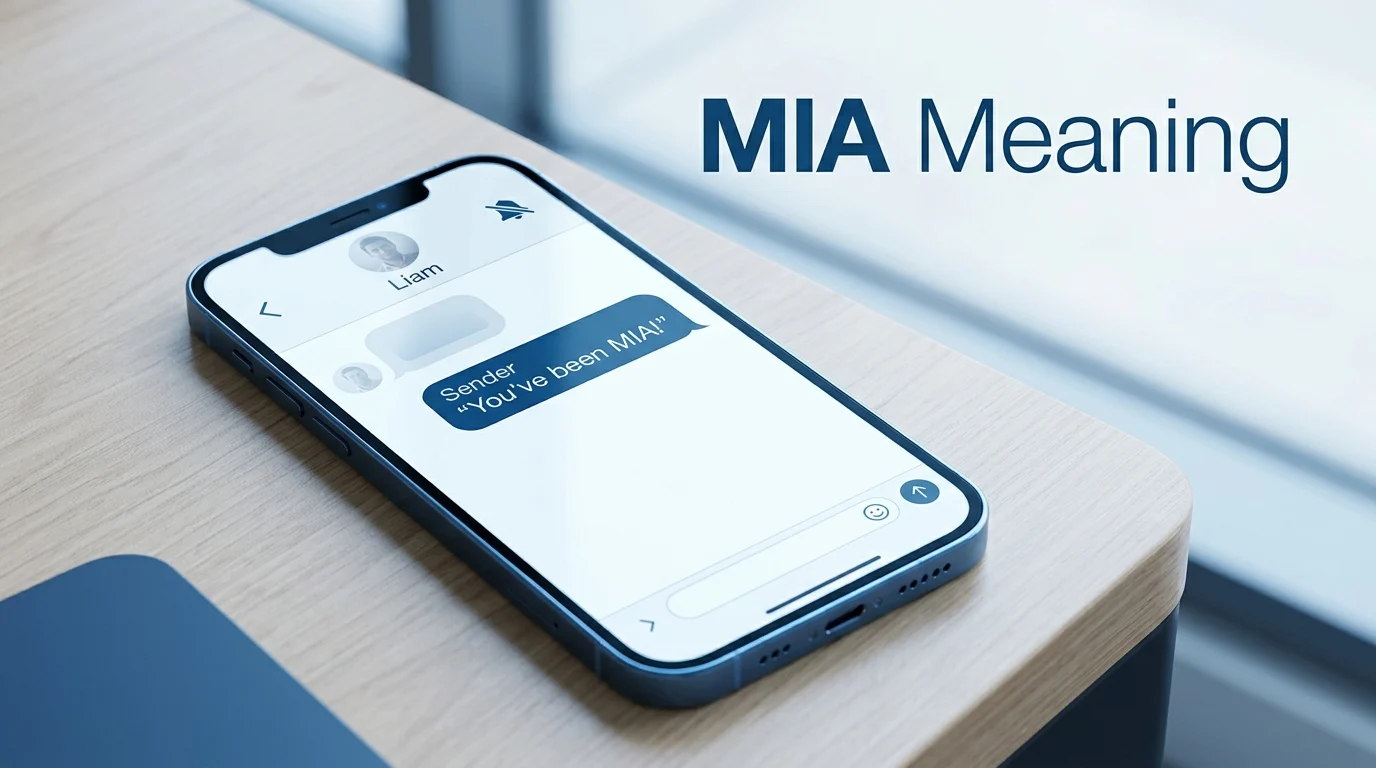

You get a message saying, “You’ve been MIA lately,” and the phrase may sound more serious than the sender intended. The MIA meaning in text is usually “missing in action,” meaning someone has been absent, unavailable, or unusually quiet. In casual conversations, it often describes a person who suddenly stops responding or disappears from a social setting. The expression can be playful, concerned, or mildly annoyed depending on the relationship and context. Understanding the surrounding message helps you tell whether the sender is joking about your silence, genuinely checking on you, or pointing out that you have not been around.
What Does MIA Mean in Text?
MIA stands for “missing in action.” In texting and social media, it is commonly used informally to describe someone who has disappeared, stopped replying, or has not been active for a while. The expression is usually casual rather than formal.
| Detail | Explanation |
|---|---|
| Most Common Meaning | Missing in action |
| Full Form | Missing in action |
| Tone | Casual, playful, concerned, or mildly annoyed |
| Common Use | Texts, chats, social media, and everyday conversation |
| Formal or Informal | Mostly informal |
For example, someone might text, “Where have you been? You’ve been MIA all week.” Here, MIA simply means the person has been unusually absent or difficult to reach.
The phrase does not necessarily mean someone has literally disappeared. In everyday slang, it can refer to anything from ignoring messages for several hours to being absent from a friend group for weeks.
MIA Slang Meaning Explained
The MIA slang meaning comes directly from the phrase “missing in action,” but casual speakers usually use it metaphorically. You might call a friend MIA because they have stopped joining group chats, posting online, attending social events, or answering texts.
It can describe a temporary absence rather than a permanent disappearance. For example, if your friend normally sends messages every day but suddenly goes quiet, another friend might say, “Sam has been MIA lately.”
The tone depends heavily on the wording. “You’re MIA 😂” is likely playful, while “Why are you MIA? Are you okay?” sounds more concerned.
What Does MIA Stand For?
The full form of MIA is “missing in action.” The phrase originated as a military expression describing personnel whose status was unknown after an operation or battle.
In modern casual communication, however, MIA is generally used much more loosely. Saying someone is “MIA” does not automatically imply danger or a serious situation.
How Context Changes the Meaning of MIA
Context is especially important when interpreting MIA in text. The same three letters can sound humorous in one conversation and genuinely concerned in another.
Here are a few examples:
- “Bro, you’ve been MIA 😂” — likely playful teasing because a friend has been quiet.
- “You’re MIA again. Everything okay?” — sounds concerned about someone’s absence.
- “She went MIA after the meeting.” — simply describes someone becoming unavailable.
- “Why are you MIA from the group chat?” — points out that someone has stopped participating.
Look at the surrounding words, emojis, punctuation, and relationship between the speakers. A laughing emoji can soften the expression, while a serious question can make it sound more like a genuine check-in.
Timing matters too. If someone has not replied for two hours, “MIA” may be playful exaggeration. If they have disappeared from conversations for several weeks, the same expression can carry more concern.
Capitalization usually does not change the meaning. MIA, mia, and occasionally M.I.A. can refer to the same phrase when used as slang.
MIA Meaning Across Texting and Social Platforms
The meaning of MIA generally stays the same across social platforms, so there is no major platform-specific slang definition you need to memorize.
Text Messages
In texting, MIA usually means someone has not responded or has become unusually quiet.
Example: “You’ve been MIA since yesterday.”
The tone could be teasing or concerned depending on the relationship.
Snapchat and Instagram
On Snapchat or Instagram, someone may be described as MIA when they stop posting, viewing stories, replying to messages, or participating in conversations.
Example: “You’ve been MIA on Insta lately.”
This normally means the person has not been active in the way they usually are.
TikTok
On TikTok, MIA can similarly describe someone who has stopped appearing, posting, commenting, or interacting.
Example: “Why have you been MIA?”
Again, the meaning is generally “missing” or “not around,” rather than a special TikTok-specific definition.
Group Chats and Discord
In group chats, MIA often refers to someone who has stopped contributing to the conversation.
Example: “Where’s Alex? He’s been MIA all day.”
The expression can be especially casual in friend groups and online communities.
Real Conversation Examples
1: Friends
Person A: “You’ve been MIA all weekend.”
Person B: “Sorry 😂 I needed some time offline.”
Meaning: Person A is pointing out that their friend has been unusually absent.
2: Group Chat
Person A: “Has anyone heard from Mia?”
Person B: “Nope, she’s been MIA since Monday.”
Meaning: The group has noticed that Mia has not been responding or participating.
3: Dating Conversation
Person A: “You went MIA after our date.”
Person B: “I know, sorry. Work got .”
Meaning: One person is saying the other suddenly became unavailable or stopped communicating.
Is MIA Rude?
MIA is not inherently rude. In casual conversation, it is often a lighthearted way to point out someone’s absence.
However, the expression can sound mildly critical when it is used to complain about someone’s lack of communication. For example, “You always go MIA when I need you” sounds more frustrated than “Hey, you’ve been MIA 😂.”
Your relationship with the sender also matters. A close friend may use MIA as harmless teasing, while the same phrase from a coworker could feel more pointed.
Is MIA Flirty?
MIA is not inherently flirty. It can appear in flirting or dating conversations, but the flirtation comes from the surrounding message rather than the abbreviation itself.
For example, “You’ve been MIA… should I assume you missed me? 😉” has a flirtatious tone because of the wording and emoji.
By contrast, “Why were you MIA yesterday?” is simply asking about someone’s absence.
How to Reply to MIA
Your response should match the sender’s tone and the reason you were unavailable.
Friendly Replies
- “Haha, I know. I’ve been busy lately.”
- “I’m back now! What did I miss?”
- “Sorry, life got hectic for a bit.”
- “Yeah, I disappeared for a minute 😂”
Funny Replies
- “MIA but alive and well.”
- “I was on a very necessary disappearing act.”
- “My social battery filed for bankruptcy.”
- “I have officially returned from the dead 😂”
Polite Replies
If someone sounds genuinely concerned, a straightforward response works better:
- “Sorry for disappearing. I’ve been dealing with a few things.”
- “I’m okay, just needed some time away from my phone.”
- “Thanks for checking in. I’m doing fine.”
You do not need to apologize simply because someone calls you MIA. If you intentionally took a break, you can explain that directly.
When to Use MIA
MIA works best in casual conversations where the other person understands informal language. It can fit naturally in texts, group chats, social media messages, gaming communities, and conversations with friends.
You can use it when someone has stopped responding, disappeared from a social group, become inactive online, or simply has not been around as expected.
The phrase is also useful when you want to make a serious observation sound lighter. Saying “You’ve been MIA lately” can feel less formal than “You have been unusually unavailable.”
When to Avoid MIA
Although MIA is common in casual communication, clearer wording is usually better in professional or sensitive situations.
Avoid relying on it in formal emails, job applications, academic writing, client communication, official announcements, or situations where the reader may not recognize the abbreviation.
For example, instead of writing “The manager has been MIA,” a professional message could say “The manager has been unavailable.”
The issue is not that slang is always inappropriate. It is that informal abbreviations can create unnecessary ambiguity when precision matters.
Common Mistakes About MIA
| Common Mistake | Correct Understanding |
|---|---|
| Assuming MIA always means something serious | In casual slang, it often simply means someone is absent or unavailable. |
| Thinking MIA is always rude | The tone can be playful, concerned, neutral, or mildly frustrated. |
| Treating MIA as a platform-specific slang term | Its basic meaning generally stays the same across texting and social platforms. |
Another common misunderstanding is assuming every use of Mia refers to the abbreviation. If someone writes “Mia is coming later,” Mia may simply be a person’s name. Context makes the difference clear.
In other contexts, MIA can also refer to Miami International Airport, whose airport code is MIA. That meaning is unrelated to the slang use and normally becomes obvious from travel-related context.
Similar Slang Terms
Several casual expressions overlap with MIA, but they are not exact substitutes.
| Term | Meaning | Main Difference |
|---|---|---|
| Ghosting | Suddenly cutting off communication | Usually suggests a more deliberate or complete disappearance. |
| AFK | Away from keyboard | More closely associated with being temporarily unavailable online. |
| Offline | Not connected or active | Describes online status rather than necessarily ignoring communication. |
| Missing | Not present or available | Broader and less slang-specific than MIA. |
The biggest distinction is between MIA and ghosting. Someone can be MIA without intentionally ignoring anyone. Ghosting usually suggests that a person has stopped communicating without explanation.
Origin of MIA
The expression “missing in action” is associated with military terminology, where it describes personnel whose status is unknown after an operation or conflict.
The abbreviation later became common in everyday language as a metaphor for someone who is absent or difficult to reach. In casual conversation, it no longer necessarily carries its original military seriousness.
When you see MIA in a text today, the intended meaning is usually straightforward: someone has been missing, absent, or unusually unavailable.
Quick Recap
- MIA most commonly means “missing in action.”
- In slang, it usually describes someone who has been absent, quiet, or unavailable.
- The expression can sound playful, concerned, neutral, or mildly annoyed.
- Its meaning generally stays consistent across texting, Snapchat, Instagram, TikTok, and group chats.
- MIA is different from ghosting because being absent does not necessarily mean someone is intentionally cutting off communication.
Frequently Asked Questions
What does MIA mean in text?
MIA means “missing in action” and usually describes someone who has been absent, unavailable, or unusually quiet.
Is MIA rude?
MIA is usually casual rather than rude, although repeated use can sound critical when someone is frustrated.
What does MIA mean on TikTok?
On TikTok, MIA generally means someone has been absent, inactive, or less visible than usual.
How should you reply to MIA?
Reply casually if the message is playful, or explain your absence directly when the sender sounds genuinely concerned.
Can MIA have different meanings?
Yes, MIA can mean “missing in action” in slang or Miami International Airport when used in travel-related contexts.
Final Thoughts
The main MIA meaning in text and slang is “missing in action,” and it usually describes someone who has been absent, unavailable, or unusually quiet. In everyday conversations, the expression is generally informal and can be playful, concerned, or mildly frustrated depending on the situation. Context is the key to understanding its tone: an emoji from a friend may make it teasing, while a serious question may signal genuine concern. If you use MIA casually with people who understand the abbreviation, it can be a simple way to point out someone’s absence without sounding overly formal.
Discover More Post:
25+ Funny Birthday Thank You Responses (Funny Ways to …
25+ Funny Responses to Have a Good Day (Clever, Witty, and …
Funny Responses to Tell Me About Yourself | Make Everyone …