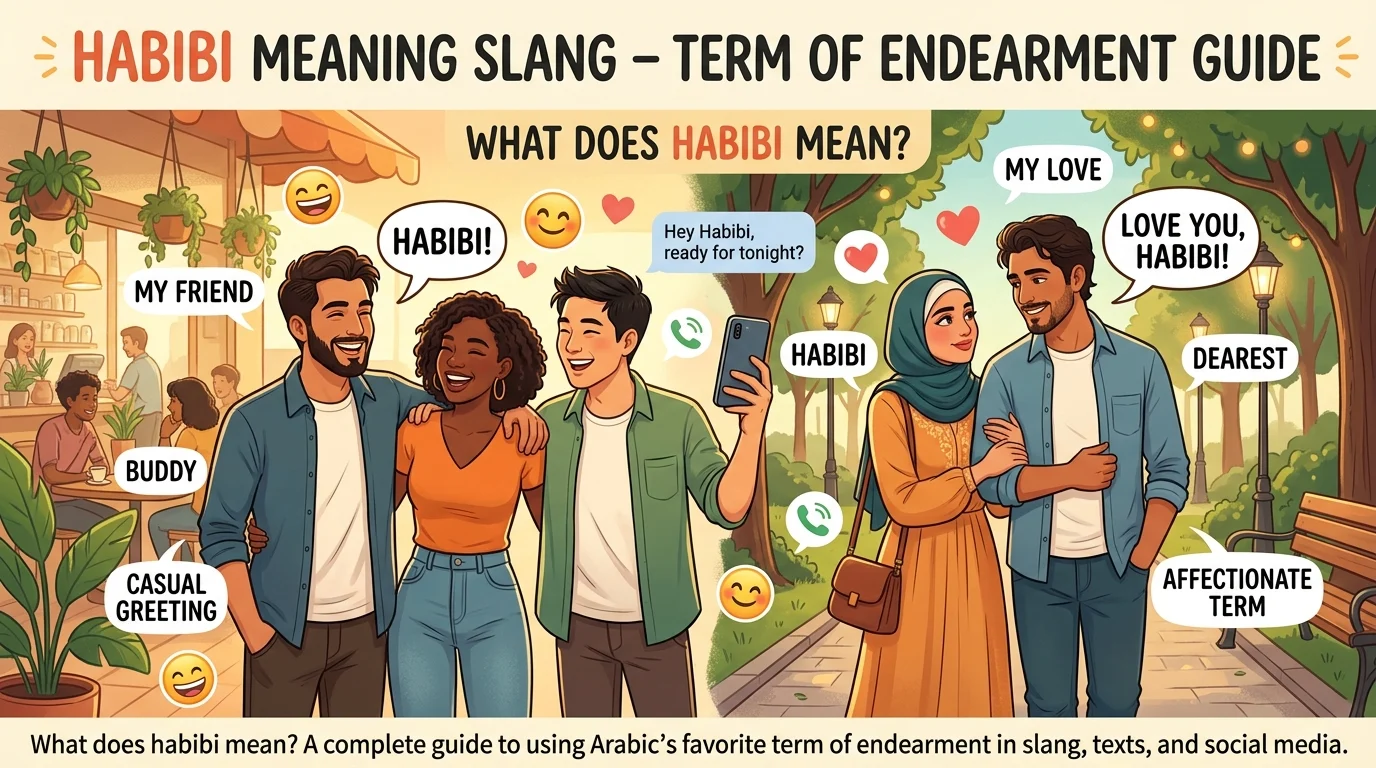

Habibi (pronounced ha-BEE-bee) is an Arabic slang term that translates to “my love,” “my dear,” or “my beloved.” It is used as a term of endearment for friends, family members, romantic partners, and even casual acquaintances. The feminine form is habibti. In internet slang and everyday conversation, habibi can mean “buddy,” “bro,” “dude,” or “bae” depending on the context and tone.
You have probably heard someone say “habibi” in a song, seen it in a TikTok caption, or received a text that ended with the word. Even if you do not speak a word of Arabic, this term has a way of showing up everywhere. From rap lyrics to Instagram DMs, from casual group chats to reality TV shows like Love Is Blind Habibi, the word has crossed borders and become part of global internet culture.
But what does habibi actually mean? Is it only for couples? Can you use it with your friends? And more importantly, can you use it without sounding cringey or disrespectful?
This guide breaks down everything you need to know about the habibi meaning in slang. You will learn its origin, how to use it in different contexts, what it means on various platforms, and when to avoid it altogether. By the end, you will be able to drop a habibi like a pro.
Quick Answer
| Aspect | Details |
|---|---|
| Meaning | “My love,” “my dear,” “my beloved” |
| Context | Romantic, platonic, casual, playful |
| Usage | Friends, family, partners, sometimes strangers |
| Platforms | WhatsApp, Snapchat, TikTok, Instagram, texts |
| Example | “What do you want to eat, habibi?” |
| Tone | Warm, affectionate, playful, teasing |
What Does Habibi Mean in Slang?
At its core, habibi is an Arabic word that literally means “my love.” It comes from the root word hubb, which means love, with the suffix *-i* making it possessive. The masculine form is habibi (حبيبي), and the feminine form is habibti (حبيبتي).
In slang usage, however, habibi has stretched far beyond its literal translation. Depending on who is saying it and how they say it, habibi can mean:
- My love – when used with a romantic partner
- My dear – when used with family members
- Buddy or pal – when used among close friends
- Bro or dude – when used casually in text or speech
- Honey or sweetie – when used by a parent to a child
- An icebreaker – when used with a new love interest
The beauty of habibi is that it is a tone-shifter. The word itself does not change, but the way it lands depends entirely on the delivery, the relationship, and the situation. “Relax” sounds blunt. “Relax, habibi” sounds warmer and more affectionate. That versatility is exactly why habibi has become so popular in English-speaking internet culture.
Full Definition and Origin
Linguistic Roots
Habibi comes from the Arabic triliteral root *H-B-B*, which forms words related to love and affection. The word habib means “beloved” or “loved one.” When you add the possessive *-i* at the end, it becomes “my beloved”.
The term has been used for centuries in Arabic poetry and literature, where lovers would profess their devotion through elaborate verses. Over time, it moved from the pages of poetry into everyday speech, becoming one of the most common terms of endearment across the Arab world.
From Arabic to Global Slang
Habibi did not stay in the Middle East. Through migration, music, social media, and pop culture, it spread to Europe, North America, and beyond. Cities with strong Arab diaspora communities, like London, Paris, and Berlin, have integrated habibi into everyday speech.
In the United States, habibi gained traction through hip-hop and rap. Artists like Russ and Oxxxymiron have used the term in their lyrics, embedding it further into mainstream culture. More recently, Netflix’s Love Is Blind Habibi brought the word to a global audience, cementing its place in pop culture.
Today, habibi is as much an internet slang term as it is an Arabic word. It appears in TikTok captions, Instagram comments, WhatsApp messages, and even professional settings in some regions.
Context and Usage: How Habibi Works in Real Life
The Tone-Shifter Effect
Habibi is not just a word. It is a mood adjuster. It changes how a sentence feels without changing what it says. Consider these examples:
- “What are you doing?” – neutral, could be curious or annoyed
- “What are you doing, habibi?” – playful, teasing, or gently caring
- “Come on.” – impatient
- “Come on, habibi.” – encouraging or lightly mocking, depending on delivery
This is why habibi works so well in short-form content and text messages. It adds warmth and personality to otherwise flat statements.
Who Can You Call Habibi?
The short answer is: almost anyone, as long as the relationship allows it.
| Relationship | Appropriateness |
|---|---|
| Romantic partner | Very appropriate – means “my love” |
| Close friend | Very appropriate – means “buddy” or “bro” |
| Family member | Very appropriate – means “dear” or “sweetie” |
| Colleague (in Arab cultures) | Appropriate in casual settings |
| Stranger | Risky – can come off as too forward or condescending |
| Someone you just met | Generally not recommended |
Habibi assumes comfort. You would not say it to a stranger the same way you would say it to a close friend. In Arab societies, there are rules of engagement. You cannot drop a habibi in the first sitting. The same principle applies in English-speaking contexts.
Habibi vs. Habibti
One of the most common mistakes is using habibi for everyone. While many Arabic speakers use habibi interchangeably, the grammatically correct forms are:
In casual slang, however, habibi is often used regardless of gender. This is especially true in non-Arabic-speaking countries where people have picked up the term without the grammatical nuance. If you want to be accurate, use habibi for men and habibti for women. If you want to be casual, habibi works for both in many contexts.
Real-Life Conversation Examples
1: Between Friends (Platonic)
Person A: “Habibi, where have you been? I have not seen you in weeks.”
Person B: “Work has been habibi. But I am free this weekend. Let us hang out.”
Person A: “Say less. Saturday night. My place. We are ordering pizza.”
Person B: “You are the best, habibi. See you then.”
2: Romantic Context
Person A: “I miss you so much, habibi.”
Person B: “I miss you too. When can I see you again?”
Person A: “Tonight. I am counting the minutes.”
Person B: “My habibi. I will be there at 8.”
3: Playful Teasing
A: “Bro, you really wore that shirt to the party?”
B: “What is wrong with my shirt?”
A: “Nothing, habibi. You look great. Very 2005 vibes.”
B: “I am choosing to take that as a compliment.”
4: Casual Greeting
Person A: “Hey habibi, what is good?”
Person B: “Not much, just chilling. You?”
Person A: “Same. Just got off work. Finally.”
Person B: “Relax, habibi. You earned it.”
5: Parent to Child
Parent: “Habibi, did you finish your homework?”
Child: “Almost, Dad.”
Parent: “Almost is not done. Finish up, then you can play.”
Child: “Okay, habibi. I mean, okay, Dad.”
Parent: “Nice try.”
Platform-Specific Meaning
Habibi on WhatsApp
On WhatsApp, habibi is used in casual one-on-one chats and group conversations. It often appears as a term of endearment between friends or as a playful jab. Because WhatsApp is a private messaging platform, the tone tends to be more intimate. You are more likely to see habibi used between people who actually know each other.
Example: “Habibi, are we still on for dinner tonight?”
Habibi on Snapchat
Snapchat is all about quick, visual communication. Habibi shows up in captions on snaps, often accompanied by a photo or video. It is used to address friends in a lighthearted way. Streaks and casual conversations are prime territory for habibi.
Example: A snap of a friend making a funny face with the caption: “Looking good, habibi.”
Habibi on TikTok
TikTok is where habibi has truly exploded. The platform’s short-form, trend-driven nature makes it perfect for slang. Habibi appears in:
- Duets and stitches between friends
- Commentary videos
- Football and sports content (“Come on, habibi!”)
- Couple content and relationship humor
Hashtags like #habibi and #habibiTikTok have millions of views. The word is often used ironically or playfully, especially in videos that mock or celebrate Arab culture.
Example: A video of someone struggling to open a jar with the caption: “Habibi, please help.”
Habibi on Instagram
On Instagram, habibi appears in captions, DMs, and comments. It is common in:
- Couple posts and anniversary captions
- Friend group photos
- Travel content from the Middle East
- Meme pages
Example caption: “Date night with my habibi.”
Habibi in Texting
In SMS and iMessage, habibi is used similarly to “babe,” “bro,” or “dude.” It adds a layer of affection or playfulness to otherwise mundane messages. It is also common in late-night texts, inside jokes, and quick check-ins.
Example: “Habibi, you forgot your jacket at my place.”
Alternative Meanings and Variations
Spelling Variations
Because habibi has been adopted by non-Arabic speakers, several spelling variations exist:
- Habibi – standard
- Habiby – common anglicization
- Habeeby – phonetic spelling
- Habibie – another variation
- 7bb – online chat shorthand where “7” represents the Arabic letter ha
Related Arabic Slang Terms
Habibi is often used alongside other Arabic slang terms that have crossed into global internet culture:
- Yalla – means “let’s go,” “hurry up,” or “come on”
- Wallah – means “I swear” or “I promise”
- Inshallah – means “God willing”
These terms frequently appear together in casual speech and social media content.
Habibi in Business and Branding
Habibi is not just a slang term. It is also used as a name for businesses, restaurants, bands, and dance troupes. You will find cafes called “Habibi,” clothing brands with “Habibi” in the name, and even lifestyle businesses using the term to convey warmth and hospitality.
How to Respond When Someone Calls You Habibi
Your response depends on who is saying it and in what context.
| Who Said It | Best Response |
|---|---|
| Romantic partner | “Habibi” back, or “I love you too” |
| Close friend | “Habibi” back, or “What’s up?” |
| Family member | “Yes, habibi?” or a warm acknowledgment |
| Acquaintance | A smile and “Hey” – no need to overthink |
| Stranger | Use your judgment – a polite nod or neutral response |
If you are unsure, mirror the other person’s tone. they said it playfully, respond playfully. If they said it warmly, respond warmly. The beauty of habibi is that it invites reciprocity. You can almost always say it back.
Misinterpretations and When NOT to Use Habibi
Common Misinterpretations
Myth 1: Habibi is only for romantic partners.
Reality: Habibi is used for friends, family, and even colleagues in many contexts.
Myth 2: Habibi means the same thing as “baby.”
Reality: While it can mean “baby” in a romantic context, it can also mean “buddy” or “dude”.
Myth 3: You can use habibi with anyone.
Reality: Habibi assumes familiarity. Using it with a stranger or someone senior can be inappropriate.
Myth 4: Habibi is a greeting.
Reality: Habibi is not an opener. It is a modifier. “Hello habibi” sounds off because habibi lives inside the sentence, not at the front of it.
When NOT to Use Habibi
- With strangers – unless you are in a culture where it is normalized
- In formal settings – job interviews, official emails, courtrooms
- With someone who does not know you well – it can come off as presumptuous
- When you are unsure of the other person’s comfort level – better safe than sorry
- In professional environments outside the Arab world – unless you have that kind of rapport
In some cultures, using habibi with someone you just met can be seen as condescending or overly familiar. When in doubt, do not use it.
Usage Tips: How to Use Habibi Like a Native
Do’s
- Use it with people you know – friends, family, partners
- Match the tone – if they are playful, be playful
- Use it inside sentences – not as a standalone greeting
- Know your audience – some people love it, others find it cringey
- Pronounce it correctly – ha-BEE-bee (stress on the second syllable)
Don’ts
- Do not overuse it – it loses its impact
- Do not use it formally – save it for casual contexts
- Do not force it – if it does not feel natural, skip it
- Do not assume everyone knows it – explain if needed
- Do not use it sarcastically with someone who might not get the joke
For Non-Arabic Speakers
If you are not Arabic and you want to use habibi, here is the golden rule: use it sparingly and authentically. Do not force it into every sentence. Use it when it feels natural, and always be respectful of the culture it comes from.
People generally appreciate when others make an effort to use their language. But there is a fine line between appreciation and appropriation. Use habibi with genuine warmth, not as a trend.
FAQs
1. What does habibi mean in slang?
Habibi in slang means “my love,” “my dear,” “buddy,” or “bro,” depending on the context. It is a versatile term of endearment used among friends, family, and romantic partners.
2. Is habibi only for men?
The word habibi is grammatically masculine and is used for males. The feminine form is habibti. However, in casual slang, habibi is often used regardless of gender.
3. Can I call my girlfriend habibi?
If you are male and your girlfriend is female, the correct term is habibti. But many couples use habibi interchangeably in casual conversation.
4. What does habibi mean in texting?
In texting, habibi means the same as in speech: “my love,” “dear,” or “bro.” It is used to add warmth or playfulness to a message.
5. Is habibi a romantic word?
It can be romantic, but it is not exclusively romantic. It is used for friends, family, and even casual acquaintances in some contexts.
6. What is the difference between habibi and habibti?
Habibi is for males. Habibti is for females.
7. Can I use habibi with my friends?
Yes, absolutely. Habibi is very commonly used among close friends as a term of endearment.
8. What does “ya habibi” mean?
“Ya habibi” means “oh my love” or “hey my dear.” The “ya” is a vocative particle used to call someone.
9. Is it offensive to say habibi?
No, it is not offensive. But using it with strangers or in formal settings can be inappropriate. It is a term of affection, not a universal greeting.
10. Why do people say habibi on TikTok?
People say habibi on TikTok because it is a trendy, versatile slang term that adds warmth and personality to videos. It is especially popular in sports, couple, and comedy content.
11. What does “habibi come on” mean?
“Habibi come on” means “my dear, let’s go” or “come on, buddy.” It is often used to encourage or lightly tease someone.
12. Can a girl say habibi to a guy?
Yes, a girl can say habibi to a guy. It is common in Arabic-speaking cultures for women to use habibi with male friends, family, and partners.
13. What does habibi mean in rap?
In rap, habibi often means “my love” or “my dear,” and is used to address a romantic interest or to add a multicultural flavor to lyrics.
14. Is habibi used in the UK?
Yes, habibi is used in the UK, especially in cities with large Arab diaspora communities like London.
15. What is the plural of habibi?
There is no direct plural. You would say “habibi” to each person individually, or use a collective term like “habayeb” (loved ones) in Arabic.
Conclusion
Habibi is more than just a word. It is a bridge between cultures, a tone-shifter, and one of the most versatile terms of endearment in the world. Whether you use it with your partner, your best friend, or your family, habibi carries warmth, affection, and a sense of closeness that few other words can match.
From its roots in Arabic poetry to its current status as global internet slang, habibi has proven that love truly does transcend language. It has been adopted by rappers, TikTokers, reality TV stars, and everyday people who just want to add a little more warmth to their conversations.
If you are new to the word, start small. Use it with people you know. Pay attention to how they respond. And remember: the goal is not to sound like you are trying too hard. The goal is to connect. And habibi, when used right, is one of the best ways to do that.
So go ahead. Drop a habibi in your next text. Call your friend habibi. See how it lands. Chances are, they will say it back.
And if they do not, no worries. Not everyone is ready for that level of warmth. But for those who are, habibi is a gift. Use it wisely.