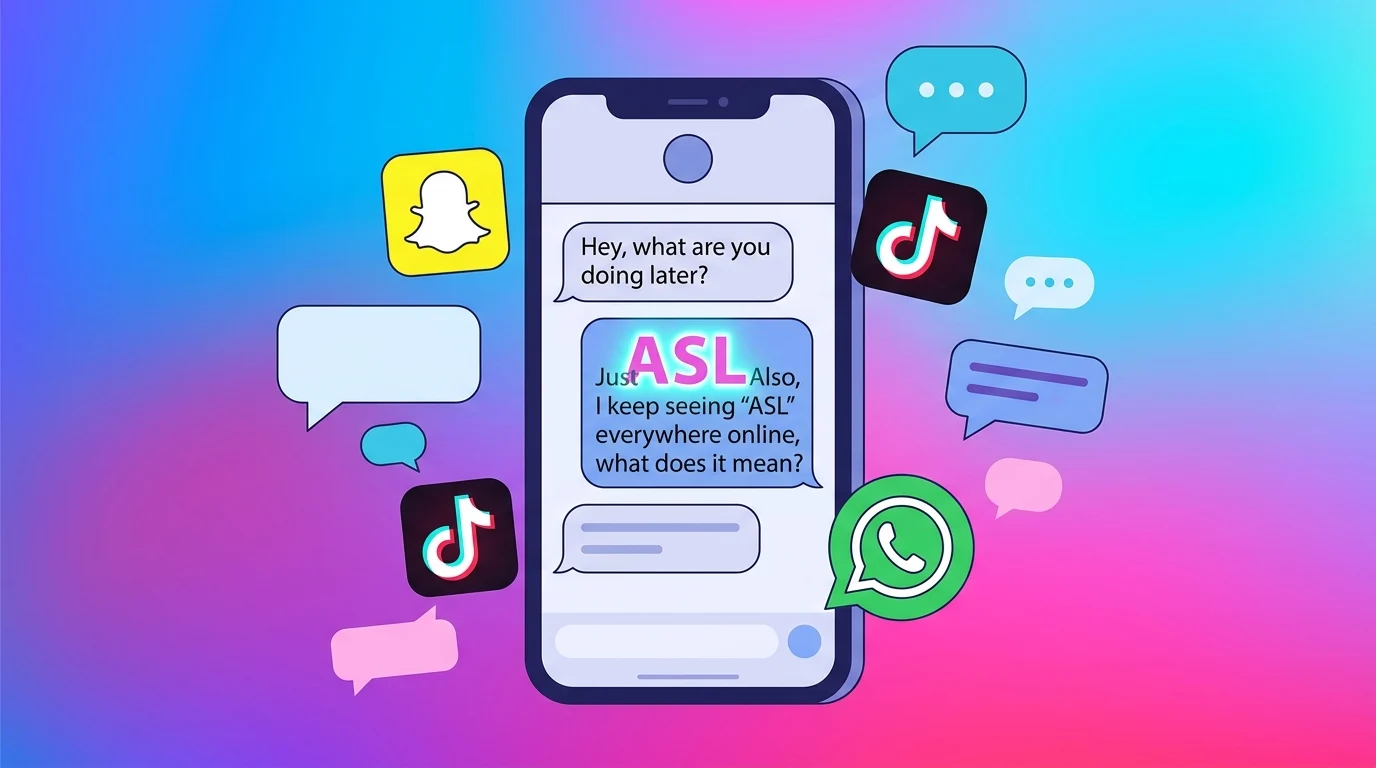

ASL has three main meanings depending on the context. In texting and social media, ASL most commonly stands for “age, sex, location” — a question used to ask someone’s basic personal information. However, among Gen Z users on platforms like TikTok, “asl” (lowercase) is used as a contraction for “as hell” to add emphasis (e.g., “tired asl” means very tired). ASL also officially stands for American Sign Language in educational and accessibility contexts.
You’re scrolling through your feed, and you see it: “ASL?” in your DMs. Or maybe a friend comments “that’s cool asl” on your post. Suddenly, you’re not sure what they’re actually saying.
You’re not alone. The three-letter abbreviation “ASL” has gone through a wild evolution. What started as a straightforward question in early internet chat rooms has now split into multiple meanings that depend entirely on who’s talking, where they’re talking, and how they type it.
This guide breaks down everything you need to know about ASL meaning. Whether you’re trying to figure out what someone just asked you, or you want to make sure you’re using it correctly yourself, we’ve got you covered. By the end, you’ll know exactly what ASL means in any context — and you’ll never be confused by it again.
Quick Answer
| Element | Details |
|---|---|
| Meaning | Age, Sex, Location (question) OR As Hell (emphasis) OR American Sign Language |
| Context | Texting, social media, chat rooms, education |
| Usage | Asking for basic info OR exaggerating a feeling OR referring to sign language |
| Platforms | Snapchat, TikTok, WhatsApp, Instagram, dating apps, chat rooms |
| Example | “ASL?” = “What’s your age, sex, and location?” / “I’m tired asl” = “I’m very tired” |
| Tone | Casual, direct, informal, playful |
What Does ASL Mean?
The short answer: ASL can mean three different things.
The meaning depends entirely on the context — who is using it, what platform they’re on, and how they type it. Here’s a quick breakdown of all three meanings:
| Meaning | Context | Example |
|---|---|---|
| Age, Sex, Location | Texting, chat rooms, dating apps, Snapchat | “ASL?” → “19, female, California” |
| As Hell | Gen Z slang, TikTok, Instagram, casual DMs | “That’s funny asl” → “That’s very funny” |
| American Sign Language | Education, accessibility, deaf culture | “She teaches ASL at the university” |
Let’s explore each of these in detail.
Full Definition
ASL as “Age, Sex, Location”
The original and most widely recognized meaning of ASL in digital communication is “age, sex, location.” It’s a question used to quickly learn basic personal information about someone you’re chatting with online.
This usage originated in the early days of the internet, particularly in IRC (Internet Relay Chat) chat rooms in the 1980s and later on instant messaging services like AOL Instant Messenger and MSN Messenger in the 1990s. It became the standard icebreaker for anonymous online interactions — a way to figure out who you were talking to without wasting time on small talk.
When someone types “ASL?” in a chat, they’re asking:
- A = How old are you?
- S = What is your sex/gender?
- L = Where are you located (city, state, or country)?
It’s a direct, no-nonsense question that was especially popular in the early 2000s chat room culture.
ASL as “As Hell” (Gen Z Slang)
In recent years, a new meaning of “asl” has taken over — particularly among Gen Z users on TikTok and other social media platforms. In this context, “asl” (usually lowercase) is a contraction for “as hell”.
This version is used as an intensifier — it adds emphasis to whatever you’re saying, similar to using “very,” “really,” or “so much.”
Examples:
- “I’m tired asl” = “I’m very tired”
- “She’s pretty asl” = “She’s really pretty”
- “This food is good asl” = “This food is extremely good”
This shift in meaning started around 2018 and became widespread on TikTok in the early 2020s. The change has caused some confusion and even frustration among older internet users who grew up with the original “age, sex, location” meaning.
ASL as “American Sign Language”
ASL is also the official acronym for American Sign Language — the primary sign language used by deaf communities in the United States and parts of Canada.
This is a completely unrelated meaning that appears in educational, professional, and accessibility contexts. Unlike the slang versions, this meaning is always written in all caps and is never used as a question or an intensifier.
Context and Usage
When to Use Each Meaning
Understanding which meaning of ASL is being used comes down to context clues. Here’s how to tell them apart:
| Clue | Likely Meaning |
|---|---|
| Written as a question (“ASL?”) | Age, Sex, Location |
| Followed by an adjective (“tired asl”) | As Hell |
| Referencing deaf culture or education | American Sign Language |
| Used in a chat room or dating app | Age, Sex, Location |
| Used on TikTok or in Gen Z slang | As Hell |
| Written in all caps | American Sign Language or Age, Sex, Location |
| Written in lowercase | As Hell (usually) |
The Generational Divide
One of the most interesting aspects of ASL’s evolution is the generational divide it has created.
- Millennials and older internet users grew up with ASL meaning “age, sex, location.” For them, seeing “asl” used as “as hell” feels confusing and even wrong.
- Gen Z users have adopted “asl” as “as hell” and often use it without even knowing the original meaning.
This has led to plenty of humorous misunderstandings and memes online, with older users complaining about the “new” meaning and younger users finding the confusion amusing.
Real-Life Examples
1: ASL as Age, Sex, Location
User1: Hey
User2: Hi
User1: ASL?
User2: 22, female, Texas. You?
User1: 24, male, Florida. Cool, what’s up?
2: ASL as “As Hell” (Texting)
Friend1: I’m bored asl rn
Friend2: Same, this class is dragging
Friend1: Fr, I’m tired asl too
3: ASL as “As Hell” (TikTok Comment)
User1: This video is funny asl 😂
User2: Bro got roasted asl in the comments
User3: I’m crying asl
4: ASL on Snapchat
Snap DM: ASL?
Response: 19, M, NY
Snap DM: Cool, what school you go to?
5: Mixed Generational Context
Mom: What does “asl” mean? I keep seeing it.
Teen: It means “as hell,” like “that’s cool asl.”
Mom: I thought it meant age, sex, location?
Teen: That’s old school. Nobody uses it like that anymore.
Mom: Oh. Well, I’m confused asl now.
Platform-Specific Meaning
On WhatsApp, ASL almost always means “age, sex, location.” It’s used primarily in casual one-on-one chats or group conversations with new contacts. People use it to quickly learn basic information about someone they’ve just connected with.
Snapchat
Snapchat users commonly use ASL to mean “age, sex, location” — especially when someone sends a direct message asking for basic personal details. However, you’ll also see “asl” used as “as hell” in Snapchat stories and casual DMs among younger users.
TikTok
TikTok is where the “as hell” meaning of “asl” truly exploded. On this platform, “asl” is almost always used as an intensifier in comments, captions, and video descriptions. You’ll see phrases like:
- “She ate that asl”
- “This is wild asl”
- “I’m obsessed asl”
Instagram sees both meanings depending on the context. In DMs, “ASL?” is still used to ask for personal information. In comments and captions, “asl” is more commonly used as “as hell” to add emphasis.
Dating Apps
On dating apps like Tinder, Bumble, and Hinge, ASL is rarely used directly because most profiles already display age and location. However, it may still appear in initial messages as a conversation starter.
Gaming Chats and Omegle
In gaming chats and anonymous platforms like Omegle, ASL remains a common icebreaker. It’s used to quickly establish basic information about the person you’re interacting with.
Alternative Meanings
Beyond the three main meanings, ASL can stand for a variety of other things in different contexts:
| Acronym | Meaning |
|---|---|
| ASL | Above Sea Level |
| ASL | Apache Software License |
| ASL | ACPI Source Language |
| ASL | Action Specification Language |
| ASL | Application Services Library |
However, these are highly specialized and unlikely to appear in everyday conversation. For 99% of online interactions, ASL means either age/sex/location, as hell, or American Sign Language.
Related Terms and NLP Variations
Understanding ASL also means understanding the ecosystem of slang and abbreviations that surround it. Here are some related terms you might encounter:
- AF — “As F***,” another intensifier with a similar function to “asl” (e.g., “tired af”)
- WYD — “What You Doing,” often used alongside ASL in chat rooms
- HMU — “Hit Me Up,” used to invite further conversation
- FR — “For Real,” used to emphasize sincerity
- No Cap — “No Lie,” used to assert truthfulness
- Lowkey — Used to express something subtly or moderately
These terms often appear together in casual online conversations and share the same informal, fast-paced communication style.
How to Respond to ASL
If Someone Asks “ASL?” (Age, Sex, Location)
When someone asks “ASL?” they’re requesting your basic personal information. How you respond depends on your comfort level and the context.
1: Share basic info
“25, male, California.”
“19, female, New York. You?”
2: Share general info only
“I’m in my 20s, from the US.”
“Adult, female, East Coast.”
3: Decline politely
“Not comfortable sharing that.”
“I’d rather keep that private.”
4: Ask why they want to know
“Why do you ask?”
“What do you want to know for?”
Safety tip: Never share your exact address or specific location details with strangers online. Sharing your city or state is generally safe, but be cautious about providing more specific information.
If Someone Uses “asl” as “As Hell”
If someone says you’re “funny asl” or “tired asl,” they’re just using it as an intensifier. No response is required — you can simply acknowledge it or continue the conversation naturally.
Misinterpretations
Because ASL has multiple meanings, misunderstandings are common. Here are some frequent points of confusion:
1. Thinking “asl” Always Means Age/Sex/Location
Many older internet users automatically read “asl” as “age, sex, location” even when it’s being used as “as hell.” This can lead to confusing conversations where one person thinks they’re being asked personal questions while the other is just emphasizing a point.
Example of confusion:
Friend: I’m tired asl
You: Why do you need to know my location?
Friend: What? No, I mean I’m really tired.
2. Thinking “ASL” Always Means American Sign Language
If someone sees “ASL” in a text message and assumes it refers to sign language, they might misunderstand the entire conversation. However, this is less common because the context usually makes it clear.
3. Capitalization Confusion
As a general rule:
- ASL (all caps) = Age, Sex, Location or American Sign Language
- asl (lowercase) = As Hell
While this isn’t a hard-and-fast rule, it’s a useful guideline.
When NOT to Use ASL
While ASL is versatile, there are situations where you should avoid using it:
Professional Settings
Don’t use ASL in work emails, professional messages, or formal communications. It’s casual slang and doesn’t belong in professional contexts.
With People Who Don’t Know Slang
If you’re talking to someone who isn’t familiar with internet slang (like older relatives or people from different cultural backgrounds), using “asl” might confuse them.
When Clarity Matters
If there’s any chance of misunderstanding, spell out what you mean. For example, instead of saying “I’m tired asl,” say “I’m really tired” to avoid confusion.
With Strangers (Age/Sex/Location)
Asking “ASL?” to strangers can come across as intrusive or even creepy. Many people find it invasive, and it’s associated with superficial or predatory interactions. Use it sparingly and only in appropriate contexts.
Usage Tips
Here are some practical tips for using ASL correctly:
Tip 1: Know Your Audience
Consider who you’re talking to. If they’re Gen Z or active on TikTok, they’ll understand “asl” as “as hell.” If they’re older or less familiar with internet slang, they might think you’re asking for their age and location.
Tip 2: Use Lowercase for “As Hell”
To signal that you mean “as hell,” use lowercase: “asl.” This helps distinguish it from the question form.
Tip 3: Use All Caps for the Question
When asking “age, sex, location,” using all caps (“ASL?”) makes it clear what you mean.
Tip 4: Don’t Overuse It
Like any slang, overusing “asl” can make you sound repetitive or try-hard. Use it naturally and sparingly.
Tip 5: Be Safe
If someone asks you “ASL?” online, especially on anonymous platforms, be cautious about what information you share.
FAQs
1. What does ASL mean in text?
In texting, ASL can mean “age, sex, location” (as a question) or “as hell” (as an intensifier). The meaning depends on the context.
2. What does ASL mean on Snapchat?
On Snapchat, ASL usually means “age, sex, location.” It’s a way for users to ask basic personal information in DMs.
3. What does ASL mean on TikTok?
On TikTok, “asl” (lowercase) is used as a contraction for “as hell” to add emphasis.
4. What does ASL mean in slang?
In modern slang, “asl” means “as hell.” It’s used to intensify adjectives, like “tired asl” meaning “very tired”.
5. Does ASL mean American Sign Language?
Yes, ASL is the official acronym for American Sign Language. This is a completely different meaning from the slang usage.
6. Is ASL still used as “age, sex, location”?
Yes, though it’s less common than it used to be. It still appears on dating apps, gaming chats, and anonymous platforms.
7. How do you respond to “ASL?”
You can share your age, gender, and general location, or you can politely decline if you’re not comfortable.
8. Why do Gen Z use “asl” differently?
Gen Z adopted “asl” as a contraction for “as hell” starting around 2018, and it became widespread on TikTok in the early 2020s.
9. Is “asl” the same as “AF”?
Both are intensifiers, but they’re used slightly differently. “AF” stands for “as f***” and is more intense and explicit than “asl.”
10. Is it safe to share your ASL online?
Sharing your general age, gender, and city is usually safe, but never share your exact address or specific location details with strangers.
Conclusion
ASL is a small abbreviation with a surprisingly big story. What started as a practical question in early internet chat rooms has evolved into a multi-meaning term that spans generations, platforms, and contexts.
Here’s what to remember:
- ASL? = Age, Sex, Location — a question used to learn basic information about someone.
- asl = As Hell — an intensifier used to emphasize feelings or descriptions.
- ASL = American Sign Language — the official sign language of the US.
The key to understanding ASL is context. Who is talking? What platform are they on? How are they typing it? Once you know what to look for, you’ll never be confused by “ASL” again.
Whether you’re using it to ask someone’s age on Snapchat, emphasizing how tired you are on TikTok, or learning sign language, you now know exactly what ASL means and how to use it.