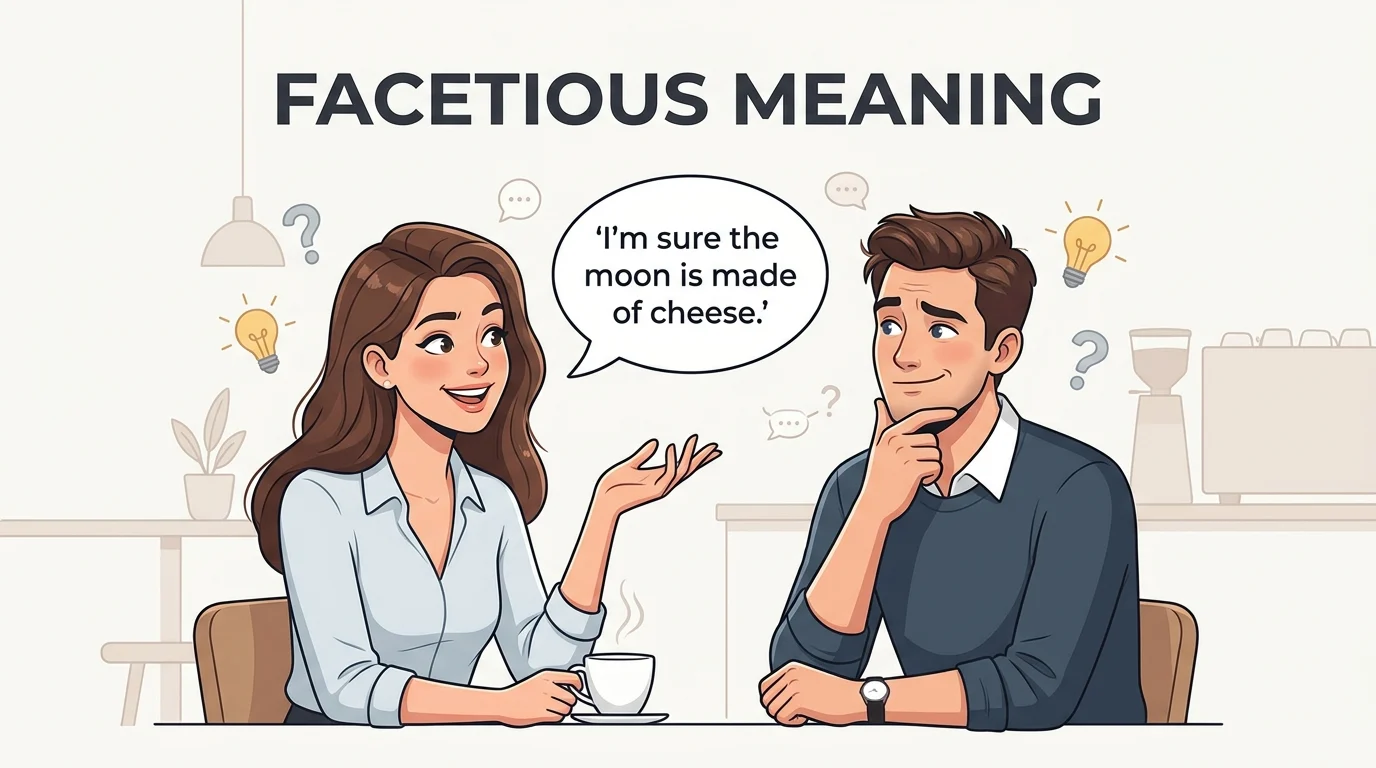

Imagine someone says, “Sure, I’d love to spend my entire Saturday cleaning the garage,” when they clearly mean the opposite. If you recognize that the person is joking rather than speaking seriously, you are picking up on a facetious remark. The facetious meaning describes language that is intentionally playful, joking, or unserious, often when the speaker is pretending to be serious. Context matters because a facetious comment can sound sincere when you read it without hearing the speaker’s voice. Below, you’ll see how facetious language works in text, how it differs from sarcasm, and how to respond naturally.
What Does Facetious Mean?
Facetious means treating a serious subject in a deliberately humorous or unserious way. A facetious remark is usually intended as a joke, even when the words sound serious on the surface. It is not an abbreviation or acronym, so there is no “facetious full form.”
In everyday communication, the word can describe both a comment and a person’s manner of speaking.
| Detail | Explanation |
|---|---|
| Meaning | Deliberately humorous or unserious, especially about something serious |
| Full form | Not applicable; facetious is a complete word |
| Typical tone | Playful, joking, ironic, or sometimes flippant |
| Common use | Conversation, writing, texts, social media, and casual discussion |
| Formal or informal | The word itself is standard English; the behavior it describes can be informal |
For example, if someone asks, “Did you finish the 20-page report?” and you answer, “Absolutely. I only started it five minutes ago,” your response could be facetious if you are joking about your lack of progress.
The Main Facetious Meaning Explained
The simplest way to understand the facetious meaning is “not meant to be taken seriously, especially when discussing something that normally deserves seriousness.”
A facetious statement often works by deliberately pretending to be sincere. The humor comes from the mismatch between the serious wording and the obvious lack of seriousness behind it.
Consider this example:
“Great, another three-hour meeting. My favorite way to spend a Friday afternoon.”
If the speaker clearly dislikes long meetings, the statement is facetious. They are pretending to be enthusiastic to make a humorous point about how unpleasant the meeting is.
Facetious comments can be lighthearted, but the word sometimes carries a negative sense. Calling someone’s response “facetious” may suggest that they are being flippant or making light of something that should be treated more seriously.
How Context Changes the Meaning
Understanding a facetious comment often requires more than reading the individual words. The surrounding conversation, punctuation, relationship between speakers, and delivery can reveal whether someone is joking.
Here are a few examples:
Example 1
Person A: “I forgot my umbrella again.”
Person B: “Perfect. I was hoping we could both get soaked.”
The second person is likely being facetious because the exaggerated enthusiasm conflicts with the situation.
Example 2
Person A: “Did you really enjoy waiting two hours?”
Person B: “Oh yes, it was the highlight of my life.”
The exaggeration signals a joke rather than genuine enjoyment.
Example 3
Text: “Wow, another software update. Exactly what I needed today 😂”
The emoji makes the playful tone easier to recognize.
Example 4
Text: “Sure, because ignoring the problem always works.”
Without additional context, this could be criticism, sarcasm, or a facetious remark. The relationship and previous messages help determine the intended tone.
Capitalization and punctuation can also matter. A message such as “OH, GREAT!!!” may communicate exaggerated enthusiasm, while a plain “Great” could be sincere.
Facetious Meaning in Text and Online Chats
The facetious meaning in text is generally the same as in spoken English. The major difference is that text removes vocal cues such as emphasis, pauses, and facial expressions.
That can make facetious humor easier to misunderstand.
People may use exaggerated wording, quotation marks, emojis, or phrases such as “yeah, right” to signal that they are joking. However, none of these automatically makes a message facetious.
For example:
“Sure, because I have nothing else to do 😂”
This could be facetious if the speaker is joking about having too many responsibilities.
On TikTok, Instagram, Snapchat, WhatsApp, Reddit, and group chats, the underlying meaning remains the same. The platform does not give facetious a special slang definition. Instead, users may use the term to describe a particular comment or response.
Is Facetious the Same as Sarcastic?
Facetious and sarcastic overlap, but they are not exact synonyms.
Sarcasm commonly involves saying something that conveys a meaning different from the literal words, often to mock, criticize, or express irritation. Facetiousness focuses more broadly on deliberately treating something unseriously or jokingly.
For example:
| Term | Meaning | Main Difference |
|---|---|---|
| Facetious | Deliberately humorous or unserious | May simply be playful or flippant |
| Sarcastic | Often expresses a meaning opposite to the literal words | More commonly used for mockery or criticism |
| Ironic | Involves a contrast between expectation and reality | Does not necessarily involve deliberate joking |
| Sincere | Genuine and serious | Opposite of a deliberately unserious remark |
A comment can be both sarcastic and facetious, but it does not have to be both.
For instance, joking about a minor inconvenience may be facetious without being particularly insulting or mocking.
Real Conversation Examples
1: Friends
Person A: “I have three assignments due tomorrow.”
Person B: “Nice, sounds like a relaxing evening.”
Meaning: Person B is being facetious by pretending that a heavy workload sounds relaxing.
2: Family
Person A: “Who left all these dishes in the sink?”
Person B: “Probably the invisible cleaning crew.”
Meaning: The response is a playful, facetious way of avoiding a serious answer.
3: Workplace
Person A: “The presentation starts in five minutes, and the slides aren’t finished.”
Person B: “Excellent. I always perform best under completely unnecessary pressure.”
Meaning: The speaker is joking about the stressful situation rather than genuinely praising it.
What Tone Does Facetious Have?
Facetious language is usually playful, humorous, ironic, or flippant. The exact tone depends on the subject and the relationship between the people communicating.
With close friends, a facetious comment may be harmless teasing. In a serious conversation, however, the same style can sound dismissive or insensitive.
Is Facetious Rude?
Not necessarily. A facetious remark can be perfectly harmless when everyone understands the joke, but it may seem rude when it trivializes someone’s concern.
For example, joking about being late to a casual gathering is different from making a facetious comment about someone’s serious personal problem.
Is Facetious Offensive?
The word itself is not offensive. A facetious comment can become offensive or inappropriate depending on what it makes light of.
Sensitive subjects require extra care because humor may be interpreted as disrespect rather than playful conversation.
Is Facetious Flirty?
Facetiousness is not inherently flirty. Someone can use a facetious response while flirting, but the flirtatious meaning comes from the broader conversation, wording, and relationship.
How to Reply to a Facetious Comment
Your best response depends on whether you recognize the joke and whether you want to continue it.
Play Along
If the comment is clearly harmless, you can match the humor.
- “Obviously. Your dedication is inspiring.”
- “Glad we’re taking this very seriously.”
- “Exactly the productivity strategy I recommend.”
Keep It Light
If you want to acknowledge the joke without extending it, try:
- “Okay, I see what you did there.”
- “Very funny.”
- “Nice one.”
Ask for Clarification
If you cannot tell whether the person is joking, a direct response prevents unnecessary confusion.
- “Are you being serious or facetious?”
- “Wait, are you joking?”
- “I can’t tell if you’re serious.”
When to Use Facetious Language
Facetious remarks generally work best in relaxed conversations where the audience understands your sense of humor. Friends, family members, familiar coworkers, group chats, and casual online discussions may provide suitable settings.
The key is knowing your audience. If the subject is sensitive or the relationship is unfamiliar, straightforward language is often safer.
You can also use the word facetious itself in normal conversation when describing someone’s behavior:
“I wasn’t being serious; I was being facetious.”
That usage is clear and appropriate in both casual and formal contexts.
When to Avoid Facetious Remarks
Be cautious with facetious humor in professional emails, job applications, academic writing, client communication, formal announcements, and sensitive personal conversations.
The issue is not that facetious language is automatically wrong. The problem is that written communication can hide vocal cues, making humor harder to recognize.
If the recipient might reasonably interpret your statement literally, clearer wording is usually the better choice.
Common Mistakes About the Word Facetious
| Common Mistake | Correct Understanding |
|---|---|
| Assuming facetious always means sarcastic | Facetious and sarcastic can overlap, but facetiousness broadly involves deliberate unseriousness |
| Assuming facetious comments are always harmless | They can sound flippant or dismissive when used around sensitive subjects |
| Treating facetious as internet slang | Facetious is a standard English adjective, not a platform-specific abbreviation or slang acronym |
Another common misunderstanding is assuming that every joke is facetious. A joke can simply be humorous without deliberately treating a serious topic in an unserious way.
Similar Terms You May Confuse With Facetious
Several words describe humor or unserious communication, but their meanings are not identical.
| Term | Meaning | Main Difference |
|---|---|---|
| Sarcastic | Mocking or expressing something through contrasting language | Often sharper or more critical |
| Flippant | Lacking appropriate seriousness | Can describe attitude without being humorous |
| Ironic | Involving an unexpected contrast | Does not necessarily involve intentional joking |
| Playful | Lighthearted and fun | Usually has less emphasis on making light of seriousness |
| Joking | Said or done for humor | Broader than facetious |
These distinctions matter because describing someone as “facetious” can imply more than simply saying they were funny.
Origin and Meaning of Facetious
Facetious is an established English word rather than a modern internet abbreviation or social-media invention. Its history is connected with words associated with wit and humorous behavior.
You do not need to know its historical development to understand modern usage: when someone is facetious, they are deliberately being humorous or unserious, particularly in a context where a serious response might normally be expected.
Quick Recap
- Facetious meaning: deliberately humorous, unserious, or flippant, especially about something serious.
- It is a standard English word, not an acronym, so it has no full form.
- Facetious comments can appear in texts, social media, conversations, and professional settings, although context determines whether they are appropriate.
- Facetious and sarcastic can overlap, but they are not identical.
- If a facetious message is unclear, asking whether the person is joking is the simplest response.
Frequently Asked Questions
What does facetious mean in text?
Facetious means someone is deliberately joking or being unserious, often while pretending to make a serious statement.
Is facetious rude?
Facetious language is not inherently rude, but it can seem dismissive when used to make light of serious concerns.
What does facetious mean on TikTok?
On TikTok, facetious has its standard meaning and describes comments or statements intentionally presented in a joking or unserious way.
How should you reply to facetious comments?
You can play along with the joke, acknowledge it briefly, or ask whether the person is being serious.
Can facetious have different meanings?
Facetious consistently describes deliberate unseriousness, although its tone can range from playful humor to dismissive or flippant.
Final Thoughts
The facetious meaning is straightforward: it describes language that is intentionally humorous or unserious, particularly when someone treats a serious subject lightly. You may encounter facetious comments in conversations, texts, social media posts, and group chats, but the surrounding context determines how they should be interpreted. A facetious remark can be playful among friends yet sound insensitive in a serious discussion. If you’re unsure whether someone is joking, look at their wording, punctuation, emojis, and relationship with you—or simply ask. Understanding those cues makes it much easier to recognize facetious language and respond appropriately.
Discover More Post:
25 Funny Responses to How Was Your Day (That Will Make …
25+ Funny Responses to “How Was Your Weekend” (Clever …
70+ Funny Responses to What Are Your Pronouns