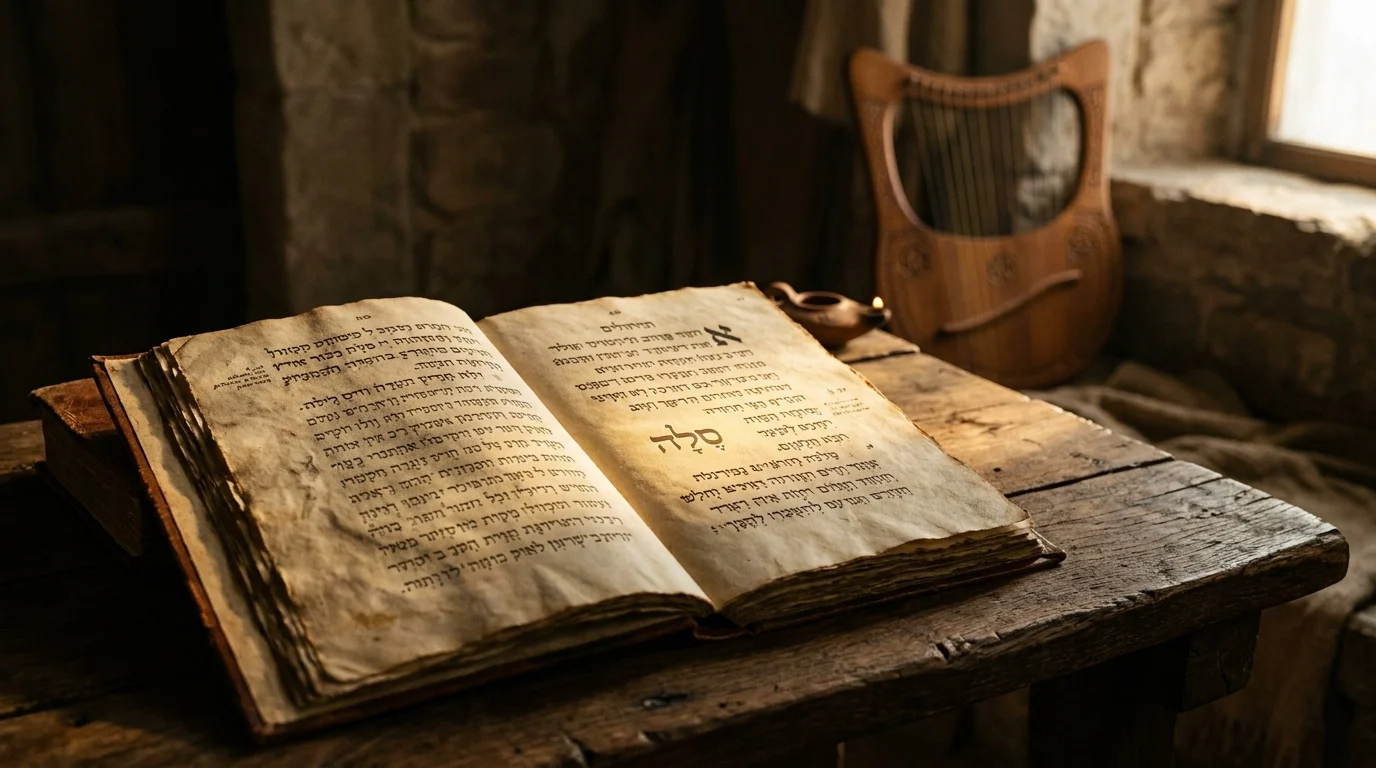

You may come across the word “Selah” while reading the Psalms and wonder why it appears between verses or at the end of a passage. The most widely accepted view is that Selah is an ancient Hebrew term connected with a pause, musical instruction, or moment for reflection. Its exact meaning remains uncertain because the original biblical texts do not provide a clear definition. The word appears mainly in the Psalms and also in Habakkuk, where it seems connected with the way the text was performed or contemplated. Understanding its context helps explain why Selah is often associated with pausing, reflecting, and giving weight to the words that come before it.
What Does Selah Mean?
The selah meaning is not completely certain, but it is generally understood as a musical or liturgical direction associated with a pause, break, or moment of reflection. It appears frequently in the Psalms and three times in Habakkuk.
| Detail | Explanation |
|---|---|
| Most common meaning | A pause, musical break, or moment for reflection |
| Original language | Hebrew |
| Main biblical context | Psalms and Habakkuk |
| Tone | Reflective, solemn, worshipful |
| Modern use | Often used to mean “pause and reflect” |
Because ancient Hebrew musical notation is not fully understood today, scholars cannot state one definitive translation. “Pause” is a helpful interpretation, but it should not be treated as a proven literal translation.
The Main Selah Meaning in the Bible
In biblical usage, Selah appears as a distinctive term within several psalms. It is often positioned after a statement, prayer, or poetic section, which has led interpreters to connect it with a pause in singing or music.
One common interpretation is that Selah instructed performers to stop briefly, perhaps allowing the music to continue, change, or become more prominent. Another interpretation connects it with raising the voice or emphasizing what was just said. The precise musical instruction, however, is unknown.
For example, Psalm 46 contains the word Selah after statements describing God’s protection and power. Reading the passage with a deliberate pause can naturally create a sense of emphasis and reflection.
So, when someone asks, “What does Selah mean?” the safest answer is that it is an ancient biblical term whose exact meaning is uncertain but is traditionally associated with a pause, musical direction, or reflective emphasis.
Why Is Selah Used in the Psalms?
The Psalms were poetry intended for worship, and many were connected with music. Selah occurs in this musical and poetic setting rather than functioning like an ordinary conversational word.
Its placement may have helped performers or listeners respond to the preceding words. A pause could give worshippers time to absorb an important statement, allow an instrumental passage, or mark a transition within the composition.
This is why the modern idea of Selah as “pause and reflect” is so common. Although that phrase should not be presented as the proven dictionary definition, it captures one reasonable way readers understand the word’s function.
Is Selah a Hebrew Word?
Selah appears in the Hebrew Bible, but its exact linguistic derivation is debated. Scholars have proposed different connections for the term, including explanations related to musical direction, elevation, or pausing.
There is no universally accepted explanation that settles the question. As a result, claims that Selah definitely means one specific English word should be treated cautiously.
You may also see the word transliterated directly as Selah rather than translated. This preserves the original term while avoiding an overly confident interpretation.
How Context Changes the Meaning of Selah
Context is especially important with Selah because the word does not behave like ordinary slang or a modern abbreviation.
Here are several ways its context can shape how you understand it:
- After a powerful statement: It can naturally invite a pause to consider the preceding idea.
- Within a musical passage: It may indicate some type of musical or performance instruction.
- In modern inspirational writing: People often use Selah symbolically to mean “pause and reflect.”
- In a religious conversation: It usually carries a spiritual or contemplative sense rather than a casual one.
For example, someone writing “Take a moment. Selah.” is probably using the word metaphorically to encourage reflection. Someone reading Selah in a biblical Psalm is encountering the term in its historical scriptural context.
Selah Meaning in Text and Modern Communication
Unlike internet abbreviations such as “LOL” or “BRB,” Selah is not generally a texting acronym or mainstream piece of internet slang. If you see it in a message, caption, journal entry, or social media post, the writer is usually using the biblical term or its modern reflective sense.
For example:
“Some moments don’t need an answer. Selah.”
Here, Selah functions as a poetic invitation to stop and think about the statement.
It can also appear in faith-based posts, devotional writing, inspirational captions, or personal reflections. The intended meaning is usually closer to “pause and consider this” than to a literal instruction about stopping a conversation.
Does Selah Mean “Pause”?
“Pause” is one of the most common explanations of Selah, but saying that Selah definitively translates to “pause” goes further than the evidence allows.
The word’s exact function is uncertain. Its repeated appearance in musical and poetic passages has encouraged the interpretation that it indicated a break, musical interlude, or moment of emphasis.
Therefore, “pause and reflect” works well as a modern explanation, especially in devotional contexts, while “pause” alone should not be presented as the only established definition.
Real Conversation Examples
Person A: “I keep worrying about things I can’t control.”
Person B: “Maybe this is a moment to Selah and breathe.”
Meaning: Person B is using Selah figuratively to encourage a pause and reflection.
Person A: “I posted a quote about being grateful, then added ‘Selah.’”
Person B: “That makes sense. It gives people a moment to think about the message.”
Meaning: Here, Selah emphasizes contemplation rather than functioning as ordinary slang.
Person A: “What does Selah mean in this Psalm?”
Person B: “Its exact meaning is uncertain, but it’s commonly connected with a pause or musical instruction.”
Meaning: This conversation uses Selah in its biblical context and acknowledges the uncertainty surrounding its precise function.
Is Selah Religious?
Selah has a strong biblical and religious association because it appears in the Hebrew Bible, particularly in the Psalms. Its modern use is therefore often connected with prayer, worship, Scripture, meditation, and spiritual reflection.
However, people can also use the word outside formal religious settings. In modern writing, Selah may simply express the idea of stopping to consider something meaningful.
The context usually makes the intended use clear.
Is Selah a Name?
Selah is also used as a personal name in modern contexts. This is different from asking about the selah meaning in biblical passages.
When Selah appears as someone’s name, its intended significance may be inspired by the biblical term or by one of the traditional interpretations associated with it. You should not automatically assume that every occurrence of “Selah” refers to the biblical musical term.
How to Use Selah Correctly
If you want to use Selah in modern writing, it works best when you are deliberately creating a reflective or contemplative tone.
Reflective Use
- “Take a breath and appreciate where you are. Selah.”
- “Not every difficult season lasts forever. Selah.”
- “Sometimes silence says enough. Selah.”
These examples use the word metaphorically to signal reflection.
Biblical Use
When discussing Scripture, you can retain Selah rather than assigning it a definite English translation. If explaining it to someone, phrases such as “a possible musical pause” or “a term associated with reflection” are more accurate than claiming one unquestionable definition.
When to Use Selah
Selah can work naturally in:
- Personal reflections
- Devotional writing
- Religious discussions
- Poetry
- Inspirational captions
- Discussions about biblical passages
- Reflective social media posts
It is most effective when the surrounding message genuinely invites contemplation.
When to Avoid Selah
You generally should not use Selah when clarity is more important than poetic or religious expression.
For example, professional emails, academic assignments, workplace instructions, and formal announcements usually benefit from straightforward language. If your audience may not recognize the term, “pause,” “reflect,” or “take a moment to consider this” may communicate your meaning more clearly.
There is nothing inherently wrong with using Selah in informal writing; the issue is whether your audience will understand what you mean.
Common Misunderstandings About Selah
| Common Mistake | Correct Understanding |
| Selah definitely means “pause.” | A pause is a common interpretation, but the exact meaning remains uncertain. |
| Selah is modern internet slang. | It is an ancient biblical term that is sometimes used metaphorically today. |
| Every use of Selah has a religious meaning. | Modern writers may use it simply to express reflection or contemplation. |
Another common mistake is treating a proposed etymology as settled fact. Because the word’s origin and precise function remain debated, careful explanations distinguish established usage from interpretation.
Selah vs. Similar Words
| Term | Meaning | Main Difference |
| Pause | Stop temporarily | A straightforward modern English word |
| Reflect | Think carefully about something | Focuses on thought rather than a musical setting |
| Meditate | Engage in sustained contemplation | Often has a spiritual or mental focus |
| Amen | An expression affirming agreement or belief | Used as a response or conclusion rather than a pause |
| Selah | Biblical term associated with pause, music, or reflection | Its exact original function remains uncertain |
These words can overlap in modern devotional writing, but they are not interchangeable in every context.
What Is the Origin of Selah?
The precise origin and meaning of Selah are uncertain. The term occurs in the Hebrew Bible, especially in the Psalms, but ancient musical instructions are difficult to interpret because the original performance system is no longer fully known.
Several explanations have been proposed by scholars, including connections with pausing, musical performance, or emphasis. None should be presented as an unquestionably established definition.
That uncertainty is why reputable explanations often describe Selah as a term of uncertain meaning rather than assigning it a single exact English equivalent.
Quick Recap
- Selah is an ancient biblical term, especially associated with the Psalms.
- Its exact meaning is uncertain, although “pause,” musical direction, and reflection are common interpretations.
- In modern writing, Selah often means a moment to pause and reflect.
- It is not generally a texting acronym or internet abbreviation.
- Context matters because biblical Selah and modern metaphorical uses are not necessarily identical.
Frequently Asked Questions
What does Selah mean in text?
In modern texts, Selah usually expresses a reflective pause, encouraging the reader to stop and consider the preceding message.
Is Selah a Hebrew word?
Selah appears in the Hebrew Bible, although scholars continue to debate its precise linguistic origin and original function.
What does Selah mean in the Bible?
Biblical Selah is commonly associated with a pause, musical direction, or moment of emphasis, though its exact meaning remains uncertain.
Is Selah the same as “pause and reflect”?
“Pause and reflect” captures a common modern interpretation, but it should not be treated as Selah’s definitive translation.
Can Selah have different meanings?
Yes, Selah can refer to its uncertain biblical function or be used figuratively today to express reflection and contemplation.
Final Thoughts
The selah meaning is best understood with a little caution: it is a biblical term whose exact original function is uncertain. It is commonly associated with a pause, musical direction, emphasis, or reflection, particularly in the Psalms. In modern writing, people often use Selah as a concise way to invite someone to stop and think about an important idea. The surrounding context remains essential, especially when distinguishing its biblical use from its modern inspirational meaning. If you use Selah yourself, choosing it for a genuinely reflective moment makes its intended message much clearer.