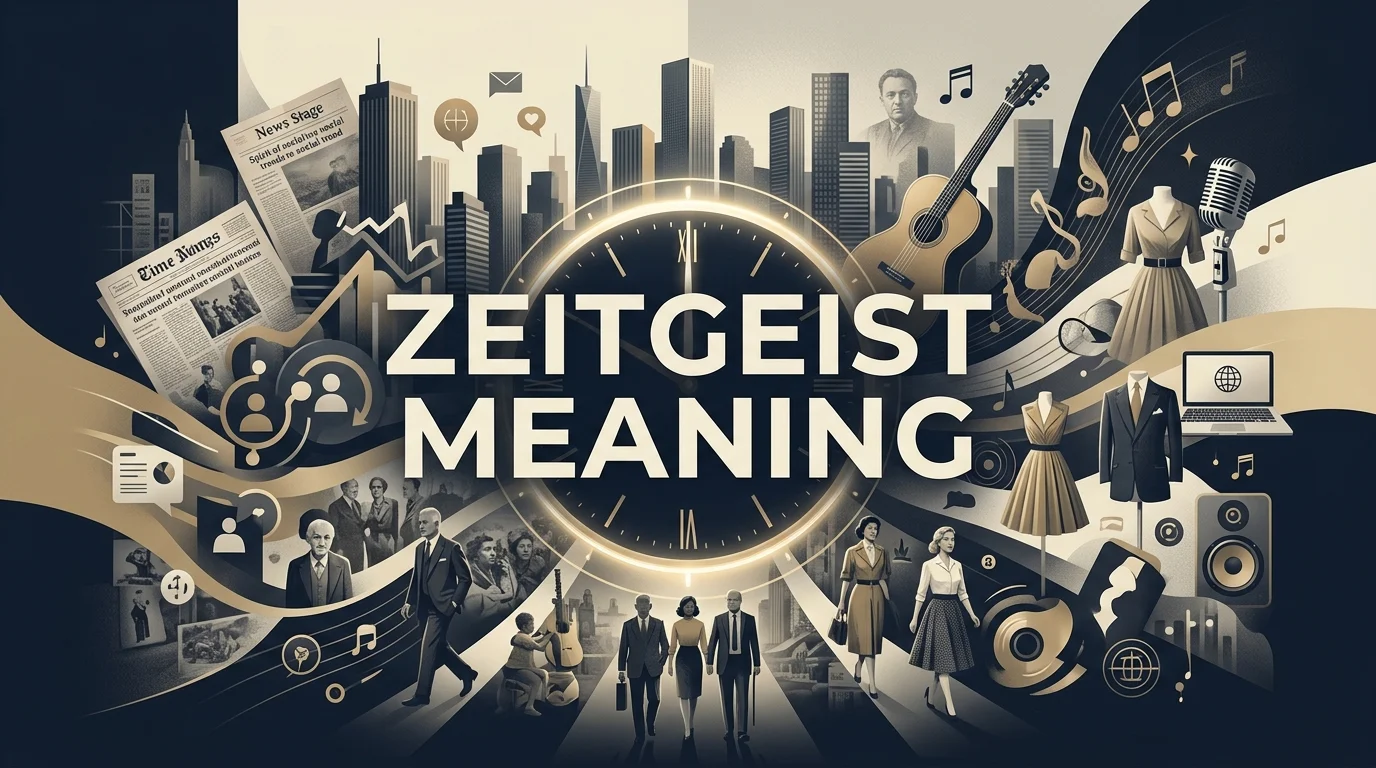

You might hear someone say, “That movie really captures the zeitgeist,” and wonder what they mean. The zeitgeist meaning is the general spirit, mood, ideas, attitudes, and cultural atmosphere of a particular period in history. It describes what feels characteristic of an era rather than one person’s individual opinion.
The word often appears when people discuss music, fashion, politics, technology, art, entertainment, or social attitudes. Although zeitgeist comes from German, it is commonly used in English writing and conversation. Understanding the surrounding context helps you recognize whether someone is talking about a historical period, a cultural trend, or the mood of a particular moment.
What Does Zeitgeist Mean?
Zeitgeist means the defining spirit or intellectual and cultural climate of a particular time period. The word comes from German: Zeit means “time,” while Geist can mean “spirit” or “mind.” In English, it usually describes the ideas, attitudes, values, trends, and feelings that characterize an era.
| Detail | Explanation |
|---|---|
| Meaning | The prevailing spirit or cultural mood of a period |
| Origin | German |
| Tone | Neutral, intellectual, or descriptive |
| Common use | Culture, history, media, politics, art, and society |
| Formal or informal | More common in formal or thoughtful discussion |
For example, someone might say, “Social media helped define the zeitgeist of the 2010s.” They mean that social media reflected and influenced the attitudes, habits, and cultural changes associated with that period.
The Main Zeitgeist Meaning Explained
The simplest way to understand zeitgeist is “the spirit of an era.” It does not refer to one isolated trend. Instead, it describes a broader atmosphere created by the ideas, behaviors, concerns, styles, and values that are prominent during a particular period.
The term is especially useful when several cultural developments seem connected. For instance, a period characterized by rapid technological change, constant online communication, and changing ideas about work might be described as having a particular technological or digital zeitgeist.
The word can describe both historical periods and more recent times. You could discuss the zeitgeist of the 1960s, the early internet era, or the cultural mood surrounding a major social change.
A Simple Example
“The popularity of minimalist design reflects the zeitgeist of the decade.”
Here, zeitgeist refers to the broader cultural preference for simplicity and minimalism. The sentence is not saying that everyone shared exactly the same preference. It suggests that the trend represents something noticeable about the period as a whole.
Is Zeitgeist Slang?
No. Zeitgeist is not generally considered slang. It is an established English word borrowed from German and is commonly associated with discussions of culture, history, philosophy, society, and current events.
Someone may use it casually in a conversation, but that does not make it internet slang. For example:
“That song is totally the zeitgeist right now.”
The wording is casual, but zeitgeist still keeps its standard meaning: something that reflects the cultural mood of the current period.
You may therefore see zeitgeist meaning searches alongside discussions of social media, but the term itself is not a text abbreviation or platform-specific expression.
How Context Changes the Meaning
The core definition remains fairly consistent, but context determines what aspect of a period someone is describing.
Consider these examples:
- “The zeitgeist of the 1920s” refers to the broader cultural and intellectual atmosphere of that decade.
- “The film captures the zeitgeist” means the film reflects important feelings, concerns, or trends of its time.
- “The political zeitgeist has changed” focuses on prevailing political attitudes.
- “That fashion trend represents the current zeitgeist” connects a style to broader cultural preferences.
The surrounding subject is your biggest clue. Words about movies, music, technology, politics, fashion, or social behavior usually indicate the particular part of the era being discussed.
The tone also matters. In serious writing, zeitgeist can sound analytical. In casual conversation, it may simply be a sophisticated way to say that something feels representative of the current moment.
Zeitgeist in Text, Chat, and Social Media
When zeitgeist appears in a text message or online conversation, its basic meaning does not change.
It can describe something that seems to capture what people are thinking, enjoying, worrying about, or experiencing at a particular moment.
For example:
“That meme is basically the internet zeitgeist.”
The speaker means the meme represents something characteristic of the internet’s current cultural mood.
On platforms such as TikTok, Instagram, Reddit, or X, users may use zeitgeist when discussing viral culture, memes, fashion, entertainment, or changing social attitudes. However, there is no special TikTok or Snapchat definition that replaces the standard meaning.
If someone writes, “This show is the zeitgeist,” they are usually saying that the show reflects something significant about the current cultural moment.
Real Conversation Examples
1: Friends Discussing Music
Person A: “Everyone seems obsessed with that artist right now.”
Person B: “Yeah, they really fit the current zeitgeist.”
Meaning: Person B believes the artist reflects the musical and cultural interests of the present period.
2: Social Media Discussion
Person A: “Why is everyone suddenly talking about quiet luxury?”
Person B: “It feels like part of the current zeitgeist.”
Meaning: The speaker sees the trend as part of a broader cultural mood rather than an isolated fashion choice.
3: Film Discussion
Person A: “Why do people keep calling that movie a defining film of its generation?”
Person B: “Because it captures the zeitgeist so well.”
Meaning: The movie reflects important attitudes, concerns, or cultural characteristics associated with its era.
What Tone Does Zeitgeist Have?
Zeitgeist usually has a neutral, analytical, or intellectual tone. It is not inherently friendly, rude, sarcastic, flirty, or offensive.
The surrounding sentence can make it sound more casual or humorous. Someone saying “That haircut is the zeitgeist” may be jokingly presenting a fashion choice as a symbol of the current cultural moment.
In academic, journalistic, or professional writing, the word often sounds more serious. In casual speech, it can sound deliberately sophisticated, especially when a simpler phrase such as “the mood of the time” would work.
Is Zeitgeist Rude?
No. Zeitgeist is not inherently rude or insulting. Its effect depends on the sentence and the speaker’s attitude, not on the word itself.
Is Zeitgeist Flirty?
No. Zeitgeist does not have a standard romantic or flirty meaning. If it appears in a romantic conversation, the surrounding message determines the speaker’s intent.
How to Reply to Zeitgeist
Because zeitgeist is a descriptive word rather than a question or abbreviation, your response depends on what the other person is discussing.
Thoughtful Replies
- “I can see that. It definitely reflects what people are interested in right now.”
- “That’s an interesting way to describe it.”
- “Yeah, it feels representative of this particular moment.”
- “I think the same thing is happening with music and fashion.”
Casual Replies
- “Honestly, yeah.”
- “That’s actually a good description.”
- “I can see why you’d call it that.”
- “Definitely feels like a current trend.”
If You Are Confused
- “When you say zeitgeist, do you mean the general cultural mood?”
- “Do you mean it represents the current era?”
- “Are you talking about the broader cultural trend?”
These responses work because they focus on the actual idea behind the word rather than treating zeitgeist like slang with a hidden code or abbreviation.
When to Use the Term
You can use zeitgeist when discussing a broader cultural or historical atmosphere. It works especially well in conversations about:
- Movies, television, and music
- Fashion and design
- Technology
- Social attitudes
- Politics and history
- Art and literature
- Internet culture
- Generational trends
For example, saying “The album captures the zeitgeist of the early 2000s” is appropriate when you mean the album reflects recognizable characteristics of that period.
The term is most useful when you are talking about more than one isolated trend. If you simply mean that something is popular, “popular” may be clearer.
When to Avoid the Term
You do not need to avoid zeitgeist completely in formal communication, because it is a legitimate English word. However, clearer alternatives may be better when your audience is unfamiliar with the term.
For example, in a customer email, saying “the current cultural mood” may communicate your point more directly than zeitgeist. In academic writing, meanwhile, zeitgeist can be appropriate when you are specifically discussing the intellectual or cultural climate of a historical period.
Avoid using the word simply because it sounds sophisticated. If you cannot explain what cultural mood or period you mean, the sentence may become vague.
Common Mistakes About Zeitgeist
| Common Mistake | Correct Understanding |
| Treating it as slang | It is an established word used in English and borrowed from German. |
| Assuming it means “trend” | A zeitgeist is broader than one trend and can include attitudes, ideas, and cultural moods. |
| Assuming everyone shares it | It describes a prevailing atmosphere, not necessarily every individual’s beliefs. |
Another common misunderstanding is assuming that zeitgeist refers only to the present. It can describe any period, including centuries or decades in the past.
Similar Terms Compared With Zeitgeist
| Term | Meaning | Main Difference |
| Zeitgeist | Spirit or cultural climate of an era | Broad cultural atmosphere |
| Trend | A developing popular tendency | Usually narrower and more specific |
| Culture | Shared practices, values, and beliefs | Broader and not limited to one period |
| Mood | A prevailing emotional feeling | Usually focuses more on emotion |
| Spirit of the times | General character of a period | Very close to zeitgeist, but more literal |
The closest everyday alternative is “spirit of the times.” In many sentences, you can replace zeitgeist with that phrase without substantially changing the meaning.
Where Did the Word Zeitgeist Come From?
Zeitgeist is a German compound word formed from Zeit, meaning “time,” and Geist, meaning “spirit” or “mind.” It entered English usage as a term for the characteristic intellectual or cultural spirit of a particular period.
The concept became especially associated with philosophical and historical discussions about how the ideas of an era shape its culture. In modern English, the word is used more broadly for anything that seems to represent the prevailing character of a particular moment.
Because its historical development involves philosophical usage and German intellectual vocabulary, the exact sense can vary slightly depending on the writer and context.
Quick Recap
- Zeitgeist means the prevailing spirit, mood, ideas, or cultural climate of a particular period.
- The word comes from German and is not normally considered slang.
- It can describe historical eras as well as the current cultural moment.
- A trend can contribute to a zeitgeist, but a zeitgeist is broader than one trend.
- Context tells you which aspect of an era the speaker is describing.
- In casual conversation, clearer alternatives such as “the cultural mood” may sometimes be easier to understand.
Frequently Asked Questions
What does zeitgeist mean in text?
Zeitgeist in text means the broader cultural mood, ideas, and attitudes that characterize a particular period.
Is zeitgeist rude?
No, zeitgeist is neutral and descriptive, although its surrounding wording can make the statement sound humorous or critical.
What does zeitgeist mean on TikTok?
On TikTok, zeitgeist usually describes content or trends that reflect the broader cultural mood of the current moment.
How should you reply to zeitgeist?
Respond by discussing the cultural trend being mentioned, or ask whether the speaker means the broader spirit of the current era.
Can zeitgeist have different meanings?
Zeitgeist keeps its core meaning across contexts, while the specific cultural, social, or intellectual aspects it describes can change.
Final Thoughts
The zeitgeist meaning is simple once you connect it with the phrase “spirit of the times.” It describes the broader cultural, intellectual, or social atmosphere associated with a particular period. Unlike slang or abbreviations, zeitgeist does not have a hidden texting definition that changes from platform to platform.
Context still matters because the word can refer to different aspects of an era, from fashion and entertainment to technology and social attitudes. If you understand what period and cultural subject the speaker is discussing, the intended meaning is usually clear. When a simpler phrase works better for your audience, “cultural mood” or “spirit of the times” can communicate the same idea more directly.