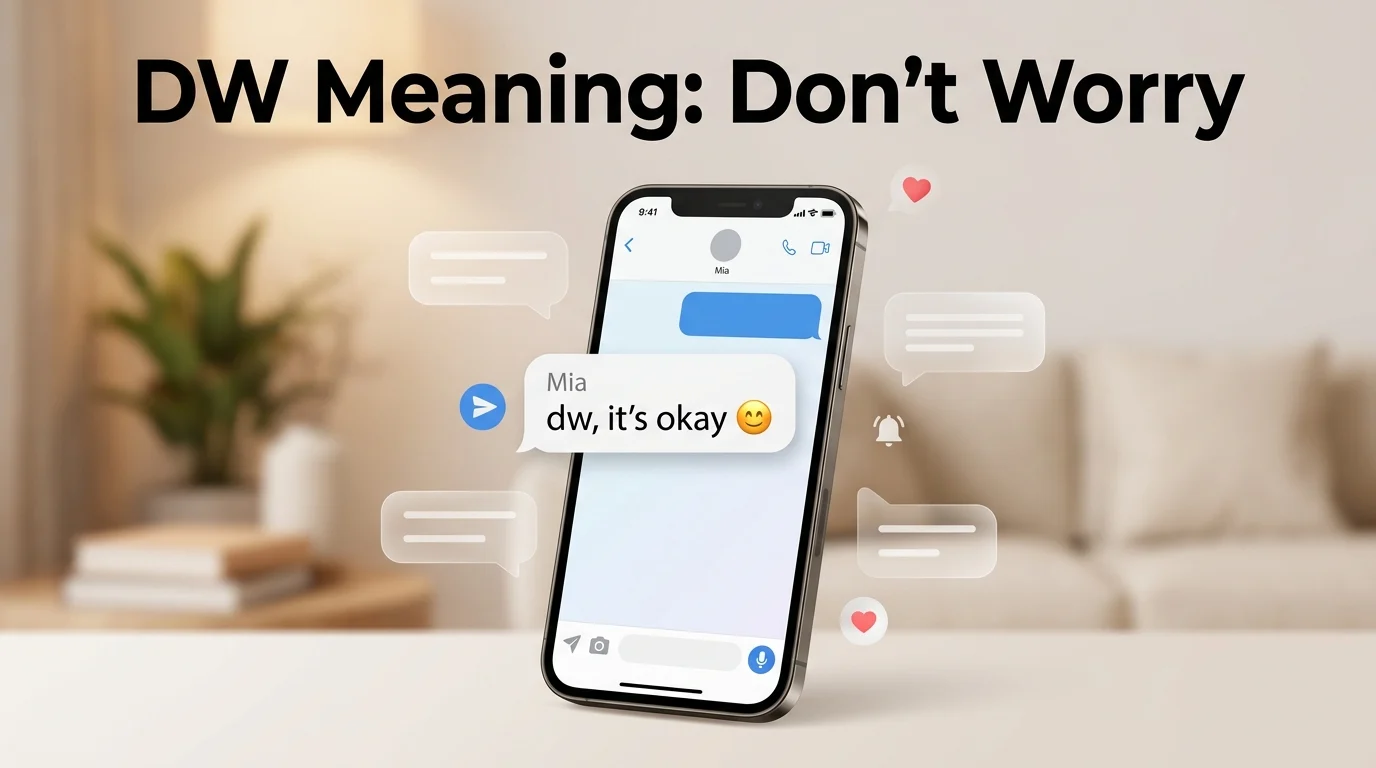

You get a text saying “dw, I’ll handle it” and may wonder what the two letters actually mean. In most casual conversations, DW means “don’t worry.” It is a quick way to reassure someone, tell them not to stress, or signal that a situation is under control. The DW meaning in text is usually straightforward, but the exact tone can change depending on the conversation, punctuation, and relationship between the people talking. Below, you’ll find the common meaning of DW, realistic examples, platform usage, possible alternative meanings, suitable replies, and situations where writing the full phrase is clearer.
What Does DW Mean?
DW usually means “don’t worry” in text messages, chats, and social media conversations. People use it when reassuring someone, dismissing a concern, or letting them know that a problem is not as serious as they think. It is informal and generally has a friendly or neutral tone.
| Detail | Explanation |
|---|---|
| Most Common Meaning | Don’t worry |
| Full Form | “Don’t worry” |
| Tone | Usually reassuring, casual, or friendly |
| Common Platforms | Text messages, Snapchat, Instagram, WhatsApp, TikTok, Discord |
| Formal or Informal | Informal |
For example, if someone texts, “Sorry I’m late,” you might reply, “dw, take your time.” Here, DW reassures the other person that their lateness is not causing a problem.
DW Meaning in Text: “Don’t Worry”
The most common DW slang meaning is “don’t worry.” It works as a shortened reassurance and is especially common when people want to keep a message brief.
You might see DW when someone is trying to calm another person down, remove guilt, or explain that something has already been taken care of.
Consider these examples:
- “dw about the homework, I already sent it.”
- “Dw, you didn’t offend me.”
- “dw, I can pick you up.”
- “You’re good, dw.”
The abbreviation does not necessarily mean the sender thinks your concern is unreasonable. Often, it simply means, “There’s no need to stress about this.”
Capitalization can vary. “dw,” “DW,” and “Dw” can all represent “don’t worry,” although lowercase is especially common in casual texting.
Are There Other DW Meanings?
In ordinary texting, “don’t worry” is by far the meaning most readers should consider first. However, DW can represent other words or phrases in specialized settings.
One example is “deadweight” in some gaming or online discussions, where players may use DW to describe a person or character perceived as contributing little to a team. That interpretation is much more dependent on the community and conversation.
| Meaning | Context | Tone | Example |
|---|---|---|---|
| Don’t worry | Texting and casual chat | Reassuring | “dw, it’s fine” |
| Deadweight | Some gaming discussions | Critical or dismissive | “He’s DW this round” |
Do not automatically interpret DW as “deadweight” simply because you see it in an online game. Look at the surrounding words first.
How Context Changes the DW Meaning
The same two letters can feel slightly different depending on who sends them and how they are written.
1. A reassuring conversation
“I forgot to bring your charger.”
“dw, I have another one.”
Here, DW clearly means “don’t worry” and removes the other person’s concern.
2. A serious concern
“I think I messed everything up.”
“dw, we can figure it out.”
The abbreviation is still reassuring, but the situation makes the message more emotionally supportive.
3. A short or dismissive response
“Are you upset with me?”
“dw.”
This still likely means “don’t worry,” but the extremely short response may feel less warm than “Don’t worry, I’m not upset.”
4. A gaming conversation
“Why isn’t our teammate helping?”
“He’s basically deadweight.”
If someone uses DW around this discussion, the surrounding gaming context could point toward “deadweight” rather than “don’t worry.”
Punctuation and emojis also matter. “dw 😊” can feel warm and reassuring, while “dw.” may sound more final or detached. The relationship between the speakers matters too: a close friend may use DW casually, while the same abbreviation from someone unfamiliar could feel abrupt.
DW on Texting and Social Media
The basic DW meaning generally stays the same across casual messaging platforms. Whether you see it in a text message, Instagram DM, Snapchat conversation, WhatsApp chat, TikTok comment, or Discord message, “don’t worry” is usually the intended meaning when the context involves reassurance.
On social platforms, people may also use DW because short abbreviations fit naturally into quick conversations.
Examples include:
- Text: “dw, I’ll call you later.”
- Snapchat: “dw lol, I saved it.”
- Instagram DM: “dw, you can tell me.”
- Discord: “dw, we still have plenty of time.”
The platform itself usually does not change the definition. The conversation does.
Real Conversation Examples
1: Friends
Person A: “Sorry I couldn’t make it yesterday.”
Person B: “dw, we can hang out this weekend.”
Meaning: Person B is saying “don’t worry” and reassuring their friend that there are no hard feelings.
2: Classmates
Person A: “Did I miss anything important in class?”
Person B: “dw, I’ll send you my notes.”
Meaning: DW tells the classmate not to stress because the notes can help them catch up.
3: Group Chat
Person A: “I accidentally deleted the shared file.”
Person B: “dw, I have a backup.”
Meaning: The sender uses DW to reassure the group that the mistake can be fixed.
Is DW Rude?
DW is not inherently rude. Its usual purpose is reassurance, so it often sounds friendly or neutral.
However, the way someone uses it can affect how the message feels. A detailed response such as “Don’t worry, seriously. Everything is okay” sounds more emotionally attentive than simply “dw.”
If someone is discussing a serious personal issue, responding with only two letters may come across as dismissive even when the sender intends to be supportive.
The safest interpretation comes from the complete conversation rather than the abbreviation alone.
Is DW Flirty?
DW is not normally a flirty abbreviation. Its standard meaning is simply “don’t worry.”
It can appear in a flirtatious conversation, but that does not make DW itself romantic. For example, someone might write “dw, I’ll make it up to you 😉” in a playful conversation. The potentially flirty tone comes from the surrounding wording and emoji, not from DW.
How to Reply to DW
Your best response depends on what the other person is reassuring you about.
Friendly Replies
- “Thanks, I appreciate it!”
- “Okay, good 😊”
- “Alright, I won’t stress.”
- “Thanks for letting me know.”
- “Got it, thank you!”
Casual Replies
- “Haha okay.”
- “You got it.”
- “Fair enough 😂”
- “Okay, we’re good then.”
When You Need More Reassurance
If the message is too short to tell how the person feels, you can ask directly:
- “Are you sure everything’s okay?”
- “Okay, but seriously, you’re not upset?”
- “Thanks, I just wanted to make sure.”
These responses keep the conversation natural without assuming what the sender meant emotionally.
When to Use DW
DW works best in casual communication with people who already understand texting abbreviations. You can comfortably encounter it in conversations with friends, classmates, relatives, online communities, and other familiar contacts.
It is particularly useful when you want to reassure someone quickly:
“ I got it.”
“dw about the payment.”
“dw, we have time.”
The abbreviation is short, recognizable, and informal, making it suitable for quick conversations where brevity is expected.
When to Avoid DW
Writing “don’t worry” in full is usually better when clarity or professionalism matters more than speed.
Consider avoiding DW in:
- Professional emails
- Job applications
- Client communication
- Academic assignments
- Formal announcements
- Important workplace messages
- Sensitive conversations with unfamiliar people
That does not mean abbreviations are automatically inappropriate in every workplace. If your team routinely uses casual messaging and everyone understands DW, it may be perfectly acceptable. The key is matching your wording to the audience and situation.
Common Mistakes About DW
| Common Mistake | Correct Understanding |
|---|---|
| Assuming DW always has one meaning | “Don’t worry” is the common texting meaning, but specialized contexts can use other meanings. |
| Thinking DW is automatically rude | The abbreviation is generally neutral or reassuring; the surrounding message determines the tone. |
| Assuming DW is always flirty | DW itself is not romantic; flirtation comes from the broader conversation and wording. |
Another common mistake is treating every short response as emotionally identical. “dw,” “dw 😊,” and “don’t worry, everything’s fine” can communicate the same basic idea while creating noticeably different impressions.
Similar Slang Terms
Several texting abbreviations can appear in conversations where someone is reassuring or responding to a concern.
| Term | Meaning | Main Difference |
|---|---|---|
| DW | Don’t worry | Directly reassures someone |
| NVM | Never mind | Withdraws or dismisses a previous thought |
| NP | No problem | Usually responds to an apology, request, or thanks |
| IDC | I don’t care | Expresses indifference rather than reassurance |
| IMO | In my opinion | Introduces a personal viewpoint |
For example, “np” can reassure someone after they apologize, while “dw” focuses more directly on telling them not to worry.
Origin and Popularity of DW
There is no need to assign DW a specific creator or exact invention date. It follows the broader pattern of shortening common phrases for faster informal communication, and its meaning is generally clear from the words “don’t worry.”
Because short forms can develop independently across different online communities, unusual interpretations should be treated cautiously. When you encounter DW, the surrounding conversation is the strongest clue to its intended meaning.
Quick Recap
- DW usually means “don’t worry” in texting and casual online conversations.
- It is generally reassuring, friendly, or neutral rather than rude.
- The tone can become warmer, colder, or more dismissive depending on wording, punctuation, and emojis.
- Specialized communities may use DW differently, such as “deadweight” in some gaming discussions.
- When someone sends DW, a simple “Thanks, I appreciate it!” is usually an appropriate reply.
Frequently Asked Questions
What does DW mean in text?
DW means “don’t worry” in most casual text conversations, usually reassuring someone that everything is okay.
Is DW rude?
DW is generally not rude, although a very short reply can sound dismissive during serious or emotional conversations.
What does DW mean on TikTok?
On TikTok, DW usually means “don’t worry” when used in comments, captions, or casual direct messages.
How should you reply to DW?
You can reply with “Thanks,” “Okay, I appreciate it,” or another response matching the conversation’s tone.
Can DW have different meanings?
Yes, DW can have specialized meanings such as “deadweight,” particularly in some gaming or community-specific conversations.
Final Thoughts
The main DW meaning in text, chat, and social media is “don’t worry.” People generally use it as a quick way to reassure someone, reduce concern, or show that a situation is under control. While other meanings exist in specialized contexts, the surrounding conversation usually makes the intended definition clear. Pay attention to the topic, relationship, punctuation, emojis, and wording before interpreting the tone. For casual conversations, DW is simple and useful; for professional or sensitive communication, spelling out “don’t worry” can make your meaning clearer and more considerate.