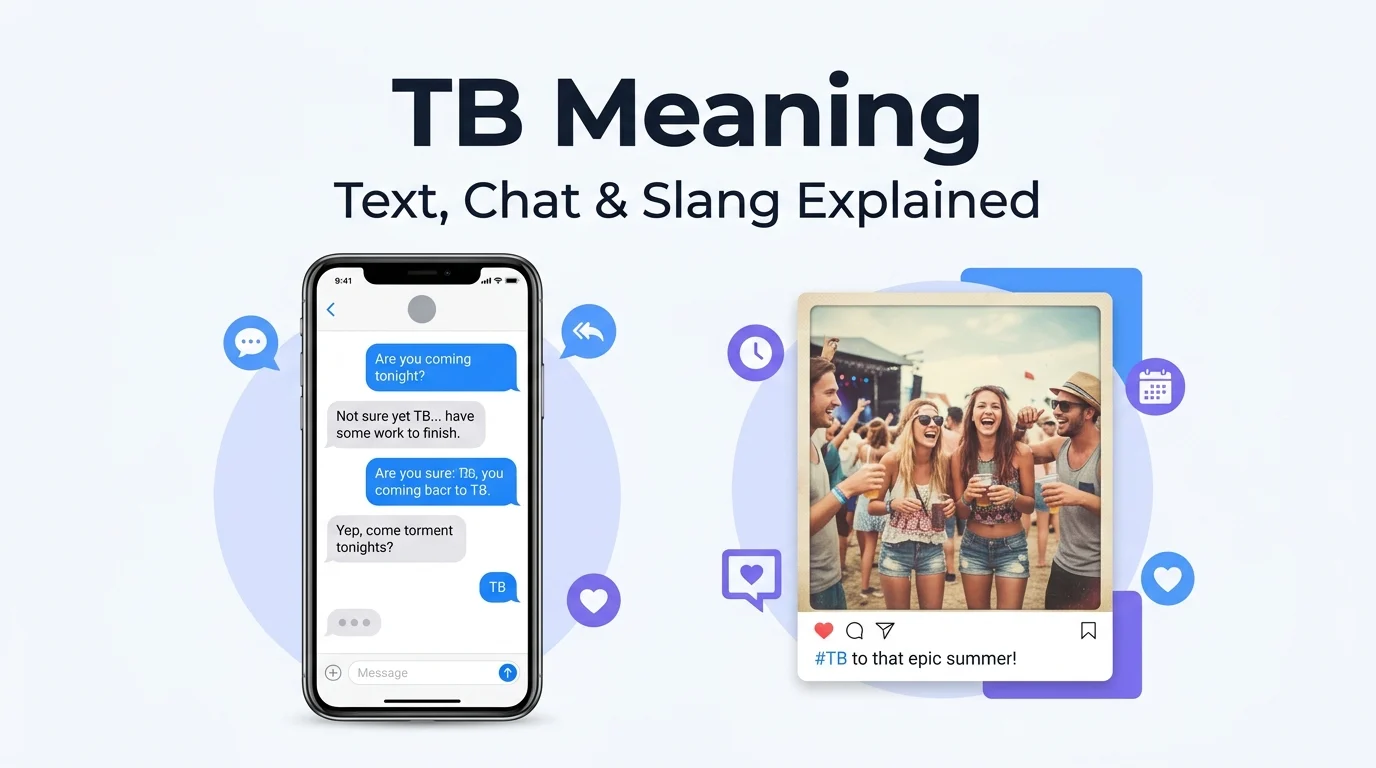

You might see “TB” in a message and wonder whether someone wants you to reply or is talking about an old memory. The tb meaning changes with context, but two slang uses matter most: “text back” in private conversations and “throwback” when referring to something from the past. A message such as “TB when you’re free” is very different from a caption saying “TB to summer.” Understanding the surrounding words, platform, and type of post usually makes the intended meaning clear. Here’s how to recognize each use, respond naturally, and avoid confusing TB with unrelated abbreviations.
What Does TB Mean?
The tb meaning in text usually depends on where you see it. In a direct message, TB commonly means “text back,” meaning someone should reply. On social media, especially with an old photo, video, memory, or trend, TB commonly means “throwback.”
| Detail | Explanation |
|---|---|
| Main slang meanings | Text back; throwback |
| Tone | Casual, informal |
| Common settings | Texts, DMs, captions, comments, social media |
| Formal or informal | Informal |
| Key clue | Reply-related context suggests “text back”; old content suggests “throwback” |
TB Meaning in Text: Text Back
In private chats, TB can mean “text back.” People use it as a short way to ask someone to reply or to say that they will respond later.
For example:
“TB when you get home.”
This means, “Text back when you get home.” The sender expects the conversation to continue after the other person is available.
You might also see:
“Busy rn, I’ll TB later.”
Here, the writer is saying they are busy and will text back later.
This use is especially natural in casual conversations with friends, family members, classmates, or someone you regularly message. It can sound like a simple reminder rather than a demand, although a very short message such as “TB” can feel impatient depending on the relationship.
TB Meaning on Social Media: Throwback
Another major TB slang meaning is “throwback.” In this sense, TB refers to something from the past, such as an old picture, video, event, song, trend, trip, or memory.
For example:
“TB to our beach trip.”
The person is looking back at the beach trip and sharing a nostalgic reference to it.
You may also see:
“TB to when we had no responsibilities 😂”
The abbreviation introduces a memory from an earlier period, while the laughing emoji makes the post playful.
This meaning is particularly easy to recognize when TB appears next to an old image or is followed by “to”, as in “TB to last summer.”
Other Meanings of TB
TB has meanings outside internet slang, so context matters before assuming it means “text back” or “throwback.”
In medical conversations, TB commonly refers to tuberculosis. In technology and computing, TB can mean terabyte, a unit used to describe digital storage.
These aren’t normally slang meanings, but they can appear in online conversations.
| Meaning | Context | Example |
| Text back | Private chats and DMs | “TB when you’re free.” |
| Throwback | Old photos, memories, posts | “TB to our first trip.” |
| Tuberculosis | Medical discussions | “The doctor ordered a TB test.” |
| Terabyte | Technology and storage | “My laptop has a 1 TB drive.” |
The surrounding topic usually makes these meanings easy to separate. A conversation about replying points toward “text back,” while an old photograph points toward “throwback.”
How Context Changes the TB Meaning
Because TB has more than one interpretation, look at the message before deciding what it means.
1. Look at the surrounding words
“TB when you arrive.”
This likely means “text back when you arrive.”
But:
“TB to our freshman year.”
This clearly points toward “throwback.”
2. Look at the content
If TB appears beside an old photograph, video, or memory, “throwback” is the natural interpretation.
If it appears after someone says they are going offline, “text back” makes more sense.
3. Consider the platform
A private messaging conversation is more likely to use TB for “text back.” A public Instagram or TikTok post featuring older content is more likely to use it for “throwback.”
4. Notice emojis and punctuation
“TB to this 😂”
The emoji supports a nostalgic or funny reference.
Meanwhile:
“TB when you can pls”
sounds like a casual request for a reply.
The same two letters can therefore communicate very different ideas without changing their spelling.
TB Meaning on TikTok, Snapchat, and Instagram
Platform context can help, although users don’t always follow one fixed definition.
TB on TikTok
On TikTok, TB can mean “throwback” when someone refers to an older trend, video, song, or period of TikTok culture.
Example:
“TB to when everyone used this sound.”
The user is remembering an earlier trend.
In a private TikTok message, however, TB may mean “text back” if the surrounding conversation is about replying.
TB on Snapchat
On Snapchat, either meaning can appear. A direct message such as “TB later” can mean “text back later,” while TB attached to an old Snap or saved memory can mean “throwback.”
Example:
“TB to our first day of school 😭”
Here, the old memory makes “throwback” the obvious interpretation.
TB on Instagram
Instagram often provides strong visual clues. TB in a caption accompanying an older photograph commonly means “throwback.”
Example:
“TB to this vacation.”
In Instagram DMs, the same abbreviation can instead mean “text back.”
TB in WhatsApp and Regular Texts
In private messaging, “text back” is a particularly natural interpretation.
For example:
“I’m heading out. TB when you’re free.”
The sender is asking the recipient to reply later rather than referring to a memory.
Real Conversation Examples
1: Friends texting
Person A: “I gotta run. TB when you’re free.”
Person B: “Sure, I’ll message you tonight.”
Meaning: TB means “text back.” Person A wants the conversation to continue later.
2: Social media post
Person A: “TB to our first concert together 🥹”
Person B: “That night was so much fun!”
Meaning: TB means “throwback.” Person A is remembering an earlier event.
3: Group chat
Person A: “Did anyone save that old video?”
Person B: “TB to the 2022 version 😂”
Meaning: TB means “throwback,” referring to something from an earlier period.
Is TB Rude?
TB is not inherently rude. Its tone depends on the wording and relationship between the people involved.
“TB when you get home 😊” sounds like a friendly request.
“TB.” by itself can feel more abrupt, particularly if the sender is clearly waiting for a response.
Likewise, a throwback caption such as “TB to the best summer ever ❤️” is generally nostalgic rather than rude.
The safest way to judge the tone is to read the entire message instead of interpreting the abbreviation alone.
Is TB Flirty?
TB itself is not specifically a flirty abbreviation. When it means “text back,” it can appear in conversations between people who are dating or interested in each other, but the abbreviation does not prove romantic interest.
For example:
“TB when you get home ❤️”
could feel affectionate because of the heart emoji and the relationship between the speakers. Without that surrounding context, “TB” simply means “text back.”
How to Reply to TB
Your response should match the meaning you think the sender intended.
If TB Means “Text Back”
You can reply naturally with:
- “Sure, I’ll text you later.”
- “Yep, I’ll message you when I’m free.”
- “Will do!”
- “I’ll text you when I get home.”
If you aren’t sure what the sender means, clarification is perfectly reasonable:
- “TB as in text back?”
- “Do you mean text back?”
If TB Means “Throwback”
For a nostalgic post or message, you could respond:
- “I remember this!”
- “Wow, that feels like forever ago.”
- “Such a good memory 😂”
- “We need to do that again.”
These responses acknowledge the memory rather than treating TB as a request for a reply.
When to Use TB
TB works best in casual communication where the people involved already understand informal abbreviations.
It can fit naturally in:
- Text messages with friends
- Group chats
- Casual DMs
- Social media captions
- Comments about old memories
- Informal conversations
If you’re using TB for “throwback,” adding enough context—such as “TB to…” or an old photo—helps readers understand you immediately.
If you’re using it for “text back,” make sure the surrounding sentence makes the request clear.
When to Avoid TB
TB is better avoided when clarity matters more than brevity. In professional emails, academic writing, job applications, client messages, and formal announcements, write “text back,” “reply,” “respond,” or another complete phrase instead.
The abbreviation can also be confusing when you’re communicating with someone unfamiliar with texting slang. In sensitive conversations, clear wording is usually preferable because a two-letter abbreviation can easily be misunderstood.
Common Mistakes About TB
| Common Mistake | Correct Understanding |
| Assuming TB always means one thing | TB can mean “text back” or “throwback,” among other non-slang terms. |
| Assuming social media and private chats use TB identically | Public posts often favor “throwback,” while direct messages can use “text back.” |
| Treating TB as automatically flirty or rude | Its emotional tone comes from the surrounding message and relationship. |
Another common mistake is believing every abbreviation has a single official “full form.” TB doesn’t have one universal expansion in casual online communication. The correct interpretation comes from context.
Similar Slang Terms
Several abbreviations can appear in similar conversations, but they aren’t interchangeable with TB.
| Term | Meaning | Main Difference |
| TBT | Throwback Thursday | Specifically associated with sharing or referencing something from the past, traditionally on Thursday |
| BRB | Be right back | Says the sender is temporarily leaving and expects to return |
| HMU | Hit me up | Invites someone to contact or message you |
| BTW | By the way | Introduces an additional point in a conversation |
| IDK | I don’t know | Expresses uncertainty or lack of knowledge |
The closest comparison is TBT, because both TB and TBT can refer to past memories. TB is shorter and can simply mean “throwback,” while TBT specifically expands to “Throwback Thursday.”
Origin and Popularity of TB
There isn’t one single origin for every use of TB. The abbreviation naturally comes from shortening established phrases such as “text back” and “throwback,” while the non-slang meanings of TB developed independently in medical and technical terminology.
The “throwback” use is closely related to the broader practice of sharing older photos, memories, and past moments online. Meanwhile, “text back” is simply a compact way to refer to replying to a message.
Because the same abbreviation appears in different contexts, it’s more useful to identify the meaning from the conversation than to assume one universal definition.
Quick Recap
- TB can mean “text back” in private messages when someone wants a reply.
- TB can mean “throwback” when referring to an old photo, memory, event, or trend.
- On TikTok and Instagram, old content often points toward “throwback.”
- In direct chats, a request to respond usually points toward “text back.”
- TB is informal, so clearer wording is better in professional or formal communication.
Frequently Asked Questions
What does TB mean in text?
TB commonly means “text back” in private messages, especially when someone is asking you to reply later.
Is TB rude?
TB is not inherently rude, although a standalone “TB” can sound abrupt when someone is impatient for your response.
What does TB mean on TikTok?
On TikTok, TB often means “throwback” when someone refers to an older trend, video, song, or memory.
How should you reply to TB?
If TB means “text back,” simply reply or confirm when you can respond; if unclear, ask what they mean.
Can TB have different meanings?
Yes, TB can mean “text back,” “throwback,” tuberculosis, or terabyte depending on the conversation and subject.
Final Thoughts
The tb meaning is easiest to understand when you look at the context instead of the abbreviation alone. In private chats, TB commonly means “text back,” while posts involving old photos, memories, or trends often use it to mean “throwback.” The platform, surrounding words, emojis, and relationship between the speakers can all provide useful clues. TB is casual slang, so it works best when your audience is familiar with informal messaging. When there is any chance of confusion—especially in professional or sensitive communication—using the complete phrase is clearer and safer.