
If you come across a word ending in -ness, -ful, -ly, or -ment, you are looking at a common example of a suffix. The suffix meaning is a letter or group of letters added to the end of a base word to change its meaning, grammatical function, or sometimes both. For example, adding -er to teach creates teacher, while adding -ly to quick creates quickly. Understanding suffixes makes unfamiliar words easier to decode and helps you recognize how English words are formed. This guide explains what suffixes mean, the main types, common examples, spelling changes, and how to identify them in everyday English.
What Does Suffix Mean?
A suffix is a letter or group of letters placed at the end of a word or word root. The suffix meaning generally involves changing the word’s meaning, grammatical role, or both. Unlike a prefix, which appears at the beginning, a suffix comes at the end.
| Detail | Explanation |
|---|---|
| Meaning | Letters added to the end of a base word |
| Position | At the end of a word |
| Main purpose | Changes meaning, word class, or grammatical form |
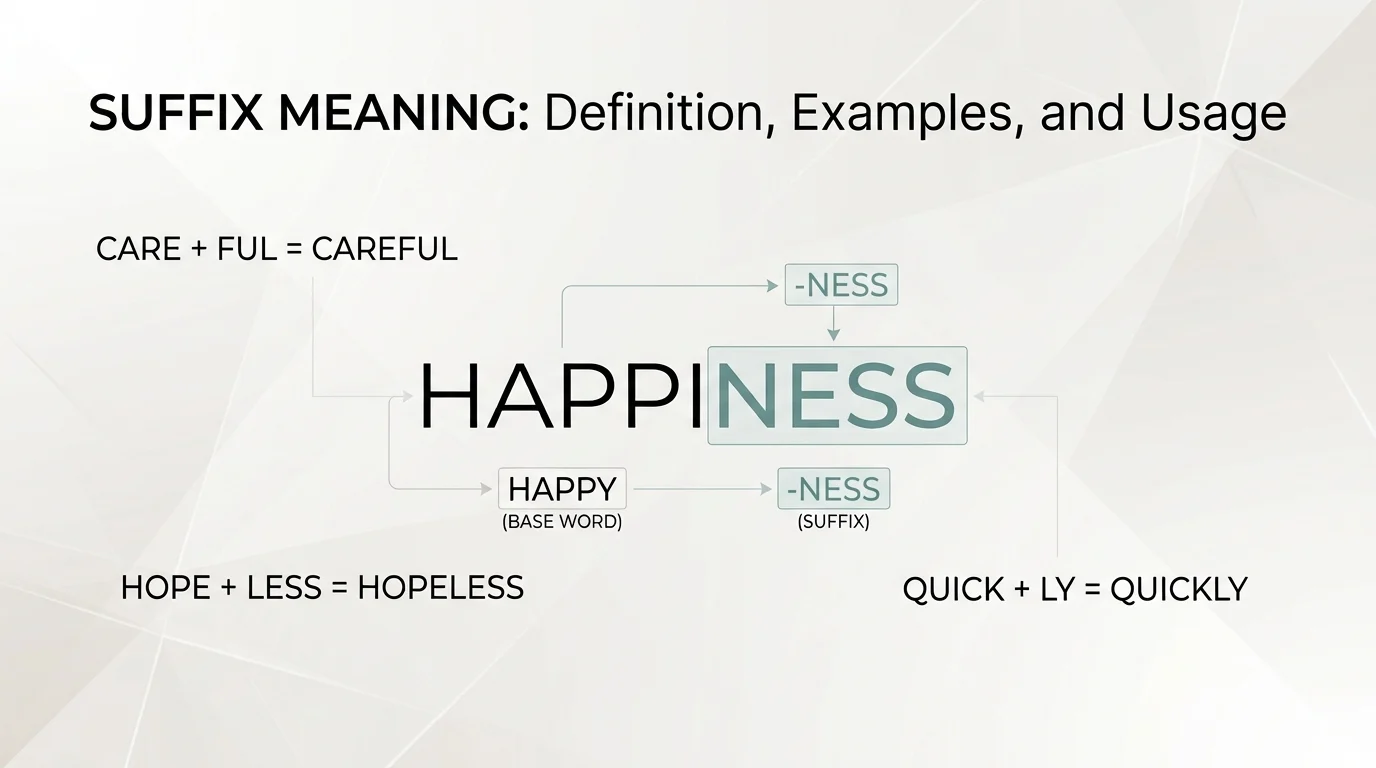
| Example | happy + -ness = happiness |
| Opposite position | A prefix comes before the base word |
For example, -ness changes the adjective kind into the noun kindness. The ending does more than add letters; it changes how the word functions in a sentence.
Suffix Meaning in English
The suffix meaning can vary depending on the suffix being used. Some suffixes create new words, while others show grammatical information such as tense or number.
Consider these examples:
- care + -ful = careful
- hope + -less = hopeless
- quick + -ly = quickly
- teach + -er = teacher
- walk + -ed = walked
- cat + -s = cats
Careful, -ful means “full of” or “characterized by.” In hopeless, -less conveys the absence of something. In walked, -ed marks the past tense.
This is why the suffix meaning cannot always be reduced to one definition. You need to consider the specific ending and the base word it modifies.
Types of Suffixes and Their Meanings
English suffixes can generally be grouped according to what they do. Some form new vocabulary, while others primarily provide grammatical information.
Derivational Suffixes
Derivational suffixes create a new word or change the grammatical category of a word.
Examples include:
- -ness: dark → darkness
- -ment: develop → development
- -er: drive → driver
- -ful: beauty → beautiful
- -less: fear → fearless
- -ly: slow → slowly
The resulting word may have a different meaning or function. For instance, slow is an adjective, while slowly is generally an adverb.
Inflectional Suffixes
Inflectional suffixes usually show grammatical information without creating an entirely new dictionary word.
Common examples include:
- -s for plural nouns: book → books
- -s for third-person singular verbs: run → runs
- -ed for past tense: jump → jumped
- -ing for present participles or progressive forms: read → reading
- -er for comparative adjectives: fast → faster
- -est for superlative adjectives: fast → fastest
The distinction matters because not every suffix changes a word’s basic meaning. Some simply provide grammatical information.
Common Suffix Examples
Learning common endings is one of the easiest ways to understand suffix meaning in text and everyday English.
| Suffix | Common Function | Example |
|---|---|---|
| -ness | Forms nouns | happy → happiness |
| -ful | Means full of or characterized by | care → careful |
| -less | Means without | hope → hopeless |
| -ly | Often forms adverbs | quiet → quietly |
| -ment | Forms nouns | enjoy → enjoyment |
| -er | Person who performs an action | teach → teacher |
| -able | Indicates possibility or suitability | read → readable |
| -ed | Often marks past tense | call → called |
| -ing | Often marks an ongoing action | play → playing |
| -s | Shows plural or verb agreement | dog → dogs |
These patterns are useful clues, but they do not guarantee a single interpretation. English contains irregular words and historical spellings that do not follow simple suffix rules.
How Context Changes the Suffix Meaning
A suffix can perform different jobs depending on the word and sentence around it. Looking only at the ending may therefore give you an incomplete interpretation.
For example:
“She is careful with her phone.”
Here, -ful helps form the adjective careful, describing someone who takes care.
“The teacher entered the classroom.”
The -er in teacher identifies a person who teaches.
“He walked home.”
The -ed ending shows that the action happened in the past.
“They are walking home.”
The -ing ending contributes to the progressive verb form.
Context also helps distinguish grammatical suffixes from endings that happen to look similar. The -er in teacher has a different function from the -er in taller.
Suffix Meaning in Different Word Classes
Suffixes can help transform one type of word into another.
An adjective can become a noun:
- kind → kindness
- dark → darkness
An adjective can become an adverb:
- slow → slowly
- careful → carefully
A verb can become a noun referring to a person:
- teach → teacher
- drive → driver
A verb can also become a noun describing an action or result:
- develop → development
- agree → agreement
Recognizing these patterns can help you infer the meaning of unfamiliar vocabulary without immediately looking it up.
Real Examples of Suffixes in Sentences
Person A: “Why is Maya so helpful?”
Person B: “She always volunteers when someone needs assistance.”
Meaning: The suffix -ful helps form helpful, meaning willing or able to help.
Person A: “Who is your science teacher?”
Person B: “Mr. Lewis teaches our class.”
Meaning: The -er in teacher identifies someone who performs the action of teaching.
Person A: “Was the movie enjoyable?”
Person B: “Yes, especially the final scene.”
Meaning: The suffix -able in enjoyable indicates that something can be enjoyed or is pleasant to experience.
Why Suffixes Matter
Suffixes are useful because they provide clues about unfamiliar words. If you recognize -ness, you can often predict that the word is a noun describing a state, quality, or condition.
For example, if you know kind means showing consideration, kindness likely refers to the quality or behavior of being kind.
Similarly, recognizing -less can suggest the absence of something. Careless therefore describes someone or something lacking care.
These clues are not perfect definitions, but they can make reading and vocabulary development easier.
Common Mistakes With Suffixes
| Common Mistake | Correct Understanding |
|---|---|
| Assuming every ending is a suffix | Some word endings are part of the base word rather than productive suffixes. |
| Giving every suffix one fixed meaning | A suffix’s function can vary according to the word and grammatical context. |
| Confusing similar endings | The same letters can serve different grammatical or word-forming functions. |
Another common mistake is assuming that knowing a suffix automatically reveals the entire word’s definition. Word formation provides a useful clue, but the base word and context still matter.
Similar Terms: Prefix, Root, and Suffix
| Term | Meaning | Main Difference |
|---|---|---|
| Prefix | A word element added at the beginning | Appears before the base or root |
| Suffix | A word element added at the end | Appears after the base or root |
| Root | The core element carrying central meaning | Forms the foundation of a word |
| Base word | A word to which an affix can be added | Can often stand independently |
For example, in unhappiness, un- is a prefix, happy is the base word, and -ness is a suffix.
When to Use Suffixes
You do not normally “use” a suffix by itself in conversation. Instead, suffixes are part of English word formation and grammar.
They are especially useful when:
- Learning new vocabulary
- Understanding unfamiliar words
- Improving spelling
- Identifying parts of speech
- Studying grammar
- Analyzing how words are constructed
- Teaching or learning English
When you understand common suffix patterns, you can often make a reasonable first guess about an unfamiliar word’s function.
When Suffixes Can Be Misleading
Suffixes should not be treated as foolproof decoding tools. English has many words whose endings resemble common suffixes but do not function exactly as learners might expect.
For example, seeing -er does not always mean “a person who does something.” In teacher, it does; in faster, it marks comparison.
Likewise, -ly frequently forms adverbs, but not every word ending in -ly is an adverb. Words such as friendly and lovely are commonly adjectives.
The safest approach is to combine the suffix clue with the word’s meaning and grammatical role.
How to Identify a Suffix
To identify a suffix, start at the end of the word and look for a familiar ending that contributes meaning or grammatical information.
For example:
- Find the potential ending: happiness → -ness
- Remove it: happy
- Compare the meanings: happy describes a feeling, while happiness names the state or quality.
- Check the sentence to confirm its grammatical role.
This method works well for many common words, although irregular forms require additional vocabulary knowledge.
Quick Recap
- A suffix is a letter or group of letters added to the end of a word or root.
- The suffix meaning can change a word’s meaning, grammatical category, or grammatical form.
- Common examples include -ness, -ful, -less, -ly, -ment, -ed, -ing, -s, -er, and -est.
- Context matters because similar endings can perform different functions.
- Recognizing suffixes can make unfamiliar English words easier to understand.
Frequently Asked Questions
What does suffix mean in text?
A suffix is an ending added to a word to modify its meaning, grammatical function, or form.
What does a suffix stand for?
A suffix does not have one full form because it refers broadly to word endings with different functions.
What is an example of a suffix?
In kindness, -ness is the suffix that changes the adjective kind into a noun.
Is a suffix the same as a prefix?
No, a suffix appears at the end of a word, while a prefix appears at the beginning.
Can suffixes have different meanings?
Yes, different suffixes perform different functions, and similar endings can also have different grammatical roles.
Final Thoughts
The basic suffix meaning is straightforward: it is a letter or group of letters added to the end of a word or root. Suffixes can create new words, change a word’s grammatical category, or provide information such as tense, number, or comparison. Common endings such as -ness, -ful, -less, -ly, -ed, and -ing appear throughout everyday English. When you encounter an unfamiliar word, recognizing its suffix can provide a useful clue, but always consider the base word and sentence context before deciding what it means.