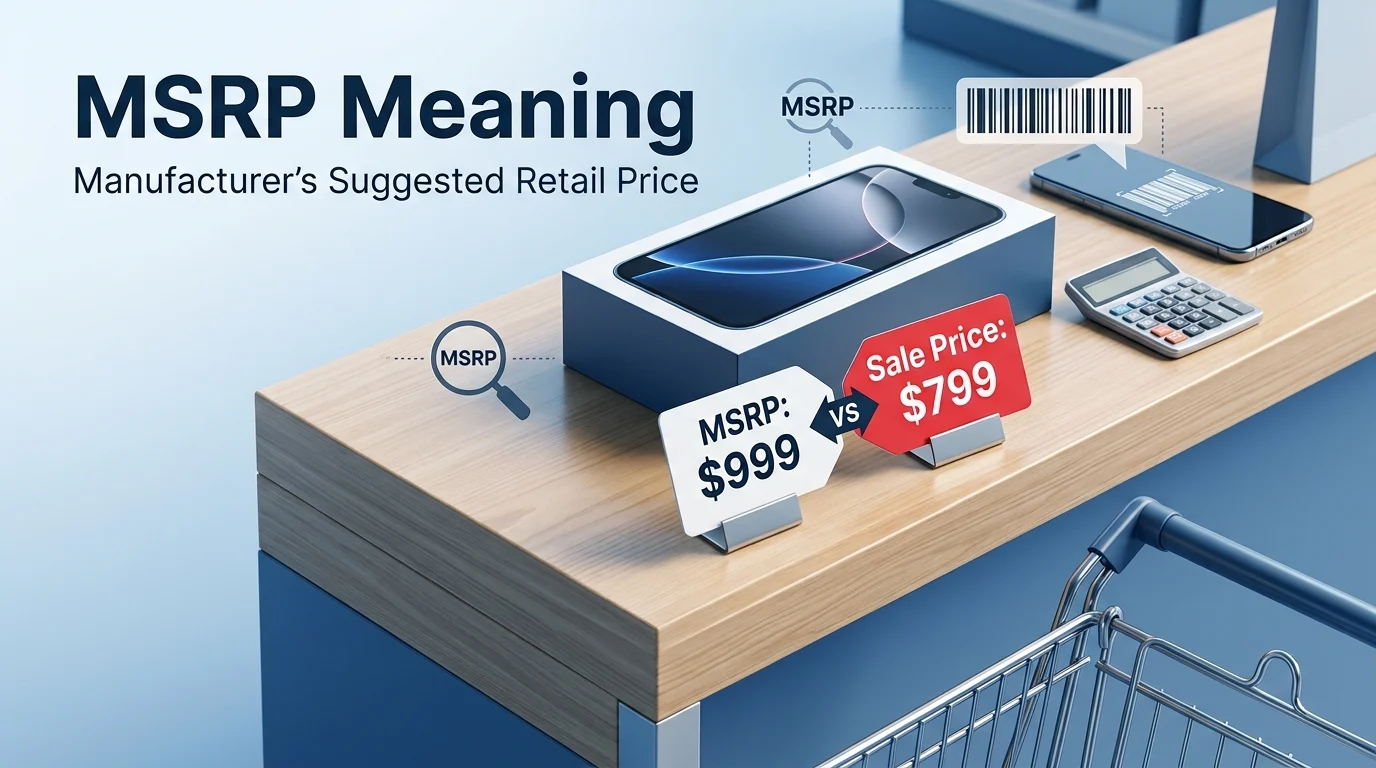

You may see “MSRP” on a product page, price tag, car listing, or advertisement and wonder what the number actually means. The MSRP meaning is Manufacturer’s Suggested Retail Price—the price a manufacturer recommends that retailers charge for a product. It is a suggested price, not necessarily the amount you will pay. Understanding MSRP helps you recognize discounts, compare products, and judge whether a listed price is above or below the manufacturer’s recommendation. This guide explains what MSRP stands for, how it works, how it differs from actual selling prices, and why the term appears so often when people compare products.
What Does MSRP Mean?
MSRP stands for Manufacturer’s Suggested Retail Price. It is the price a manufacturer recommends for a retailer to use when selling a product to consumers.
The MSRP meaning is straightforward: it provides a standard reference price for a product, while the actual selling price can be higher or lower.
| Detail | Explanation |
|---|---|
| Full Form | Manufacturer’s Suggested Retail Price |
| Meaning | A manufacturer-recommended consumer price |
| Tone | Neutral and business-related |
| Common Uses | Cars, electronics, appliances, clothing, and other products |
| Mandatory Price? | Generally no; retailers can set their own prices |
For example, if headphones have an MSRP of $200 but a retailer sells them for $150, the retailer is offering them below the manufacturer’s suggested price.
What Does MSRP Stand For?
The MSRP full form is Manufacturer’s Suggested Retail Price.
Each part of the phrase explains its purpose. “Manufacturer” refers to the company that makes or supplies the product. “Suggested” means the price is a recommendation rather than necessarily a required selling price. “Retail price” refers to the amount associated with selling the product to the final consumer.
This distinction matters because MSRP does not automatically tell you the price you will pay at checkout. A store may offer a discount, run a promotion, charge more because of demand, or use another pricing strategy.
For instance, a television could have an MSRP of $1,000 but regularly sell for $750. In that situation, $1,000 serves as the manufacturer’s reference price, while $750 is the retailer’s current selling price.
How Is MSRP Used?
MSRP gives manufacturers, retailers, and consumers a common reference point.
Manufacturers may publish an MSRP when launching a new product so customers have an idea of its intended market position. Retailers can then choose their own prices based on competition, inventory, demand, promotions, and operating costs.
Consumers often use MSRP to evaluate whether a deal looks attractive. If a product is advertised as “20% below MSRP,” the MSRP provides the comparison point for that discount.
However, you should not automatically assume that a discount from MSRP represents the best possible deal. The same product may have been regularly sold below MSRP, so comparing current prices across retailers can give you a more useful picture.
A Simple Example
Imagine a laptop has an MSRP of $1,200.
- Retailer A sells it for $1,200.
- Retailer B sells it for $1,050.
- Retailer C has a promotion for $900.
The MSRP remains $1,200, but the actual prices differ. The $900 price is $300 below MSRP, while Retailer B’s price is $150 below it.
MSRP Meaning in Text and Online Conversations
When someone uses MSRP in text, chat, forums, or online discussions, the meaning generally stays the same: Manufacturer’s Suggested Retail Price.
Unlike many internet abbreviations, MSRP is not normally slang. Someone might write it while discussing whether a product is fairly priced, comparing listings, or talking about a discount.
For example:
Person A: “The MSRP is $500, but I found it for $350.”
Person B: “That sounds like a pretty good price.”
Here, MSRP simply establishes the manufacturer’s recommended reference price.
You may also see phrases such as “under MSRP,” “above MSRP,” “MSRP price,” or “MSRP discount.” Technically, “MSRP price” is repetitive because the P already stands for “Price,” but the phrase is sometimes used conversationally.
How Context Changes the MSRP Meaning
The basic definition does not usually change, but context determines what the person is trying to communicate with the MSRP figure.
1. Product Shopping
“The MSRP is $80, but it’s on sale for $55.”
Here, MSRP is being used to show the difference between the recommended price and the current sale price.
2. Car Buying
“The dealer is asking $2,000 over MSRP.”
This means the seller’s listed price is $2,000 higher than the manufacturer’s suggested price.
3. Collectibles
“This figure had an MSRP of $30 when it launched.”
The speaker is using MSRP as a historical reference to discuss the product’s original recommended retail price.
4. Business Discussion
“We need to decide whether the product should launch below MSRP.”
In this context, MSRP is part of a pricing strategy discussion rather than a casual shopping conversation.
The surrounding words usually make the intended use obvious because MSRP is a specific business and pricing term.
MSRP in Different Shopping Contexts
MSRP is particularly common in industries where manufacturers sell products through retailers or dealers.
Cars
Vehicle pricing is one of the most familiar uses of MSRP. A vehicle’s MSRP can provide a reference point when comparing a manufacturer’s suggested price with a dealer’s offer, incentives, fees, and other charges.
A car’s final purchase price can involve much more than MSRP, so buyers should not treat the MSRP as the complete amount they will necessarily pay.
Electronics
Televisions, laptops, phones, cameras, headphones, and appliances may have an MSRP. Retailers frequently advertise these products at prices below the manufacturer’s suggested amount.
Clothing and Accessories
Brands may use MSRP as a reference for apparel, shoes, bags, and accessories. Outlet stores and discount retailers may display a suggested price alongside their current selling price.
Collectibles and Hobby Products
Toys, trading products, games, and hobby items can also have an MSRP. In these markets, the actual price may later be influenced by scarcity, demand, or whether a product is still being manufactured.
Real Conversation Examples
Person A: “Do you know the MSRP for this monitor?”
Person B: “I think it’s around $600.”
Meaning: Person A wants to know the manufacturer’s suggested retail price so they can evaluate the current listing.
Person A: “The MSRP is $1,500, but the store has it for $1,100.”
Person B: “That’s quite a bit lower.”
Meaning: The MSRP is being used as a reference point to highlight a discount.
Person A: “They’re charging $400 over MSRP for that car.”
Person B: “I’d compare a few dealers before buying.”
Meaning: The seller’s price is higher than the manufacturer’s suggested price, so the buyer is considering alternatives.
Is MSRP the Same as Retail Price?
No. MSRP is a recommended price, while the retail price is the amount a retailer actually charges.
A retailer may sell a product at MSRP, below MSRP, or above MSRP. The difference depends on factors such as competition, promotions, supply, demand, and the retailer’s pricing strategy.
This is why seeing an MSRP of $100 does not necessarily mean the product normally costs $100. You should check actual current prices if you want to determine whether an offer is competitive.
MSRP vs. Sale Price vs. Wholesale Price
These terms describe different pricing concepts.
| Term | Meaning | Main Difference |
|---|---|---|
| MSRP | Manufacturer’s suggested retail price | Manufacturer’s recommended consumer price |
| Retail Price | Price charged to the customer | Actual selling price |
| Sale Price | Temporary or promotional selling price | Usually reduced from a regular listed price |
| Wholesale Price | Price charged in business-to-business transactions | Typically applies before retail sale |
For example, a manufacturer might recommend an MSRP of $100, sell units to a retailer at a wholesale price of $60, and the retailer might normally charge $100 or temporarily discount the product to $80.
These figures serve different purposes, so they should not be treated as interchangeable.
Is MSRP a Discount?
No. MSRP itself is not a discount.
Instead, MSRP can be used as a reference point for calculating or describing a discount. If an item has an MSRP of $200 and currently sells for $150, the $50 difference represents a price reduction from MSRP.
Still, be careful with discount claims. A product being advertised below MSRP does not automatically mean the current price is unusually low. Checking prices from multiple sellers gives you better context.
When Should You Use MSRP?
Use MSRP when you need to discuss a manufacturer’s recommended consumer price clearly and efficiently.
It is appropriate in:
- Product comparisons
- Shopping discussions
- Car-buying conversations
- Retail pricing
- Business and sales discussions
- Product reviews
- Market analysis
- Online buying communities
Because MSRP is a standard pricing abbreviation, it is generally understood in commercial and shopping contexts.
When to Avoid Using MSRP
You should avoid relying on MSRP when your audience may not understand the abbreviation and the exact price matters more than the pricing concept.
For example, in a formal customer message, saying “The product costs $450” may be clearer than simply saying “The MSRP is $450,” especially if $450 is not the actual amount the customer will pay.
Likewise, in academic writing or general-audience communication, spell out Manufacturer’s Suggested Retail Price on first use if readers may be unfamiliar with the abbreviation.
Most importantly, do not use MSRP as though it were automatically the final price. Taxes, shipping, fees, discounts, dealer charges, and other costs may affect the actual amount paid.
Common Mistakes About MSRP
| Common Mistake | Correct Understanding |
|---|---|
| Assuming MSRP is the required selling price | MSRP is generally a manufacturer’s recommendation, not necessarily the retailer’s final price. |
| Assuming MSRP equals the current market price | Products may regularly sell above or below MSRP depending on market conditions. |
| Treating MSRP as a discount | MSRP is a reference price that can be used to describe a discount. |
| Assuming MSRP includes every purchase cost | The final amount may include taxes, fees, shipping, or other charges. |
Another common misunderstanding is believing that every product has only one meaningful price. In reality, manufacturers, wholesalers, retailers, and customers can encounter different prices throughout the supply chain.
Similar Pricing Terms
| Term | Meaning | Main Difference |
|---|---|---|
| Retail price | Amount a retailer charges consumers | The actual listed selling price |
| Sale price | Promotional or reduced price | Usually temporary or discounted |
| Wholesale price | Price for business buyers | Generally occurs before the retail sale |
| MAP | Minimum Advertised Price | A manufacturer’s policy concerning advertised prices, where applicable |
| List price | A listed reference price | May refer to a stated price without necessarily being the manufacturer’s suggested retail price |
MSRP and MAP are especially easy to confuse. MSRP communicates a suggested retail price, while MAP generally relates to the minimum price at which a product may be advertised under a manufacturer’s pricing policy.
Quick Recap
- MSRP means Manufacturer’s Suggested Retail Price.
- It represents a manufacturer’s recommended price for selling a product to consumers.
- MSRP is not necessarily the final price you will pay.
- Retailers can sell products above or below MSRP.
- Discounts are often described by comparing the current price with MSRP.
- Context matters when evaluating whether an MSRP represents a meaningful deal.
Frequently Asked Questions
What does MSRP mean in text?
MSRP means Manufacturer’s Suggested Retail Price in text, usually when discussing product prices, discounts, cars, or retail purchases.
What does MSRP stand for?
MSRP stands for Manufacturer’s Suggested Retail Price, a manufacturer’s recommended consumer price for a particular product.
Is MSRP the actual price you pay?
Not necessarily, because retailers may charge more or less than MSRP based on promotions, demand, competition, and other factors.
Is MSRP the same as retail price?
No, MSRP is a manufacturer’s recommendation, while retail price is the amount a retailer actually charges customers.
Can MSRP be higher or lower than the selling price?
Yes, retailers can sell products above or below MSRP depending on market conditions, pricing strategies, and customer demand.
Final Thoughts
The MSRP meaning is simple: Manufacturer’s Suggested Retail Price. It gives shoppers a useful reference for understanding how a manufacturer positions a product, but it does not necessarily represent the price you will actually pay. A retailer can charge less or more than MSRP, and the final purchase cost may include discounts, taxes, fees, or other expenses. When you see MSRP in a product listing, car advertisement, or shopping conversation, treat it as a reference point rather than an automatic final price. Comparing the current selling price with MSRP and other available prices gives you a clearer picture of the deal.